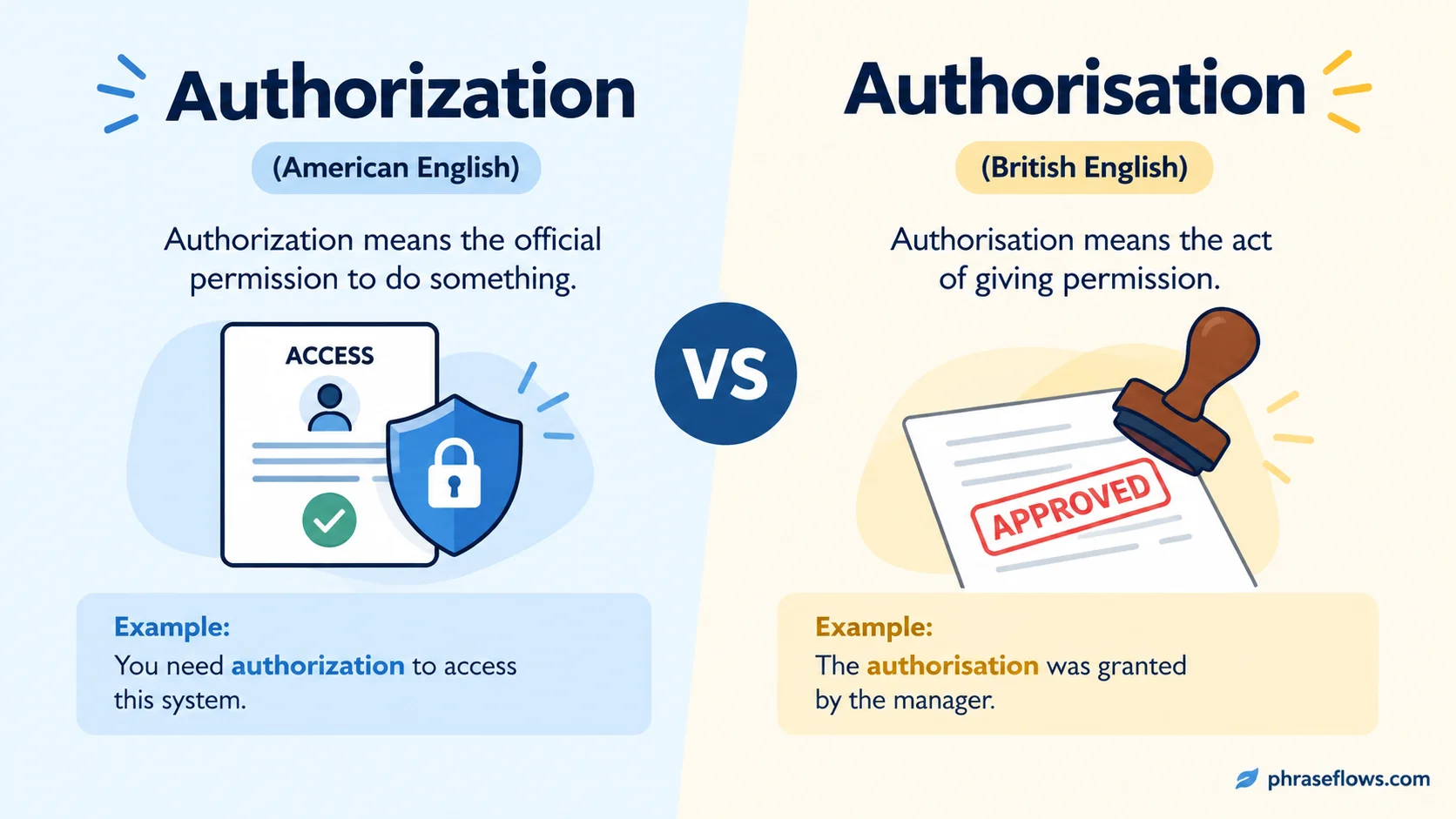

Have you ever wondered whether to write authorization vs. authorisation? Both spellings are correct, but the right choice depends on the type of English you’re using. Authorization is the preferred spelling in American English, while authorisation is commonly used in British English. Although the two words look slightly different, they share the same meaning and grammatical function.
The difference comes down to regional spelling conventions. American English generally uses the letter Z in words such as authorization, while British English often uses S in the same position. However, some British publishers follow Oxford spelling and prefer the Z form. This means neither spelling is universally better or more correct. Your audience, location, and preferred writing style should guide your decision.
Understanding authorization vs. authorisation is especially useful when writing business emails, legal documents, academic papers, reports, or other formal content. Using the appropriate spelling helps you maintain consistency and present your writing professionally. In this guide, you’ll learn what both spellings mean, where each one is commonly used, and how to choose the right form for your audience.
Authorization vs. Authorisation: The Quick Answer
The simplest way to understand authorization vs. authorisation is to remember that both words are correct. Neither spelling changes the basic meaning of the word. The choice depends mainly on your preferred English variety and the style guide you’re following.
| Feature | Authorization | Authorisation |
| Preferred usage | American English | British English in styles that use -isation |
| Meaning | Official permission or approval | Official permission or approval |
| Part of speech | Noun | Noun |
| Verb form | Authorize | Authorise |
| Example | You need authorization to enter. | You need authorisation to enter. |
For most American readers, authorization will look familiar. British readers may commonly encounter authorisation, particularly in organizations that prefer -ise endings. However, British English isn’t governed by one universal spelling rule. Oxford University Press, for example, uses many -ize forms, while the University of Oxford’s own style guide prefers -ise forms.
Oxford University
+1
The practical rule is simple: choose the spelling that fits your audience and use it consistently. If your employer, university, publisher, or client has a style guide, follow that guide rather than switching between spellings.
What Does Authorization Mean?
Authorization is a noun that means official permission, approval, or the power to allow something to happen. It can also refer to the act of granting that permission. People use the term when an action requires approval from someone with the appropriate authority.
Cambridge English Dictionary
+1
For example, an employee might need authorization from a supervisor before purchasing equipment for the office. A bank may require authorization before processing a transaction. Similarly, a company might ask for written authorization before releasing confidential records.
The important point is that authorization often involves permission from a person, organization, or authority entitled to grant it. It may be informal in some situations, but it often appears in formal procedures where accountability matters.
Examples of Authorization in Sentences
Here are several examples that show how American English writers commonly use the word:
- Workplace: The manager gave me authorization to purchase the new software.
- Banking: The bank requested authorization before completing the transaction.
- Healthcare: The clinic obtained authorization before releasing the patient’s records.
- Education: Students need authorization to access certain restricted facilities.
- Business: The finance department requires written authorization for large expenses.
- Technology: The application checks user authorization before allowing access to protected information.
Notice how the word fits different situations without changing its central meaning. In each example, someone needs permission or formal approval to take a particular action.
Authorization can also appear in phrases such as prior authorization, written authorization, and without authorization. These expressions are especially common in administrative, legal, financial, and technical contexts.
Authorization as a Noun
Authorization is a noun, so it names a form of permission or the process of granting permission. It can be countable or uncountable depending on how the sentence uses it.
For example:
- The project cannot proceed without authorization. Here, the word refers to permission in a general sense.
- The agency issued three separate authorizations. Here, it refers to distinct approvals or permissions.
The plural form is authorizations. You can use it when discussing several approvals, permissions, or official documents.
What Does Authorisation Mean?
Authorisation has the same meaning as authorization. It refers to official permission, approval, or the act of giving someone permission to do something. The difference lies in the spelling, not the definition.
British English writers often use authorisation in workplace policies, government documents, formal letters, and administrative procedures. For example, a British company might require written authorisation before an employee can approve a purchase. An organization may also request authorisation before sharing private information.
The spelling follows a pattern used by many British English writers who prefer words ending in -isation rather than -ization. However, this is a style preference rather than a rule followed by every British publisher.
Oxford University
+1
Examples of Authorisation in Sentences
The following examples show how authorisation works in British-style writing:
- Workplace: The employee received authorisation to order new office equipment.
- Banking: Please provide authorisation before we process your payment.
- Healthcare: The clinic requires authorisation before releasing the records.
- Education: Written authorisation is required for the student to leave early.
- Administration: The department granted authorisation for the proposed changes.
- Technology: The system checks a user’s authorisation before granting access.
Each sentence communicates the same idea that an American English writer would express using authorization. The spelling changes, but the meaning and grammatical role remain the same.
Authorisation as a Noun
Like authorization, authorisation is a noun. It can describe permission generally or refer to a specific approval.
Consider these examples:
- We cannot proceed without authorisation. The word refers to permission in general.
- The department issued two authorisations. The word refers to two separate approvals.
Its plural form is authorisations. When writing for a British audience that prefers -ise spellings, use this form consistently alongside authorise, authorised, and authorising.
What Is the Difference Between Authorization and Authorisation?
The main difference between authorization vs. authorisation is regional spelling preference. Both words express the same concept and serve the same grammatical purpose.
The distinction becomes clearer when you compare their spelling, pronunciation, and use in different types of writing.
| Comparison | Authorization | Authorisation |
| Spelling pattern | Uses Z in -ization | Uses S in -isation |
| Common regional preference | American English | British English in -ise styles |
| Definition | Official permission or approval | Official permission or approval |
| Grammatical role | Noun | Noun |
| Related verb | Authorize | Authorise |
| Example phrase | Written authorization | Written authorisation |
Neither spelling is automatically more formal, more accurate, or more professional than the other. The better choice depends on the writing convention you need to follow.
American English vs. British English
American English generally uses authorization, while many British English style guides prefer authorisation. This difference reflects a wider spelling pattern involving words that end in -ize or -ise and their related nouns ending in -ization or -isation.
For example:
| American English | British English in -ise styles |
| Authorization | Authorisation |
| Organization | Organisation |
| Standardization | Standardisation |
| Modernization | Modernisation |
| Centralization | Centralisation |
| Specialization | Specialisation |
These pairs illustrate a common pattern rather than an absolute rule for every British publication. Some British dictionaries and publishers use -ize spellings. Oxford University Press and the International Organization for Standardization (ISO), for example, follow conventions that retain -ize in words such as organization and standardization.
ISO House Style
+1
This is why you shouldn’t assume that every British writer must use authorisation. Instead, check the preferred dictionary or style guide whenever spelling consistency matters.
Authorization vs. Authorisation: Pronunciation and Meaning
Despite their different spellings, authorization and authorisation generally have the same pronunciation within a given English accent. The letter change from Z to S doesn’t create a separate word or a new definition.
The pronunciation may vary between American and British accents, as many English words do. However, that variation comes from the accent rather than from a difference in meaning between the two spellings.
Cambridge English Dictionary
+1
Both words refer to official permission, the power to approve something, or the act of granting permission.
For example:
- The director gave authorization for the project.
- The director gave authorisation for the project.
Both sentences communicate the same message. The choice of spelling simply reflects the writer’s preferred convention.
Authorization vs. Authorisation: Grammatical Usage
Both spellings function as nouns. You can use them as the subject or object of a sentence, or after a preposition.
As a subject:
- Authorization is required before work begins.
- Authorisation is required before work begins.
As an object:
- The manager granted authorization.
- The manager granted authorisation.
After a preposition:
- The employee acted without authorization.
- The employee acted without authorisation.
The related verbs differ in spelling, too: authorize and authorise. Their past-tense forms are authorized and authorised, while their -ing forms are authorizing and authorising.
Keep these related forms aligned with your chosen spelling convention. Using authorisation in one sentence and authorized in the next may look inconsistent if you’re following a British style guide that prefers -ise spellings.
Authorization vs. Authorisation in Different Contexts
Choosing between authorization and authorisation isn’t just about geography. The type of document and the expectations of its audience also matter. A company policy, legal form, academic paper, or technical manual may have specific spelling requirements.
Business and Workplace Writing
In business communication, authorization often refers to permission to approve spending, access information, sign documents, or make decisions on behalf of an organization.
For example, a company may require a department manager to approve purchases above a certain amount. An employee might then write, “I need authorization to purchase the equipment.”
A British-style version could read, “I need authorisation to purchase the equipment.”
Both are correct. The best choice depends on the organization’s language standards.
Common workplace phrases include:
- Written authorization for a purchase or business decision.
- Authorization request for a formal approval process.
- Authorized representative for someone permitted to act on another person’s behalf.
- Without authorization for an action taken without the required permission.
- Prior authorisation for approval that must be obtained in advance.
When writing a policy or employee handbook, consistency is particularly important. A clear document should use one spelling system throughout its headings, instructions, examples, and forms.
Legal and Official Documents
Legal and official writing often uses authorization to describe permission granted under a law, contract, policy, or formal arrangement.
For instance, a document might state that an individual has authorization to represent a company. Another form might require written authorization before an organization releases certain records.
However, spelling is only one part of legal accuracy. The wording of a legal document must also reflect the applicable jurisdiction, the relevant rules, and the intended legal effect. Changing a spelling variant won’t usually change the meaning, but changing the underlying terms or conditions could.
When preparing official documents, follow the terminology and spelling used by the relevant authority. If a form supplied by an organization uses authorisation, retain that spelling when completing related materials unless instructed otherwise.
Academic and Educational Writing
Students and researchers should choose their spelling based on the requirements of their institution, instructor, or publisher.
An American university may expect American English, making authorization the natural choice. A British institution may prefer authorisation if its style guide follows the -ise convention.
For example:
- American English: The study required authorization from the research committee.
- British English: The study required authorisation from the research committee.
Both sentences are grammatically correct. The key is to follow the required style and avoid changing conventions midway through a paper.
If you’re unsure which spelling to use, check the assignment instructions or the publication’s author guidelines before editing the entire document.
Digital and Technical Communication
In technology, authorization has a specific role in access control. It commonly refers to determining what an authenticated user, application, or system is allowed to do.
For example, a user may sign in to an application successfully but still lack authorization to view confidential files. Authentication establishes or verifies identity, while authorization determines the permitted actions.
This distinction is important in software documentation and cybersecurity discussions.
Technical teams may also use the spelling authorisation when following a British English house style. However, programming languages, application interfaces, API specifications, database fields, and configuration files may require exact terms. In those cases, preserve the spelling required by the relevant technical standard or system.
The same principle applies to documentation: use the preferred spelling in prose, but never change a required technical identifier simply to make it match a regional spelling preference.
How to Use Authorization and Authorisation Correctly
You can choose the right spelling by following a few practical steps. There’s no need to memorize a long list of exceptions for this particular word.
Start with your audience. If you’re writing for American readers, use authorization. If you’re writing for a British organization that prefers -ise spellings, use authorisation.
Next, check whether a style guide applies. Businesses, universities, government agencies, and publishers may have their own spelling rules. Following those rules is more reliable than guessing based on the country alone.
Finally, check related words throughout the document. If you’ve chosen authorisation, you may also need authorise, authorised, and authorising to match the same style.
Common Phrases With Authorization and Authorisation
The following phrases appear in business, administrative, and everyday writing.
| American English | British English in -ise styles |
| Official authorization | Official authorisation |
| Written authorization | Written authorisation |
| Prior authorization | Prior authorisation |
| Authorization request | Authorisation request |
| Authorization letter | Authorisation letter |
| Authorization form | Authorisation form |
| Without authorization | Without authorisation |
| Grant authorization | Grant authorisation |
| Seek authorization | Seek authorisation |
| Obtain authorization | Obtain authorisation |
These phrases don’t have different meanings simply because their spellings differ. Choose the form that fits your document and keep it consistent.
Real-World Case Study: Choosing the Right Spelling for a Business
Imagine a company that operates in both the United States and the United Kingdom. Its American office prepares an employee handbook, while its British office creates a similar document for local staff.
The American handbook states:
Employees must obtain written authorization before approving expenses above the department’s spending limit.
The British handbook states:
Employees must obtain written authorisation before approving expenses above the department’s spending limit.
Both statements communicate the same requirement. Neither spelling changes the company’s approval process.
The real challenge appears when the company combines documents from both offices. If editors copy paragraphs without checking spelling conventions, the final handbook might contain authorization, authorisation, authorize, and authorised in ways that don’t follow its chosen style.
The lesson: establish a spelling convention before drafting or combining documents. This makes the content easier to edit, more consistent, and more professional.
Common Mistakes to Avoid With Authorization vs. Authorisation
Even though both spellings are correct, writers can still make mistakes when choosing between them. The following points will help you avoid common problems.
Treating Authorisation as Incorrect
One common mistake is assuming that authorisation is a misspelling because American English uses authorization. In fact, both forms appear in reputable dictionaries.
The Cambridge Dictionary lists authorization as a noun and identifies authorisation as the usual British variant.
Cambridge English Dictionary
+1
The spelling you choose should reflect your intended audience and style guide.
Assuming the Two Words Have Different Meanings
Authorization and authorisation don’t describe two different kinds of permission. They’re spelling variants of the same word.
For example, written authorization and written authorisation both refer to permission recorded in writing. You don’t need to choose one based on how much permission someone receives or how formal the situation is.
Mixing American and British Spelling Conventions
Switching between spelling systems can make a document look poorly edited. For instance, a document that uses authorisation throughout but suddenly switches to authorized may conflict with a house style that prefers -ise forms.
To prevent this problem, check the related forms as well as the main word:
- American English: authorize, authorization, authorized, authorizing.
- British English in -ise styles: authorise, authorisation, authorised, authorising.
Remember that some British publishers use -ize forms. Follow the style guide you’ve selected rather than treating every British spelling as fixed.
Ignoring an Organization’s Style Guide
A company’s preferred spelling may matter more than your personal preference. If an organization consistently uses authorisation, changing it to authorization during editing could make the document inconsistent with its other materials.
Before making changes, check the organization’s existing documents or editorial guidelines. This small step can save time during proofreading.
Read More: Phoenix vs. Pheonix: Difference, Correct Spelling, Meaning, and Usage
Authorization vs. Authorisation: Related Words and Their Spellings
The difference between authorization and authorisation belongs to a wider set of spelling variations in English. Recognizing these patterns can help you edit other words more confidently.
| American English | British English in -ise styles |
| Authorization | Authorisation |
| Organization | Organisation |
| Standardization | Standardisation |
| Modernization | Modernisation |
| Centralization | Centralisation |
| Specialization | Specialisation |
| Realization | Realisation |
These examples illustrate a common pattern, but British spelling conventions aren’t entirely uniform. For example, Oxford University Press generally prefers -ize in words where that spelling is accepted, while the University of Oxford’s institutional style guide prefers -ise.
Oxford University
+1
This distinction matters when editing content for an international audience. Rather than assuming one spelling system applies to every English-speaking country, use a reliable dictionary and the relevant publication’s guidelines.
Conclusion:
Both authorization and authorisation are correct spellings of the same word. The main difference comes from regional English preferences: American English generally uses authorization, while British English commonly uses authorisation. However, some British publishers also prefer the Z spelling under Oxford style. When choosing between them, consider your audience, follow the required style guide, and keep your spelling consistent throughout the document. Understanding this small difference can help you produce clear and professional writing.
FAQs:
1. Is it authorization or authorisation?
Both spellings are correct. Authorization is the standard choice in American English, while authorisation is commonly preferred in British English.
2. What is the difference between authorization and authorisation?
There is no difference in meaning or grammatical function. The only difference is spelling: American English generally uses Z, while British English commonly uses S.
3. Is authorisation incorrect in American English?
Authorisation is understandable, but it isn’t the standard American spelling. Most American publications and style guides prefer authorization.
4. Do British people use authorization or authorisation?
British English commonly uses authorisation. However, some British publishers follow Oxford spelling, which favors authorization and other Z spellings.
5. Which spelling should I use in professional writing?
Choose the spelling that matches your audience or organization’s style guide. Use authorization for most American audiences and authorisation for most British audiences. Most importantly, remain consistent throughout your writing.



1 thought on “Authorization vs. Authorisation: Which Is Correct?”