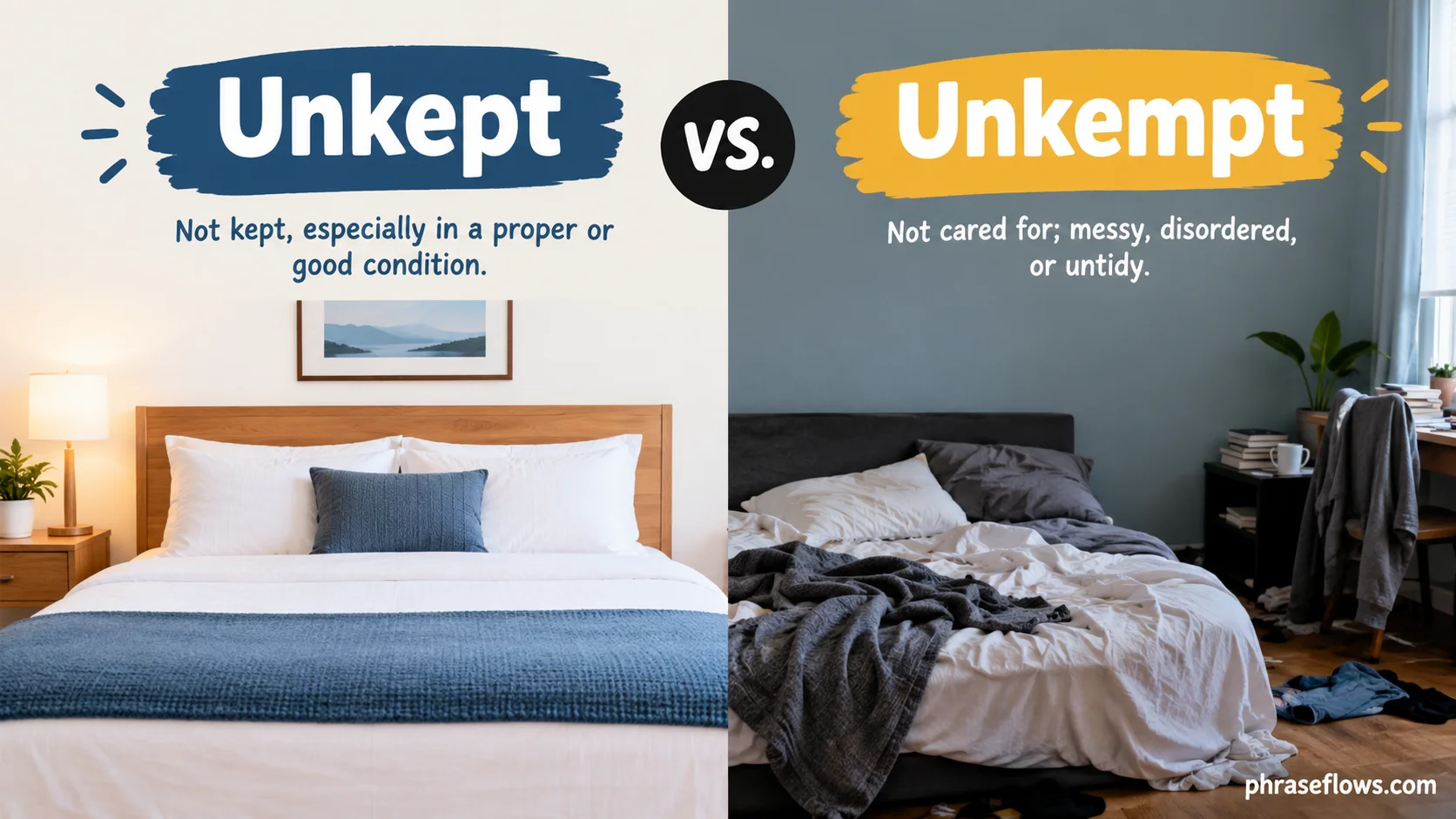

Unkept vs. unkempt look almost identical at first glance. Both words can suggest a lack of care, which makes the pair especially easy to mix up. However, they don’t mean the same thing and they usually appear in different contexts.
The easiest way to remember the difference is to connect unkept with the word kept. Something unkept hasn’t been kept, maintained, honored, or fulfilled. Unkempt, on the other hand, describes something that looks untidy, messy, or poorly groomed, especially a person’s hair or appearance.
Knowing this distinction can make your writing more precise. Whether you’re describing an unkept promise, an unkept garden, or unkempt hair, the surrounding context tells you which word fits.
Unkept vs. Unkempt: Quick Difference
The main difference comes down to what you want to describe.
| Word | Meaning | Common Uses | Example |
| Unkept | Not kept, maintained, honored, or fulfilled | Promises, commitments, property, gardens, duties | She was disappointed by his unkept promise. |
| Unkempt | Untidy, messy, or poorly groomed | Hair, appearance, clothing, lawns, gardens | His unkempt hair needed attention. |
Unkept is directly related to keep. If someone makes a promise and doesn’t honor it, that promise remains unkept.
Unkempt has a more specific descriptive sense. It commonly refers to something that looks neglected or disorderly. You might describe someone’s unkempt hair, unkempt appearance, or an unkempt lawn.
There is some overlap when you describe physical spaces. For example, a neglected garden could be called either unkept or unkempt, depending on what you want to emphasize.
What Does Unkept Mean?
Unkept is an adjective that means not kept. The exact meaning depends on what follows it.
With promises, commitments, and similar obligations, unkept means something was not fulfilled or honored.
An unkept promise is a promise that someone failed to keep.
For example:
- He apologized for his unkept promise.
- The politician faced criticism over several unkept commitments.
- She remembered every unkept promise from that difficult period.
The word can also describe something that hasn’t received proper maintenance or care.
For example, a property that has been neglected might be described as unkept:
- The house stood behind an unkept fence.
- The abandoned property had an unkept yard.
- The path became unkept after years without maintenance.
So, unkept has a broader connection to the idea of something not being properly “kept.”
Unkept as “Not Maintained”
One important use of unkept involves physical things that haven’t been properly maintained.
Think about a garden. If nobody waters it, trims it, removes weeds, or otherwise looks after it, you could describe it as unkept.
The word emphasizes the lack of care or maintenance.
For example:
- The park contained several unkept flower beds.
- An unkept property can quickly lose its appeal.
- The old trail looked unkept after years of neglect.
In these examples, unkept focuses on the fact that someone hasn’t properly maintained the thing.
However, unkempt can also work for some of these physical settings. The choice depends on the intended emphasis.
Compare these:
- The garden was unkept. → It hadn’t been properly maintained.
- The garden was unkempt. → It looked messy, overgrown, or disorderly.
The difference is subtle but useful.
Unkept as “Not Fulfilled”
This is one of the clearest uses of unkept.
English frequently uses the phrase keep a promise. Therefore, when somebody fails to honor that promise, you can describe it as unkept.
Common combinations include:
- unkept promise
- unkept commitment
- unkept agreement
- unkept pledge
- unkept obligation
For example:
The company faced criticism after several commitments remained unkept.
This meaning has nothing to do with someone’s physical appearance. That’s why unkempt would be incorrect in this context.
You wouldn’t normally say someone made an “unkempt promise.” The promise can be unkept, because it wasn’t kept.
What Does Unkempt Mean?
Unkempt means untidy, messy, neglected, or poorly groomed.
The word often describes a person’s appearance. Hair is one of its most common companions.
You might see phrases such as:
- unkempt hair
- unkempt beard
- unkempt appearance
- unkempt clothing
- unkempt look
- unkempt person
For example:
- His unkempt hair made him look as though he’d just gotten out of bed.
- She arrived with an unkempt appearance after a long journey.
- The character was portrayed with an unkempt beard and messy clothing.
The focus is visual. Something unkempt looks as though it hasn’t been properly groomed, arranged, or cared for.
Unkempt for Personal Appearance
When describing a person’s appearance, unkempt is usually the better choice.
Suppose someone hasn’t brushed or arranged their hair. You could say:
He had unkempt hair.
That tells the reader that his hair looked messy or poorly groomed.
You could also say:
He looked unkempt.
Here, the adjective describes his overall appearance rather than one specific feature.
Unkempt doesn’t necessarily mean dirty. That’s an important distinction.
Someone can have messy hair or wrinkled clothing without actually being dirty. The word mainly communicates a lack of neatness or grooming.
This makes unkempt different from words such as filthy or dirty, which carry stronger associations with cleanliness.
Unkempt for Places and Outdoor Areas
Although unkempt frequently describes people, it can also describe physical spaces.
An unkempt lawn might have tall grass and weeds. An unkempt garden might contain overgrown plants and scattered debris.
Examples include:
- The backyard looked unkempt after months of neglect.
- The building stood beside an unkempt lawn.
- We walked past an unkempt garden filled with overgrown shrubs.
Here, the word emphasizes the appearance of disorder.
That’s where unkept and unkempt can overlap.
Consider this distinction:
| Sentence | Main emphasis |
| The garden was unkept. | Nobody properly maintained it. |
| The garden was unkempt. | The garden looked messy or overgrown. |
Both sentences can describe a neglected garden. The first focuses more on maintenance while the second focuses more on appearance.
Unkept vs. Unkempt: Key Differences
The simplest way to distinguish the two words is to ask one question:
Are you talking about something that wasn’t kept, or something that looks untidy?
If the answer is “wasn’t kept,” unkept is usually appropriate.
If the answer is “looks untidy or poorly groomed,” unkempt is usually the better choice.
| Feature | Unkept | Unkempt |
| Basic idea | Not kept, maintained, or fulfilled | Untidy, messy, or poorly groomed |
| Connected word | Keep / kept | Separate adjective with its own established meaning |
| Promises | Yes | No |
| Commitments | Yes | No |
| Personal appearance | Less common | Very common |
| Hair | Not the usual choice | Very common |
| Clothing | Possible in a maintenance sense | Common when describing a messy appearance |
| Gardens | Possible | Possible |
| Property | Possible | Possible |
| Main emphasis | Failure to keep or maintain | Visible disorder or poor grooming |
A Simple Comparison
Imagine two different situations.
A friend promises to call you but never does. That’s an unkept promise.
Now imagine that the same friend arrives with messy hair and clothing. Their appearance could be described as unkempt.
The two words can appear in the same story because they describe completely different things:
His unkept promise disappointed her, while his unkempt appearance suggested he’d had a difficult morning.
That sentence demonstrates the distinction neatly.
Is Unkept a Correct Word?
Yes. Unkept is a legitimate English word.
Some writers mistakenly assume that unkept is simply a misspelling of unkempt. It isn’t.
The word unkept follows a familiar English pattern: the prefix un- combines with kept to express the idea of something not being kept.
This is particularly clear with phrases such as unkept promises and unkept commitments.
However, there’s an important usage point. While unkept is correct, other expressions may sound more natural in certain contexts.
For example, instead of saying:
The employee left the office unkept.
A writer would normally choose a more precise expression such as:
The office was poorly maintained.
Or, if the emphasis is appearance:
The office looked unkempt.
Good word choice isn’t simply about whether a word exists. Context and natural usage matter.
Is Unkempt a Correct Word?
Yes. Unkempt is a standard English adjective meaning untidy, messy, or poorly groomed.
It has long been associated with a lack of grooming or neatness. Modern examples often involve hair, beards, clothing, people, lawns, and gardens.
Common examples include:
- unkempt hair
- unkempt beard
- unkempt appearance
- unkempt lawn
- unkempt garden
- unkempt yard
If you’re describing something that looks neglected and untidy, unkempt can often express the idea more naturally than unkept.
Unkept vs. Unkempt in Sentences
Seeing the words in context makes their difference much easier to remember.
Examples With Unkept
- The child was upset by his father’s unkept promise.
- Several unkept commitments damaged the organization’s reputation.
- The old house had an unkept garden behind it.
- She didn’t want to make another unkept promise.
- Years of neglect left the property unkept.
- The manager apologized for the company’s unkept agreement.
- The trail had become unkept over time.
- Their unkept pledge became a source of public criticism.
Examples With Unkempt
- He walked into the room with unkempt hair.
- Her unkempt appearance suggested she’d been traveling all night.
- The abandoned house had an unkempt lawn.
- His beard looked unkempt after several weeks without grooming.
- The backyard had become unkempt during the rainy season.
- The character wore old clothes and had an unkempt appearance.
- The garden looked unkempt and overgrown.
- She brushed her hair before leaving because it looked unkempt.
Side-by-Side Sentence Comparison
| Unkept | Unkempt |
| He apologized for his unkept promise. | He apologized for his unkempt appearance. |
| The property remained unkept for years. | The property looked unkempt after years of neglect. |
| Several unkept commitments caused frustration. | His unkempt hair attracted attention. |
| The garden was unkept because nobody maintained it. | The garden looked unkempt and overgrown. |
Notice how the meaning changes even when the subject stays similar.
Unkept vs. Unkempt: Common Mistakes
Because the spellings differ by only two letters, mistakes are common.
Using “Unkempt” for a Broken Promise
This is one of the clearest errors.
Incorrect:
She apologized for her unkempt promise.
Correct:
She apologized for her unkept promise.
A promise is kept or not kept. Therefore, the negative form is unkept.
Using “Unkept” for Messy Hair
If you’re describing hair that looks messy or poorly groomed, unkempt is the natural choice.
Less natural:
He had unkept hair.
Natural:
He had unkempt hair.
The second sentence immediately communicates the intended visual image.
Treating the Words as Interchangeable
The similarity in spelling can make these words look like alternative forms of the same adjective. They aren’t.
Unkept centers on the idea of something not being kept.
Unkempt centers on the idea of something looking untidy or neglected.
Assuming “Unkept” Is a Misspelling
Spell-check software can sometimes make unusual words look suspicious. That doesn’t automatically make them incorrect.
Unkept is valid English. Its usage is simply more context-dependent than unkempt.
Unkept vs. Unkempt vs. Untidy
Untidy is another useful word to compare with this pair.
| Word | Main meaning | Example |
| Unkept | Not kept, fulfilled, or maintained | an unkept promise |
| Unkempt | Messy, neglected, or poorly groomed | unkempt hair |
| Untidy | Not neat or orderly | an untidy bedroom |
Untidy is broad and everyday. You can use it for rooms, desks, clothes, handwriting, arrangements, and many other things.
Unkempt tends to carry a stronger sense of neglect or poor grooming, especially when describing someone’s appearance.
For example:
- Untidy room → the room isn’t neat.
- Unkempt garden → the garden looks neglected or overgrown.
- Unkept garden → the garden hasn’t been properly maintained.
The distinctions aren’t always rigid. Natural English often gives speakers several choices with slightly different shades of meaning.
Unkept vs. Unkempt vs. Disheveled
Disheveled is another close alternative when describing someone’s appearance.
A disheveled person generally looks untidy or disordered. The word often suggests that the person’s hair, clothing, or overall appearance has become disturbed.
For example:
He arrived looking disheveled after rushing through the rain.
Unkempt can describe a similar appearance but often suggests a more general or ongoing lack of grooming.
Compare:
- Disheveled hair → hair that looks disturbed or disorderly.
- Unkempt hair → hair that looks neglected or poorly groomed.
- Unkept hair → generally not the standard choice when describing messy hair.
Neither disheveled nor unkempt should replace unkept when you’re talking about an unfulfilled promise.
How to Remember the Difference
Here’s an easy memory trick:
Unkept = not kept.
Unkempt = not neat.
The first one connects directly to kept.
Think of phrases such as:
- keep a promise → unkept promise
- keep a commitment → unkept commitment
- keep something maintained → unkept property
For unkempt, picture something that looks messy.
Think:
- unkempt hair
- unkempt beard
- unkempt appearance
- unkempt garden
This small distinction can prevent most mistakes.
When to Use Unkept
Use unkept when the central idea involves something that hasn’t been kept, fulfilled, honored, or maintained.
Choose it for:
- Promises: an unkept promise
- Commitments: an unkept commitment
- Pledges: an unkept pledge
- Agreements: an unkept agreement
- Property: an unkept property
- Gardens: an unkept garden
- Maintenance: an unkept area
Before using the word, ask yourself:
“Was something supposed to be kept?”
If yes, unkept may be the right choice.
When to Use Unkempt
Use unkempt when you want to emphasize messiness, disorder, neglect, or poor grooming.
It’s especially useful for:
- Hair
- Beards
- Personal appearance
- Clothing
- Lawns
- Gardens
- Yards
- Neglected-looking spaces
Ask yourself:
“Does this thing look messy or poorly groomed?”
If the answer is yes, unkempt will often fit.
A Practical Case Study: Choosing the Right Word
Consider this short scenario.
A homeowner leaves town for several months. During that time, nobody cuts the grass or cares for the garden. When the owner returns, the yard has become overgrown.
Which word works?
Both unkept and unkempt can potentially describe the yard, but they highlight different aspects.
The yard was unkept.
This emphasizes the absence of maintenance.
The yard was unkempt.
This emphasizes the yard’s messy or neglected appearance.
Now change the situation.
The homeowner promised a neighbor that they would maintain the yard but failed to do so.
The homeowner made an unkept promise.
Here, unkempt doesn’t work because the subject is a promise rather than an appearance.
This example shows why context matters more than spelling.
A Quick Decision Guide
When you’re unsure, use this checklist:
Use “unkept” if:
- Something wasn’t kept.
- A promise wasn’t fulfilled.
- A commitment wasn’t honored.
- An obligation wasn’t carried out.
- A property or area wasn’t properly maintained.
Use “unkempt” if:
- Something looks messy.
- Someone looks poorly groomed.
- Hair looks neglected.
- Clothing looks disorderly.
- A lawn or garden looks overgrown or untidy.
The distinction becomes much easier once you stop focusing on the similar spelling.
Conclusion:
Understanding the difference between unkept vs. unkempt helps you choose the right word for your writing. Although these words look similar, they have different meanings and uses.
Unkept means something that has not been fulfilled, maintained, or kept as promised. For example, an unkept promise is a promise that someone has failed to fulfill. Unkempt, on the other hand, describes something that looks messy, untidy, or poorly groomed. For example, unkempt hair refers to hair that looks messy or uncombed.
Remember this simple rule: use unkept when talking about promises, commitments, or things that have not been maintained. Use unkempt when describing a messy appearance or an untidy place. Once you understand this distinction, you can use both words confidently and avoid common spelling mistakes.
FAQs:
What is the main difference between unkept and unkempt?
Unkept refers to something that has not been fulfilled or kept, such as an unkept promise. Unkempt describes something messy or untidy, such as unkempt hair or an unkempt garden.
Is unkept a correct English word?
Yes, unkept is a correct English word. It commonly describes promises that have not been fulfilled or things that have not been maintained or cared for.
Is unkempt the same as unkept?
No, they are not interchangeable. Unkempt usually describes a messy appearance, while unkept refers to something that has not been kept, fulfilled, or maintained.
How do you use unkempt in a sentence?
You can use unkempt to describe someone or something that looks untidy. For example: After spending the weekend camping, his hair looked unkempt.
What is an example of an unkept promise?
An example is: She felt disappointed because he made an unkept promise to help her with the project. Here, unkept means that the promise was not fulfilled.




1 thought on “Unkept vs. Unkempt: Difference and Usage”