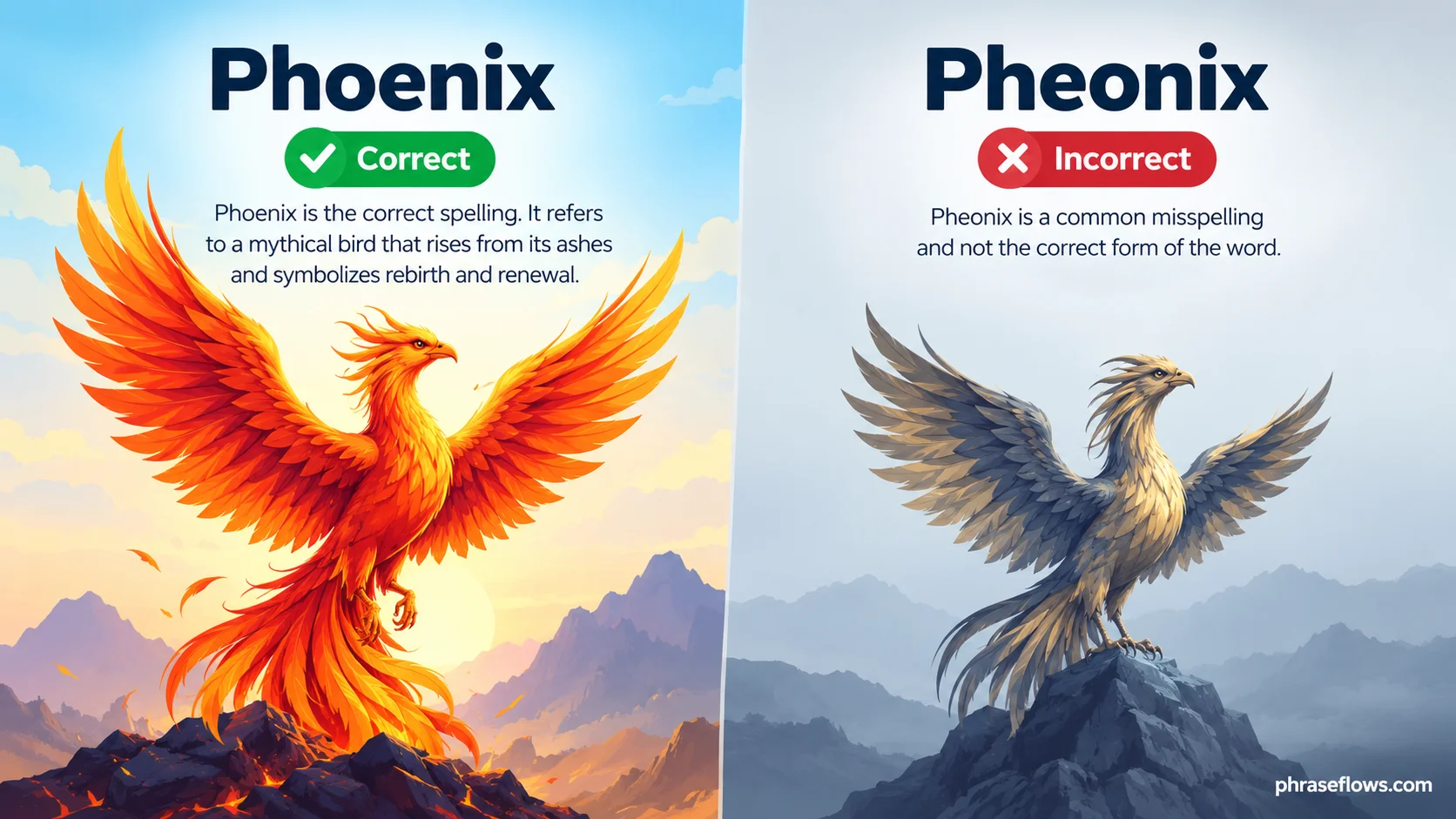

Have you ever wondered whether Phoenix vs. Pheonix is the correct spelling? These two forms look almost identical, making it easy to mix up their middle letters. However, only one is the standard spelling in modern English.
Phoenix is the correct spelling. It refers to a legendary bird associated with rebirth and renewal. It also appears as a proper name, most notably in Phoenix, Arizona. On the other hand, Pheonix is a common spelling mistake that results from switching the letters O and E.
Although the difference involves just two letters, using the wrong form can make your writing look careless. Whether you’re writing an academic assignment, a professional email, a story, or a social media post, knowing the correct spelling matters. This guide explains the meanings, pronunciation, spelling rules, and practical uses of Phoenix and Pheonix so you can avoid this common mistake.
Phoenix vs. Pheonix: Which Spelling Is Correct?
Phoenix is the correct standard spelling in modern English. Pheonix is a misspelling and isn’t an accepted alternative in ordinary English writing. The confusion usually happens because people reverse the O and E when remembering or typing the word.
The correct spelling contains the letters PH-O-E-N-I-X. Notice that O comes before E. In Pheonix, those two vowels appear in the opposite order.
Here is a quick comparison:
| Word | Correct or Incorrect | Explanation |
| Phoenix | Correct | Standard English spelling |
| Pheonix | Incorrect | Common misspelling of Phoenix |
| Phenix | Historical variant | An older alternative spelling |
The spelling Phoenix remains consistent in American and British English. Neither variety recognizes Pheonix as a standard alternative.
For example:
- Correct: The phoenix represents rebirth and new beginnings.
- Incorrect: The pheonix represents rebirth and new beginnings.
The second sentence contains a spelling error, even though readers can probably understand its meaning.
If you’re writing about the mythical bird or the Arizona capital, use Phoenix. When the word appears as a common noun, lowercase phoenix is generally appropriate. Capitalize it when it functions as a proper name.
What Does Phoenix Mean?
The word phoenix has several meanings depending on its context. Most commonly, it refers to a mythical bird that renews itself after death. People also use it figuratively to describe someone or something that recovers after a serious setback.
The word has historical roots in ancient languages. English adopted it through Latin and earlier forms influenced by Greek. Its history helps explain why the spelling looks unusual compared with many everyday English words.
According to major English dictionaries, phoenix can describe:
- A legendary bird associated with rebirth.
- A person or thing that returns after destruction or hardship.
- Someone or something considered exceptionally beautiful or excellent.
- A proper name, including the capital city of Arizona.
Let’s explore these meanings individually.
Phoenix as a Mythical Bird
The phoenix is a legendary bird found in ancient traditions, particularly those associated with Egypt. Traditional accounts describe it as a magnificent creature that lives for hundreds of years before dying in flames and returning to life from its ashes.
The story varies across different historical accounts. However, its central idea remains the same: the bird experiences renewal after destruction.
This powerful image has made the phoenix an enduring symbol of rebirth, immortality, hope, and transformation.
For example:
- The phoenix rose from its ashes in the ancient legend.
- The artist painted a golden phoenix with enormous wings.
- Stories about the phoenix have fascinated readers for centuries.
- The mythical bird represents renewal after difficult times.
Writers frequently use phoenix imagery in fantasy novels, poems, films, and other creative works. Its connection with transformation makes it especially useful when describing characters who experience significant changes.
Phoenix as a Symbol of Rebirth and Renewal
Beyond mythology, the word phoenix carries a strong figurative meaning. It can describe someone who makes an impressive comeback after facing difficulties or a community that rebuilds following a major setback.
The familiar expression “rise like a phoenix from the ashes” captures this idea. It describes a return to success after a period of failure, loss, or hardship.
For instance, imagine a small business that struggles financially but eventually reorganizes, improves its services, and attracts customers again. Someone might describe its recovery as a phoenix-like comeback.
Here are more examples:
- After years of setbacks, the company emerged like a phoenix.
- Her career became a phoenix story of determination and renewal.
- The town rebuilt its community after years of economic difficulty.
- His latest novel marked a phoenix-like return to creative success.
This figurative meaning makes phoenix useful in everyday communication. You don’t need to discuss mythology whenever you use the word. It can also describe real situations involving recovery and fresh beginnings.
Phoenix as a Proper Noun
Phoenix also appears as a proper noun in several contexts. The most familiar example is Phoenix, the capital and largest city of Arizona in the United States.
The city received its name because it developed on the site of an earlier Hohokam settlement. The name reflects the idea of a new community rising from the remains of an older civilization.
Phoenix can also appear as:
- A personal name.
- A company or business name.
- A fictional character’s name.
- A title for a book, film, or other creative work.
- The name of a southern constellation.
Because proper nouns identify specific people, places, or things, they generally begin with capital letters.
Examples:
- Phoenix is the capital of Arizona.
- My friend named his dog Phoenix.
- The Phoenix constellation appears in the southern sky.
- She moved to Phoenix for a new job.
Remember that capitalization depends on meaning. The mythical bird usually appears as phoenix, while the Arizona city is always written as Phoenix.
Why Do People Spell Phoenix as Pheonix?
The most common reason people write Pheonix is that they reverse the vowels O and E. Both forms contain the same letters, but their positions change. This small difference can create a surprisingly persistent spelling problem.
The unusual vowel combination also contributes to the confusion. English doesn’t always follow predictable spelling patterns, especially when words come from older languages.
Here are some reasons the mistake happens:
1. Unfamiliar letter arrangement
The sequence OE in phoenix may look unusual to someone who hasn’t written the word frequently. As a result, the writer may accidentally place E before O.
2. Pronunciation doesn’t reveal the spelling
Phoenix is pronounced /ˈfiː.nɪks/ in standard American English. Its pronunciation doesn’t clearly indicate the order of the written vowels.
3. Typing mistakes
When typing quickly, people sometimes switch neighboring letters or remember their order incorrectly. Because Pheonix looks similar to Phoenix, the mistake may go unnoticed.
4. Repeated exposure to incorrect spelling
If someone repeatedly encounters Pheonix in online posts, usernames, or informal messages, the incorrect form may begin to look familiar.
5. Memory and spelling habits
Some people remember a word’s general appearance rather than its exact letter sequence. This can lead to mistakes involving unusual combinations.
The easiest way to prevent the error is to remember the correct sequence: PHO comes before ENIX.
Phoenix vs. Pheonix: Key Differences
Although Phoenix and Pheonix look similar, they don’t have the same standing in standard English. One is the accepted spelling, while the other represents a spelling error.
The following table highlights their differences.
| Comparison | Phoenix | Pheonix |
| Spelling status | Correct | Incorrect |
| Standard English | Accepted | Not accepted |
| Letter sequence | O before E | E before O |
| Meaning | Mythical bird or proper name | No separate standard meaning |
| Pronunciation | /ˈfiːnɪks/ | Intended pronunciation usually matches Phoenix |
| Mythological usage | Correct | Incorrect |
| Geographic usage | Correct for Arizona | Incorrect |
| Formal writing | Appropriate | Avoid |
| American English | Standard spelling | Misspelling |
| British English | Standard spelling | Misspelling |
One important distinction deserves attention: Pheonix doesn’t have an independent meaning in standard English. Readers generally interpret it as an attempt to write Phoenix.
Therefore, don’t treat these forms as interchangeable. If you want your writing to follow standard spelling conventions, choose Phoenix every time.
How to Use Phoenix Correctly in a Sentence
Understanding the definition is only part of using a word correctly. You also need to recognize how it functions in different sentences.
Phoenix is a noun when it refers to the mythical bird, a symbolic figure, or a particular name. Depending on the context, it can appear as a subject, direct object, or object of a preposition.
For example:
- The phoenix represents hope and renewal.
- The writer included a phoenix in her fantasy story.
- The city of Phoenix attracts visitors throughout the year.
- The character returned like a phoenix after years of struggle.
Notice how the same spelling works across different contexts. Its meaning changes according to the surrounding words.
Examples of Phoenix in Everyday Writing
Practical examples make spelling rules easier to remember. The following sentences demonstrate how Phoenix works in different situations.
Mythology:
- The phoenix is famous for its legendary rebirth.
- Ancient stories describe the phoenix as a remarkable bird.
- The golden phoenix appeared in the kingdom’s oldest legend.
Figurative language:
- The neighborhood rose like a phoenix after the disaster.
- Her confidence returned like a phoenix after a difficult year.
- The organization made a remarkable comeback.
Geography:
- Phoenix is located in the state of Arizona.
- My cousin recently moved to Phoenix.
- The conference will take place in Phoenix next month.
Names and creative works:
- Phoenix is the name of the main character.
- The author chose Phoenix as the title of her novel.
- Their new project carries the name Phoenix.
These examples demonstrate why context matters. Whether you’re discussing mythology, personal names, or geography, the spelling remains Phoenix.
Incorrect Examples Using Pheonix
Recognizing incorrect examples can help you catch mistakes before publishing your work. Compare the following sentences with their corrected versions.
| Incorrect Sentence | Correct Sentence |
| The pheonix rose from its ashes. | The phoenix rose from its ashes. |
| I want to visit Pheonix, Arizona. | I want to visit Phoenix, Arizona. |
| The pheonix symbolizes hope. | The phoenix symbolizes hope. |
| She named her bird Pheonix. | She named her bird Phoenix. |
| The story features a magical pheonix. | The story features a magical phoenix. |
In every example, the problem comes from reversing the vowels. The sentence structure and intended meaning may be perfectly understandable, but the spelling still needs correction.
When proofreading, pay particular attention to the middle of the word. A quick check of the OE sequence can prevent this recurring error.
Phoenix or Pheonix: Pronunciation and Spelling
Pronunciation can sometimes make spelling confusing, especially when a word contains an unusual combination of letters. Phoenix is a good example because its written form doesn’t directly match how many people expect it to sound.
In standard American English, Phoenix is pronounced:
- IPA: /ˈfiː.nɪks/
- Syllables: Two
- First syllable: Fee
- Second syllable: Niks
- Stress: First syllable
The word sounds like “fee-niks.” Its pronunciation remains essentially the same in standard British English.
However, pronunciation doesn’t change the correct letter arrangement. Whether you say the word aloud or write it down, the standard spelling remains Phoenix.
Consider these points:
- The initial PH represents an F sound.
- The first syllable carries the main stress.
- The written OE combination doesn’t produce two separately pronounced vowel sounds.
- The final IX represents the ending sound in the word.
Pheonix usually represents an attempt to write the same spoken word. It doesn’t have a separate standard pronunciation or meaning.
If you’re unsure about its spelling, remember that English pronunciation alone won’t always tell you which letters to use. Checking a reliable dictionary can help with unfamiliar words.
Phoenix Capitalization Rules
Capitalization depends on whether you’re using phoenix as a common noun or a proper noun. Although the spelling remains the same, the first letter changes according to the word’s function.
Use lowercase phoenix when referring generally to the mythical bird or using the word figuratively.
Examples:
- The phoenix symbolizes rebirth.
- A phoenix appeared in the ancient story.
- The company rose like a phoenix after its financial difficulties.
Use uppercase Phoenix when referring to a specific person, place, or named entity.
Examples:
- Phoenix is the capital of Arizona.
- Phoenix is the name of the fictional character.
- The Phoenix constellation is located in the southern sky.
Here’s a simple comparison:
| Context | Correct Form | Reason |
| General mythical bird | phoenix | Common noun |
| Symbol of renewal | phoenix | Figurative common noun |
| Capital of Arizona | Phoenix | Geographic proper noun |
| Personal name | Phoenix | Proper name |
| Named constellation | Phoenix | Astronomical proper name |
One useful rule is to ask whether you’re referring to a general concept or a specific named entity. That distinction usually makes capitalization straightforward.
Phoenix vs. Pheonix vs. Phenix: Are They Different?
These three forms can create confusion because they look similar. However, they don’t have identical spelling status.
Phoenix is the standard modern spelling. Pheonix is a misspelling. Phenix, meanwhile, has a documented history as an older alternative form.
Historical English spelling wasn’t always consistent with modern conventions. The word appeared in earlier forms before the spelling gradually developed into the familiar Phoenix.
Etymological references trace its history through Old English and Old French forms, Medieval Latin, and Latin and Greek sources.
Here’s how the three forms compare:
| Form | Status | Explanation |
| Phoenix | Standard | Preferred modern English spelling |
| Pheonix | Misspelling | Incorrect arrangement of O and E |
| Phenix | Historical variant | Older alternative spelling |
The distinction between Pheonix and Phenix is important. Pheonix simply reverses two letters in the standard spelling. Phenix, however, has historical documentation as an alternative form.
For ordinary modern writing, Phoenix is the safest and preferred choice. Use an older variant only when discussing a historical text or reproducing a specific name or title.
How to Remember the Correct Spelling of Phoenix
Remembering Phoenix becomes easier when you focus on its unusual vowel sequence. Instead of trying to memorize the entire word repeatedly, pay attention to the first four letters.
Here are a few practical techniques:
1. Remember the PHO sequence
Think of the word as PHO + ENIX. The first three letters must appear in this order: P-H-O.
2. Keep O before E
The most important difference between Phoenix and Pheonix is the position of the two vowels. Remember: OE, not EO.
3. Connect it with the word phone
Both words begin with PHO. This familiar connection can help you remember the opening letters.
4. Write the word in a sentence
Practice using the word in meaningful examples rather than copying it without context.
For instance:
- The phoenix symbolizes a fresh beginning.
- Phoenix is the capital of Arizona.
- The mythical phoenix appears in many stories.
5. Check the spelling before publishing
If you’re writing an article, assignment, or professional document, use your spelling checker or consult a dictionary. A quick review can catch errors that your eyes might otherwise overlook.
The best approach combines visual memory with regular practice. Once you become familiar with the OE sequence, the correct spelling becomes easier to recognize.
Read More: Heros vs. Heroes: Which Spelling Is Correct?
Common Mistakes to Avoid When Using Phoenix
Even though the difference between Phoenix and Pheonix is small, several related mistakes can affect your writing. Knowing what to look for helps you use the word accurately.
Here are the most common errors:
- Reversing O and E: Writing Pheonix instead of Phoenix is the main spelling mistake.
- Using inconsistent capitalization: Writing phoenix when referring to the Arizona city ignores proper noun conventions.
- Treating Pheonix as a British spelling: British English uses Phoenix too. Pheonix isn’t a regional alternative.
- Confusing Phenix with Pheonix: Phenix has historical usage, while Pheonix is a misspelling of the modern standard form.
- Using incorrect spelling in formal documents: Academic assignments, reports, and professional emails should use Phoenix.
- Forgetting capitalization in names: Specific places, people, and named entities generally require an initial capital letter.
A Practical Case Study: Correcting Phoenix in an Article
Imagine a writer preparing an article about mythical birds. During the first draft, the writer repeatedly types Pheonix instead of Phoenix.
The article discusses ancient mythology, symbolic rebirth, and the bird’s influence on modern storytelling. Although the intended meaning is clear, the incorrect spelling appears throughout the text.
A careful proofreading process reveals the problem. The writer replaces every incorrect occurrence with Phoenix and checks whether each use needs capitalization.
The final review produces three improvements:
- The article follows standard English spelling conventions.
- Readers can recognize the intended word without confusion.
- The published content maintains consistent spelling throughout.
This example shows why proofreading matters. Even a small spelling error can appear repeatedly in a long article if you don’t catch it early.
Conclusion:
The correct spelling is Phoenix, not Pheonix. The word Phoenix refers to a mythical bird that rises from its ashes and can also describe a city in Arizona or appear as a name. Pheonix is a common spelling mistake caused by mixing up the order of the letters E and O. Although the incorrect version may look familiar, it isn’t the accepted spelling in standard English. Remember to write P-H-O-E-N-I-X whenever you use this word. Knowing the difference will help you avoid spelling errors and make your writing clearer and more accurate.
FAQs:
1. Is it Phoenix or Pheonix?
Phoenix is the correct spelling. Pheonix is a misspelling and isn’t accepted in standard English.
2. What does the word Phoenix mean?
A Phoenix is a mythical bird known for rising from its ashes after its death. It can also refer to Phoenix, the capital city of Arizona, or be used as a name.
3. Why do people misspell Phoenix as Pheonix?
People often mix up the positions of O and E when writing the word. This letter-order confusion makes Pheonix a common spelling error.
4. How do you remember the correct spelling of Phoenix?
Remember that PHO comes before ENIX. You can also break the word into two parts—Phoe and nix—to help recall the correct letter order.
5. Is Phoenix a proper noun?
Yes, Phoenix is a proper noun when it refers to the mythical bird as a named figure, the city in Arizona, or a person’s name. The word can also be used as a common noun when referring generally to the mythical bird.




1 thought on “Phoenix vs. Pheonix: Difference, Correct Spelling, Meaning, and Usage”