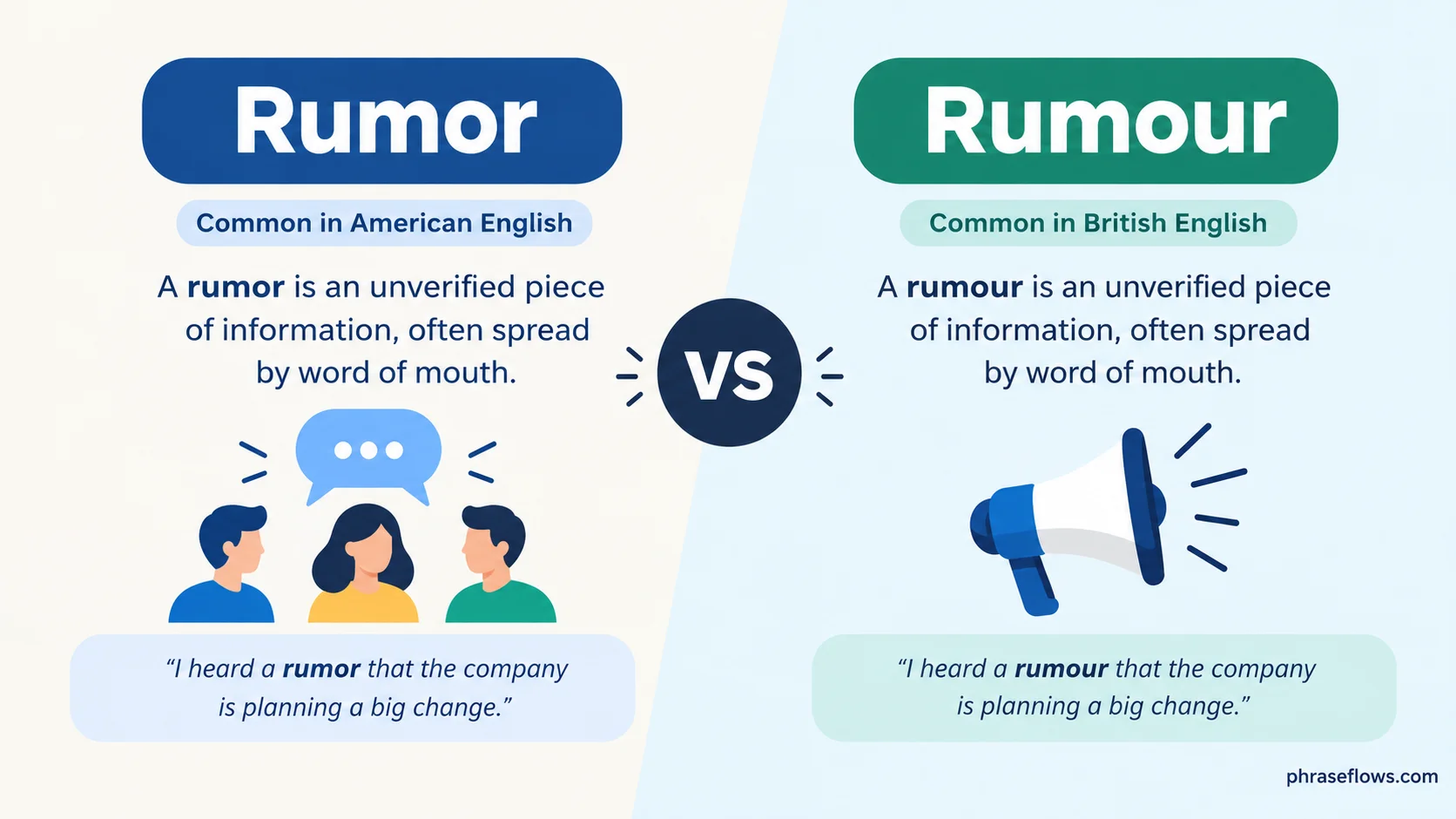

Have you ever wondered whether to write rumor vs. rumour? Both spellings are correct, but the right choice depends on the type of English you use. American English prefers rumor, while British English commonly uses rumour. Although one letter separates these words, the difference often confuses students, writers, and professionals.
Both words have the same meaning. A rumor vs. rumour is information or a story that spreads from person to person without confirmed proof. The two spellings also have the same pronunciation, so you won’t hear a difference when someone says them aloud. The variation comes from regional spelling conventions rather than a change in meaning or usage.
Knowing when to use each spelling can make your writing clearer and more consistent. If you’re writing for an American audience, choose rumor. For a British audience, rumour is generally the preferred form. In this guide, you’ll explore their meanings, spelling differences, origins, pronunciation, and everyday usage, along with examples to help you avoid common mistakes.
Rumor vs. Rumour: What’s the Difference?
The main difference between rumor and rumour is regional spelling. American English prefers rumor, whereas British English prefers rumour. Both words describe information or a story that circulates among people without confirmed proof.
The additional U in rumour doesn’t affect its pronunciation or meaning. It’s simply part of the traditional British spelling convention.
Here’s a quick comparison:
| Feature | Rumor | Rumour |
| English variety | American English | British English |
| Meaning | Unconfirmed information or story | Unconfirmed information or story |
| Pronunciation | /ˈruː.mɚ/ | /ˈruː.mər/ |
| Word type | Noun and verb | Noun and verb |
| Plural form | Rumors | Rumours |
| Past tense | Rumored | Rumoured |
| Present participle | Rumoring | Rumouring |
Examples:
- American English: A rumor about the new school schedule spread quickly.
- British English: A rumour about the new school timetable spread quickly.
Both sentences communicate the same idea. Only the spelling and one regional vocabulary choice differ.
It’s worth remembering that these words don’t describe two different kinds of information. You don’t use rumor for false stories and rumour for true ones. Their meanings are identical.
What Does Rumor Mean?
Rumor is a noun or verb that refers to unconfirmed information circulating among people. It often describes a story that someone hears from another person rather than information supported by an official announcement or reliable evidence.
People commonly use the word when discussing schools, workplaces, entertainment, politics, businesses, and personal matters.
For example, imagine someone hears that a local company plans to open another office. They tell a coworker who shares the information with several others. Before the company confirms anything, the story becomes a rumor.
A rumor may eventually prove true. It might also turn out to be partly accurate or completely false. The word itself doesn’t tell you whether the information is correct.
Rumor as a Noun
As a noun, rumor describes an unverified story, report, or claim that spreads from person to person.
You can use it when talking about something you’ve heard but haven’t confirmed. The word commonly appears with verbs such as hear, spread, start, deny, and believe.
Examples of rumor as a noun:
- I heard a rumor about a new restaurant opening downtown.
- The rumor spread throughout the office before management responded.
- Nobody knew whether the rumor was true.
- She refused to believe a rumor without checking the facts.
- A strange rumor circulated around the school last week.
The noun also has singular and plural forms.
- Singular: A rumor started during the meeting.
- Plural: Several rumors appeared after the announcement.
Although rumor usually refers to an individual piece of information, people sometimes use it in broader expressions. For example, rumor has it introduces something people are saying without presenting it as confirmed fact.
Rumor as a Verb
Although people use rumor more commonly as a noun, it can also function as a verb.
As a verb, it describes the act of circulating or reporting an unconfirmed story. In everyday American English, the passive construction is rumored to be appears frequently.
Examples of rumor as a verb:
- The actor is rumored to be joining a new television series.
- The company was rumored to be considering another location.
- Several employees rumored that management planned changes.
- The new product is rumored to arrive next spring.
Notice how the verb form introduces information that people are discussing but haven’t officially confirmed.
The word also has different grammatical forms:
- Rumor: Base form
- Rumors: Third-person singular form or plural noun
- Rumored: Past tense and past participle
- Rumoring: Present participle and gerund
These forms follow standard American English spelling conventions.
What Does Rumour Mean?
Rumour has exactly the same meaning as rumor. The only difference is its spelling.
British English generally uses rumour when referring to an unconfirmed report, story, or piece of information shared among people.
You’ll commonly encounter this spelling in British newspapers, books, magazines, educational materials, and everyday communication. It’s also widely used in countries such as Australia and New Zealand.
For example:
There was a rumour that the local library would extend its opening hours.
This sentence describes information circulating without confirmation. The spelling doesn’t suggest that the story is more or less believable.
Rumour as a Noun
As a noun, rumour identifies information that people share without knowing whether it’s accurate.
It can refer to something small, such as a change in a school schedule, or something significant, such as a company announcement that hasn’t been officially confirmed.
Examples of rumour as a noun:
- A rumour about the new manager spread quickly.
- I heard a strange rumour during lunch.
- The newspaper published a story about the growing rumour.
- Several rumours circulated before the official announcement.
- She asked everyone to stop spreading the rumour.
The plural form is rumours. You simply add an S to the singular spelling.
For instance:
- One rumour appeared online.
- Several rumours appeared online.
The word works naturally in both casual and formal contexts. However, in formal reporting, writers should distinguish clearly between an unconfirmed rumour and verified information.
Rumour as a Verb
Just like rumor, rumour can function as a verb in British English.
It describes reporting or circulating information that hasn’t been confirmed. Its verb forms retain the additional U.
Examples of rumour as a verb:
- The singer is rumoured to be working on another album.
- The company was rumoured to be opening a new branch.
- People rumoured that the event might be postponed.
- The building is rumoured to have historical importance.
You’ll often see rumoured in British news reporting and entertainment writing. It allows writers to discuss circulating claims without presenting them as established facts.
The main grammatical forms include:
- Rumour: Base form
- Rumours: Third-person singular form or plural noun
- Rumoured: Past tense and past participle
- Rumouring: Present participle and gerund
The meaning remains unchanged across all these forms.
Rumor vs. Rumour: Spelling Rules and Regional Differences
English spelling varies across countries. Some words have different spellings even though they share the same meaning and pronunciation. The difference between rumor and rumour follows one of the best-known patterns in American and British English.
American English generally uses -or, while British English often retains -our. This difference appears in several everyday words.
| American English | British English |
| Rumor | Rumour |
| Color | Colour |
| Favor | Favour |
| Honor | Honour |
| Labor | Labour |
| Neighbor | Neighbour |
| Behavior | Behaviour |
| Flavor | Flavour |
These differences don’t create separate meanings. They’re simply accepted spelling conventions in different varieties of English.
American English Uses Rumor
In the United States, rumor is the standard spelling. American dictionaries and publications generally follow this form.
The spelling fits a broader pattern established through American spelling reforms. Noah Webster, an American lexicographer, supported spelling changes that helped distinguish American written English from British conventions.
His influential dictionaries helped establish forms such as color, honor, and favor without the additional U.
Examples of rumor in American English:
- The rumor about the new school principal turned out to be false.
- Several rumors circulated after the company announced its expansion.
- I don’t believe every rumor I read online.
- A rumor has started about changes to the office schedule.
- The manager denied the rumor during the meeting.
If you’re writing for an American audience, use rumor, rumors, rumored, and rumoring.
British English Uses Rumour
British English generally retains the additional U, making rumour the preferred spelling.
This convention also appears in words such as colour, favour, and neighbour. British dictionaries and publications commonly follow these traditional spellings.
Examples of rumour in British English:
- A rumour about the new headteacher spread throughout the school.
- Several rumours appeared after the company’s announcement.
- The manager denied the rumour during the meeting.
- I heard a rumour about a possible change in the timetable.
- The newspaper investigated the rumour before publishing its report.
When writing for a British audience, use rumour, rumours, rumoured, and rumouring.
Which Spelling Is Used in Canada, Australia, and Other Countries?
The choice becomes slightly more interesting when you look beyond the United States and the United Kingdom. Other English-speaking countries have their own spelling preferences.
- Canada: Canadian English generally favors rumour, although American spellings also appear in some publications and contexts.
- Australia: Australian English generally follows British spelling conventions, so rumour is standard.
- New Zealand: New Zealand English also commonly uses rumour.
- Ireland: British-style spelling conventions are common, making rumour the usual choice.
- United States: American English consistently prefers rumor.
The important point is that regional preferences can vary. A country’s spelling conventions don’t always determine every organization’s style.
For example, an international company might follow American English across its website even when its Australian office uses British-style spelling in local publications.
Practical tip: When writing professionally, follow the spelling guide used by your publisher, school, employer, or intended audience.
Rumor vs. Rumour: Examples in Sentences
Examples make spelling differences easier to understand. Since rumor and rumour have identical meanings, you can usually replace one with the other without changing the message.
The only requirement is to maintain consistent regional spelling.
Examples of Rumor in American English
Here are several natural sentences using the American spelling:
- Hear a rumor: I heard a rumor that our school might organize another field trip.
- Spread a rumor: Someone started spreading a rumor about the company’s new policies.
- Deny a rumor: The principal denied the rumor during the morning announcement.
- Start a rumor: Nobody knew who started the rumor about the canceled event.
- Believe a rumor: You shouldn’t believe a rumor without checking its source.
- Confirm a rumor: The company finally confirmed the rumor about its upcoming expansion.
- Rumor has it: Rumor has it that the restaurant will open another location soon.
These examples show how naturally rumor fits into everyday American English.
Examples of Rumour in British English
The following sentences communicate similar ideas using the British spelling:
- Hear a rumour: I heard a rumour that our school might organize another trip.
- Spread a rumour: Someone started spreading a rumour about the company’s new policies.
- Deny a rumour: The headteacher denied the rumour during the morning announcement.
- Start a rumour: Nobody knew who started the rumour about the canceled event.
- Believe a rumour: You shouldn’t believe a rumour without checking its source.
- Confirm a rumour: The company finally confirmed the rumour about its upcoming expansion.
- Rumour has it: Rumour has it that the restaurant will open another location soon.
Notice that the meaning remains the same. Some vocabulary choices, such as headteacher instead of principal, may also vary between American and British English. However, those are separate regional differences.
Rumor vs. Rumour: Different Word Forms
The spelling difference doesn’t disappear when you change the word’s grammatical form. American English retains the shorter spelling, while British English generally keeps the additional U.
Understanding these forms helps you avoid mistakes in essays, articles, emails, and professional documents.
Here’s a complete comparison:
| Grammatical Form | American English | British English |
| Singular noun | Rumor | Rumour |
| Plural noun | Rumors | Rumours |
| Base verb | Rumor | Rumour |
| Third-person singular verb | Rumors | Rumours |
| Past tense | Rumored | Rumoured |
| Past participle | Rumored | Rumoured |
| Present participle | Rumoring | Rumouring |
Rumor vs. Rumour (Singular and Plural)
The singular noun refers to one unconfirmed story or report. The plural form describes two or more such stories.
American English adds S to rumor to create rumors. British English does the same with rumour, producing rumours.
Examples:
- American: A rumor started after the announcement.
- British: A rumour started after the announcement.
- American: Several rumors appeared on social media.
- British: Several rumours appeared on social media.
Both varieties follow the regular English pluralization rule. You don’t need to change the word’s structure beyond adding S.
Rumored vs. Rumoured
Rumored and rumoured are the past-tense and past-participle forms of the verb.
American English uses rumored, while British English uses rumoured.
Examples:
- American: The actor was rumored to be joining the television series.
- British: The actor was rumoured to be joining the television series.
- American: The rumored announcement attracted considerable attention.
- British: The rumoured announcement attracted considerable attention.
Both forms also work as adjectives.
For example, the rumored changes describes changes that people have discussed but haven’t officially confirmed.
Rumoring vs. Rumouring
The present participle and gerund forms follow the same regional spelling pattern.
- Rumoring: American English
- Rumouring: British English
The ending -ing attaches to the base form without doubling the final R.
Examples:
- American: People were rumoring that the company planned to relocate.
- British: People were rumouring that the company planned to relocate.
- American: Rumoring about someone’s private life can create unnecessary problems.
- British: Rumouring about someone’s private life can create unnecessary problems.
These forms are grammatically possible, although everyday English often favors expressions such as spreading rumors or spreading rumours.
Common Expressions and Phrases Using Rumor and Rumour
Both spellings appear in several familiar expressions. These phrases help you communicate naturally when discussing unconfirmed information, gossip, or circulating stories.
The expressions generally remain the same across American and British English. Only the regional spelling changes.
Rumor Has It vs. Rumour Has It
Rumor has it is a common expression meaning that people are saying something, although the information hasn’t necessarily been confirmed.
British English uses rumour has it.
Examples:
- American: Rumor has it that the company plans to introduce a new product.
- British: Rumour has it that the company plans to introduce a new product.
- American: Rumor has it that they’re moving to another city.
- British: Rumour has it that they’re moving to another city.
You can use this expression in casual conversations, articles, and informal storytelling. However, avoid presenting the information that follows as confirmed news unless you have reliable evidence.
Spread a Rumor vs. Spread a Rumour
This expression describes passing unconfirmed information from one person to another.
Examples:
- American: Someone tried to spread a rumor about the new employee.
- British: Someone tried to spread a rumour about the new employee.
- American: Don’t spread a rumor without checking whether it’s true.
- British: Don’t spread a rumour without checking whether it’s true.
The phrase often appears in discussions about workplace communication, friendships, schools, and social media.
The Rumor Mill vs. The Rumour Mill
The rumor mill is an informal expression for the ongoing circulation of gossip, speculation, and unconfirmed stories.
British English generally writes it as the rumour mill.
Examples:
- American: The rumor mill became busy after the manager resigned.
- British: The rumour mill became busy after the manager resigned.
- American: The rumor mill keeps producing stories about the upcoming event.
- British: The rumour mill keeps producing stories about the upcoming event.
The expression often describes situations where people exchange information without knowing whether it’s accurate.
Rumor vs. Rumour: Common Mistakes to Avoid
Although the spelling difference is simple, writers sometimes make mistakes when choosing between these words. Most problems involve inconsistent spelling or treating an unconfirmed story as established fact.
Here are some common mistakes worth avoiding.
Mixing American and British Spellings
One of the most common writing mistakes is mixing regional spelling conventions in the same document.
For example:
The company received several rumours about its new color scheme.
This sentence combines the British spelling rumours with the American spelling color.
A more consistent American version would be:
The company received several rumors about its new color scheme.
A consistent British version would be:
The company received several rumours about its new colour scheme.
Mixing conventions isn’t always a grammatical error, especially in international writing. However, maintaining one spelling system makes your content look more polished and consistent.
Assuming Rumour Is Incorrect
Some American readers may assume that rumour contains an unnecessary letter. Similarly, British readers might consider rumor an American spelling mistake.
Neither assumption is correct.
Both forms appear in established dictionaries. Their differences reflect regional spelling conventions rather than grammatical accuracy.
English meaning – Cambridge Dictionary
+2
Remember:
- Rumor is correct in American English.
- Rumour is correct in British English.
- Both forms have the same meaning.
- Neither spelling is universally superior.
Confusing Rumors With Facts
Another important mistake involves confusing an unconfirmed report with verified information.
A rumor doesn’t automatically mean a lie. It simply means that people are circulating information without establishing its accuracy.
For example, imagine hearing that a local school plans to introduce a new timetable. Several students discuss the possibility, but the school hasn’t announced anything.
At that stage, it’s a rumor.
If the school later publishes an official announcement, the information becomes confirmed.
This distinction matters because words such as rumor, fact, report, claim, and speculation don’t mean exactly the same thing.
- Rumor: Information circulating without confirmation.
- Fact: Something established as true.
- Claim: A statement that someone presents as true.
- Speculation: An idea or explanation based on incomplete information.
- Report: Information communicated about an event or situation.
Using the correct term helps readers understand how reliable the information is.
A Practical Case Study: Choosing Between Rumor and Rumour
Consider a company that operates offices in both New York and London. Employees in both locations hear that management plans to introduce a new workplace policy.
The information hasn’t received official confirmation. However, employees begin discussing it in meetings and sharing messages.
The American office writes:
Several rumors about the upcoming workplace policy have circulated among employees.
Meanwhile, the London office writes:
Several rumours about the upcoming workplace policy have circulated among employees.
Both sentences are correct. They describe the same situation and communicate the same information.
This example highlights two important writing principles:
- Follow regional spelling conventions: Use the spelling your intended audience expects.
- Maintain consistency: Don’t switch between American and British spelling without a clear reason.
A small spelling choice can make a noticeable difference in professional writing.
The History and Origin of Rumor and Rumour
The word rumor has a long history in the English language. Its origins go back to the Latin word rūmor, which referred to noise, common talk, public opinion, or hearsay.
English adopted the word through Old French rumor. Historical records trace its use in English to the late 14th century.
Over time, the word developed its familiar meaning: information or stories circulating among people without necessarily having a reliable foundation.
The spelling rumour reflects an older English and French-influenced spelling convention. American spelling reforms later helped establish rumor as the standard form in the United States.
Noah Webster played an important role in popularizing American spelling differences. His dictionaries helped establish shorter forms such as color, honor, and favor.
The same convention applies to rumor.
A useful historical detail: The difference between -or and -our isn’t unique to this word. It reflects a much broader development in English spelling.
Etymology, Origin & Meaning
+1
For additional historical information, consult the Online Etymology Dictionary’s entry for rumor.
Read More: Authorization vs. Authorisation: Which Is Correct?
Rumor or Rumour: Which Spelling Should You Use?
Choosing between rumor and rumour is easy once you know your target audience.
Neither spelling is more correct than the other. The best choice depends on the English variety you’re using.
Follow these simple guidelines:
- Writing for American readers? Use rumor.
- Writing for British readers? Use rumour.
- Writing for Australian readers? Generally use rumour.
- Writing for Canadian readers? Prefer rumour unless your publication follows American spelling.
- Writing for an international audience? Choose one consistent English variety and follow it throughout your content.
For blog posts, academic assignments, business documents, and professional communication, consistency matters more than choosing one regional spelling over another.
If your website follows American English, use rumor, color, and favorite consistently. If it follows British English, choose rumour, colour, and favourite.
That simple approach keeps your writing clear and professional.
Conclusion:
The difference between rumor and rumour comes down to regional spelling preferences. Both words have the same meaning and pronunciation, but rumor is standard in American English, while rumour is commonly used in British English and other varieties that follow British spelling conventions. Neither spelling is incorrect.
When choosing between them, consider your audience and the style guide you’re following. Use one spelling consistently throughout your writing to keep your message clear and professional. Once you understand this simple regional difference, you’ll know exactly when to use rumor or rumour.
FAQs:
1. Is rumor or rumour the correct spelling?
Both rumor and rumour are correct spellings. Rumor is preferred in American English, while rumour is commonly used in British English.
2. What is the difference between rumor and rumour?
There is no difference in meaning or pronunciation. The only difference is regional spelling: American English drops the u, while British English keeps it.
3. Is rumour British or American spelling?
Rumour is the standard British English spelling. It is also used in several other English-speaking regions that follow British spelling conventions.
4. How do you pronounce rumor and rumour?
Both words are pronounced the same way. The extra u in rumour does not change how the word sounds.
5. Should I use rumor or rumour in formal writing?
Choose the spelling that matches your audience or required style guide. Use rumor for American English publications and rumour for British English publications. Keep the spelling consistent throughout your document.