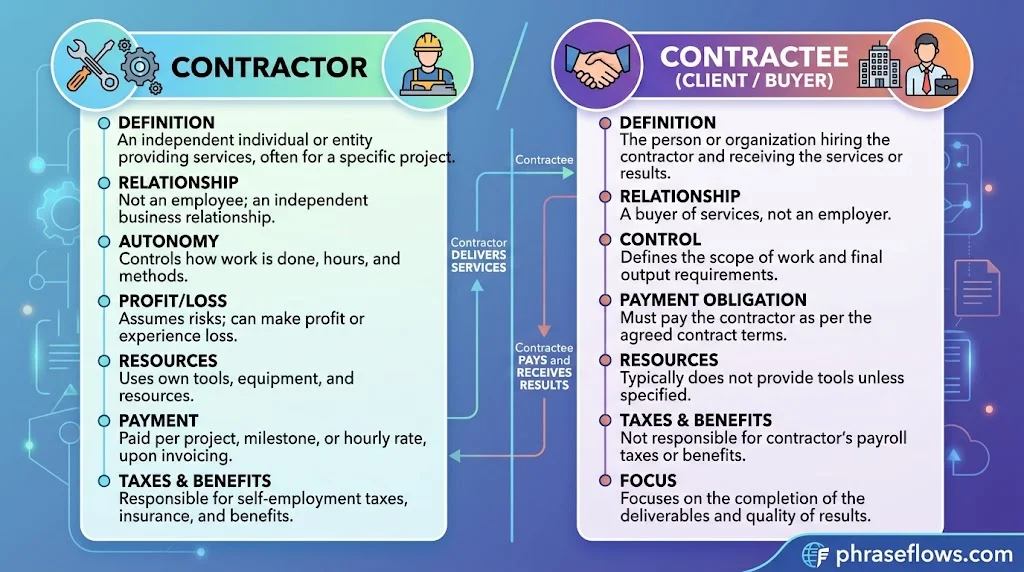

Understanding the difference between a contractor vs. contractee is important when dealing with contracts, business agreements, and legal documents. Although these terms look similar, they describe two different parties in a contractual relationship. A contractor is the person, company, or organization hired to perform a job or provide services, while a contractee is the person or organization that hires the contractor and receives the agreed work.
In most construction projects, freelance agreements, and professional services, the contractor is responsible for completing the work according to the contract terms. The contractee typically requests the service, agrees to the conditions, and pays for the completed work as specified in the agreement. Both parties have their own responsibilities, contractual duties, and obligations. Understanding these roles helps prevent confusion, communication errors, and misunderstandings when preparing or interpreting legal agreements.
Knowing when to use contractor and contractee correctly also improves your professional writing, business communication, and English vocabulary. These terms frequently appear in service agreements, employment contracts, construction contracts, and other formal documents. By learning their meanings, responsibilities, and key differences, you can choose the correct term for each situation and communicate more clearly in professional and everyday conversations.
What Is a Contractor?
A contractor is a person or organization that agrees to perform specific work, provide services, or supply goods under a contract. The agreement usually outlines the expected results, deadlines, payment terms, and responsibilities of everyone involved.
Although many people associate contractors with construction, the term applies to numerous industries. A freelance writer, software developer, marketing consultant, or building company may act as a contractor when they agree to complete work under a contract.
For instance, a business might hire a graphic designer to create a new logo. If the designer agrees to deliver the logo according to the project’s terms, the designer acts as the contractor. The business commissioning the work occupies the other side of the arrangement.
A contractor’s responsibilities depend on the agreement. One contractor may need to supply materials and equipment, while another may provide specialized knowledge or creative services. The contract determines what each party must deliver.
Common Types of Contractors
Contractors work across a wide range of fields. Their duties differ, but each role involves an agreed set of obligations.
- Construction contractor: Builds, repairs, or renovates homes, offices, and other structures.
- General contractor: Coordinates a construction project and may manage subcontractors, materials, schedules, and inspections.
- Freelance contractor: Provides services such as writing, editing, graphic design, or translation.
- IT contractor: Helps businesses with software development, technical support, cybersecurity, or system upgrades.
- Consulting contractor: Provides professional advice or specialized knowledge to solve business problems.
- Supply contractor: Agrees to provide goods or materials under a supply agreement.
These categories can overlap. For example, a construction company may act as a general contractor while hiring electrical and plumbing subcontractors to complete specialized tasks.
What Are a Contractor’s Main Responsibilities?
A contractor’s duties depend on the contract rather than the job title alone. However, many service agreements include responsibilities such as:
- Completing the agreed work: Delivering the services or products described in the agreement.
- Meeting deadlines: Following the project’s schedule and notifying the other party about significant delays.
- Maintaining quality: Meeting the specifications and standards established in the contract.
- Communicating progress: Providing updates, discussing problems, and confirming important decisions.
- Following applicable rules: Complying with relevant laws, safety requirements, permits, and professional standards.
- Managing agreed costs: Working within the budget or pricing structure established by the parties.
Consider a freelance writer hired to produce five blog posts. The contractor must deliver the agreed number of articles, follow the approved instructions, and meet the deadline. If the contract includes revisions, the writer must also follow the agreed revision process.
However, a contractor doesn’t automatically assume every responsibility associated with a project. The written agreement determines which duties belong to the contractor and which belong to the other party.
Contractor Examples in Sentences
Here are several examples showing how to use contractor naturally in everyday and professional English.
- The contractor will complete the office renovation by the end of the month.
- We hired a freelance contractor to write product descriptions for our website.
- The software contractor agreed to deliver the first version of the application next week.
- The building contractor ordered the materials required for the project.
- Our marketing contractor developed a campaign to introduce the new product.
In each sentence, contractor identifies the person or organization responsible for performing the agreed work or supplying the agreed service.
What Is a Contractee?
A contractee is a party associated with a contract, often the party for whom a contractor performs work in construction and service arrangements. The term is less common in everyday English than contractor, so its precise meaning should be checked against the context of the agreement.
In a typical home renovation project, the homeowner who hires a building company may be called the contractee. The building company acts as the contractor because it agrees to complete the renovation.
However, don’t assume that contractee always means the person who pays or receives a service. Contracts can involve different types of promises, deliveries, and obligations. The agreement itself determines each party’s role.
For everyday communication, words such as client, customer, project owner, or service recipient may express the relationship more clearly. Choose the term that accurately describes the person or organization involved.
Common Examples of a Contractee
A contractee may be an individual, a company, a nonprofit organization, or a public agency. The term can appear in formal agreements when the parties need to identify their contractual roles.
For example:
- Homeowner: Hires a construction company to remodel a kitchen.
- Business owner: Engages a freelance designer to create a company logo.
- Technology company: Hires a software developer to build a mobile application.
- Property management company: Arranges for a maintenance company to repair a building.
- Public agency: Enters into an agreement with a contractor to complete a specified project.
In each example, the organization or individual commissioning the work may be described as the contractee, depending on the agreement’s terminology.
What Are a Contractee’s Main Responsibilities?
The contractee also has responsibilities. A contract doesn’t simply tell the contractor what to do; it can establish obligations for both parties.
Depending on the agreement, a contractee may need to:
- Explain the requirements: Describe the expected work, deliverables, or services.
- Provide necessary information: Supply measurements, documents, access, or other agreed resources.
- Make payments: Pay the agreed amount according to the payment schedule, when required by the contract.
- Review deliverables: Check whether completed work meets the agreed specifications.
- Approve changes: Follow the agreed process for authorizing additional work or changes to the original scope.
- Meet other contractual duties: Complete any additional responsibilities assigned by the agreement.
For example, a company hiring a website developer may need to provide its logo, brand guidelines, product information, and feedback. If the company delays these materials, the project schedule may suffer.
The contractor and contractee should therefore communicate clearly. Both parties need to understand their obligations before work begins.
Contractee Examples in Sentences
These sentences demonstrate how contractee can appear in formal or professional writing.
- The contractee reviewed the proposed construction schedule.
- The contractee requested revisions to the project specifications.
- The agreement identifies the property owner as the contractee.
- Both parties signed the agreement before the contractor began work.
- The contractee approved the revised project plan under the terms of the agreement.
Although these examples illustrate the term’s use, everyday writing may sound more natural with a specific noun such as client or property owner.
Contractor vs. Contractee: Key Differences Explained
The simplest way to understand contractor vs. contractee is to identify what each party agrees to do. In a typical service arrangement, the contractor performs the work while the contractee commissions or receives it.
The distinction becomes clearer when you compare their roles side by side.
| Feature | Contractor | Contractee |
| Basic meaning | Party that agrees to perform work or supply goods or services | Party on the other side of the contractual arrangement |
| Typical role | Delivers the agreed work or services | Commissions or receives the agreed work or services |
| Main responsibility | Fulfills the obligations assigned to the contractor | Fulfills the obligations assigned to the other party |
| Common examples | Builder, freelance writer, software developer | Homeowner, hiring company, project owner |
| Payment arrangement | May receive payment for completed work | May pay for the agreed work |
| Contractual duties | Follow the agreed scope, standards, and deadlines | Meet agreed payment, cooperation, approval, or other obligations |
| Common usage | Widely used in business and everyday English | More common in formal or specialized contexts |
Important: This table describes a typical contractor-client arrangement. It doesn’t establish universal legal rules. A party’s exact role depends on the contract, the transaction, and the applicable law.
The Main Difference in Simple Terms
Think of a contract as a plan that connects two parties through agreed promises.
The contractor agrees to provide something, such as construction work, professional advice, or a finished website. The other party agrees to the terms and may need to pay, provide information, approve deliverables, or meet other obligations.
For example, suppose a company hires a photographer to take product pictures.
- The photographer is the contractor because they agree to provide the photography services.
- The company may be described as the contractee because it commissions the work.
- The contract explains the number of photos, delivery date, fee, and usage rights.
This distinction helps prevent confusion when you discuss project responsibilities or write formal documents.
Are Contractor and Contractee Opposites?
Not in the same way that hot and cold are opposites. Contractor and contractee identify different roles within a contractual relationship.
Both parties enter into an agreement and may have enforceable obligations. Neither word automatically makes one party more important than the other.
For example, a contractor may have to complete a project, while the contractee must provide access to the site and make payments according to the agreement. Each party has responsibilities, and either may breach the contract by failing to meet applicable obligations.
The key distinction is the role each party occupies, not whether one party has all the rights and the other has all the duties.
Contractor vs. Contractee in Real-World Situations
Definitions become easier to remember when you apply them to familiar situations. The following examples show how the terms work in different industries.
Construction Project: Contractor vs. Contractee
Imagine that a homeowner hires a building company to renovate a kitchen. Both parties sign an agreement covering the work, materials, price, and expected completion date.
The building company acts as the contractor because it agrees to complete the renovation. The homeowner may be called the contractee because they commission the work.
The contractor’s duties might include removing old cabinets, installing new countertops, and completing agreed repairs. The homeowner’s duties might include paying the agreed price and providing access to the property.
Now suppose the homeowner requests additional cabinets after the project begins. The contractor and homeowner should follow the contract’s change-order procedure, if one exists, before proceeding with the extra work.
This example shows why clear contractual terms matter. Without them, the parties might disagree about costs, deadlines, or which tasks the original price covers.
Freelance Writing Project: Contractor vs. Contractee
Consider a small business that hires a freelance writer to create ten blog posts. The agreement specifies the topics, approximate word counts, delivery dates, and payment terms.
The writer is the contractor, while the business commissioning the articles may be described as the contractee.
The writer agrees to produce the content according to the project requirements. Meanwhile, the business may need to provide its brand guidelines, review drafts, and pay invoices as agreed.
A disagreement could arise if the business requests ten additional articles without discussing the fee. The original contract might not cover that extra work.
A clear agreement can help both parties determine whether the additional request requires a revised price or a separate contract. It also makes deadlines and revision limits easier to manage.
Software Development Project: Contractor vs. Contractee
Suppose a startup hires a software developer to build an appointment-booking application. The agreement lists the planned features, testing requirements, milestones, and payment schedule.
The developer acts as the contractor. The startup may be called the contractee because it commissions the development work.
The developer may need to deliver working features, fix defects covered by the agreement, and provide technical documentation. The startup may need to supply product requirements, review milestones, and pay according to the agreed schedule.
Problems can occur when either party assumes that an unstated requirement forms part of the original deal. For example, the startup might expect ongoing maintenance even though the contract only covers initial development.
To prevent this misunderstanding, the agreement should distinguish between project delivery, post-launch support, future upgrades, and maintenance services.
Case Study: A Disagreement Over Project Scope
Consider a fictional example involving a marketing agency and a retail business.
The business hires the agency to create a website and write five product pages. Both parties agree on the price and delivery date. After the agency begins work, the business requests a newsletter system and fifteen additional product pages.
The agency explains that these additions fall outside the original scope. The business argues that they form part of the overall website project.
Here’s how a well-written agreement can help:
- Scope of work: Lists the website features and the five included product pages.
- Payment terms: Establishes the original fee and payment schedule.
- Change process: Explains how the parties approve additional work and pricing.
- Delivery terms: Sets the expected completion date and any conditions that affect it.
- Acceptance criteria: Defines how the business reviews and approves the completed work.
The agency acts as the contractor, while the retail business may be described as the contractee. However, identifying the parties is only the first step. The agreement must also explain what each party promised to do.
Lesson: Correct terminology helps identify the parties, but clear contractual terms help prevent disagreements.
When Should You Use Contractor vs. Contractee?
Choosing between contractor and contractee depends on which party you’re discussing. Before using either term, identify who agreed to perform the work and who occupies the other side of the contractual relationship.
When to Use Contractor
Use contractor when you refer to the person or organization that agrees to carry out work, supply goods, or provide services under an agreement.
The term works well in business writing, construction documents, project updates, and professional communication.
Examples:
- The contractor will submit the final report on Monday.
- We need to contact the contractor about the delayed delivery.
- The company hired a contractor to upgrade its computer systems.
- The construction contractor must follow the agreed project specifications.
In each sentence, the word identifies the party responsible for performing the specified work or service.
If you’re writing for a general audience, contractor is usually the more familiar and natural choice when referring to a service provider.
When to Use Contractee
Use contractee when a formal or technical context calls for that term to identify the other party in the contractual arrangement.
However, don’t use it automatically just because someone hires a contractor. The agreement’s terminology and the nature of the transaction matter.
Examples:
- The contractee approved the revised construction schedule.
- The agreement identifies the property owner as the contractee.
- The contractee must provide the documents specified in the agreement.
For everyday writing, you can often choose a more precise alternative.
| Instead of contractee | Consider using | When it fits |
| Contractee | Client | A person or business hires a professional service provider |
| Contractee | Customer | A person or business purchases goods or services |
| Contractee | Property owner | The person owns the property involved in a project |
| Contractee | Project owner | The person or organization commissions or owns a project |
| Contractee | Contracting party | You need a broader formal term and the specific role isn’t important |
These alternatives aren’t interchangeable in every situation. For example, a client may not own the property involved in a project, and a customer may not commission custom work. Select the term that accurately describes the relationship.
How to Choose the Correct Word Quickly
If you’re unsure which term belongs in a sentence, follow these steps:
- Identify the agreement: Determine what work, service, or goods the parties have agreed to provide.
- Identify the performer or supplier: This party will generally be the contractor in the arrangement described.
- Identify the other party: Determine its actual role and check whether contractee, client, customer, or another term fits.
- Check the context: Formal agreements may define these terms differently, so use the definitions established in the document.
- Read the sentence again: Make sure the word accurately describes the party you’re discussing.
For example, consider the sentence, “The contractor sent the invoice to the contractee.” In a typical service arrangement, this makes sense because the service provider sends the invoice to the other party. However, the invoice’s actual recipient and payment obligations still depend on the agreement.
Read More: Writing vs. Writting: Which Is the Correct Spelling?
Common Mistakes When Using Contractor and Contractee
Although the distinction sounds simple, several common mistakes can lead to confusing sentences or inaccurate assumptions.
Confusing the Contractor With the Contractee
The most obvious mistake is using the terms interchangeably.
Incorrect usage can make it unclear who must perform the work or fulfill a particular obligation.
Example:
- Confusing: The contractee will install the new roof, even though the agreement assigns that work to the roofing company.
- Clearer: The contractor will install the new roof.
Always identify the party responsible for the action before selecting the noun.
Assuming the Contractee Always Pays
In a typical service agreement, the hiring party pays the contractor. However, payment obligations depend on the agreement, not simply on the label contractee.
Contracts may involve third-party payments, staged payments, reimbursements, or other arrangements. The party commissioning the work may not be the only party involved in payment.
Instead of assuming who must pay, review the payment clause and identify the party responsible for each obligation.
Treating Contractee as a Synonym for Employer
A contractee isn’t automatically an employer. The term may describe a client or another party to a contractual arrangement.
For example, a company that hires a freelance designer to create a logo may be the designer’s client. That relationship doesn’t automatically make the designer an employee.
Worker classification requires a separate analysis. In the United States, the Internal Revenue Service considers factors involving behavioral control, financial control, and the relationship between the parties. The label used in an agreement doesn’t settle the issue by itself..
Assuming Every Contractor Is Self-Employed
The word contractor can describe a person or organization that undertakes work under a contract. It doesn’t automatically establish someone’s legal employment status.
For federal employment tax purposes in the United States, the IRS examines the actual working relationship and relevant evidence of control and independence. Calling someone an independent contractor in a document doesn’t necessarily make that classification correct.
This distinction matters when businesses hire workers. Contractual terminology and employment classification are related but separate questions.
Using Contractee When a Simpler Word Works Better
Contractee is a valid term, but it can sound technical in ordinary conversation.
Compare these sentences:
- Formal: The contractee reviewed the contractor’s proposal.
- Conversational: The client reviewed the contractor’s proposal.
Both sentences may work in the right context. The second version sounds more natural when the other party is clearly a client.
The goal isn’t to avoid contractee entirely. Instead, choose the term that makes the relationship easiest for your reader to understand.
Contractor vs. Contractee: Which Term Is More Common?
Contractor is the more familiar term in everyday English. People commonly use it when discussing construction, home repairs, professional services, and project-based work.
Contractee is less common in ordinary conversation. It appears in some formal, technical, and specialized contexts, particularly when a document needs to distinguish the contractor from the other party.
For example, someone arranging a home renovation will probably say, “I hired a contractor.” They probably won’t describe themselves as the contractee when speaking casually.
This difference in frequency doesn’t make contractee incorrect. It simply means that readers may recognize contractor more readily.
If you’re writing a blog post, email, or general business document, use client, customer, or another specific term whenever it communicates the intended meaning more clearly. In a formal agreement, follow the terminology defined in the document.
Is Contractee Grammatically Correct?
Yes. Contractee is a recognized English noun. Its spelling follows a common word-building pattern in which -ee identifies a person or party involved in an action or relationship.
Consider these related terms:
- Employer: The party that employs someone.
- Employee: The person employed.
- Payor: The party that makes a payment.
- Payee: The party that receives a payment.
- Contractor: A party that undertakes work or another contractual obligation.
- Contractee: A party associated with the contract, often the recipient or commissioning party in a service arrangement.
These word pairs can help you remember the meanings. However, English word endings don’t establish every legal right or responsibility. The surrounding context still determines how a term applies.
Conclusion:
Understanding the difference between a contractor and a contractee helps you use both terms correctly in business communication, legal documents, and professional writing. A contractor performs the agreed work or provides services, while a contractee hires the contractor and receives the services according to the contract. Both parties have specific responsibilities, and their obligations should be clearly stated in the agreement. Whether you are working on a construction project, managing freelance work, or preparing a service agreement, knowing these meanings helps prevent misunderstandings and improves communication.
FAQs:
1. What is the main difference between a contractor and a contractee?
A contractor is the person or company hired to perform work or provide services. A contractee is the person or organization that hires the contractor and receives the agreed services. Their responsibilities depend on the terms of the contract.
2. Is a contractor the person who hires someone?
No. A contractor is generally the party hired to complete specific work or provide services. The person or organization hiring the contractor is usually the client or contractee.
3. What are the responsibilities of a contractee?
A contractee typically requests the work, agrees to the contract terms, provides necessary information, and pays for the services as agreed. Depending on the contract, the contractee may also review and approve the completed work.
4. Can a company be both a contractor and a contractee?
Yes. A company can act as a contractor in one agreement and a contractee in another. For example, a construction company may hire an electrician for a project while providing construction services to a property owner.
5. Are contractor and contractee interchangeable terms?
No. Although both terms refer to parties in a contractual relationship, they have different meanings. Using them interchangeably can create confusion about who performs the work and who receives the services. Always check the contract to identify each party’s role and responsibilities.



