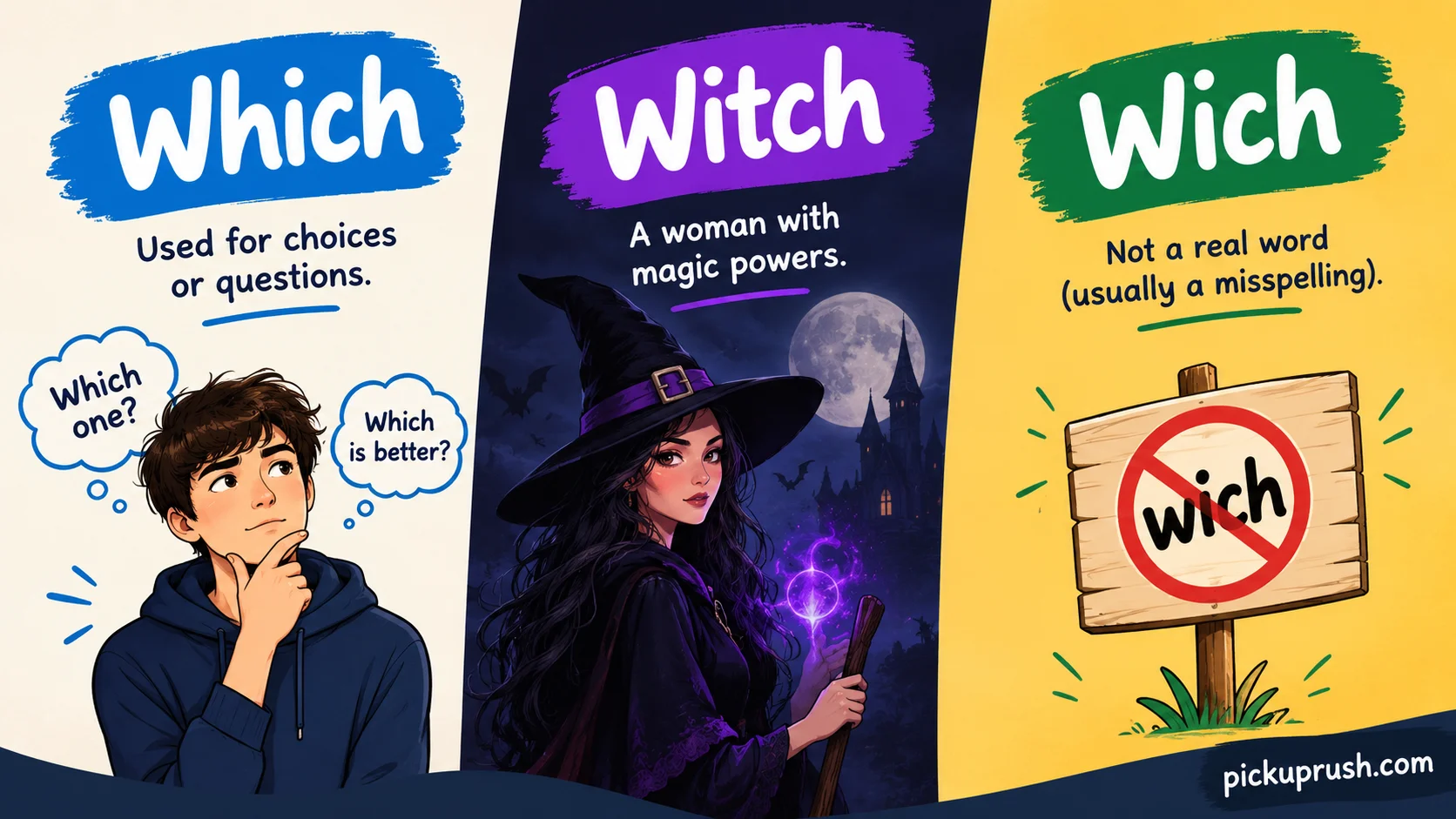

Have you ever paused while writing because you weren’t sure whether to use which, witch, or wich? You’re not alone. These words can sound alike, but their meanings, spellings, and uses are very different. Which is a common grammatical word, witch refers to a person associated with magic, and wich is usually an incorrect spelling of which.
Understanding the difference between these three words can help you avoid common spelling mistakes and improve your writing accuracy. Which is used in questions and clauses, while witch is often found in discussions of folklore, fantasy, and Halloween. On the other hand, wich generally has no standard English meaning and should normally be avoided in everyday writing.
In this guide, you’ll learn the definitions, correct usage, pronunciation, and practical examples of Which vs. Witch vs. Wich. We’ll also look at common mistakes and simple memory tricks that can make these confusing words easier to remember. By the end, you’ll have a clearer understanding of when to use each spelling in emails, academic writing, blog posts, and everyday conversations.
Which vs. Witch vs. Wich: Quick Difference
The easiest way to understand these three forms is to compare their meanings side by side.
| Word | Meaning | Grammatical Role | Example |
| Which | Used to ask about or identify a choice | Pronoun or determiner | Which book do you want? |
| Witch | A person traditionally associated with witchcraft | Noun | The witch lives in the forest. |
| Wich | Usually a misspelling of which | Not normally used as the modern word which | ❌ Wich one is yours? |
Which commonly appears in questions and relative clauses. It can identify something from a group of possibilities or add information about something already mentioned.
Witch, on the other hand, refers to a person associated with witchcraft or magical practices. You’ll often see it in folklore, fantasy, historical discussions, and Halloween-related writing.
Wich is the tricky one. In everyday modern English, it generally isn’t an alternative spelling of which. If you type wich one do you want?, you almost certainly need to add the missing h.
What Does “Which” Mean?
Which is a common English word used when you want to identify or select something from a particular group.
For example:
- Which shirt is yours?
- Which restaurant should we visit?
- Which answer is correct?
- Which route should we take?
- Which movie do you want to watch?
In each sentence, the speaker wants the listener to identify one option or a particular item.
This is slightly different from asking a completely open question. For example, “What do you want to eat?” can have countless answers. “Which dish do you want?” usually suggests that a particular set of dishes is available.
Which as a Question Word
One of the most common uses of which appears in questions.
You can use it before a noun:
Which book are you reading?
Here, which works as a determiner because it comes before the noun book.
You can also use which by itself:
Which do you prefer?
In this case, the noun doesn’t need to be repeated because the context already makes it clear.
For example, imagine someone puts two phones on a table and asks:
Which do you want?
The listener understands that the question means something like “Which phone do you want?”
Which as a Determiner
A determiner helps identify a noun. Which often performs this job when a question involves a choice.
Examples include:
- Which car belongs to you?
- Which student answered correctly?
- Which color do you prefer?
- Which restaurant serves breakfast?
- Which laptop should I buy?
- Which option makes more sense?
The structure is usually straightforward:
Which + noun
That pattern makes which easy to recognize.
Which as a Pronoun
Which can also stand alone as a pronoun.
Compare these sentences:
Which dress do you like?
and:
Which do you like?
In the first sentence, which modifies dress. In the second, which replaces the noun because the listener already knows what is being discussed.
This flexible use makes which extremely common in everyday English.
Which in Relative Clauses
Many learners know which as a question word but don’t realize that it also plays an important role in relative clauses.
A relative clause provides information about a noun or an idea that has already appeared in a sentence.
For example:
The laptop which I bought last year still works.
The phrase which I bought last year provides information about the laptop.
Another example is:
She chose the blue dress, which was on sale.
Here, which was on sale adds extra information about the dress.
The word which can therefore appear in both questions and statements. You need to look at the sentence structure rather than assuming that which always introduces a question.
Which With Commas
Punctuation matters when which introduces additional information.
Consider this sentence:
My old laptop, which I bought in college, still works.
The information between the commas gives extra detail. The sentence still identifies the laptop without that information.
Now consider:
The laptop which has a broken screen belongs to Sarah.
Here, the clause helps identify which laptop you’re talking about.
The exact rules around restrictive and nonrestrictive relative clauses can become more detailed, especially in formal writing. However, the basic principle is useful: commas can signal that a which-clause provides additional rather than identifying information.
What Does “Witch” Mean?
Witch has nothing to do with choosing between options. It is a noun connected with witchcraft and traditional beliefs about magical powers.
In modern English, you’ll often see witch in fictional stories, fantasy novels, folklore, historical discussions, and descriptions of Halloween costumes.
Examples include:
- The witch lived in an old cottage.
- The story features a powerful witch.
- The children dressed as witches for Halloween.
- The main character discovers that her grandmother was a witch.
The word can describe fictional characters as well as people discussed in historical contexts.
Witch in Folklore and History
The concept of the witch has a long history in European folklore and social history.
Historical accusations of witchcraft were not the same thing as the fictional magic found in modern fantasy stories. People in different societies held various beliefs about magic, supernatural powers, and harmful practices. Those beliefs sometimes contributed to accusations and prosecutions.
For example, European witch trials became particularly prominent during the early modern period, especially from the 15th through the 17th centuries.
When writing about historical witchcraft, it’s important to distinguish historical beliefs and accusations from fictional supernatural claims.
A sentence such as:
The witch cast a spell on the village.
could belong to a fantasy story.
A historical sentence might instead say:
The woman was accused of witchcraft during the trial.
The second sentence describes a historical accusation rather than presenting magic as a proven fact.
Witch in Modern Fiction
The word witch remains common in modern storytelling.
Fantasy writers often use witches as characters with magical abilities, mysterious knowledge, supernatural powers, or connections to folklore.
You might read sentences such as:
- The young witch learns to control her powers.
- A mysterious witch appears in the forest.
- The witch protects the village.
- Three witches live beyond the mountain.
In all these examples, witch functions as a noun.
What Does “Wich” Mean?
Now we reach the spelling that causes the most confusion.
In ordinary modern English, wich is generally not the correct spelling of which.
If you’re asking about a choice, use which.
For example:
❌ Wich book should I buy?
Correct:
✅ Which book should I buy?
Another example:
❌ Wich one do you prefer?
Correct:
✅ Which one do you prefer?
The difference is only one letter, but that letter matters.
Why Do People Write “Wich”?
There are several practical reasons people make this mistake.
First, which and witch sound identical for many speakers. When someone hears a word rather than sees it written, they may remember the sound but not the spelling.
Second, people often make quick typing errors. The letter h is easy to miss when you’re writing quickly.
Third, English spelling contains many words that don’t follow simple sound-to-letter patterns. You can’t always spell a word correctly just by writing the sounds you hear.
For example:
- which
- witch
- write
- right
- there
- their
These examples show why context and spelling knowledge matter.
Are There Legitimate Uses of “Wich”?
There is one important qualification.
Wich can appear in historical English and in certain place names or name elements. This doesn’t make it a standard alternative spelling of which in everyday modern English.
Therefore, if you’re writing a normal sentence such as:
Which restaurant should we visit?
don’t replace which with wich.
Specialized historical or proper-name uses are a different matter.
Which vs. Witch: The Main Difference
The simplest way to separate which and witch is to focus on meaning.
Which relates to a choice, identification, or relative clause.
Witch refers to a person associated with witchcraft.
Compare these examples:
Which character is your favorite?
This sentence asks the reader to choose or identify a character.
Now look at:
The witch lives in the old castle.
This sentence describes a person or fictional character associated with witchcraft.
The words may sound the same for many speakers. Their meanings and grammatical roles are completely different.
Meaning Difference
| Word | Core Meaning | Example |
| Which | Choice or identification | Which answer is correct? |
| Witch | Person associated with witchcraft | The witch entered the castle. |
| Wich | Usually a misspelling of which | ❌ Wich answer is correct? |
A quick memory trick works well:
Which = choice.
Witch = magic.
Wich = usually check your spelling.
Which vs. Witch Pronunciation
Pronunciation explains much of the confusion between which and witch.
Many American English speakers pronounce the two words the same way. Cambridge lists witch as /wɪtʃ/ and gives American pronunciations for which that include both /hwɪtʃ/ and /wɪtʃ/
Some speakers maintain a distinction between the initial sounds. Others don’t.
This variation is sometimes connected with the wine-whine distinction in English pronunciation.
That means two people can pronounce which differently while both using perfectly understandable English.
So don’t depend entirely on pronunciation when choosing the spelling.
Instead, ask yourself:
What does this word mean in my sentence?
If you’re identifying a choice, use which.
If you’re referring to a person associated with witchcraft, use witch.
Which vs. Witch vs. Wich Examples
Correct Uses of “Which”
Here are some everyday examples:
- Which book belongs to you?
- Which route is faster?
- Which phone should I buy?
- Which answer is correct?
- Which restaurant serves breakfast?
- I don’t know which option to choose.
- Tell me which one you prefer.
- She asked which dress I liked.
Each example involves selection, identification, or reference.
Correct Uses of “Witch”
Now compare them with these sentences:
- The witch lives near the forest.
- The children dressed as witches.
- The fantasy novel features a powerful witch.
- The witch appears in the final chapter.
- The story follows three witches.
- The character discovers that her grandmother was a witch.
Each example uses witch as a noun.
Incorrect Uses of “Wich”
These sentences demonstrate the most common spelling errors:
❌ Wich movie should we watch?
✅ Which movie should we watch?
❌ Wich one is yours?
✅ Which one is yours?
❌ I don’t know wich answer is correct.
✅ I don’t know which answer is correct.
❌ Wich route should we take?
✅ Which route should we take?
The correction is simple: when you mean the question word, spell it which.
Common Mistakes With Which, Witch, and Wich
Writing “Wich” Instead of “Which”
This is probably the most common mistake involving these three forms.
The writer knows the intended meaning but leaves out the h.
❌ Wich color do you like?
✅ Which color do you like?
If you see wich in an ordinary question, check whether which is what you intended.
Using “Witch” Instead of “Which”
This error can create a completely different meaning.
❌ Witch option should I choose?
Unless you’re intentionally talking about a magical character, the sentence should be:
✅ Which option should I choose?
One missing or misplaced letter can turn a normal question into something that sounds like a fantasy story.
Assuming Pronunciation Determines Spelling
English has many words that share pronunciation but differ in spelling and meaning.
These are known as homophones when they share the same pronunciation but have different meanings or spellings.
Examples include:
| Word Pair | Meaning |
| right / write | Correct direction or to put words on paper |
| there / their / they’re | Place, possession, and contraction |
| to / too / two | Direction, excess/addition, and number |
| which / witch | Choice/identification and person associated with witchcraft |
This is why spelling requires context.
Which vs. That: A Useful Related Difference
Once you understand which, another grammar question often appears: which vs. that.
Both words can introduce relative clauses in certain situations.
For example:
The book that I bought yesterday is excellent.
Here, that I bought yesterday identifies the book being discussed.
Now consider:
My new book, which I bought yesterday, is excellent.
The which clause provides additional information and is separated by commas.
The distinction becomes especially important in formal writing because punctuation can affect meaning.
A useful starting point is:
- Which can introduce relative clauses referring to things.
- Which commonly appears in nonrestrictive clauses.
- Nonrestrictive which clauses are generally separated with commas.
- That can be used in many restrictive relative clauses.
- That cannot replace which in a nonrestrictive relative clause.
If you’re writing professionally or academically, this distinction deserves careful attention.
Which, Witch, and Wich in Everyday Writing
The three spellings appear in very different contexts.
Where You’ll Use “Which”
You can expect which to appear frequently in:
- Questions
- Emails
- School assignments
- Articles
- Conversations
- Instructions
- Surveys
- Comparisons
- Relative clauses
Examples include:
Which plan should we choose?
The plan, which launched last month, has already changed.
Where You’ll Use “Witch”
You’ll most often encounter witch in:
- Folklore
- Fantasy
- Fairy tales
- Historical writing
- Halloween content
- Fiction
- Discussions of witchcraft
For example:
The witch disappeared into the forest.
Where You’ll See “Wich”
In ordinary writing, wich most often appears because someone intended to type which.
It can also appear in historical language or proper names.
That’s why it’s better to treat wich as a context-dependent form rather than automatically declaring every occurrence a spelling error. In a normal sentence, however, which is the correct choice when you mean the question word.
How to Remember Which Spelling to Use
A simple memory trick can save you from this mistake.
Think “Choice” for Which
Associate which with choice.
Which one do you want?
You’re selecting something.
Think “Magic” for Witch
Associate witch with magic, folklore, and witchcraft.
The witch entered the castle.
You’re describing a person associated with magical practices.
Treat Wich as a Warning Sign
When you type wich, stop and check the sentence.
Ask:
Did I mean which?
In normal modern English, that’s usually the answer.
Which vs. Witch vs. Wich: Side-by-Side Examples
| Sentence | Correct Word | Why |
| Which movie should we watch? | Which | It asks about a choice |
| The witch lives near the forest. | Witch | It refers to a person associated with witchcraft |
| Which answer is correct? | Which | It identifies an option |
| The story’s witch has magical powers. | Witch | It names a character |
| Wich answer is correct? | ❌ Wich | The standard spelling is which |
| I don’t know which one to choose. | Which | It refers to a choice |
| The children dressed as witches. | Witches | Plural of witch |
| Which route is shorter? | Which | It asks for identification |
| The witch appears in chapter five. | Witch | It refers to a fictional character |
| Wich book is yours? | ❌ Wich | It should be which |
This comparison makes the central difference clear: which identifies or selects while witch names a person associated with witchcraft.
Read More: Distress vs. Duress: Differences, Meaning, Usage, and Examples
Case Study: How One Letter Can Change the Meaning
Consider this sentence:
Which woman entered the room?
The speaker wants to identify a particular woman from a group.
Now change one letter:
Witch woman entered the room?
The sentence suddenly sounds very different. It may suggest that the speaker is asking about a woman who is a witch.
Here’s another comparison:
Which character uses magic?
This asks you to identify a character.
Now:
The witch uses magic.
This identifies the character as a witch.
The spelling doesn’t merely affect appearance. It affects meaning and interpretation.
Quick Facts About Which, Witch, and Wich
- Which functions as a pronoun and determiner.
- Which can appear in questions and relative clauses.
- Witch is a noun.
- Witch traditionally refers to a person associated with witchcraft or magical powers.
- Which and witch are pronounced alike by many English speakers.
- Some speakers distinguish the pronunciation of which from witch.
- Wich isn’t normally used as the standard modern spelling of which.
- Historical English and proper names can contain forms of wich that don’t follow the modern everyday rule.
Conclusion:
Understanding which vs. witch vs. wich becomes much easier when you focus on meaning and context. Which is a grammatical word used in questions and clauses, witch refers to a person traditionally associated with magic, and wich is generally a misspelling of which. Remembering these basic differences can help you avoid spelling mistakes and write with greater clarity and confidence.
The easiest memory trick is to connect which with questions or choices and witch with magic and folklore. When you see wich in ordinary English writing, check whether you actually mean which. With regular practice, you’ll be able to choose the correct word naturally in emails, academic writing, blog posts, and everyday conversations.
FAQs:
Is which a correct English word?
Yes. Which is a standard English word used as a question word, pronoun, and relative pronoun.
Is witch a correct English word?
Yes. Witch is a noun that traditionally refers to a person believed to have magical or supernatural powers.
Is wich a correct spelling?
Usually, no. Wich is generally considered a misspelling of which in standard English, although it can appear in some proper names or brand names.
Are which and witch homophones?
Yes. In standard English pronunciation, which and witch generally sound the same, but they have different meanings and spellings.
How can I remember the difference between which and witch?
Think of which as a grammatical word used for questions or choices, while witch is connected with magic, folklore, and Halloween.




1 thought on “Which vs. Witch vs. Wich: Differences, Meanings, and Correct Usage”