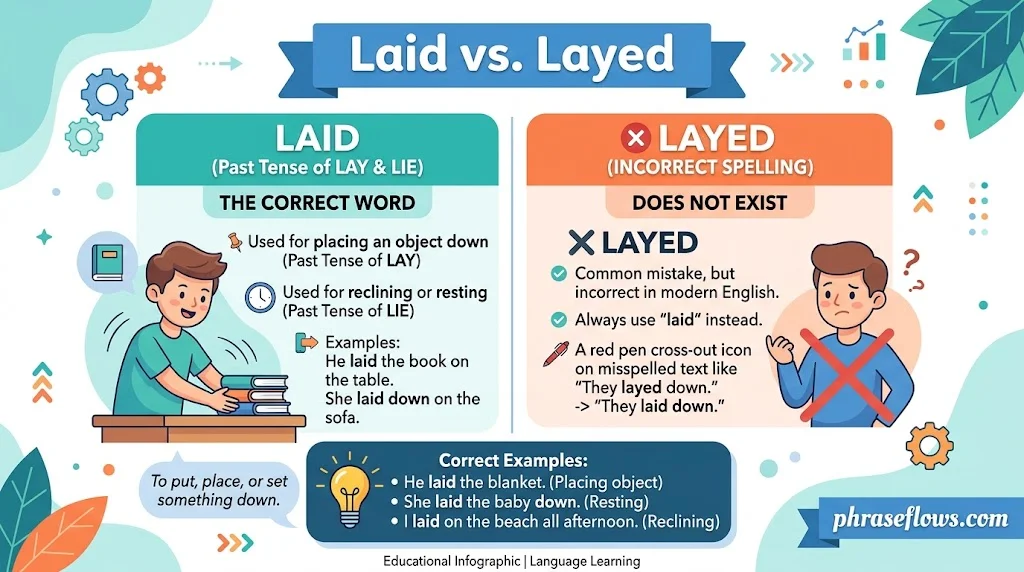

Laid vs. Layed: Difference and Usage in English Grammar is a common topic that causes confusion for English learners. At first glance, layed may look correct because many English verbs form their past tense by adding -ed. However, this pattern is misleading because laid is the correct spelling in standard English.
The difference between laid and layed comes down to spelling and verb forms. Laid is the past tense and past participle of lay, a verb that means to put or place something somewhere. For example, “She laid the book on the table.” In contrast, layed is an incorrect spelling in standard English. Learning this rule helps improve grammar, writing accuracy, and correct word usage.
Another common source of confusion is the difference between lay and lie. The verb lay requires a direct object, as in “He laid the keys on the table,” while lie describes resting without a direct object, as in “I lay on the bed yesterday.” Understanding these verb patterns makes it easier to avoid spelling mistakes in everyday conversations, emails, academic writing, and professional communication.
Laid vs. Layed: The Key Difference
The main difference between laid and layed is that laid is the accepted spelling in standard English, while layed is generally a misspelling when used as the past tense or past participle of lay.
English contains many regular verbs that form their past tense by adding -ed. For example, walk becomes walked, clean becomes cleaned, and play becomes played. However, some verbs are irregular and change form in ways that don’t follow this pattern.
Lay is one of those irregular verbs. Its principal forms are lay, laid, and laid. You must use laid when describing an action that happened in the past or when forming a perfect tense.
| Word | Correctness | Meaning or grammatical role | Example |
| Lay | Correct | Present tense meaning to put something down | I lay the book on the desk. |
| Laid | Correct | Past tense of lay | I laid the book on the desk yesterday. |
| Laid | Correct | Past participle of lay | I have laid the book on the desk. |
| Layed | Generally incorrect | Nonstandard spelling of laid | Incorrect: I layed the book on the desk. |
Remember this simple rule: If you mean that someone placed something somewhere, use laid when describing the past.
For example, write “She laid her bag beside the door,” not “She layed her bag beside the door.”
What Does Laid Mean?
Laid is the simple past tense and past participle of the verb lay. It describes placing, setting, or putting something in a particular position. The word can also appear in expressions with figurative meanings, such as laid the groundwork or laid to rest.
The verb lay is generally transitive, which means it takes a direct object. That object is the person or thing being placed somewhere, arranged, or set down.
Consider this sentence: “Marcus laid the folder on the table.” Marcus performed the action, the folder received the action, and the table identifies where he placed it.
Once you understand this pattern, recognizing the correct use of laid becomes much easier.
Laid as the Past Tense of Lay
Use laid as the simple past tense when someone placed or arranged something in the past. The action may have happened seconds ago, yesterday, or many years earlier.
For example:
- She laid the keys on the kitchen counter.
- The teacher laid the worksheets on each student’s desk.
- We laid the picnic blanket beneath a shady tree.
- He laid his jacket over the back of the chair.
- The construction crew laid the bricks along the garden path.
Each sentence describes a completed action involving an object. The keys, worksheets, blanket, jacket, and bricks are the things being placed.
Compare these examples:
- Correct: Daniel laid the phone beside his laptop.
- Incorrect: Daniel layed the phone beside his laptop.
The second sentence uses the wrong spelling. Because lay is irregular, you cannot form its past tense by simply adding -ed.
Laid as the Past Participle of Lay
The word laid also functions as the past participle of lay. You use this form with auxiliary verbs such as has, have, and had to construct perfect tenses.
The difference depends on how you build the sentence. The simple past describes a completed past action, while the present perfect often connects a past action to the present. The past perfect describes an action completed before another past event.
Examples include:
- She has laid all the documents on the conference table.
- They have laid the new flooring throughout the house.
- I had laid the clothes out before the guests arrived.
- The workers had laid the pipes before the storm began.
- He has laid the groundwork for a successful project.
Notice that laid doesn’t change in these constructions. The auxiliary verb changes to express the tense, while laid remains the past participle.
| Tense | Structure | Example |
| Simple past | Subject + laid | She laid the papers down. |
| Present perfect | Subject + has/have + laid | She has laid the papers down. |
| Past perfect | Subject + had + laid | She had laid the papers down before lunch. |
Grammar tip: Don’t write has layed, have layed, or had layed when you mean the past participle of lay. Use laid in all three constructions.
Common Expressions That Use Laid
The word laid appears in many common English expressions. Some describe physical actions, while others convey figurative meanings that you cannot always understand by looking at each word separately.
Here are several useful examples:
| Expression | Meaning | Example |
| Laid-back | Relaxed and easygoing | Our new teacher has a laid-back personality. |
| Laid off | Had employment ended by an employer, often for business reasons | Several employees were laid off during the restructuring. |
| Laid the groundwork | Prepared the conditions for something to happen | Her research laid the groundwork for future discoveries. |
| Laid to rest | Buried someone or, figuratively, settled a concern | The new evidence laid the rumor to rest. |
| Laid eyes on | Saw someone or something | It was the first time I had laid eyes on the old building. |
These expressions demonstrate how laid works beyond ordinary placement. For example, laying the groundwork for a project doesn’t mean putting soil or equipment on the ground. It means creating a foundation for future progress.
Similarly, laid-back describes a relaxed attitude rather than a physical position. Learning these expressions helps you understand the word in everyday conversation and formal writing.
What Does Layed Mean?
Layed is a spelling that people sometimes use when they assume lay follows the regular past-tense pattern. In standard contemporary English, however, it isn’t the accepted past tense or past participle of lay.
The confusion is understandable. Many English verbs take -ed in the past tense, and layed appears to follow that familiar pattern. Yet English contains irregular verbs that require a different form.
For example, say becomes said, pay becomes paid, and lay becomes laid. These verbs don’t follow the simple pattern that produces played or stayed.
Consider the following sentences:
- Incorrect: She layed the baby gently in the crib.
- Correct: She laid the baby gently in the crib.
- Incorrect: We have layed the carpet in the hallway.
- Correct: We have laid the carpet in the hallway.
The corrected sentences use the established forms of the verb. When writing an email, school assignment, article, report, or business document, choose laid rather than layed.
Why Do People Write Layed Instead of Laid?
Several features of English make this spelling mistake common. Understanding them can help you avoid repeating it.
The regular -ed pattern: Most regular verbs form the past tense by adding -ed. Because lay ends in a vowel sound represented by y, writers sometimes apply the same rule and produce layed.
Confusion with similar words: Lay and lie have overlapping forms, and their meanings sometimes appear in similar situations. This makes it easy to choose the wrong word or spelling.
Pronunciation and spelling habits: In ordinary speech, the distinction between the written forms may not be obvious. Someone who learns a word by hearing it might later guess its spelling incorrectly.
Limited proofreading: Writers who type quickly may not notice the error, particularly when a spellchecker doesn’t flag every nonstandard form.
To prevent the mistake, memorize the verb’s principal forms: lay, laid, laid. Then check whether your sentence describes placing something or reclining yourself.
Is Layed Ever Correct?
In ordinary modern English, laid is the correct form when you intend the past tense or past participle of lay. Therefore, you should generally treat layed as an error in your own writing.
You might still encounter layed in online comments, unedited text, historical material, or quotations that preserve another writer’s original wording. Its appearance in such contexts doesn’t make it the standard spelling.
There is also an important distinction between correcting a spelling mistake and changing a quotation. If you’re quoting someone directly, you may need to preserve the original wording, depending on the purpose and style of your work. Outside such special cases, use laid.
For example:
- Standard English: The team laid the equipment beside the entrance.
- Nonstandard spelling: The team layed the equipment beside the entrance.
The first sentence is appropriate for standard written English. The second uses a spelling you should avoid in edited content.
Laid vs. Layed Examples in Sentences
Examples make the difference between these spellings easier to recognize. The following table covers common situations involving household objects, work, construction, and everyday activities.
| Incorrect sentence | Correct sentence |
| She layed the keys on the counter. | She laid the keys on the counter. |
| He has layed the papers on your desk. | He has laid the papers on your desk. |
| They layed the bricks yesterday. | They laid the bricks yesterday. |
| I had layed my phone beside the bed. | I had laid my phone beside the bed. |
| The gardener layed the tools near the shed. | The gardener laid the tools near the shed. |
| We have layed the foundation for the project. | We have laid the foundation for the project. |
| Maria layed the baby in the crib. | Maria laid the baby in the crib. |
| The workers layed the tiles in the kitchen. | The workers laid the tiles in the kitchen. |
In every corrected sentence, laid expresses the act of placing something. The tense changes according to the surrounding words, but the spelling remains the same.
Everyday Examples of Laid
You can use laid in many ordinary situations. Here are additional examples showing how the word fits naturally into different contexts.
At home:
- Dad laid the newspaper beside his coffee cup.
- I laid the clean towels on the bathroom shelf.
- She laid the blanket across the sofa.
At work or school:
- The manager laid the schedule on the meeting table.
- Our instructor laid out the instructions before the activity began.
- The committee laid the foundation for a new policy.
In construction and design:
- The builders laid the concrete foundation last month.
- The electrician laid the cables beneath the floor.
- The landscaper laid stepping stones across the garden.
In figurative contexts:
- The first experiment laid the groundwork for later research.
- The investigation laid the rumors to rest.
- Their agreement laid the foundation for a stronger partnership.
These examples also show why context matters. Laid can describe a physical action or help express an abstract idea. Either way, its spelling stays the same when it comes from the verb lay.
Laid vs. Lay vs. Lie: Understanding the Difference
Although laid and layed are the main focus, confusion often begins with another pair of words: lay and lie. These verbs have different meanings and different forms, even though some of their forms look alike.
The verb lay generally means to put or place something down. The verb lie generally means to recline or rest in a horizontal position. The crucial difference is that lay normally takes a direct object, while lie doesn’t.
Compare these sentences:
- I lay the book on the table every evening.
- I lie on the couch every evening.
In the first sentence, the book is the object being placed. In the second, the speaker describes their own position.
The past-tense forms create the confusion: lay becomes laid, but lie becomes lay. Once you recognize which action the sentence describes, the correct form becomes easier to select.
Lay, Laid, Laid
The verb lay means to put, place, or set something down. Its principal forms are:
- Present: lay
- Simple past: laid
- Past participle: laid
Examples:
- I lay my notebook on the desk each morning.
- Yesterday, I laid my notebook beside the computer.
- I have laid my notebook in the same place all week.
The direct object in these examples is my notebook. The speaker places the notebook somewhere, so lay is the appropriate verb.
This pattern also applies to phrases such as lay the table, lay a carpet, and lay bricks. In each case, someone places or arranges something.
Lie, Lay, Lain
The verb lie means to recline, rest, or occupy a horizontal position. Its principal forms are different:
- Present: lie
- Simple past: lay
- Past participle: lain
Examples:
- I lie on the sofa when I need a break.
- Yesterday, I lay on the sofa after lunch.
- I have lain on this beach towel for an hour.
In these sentences, the subject changes position without placing a direct object somewhere. That’s why lie is the correct verb.
Notice that the past tense of lie is lay. This creates a sentence that can look confusing at first: “I lay on the bed.” Here, lay means that the person reclined in the past. It doesn’t mean that the person placed an object on the bed.
Quick Comparison of Lay, Laid, and Lie
| Verb form | Meaning | Example |
| Lay | Present tense of placing something | I lay the book on the shelf. |
| Laid | Past tense of lay | I laid the book on the shelf yesterday. |
| Laid | Past participle of lay | I have laid the book on the shelf. |
| Lie | Present tense of reclining | I lie on the couch after work. |
| Lay | Past tense of lie | I lay on the couch yesterday. |
| Lain | Past participle of lie | I have lain on the couch all morning. |
A useful way to remember the distinction is to ask yourself one question: Are you placing something, or are you reclining?
If you’re placing something, use lay in the present and laid in the past. If you’re reclining, use lie in the present, lay in the past, and lain as the past participle.
What About the Verb Lie Meaning to Tell an Untruth?
English has another verb spelled lie, meaning to say something untrue. Its principal forms are lie, lied, lied.
For example:
- I never lie about my homework.
- He lied about where he had been.
- She has lied to her parents before.
This verb differs from lie meaning to recline. The spelling lied belongs to the meaning of telling an untruth, while lay and lain belong to the reclining verb.
The three patterns are worth learning together:
| Meaning | Present | Past | Past participle |
| Put or place something | Lay | Laid | Laid |
| Recline or rest | Lie | Lay | Lain |
| Tell an untruth | Lie | Lied | Lied |
Learning these patterns prevents more than the laid vs. layed error. It also helps you choose the correct verb in sentences where the meaning isn’t immediately obvious.
How to Remember the Difference Between Laid and Layed
The easiest way to remember laid vs. layed is to learn the standard verb forms rather than guessing from the spelling of similar words.
Use these practical methods whenever you write.
Remember the Verb Forms
Memorize this short sequence:
Lay → Laid → Laid
The first form is the present tense, the second is the simple past, and the third is the past participle. You use laid for both past forms.
Try repeating these examples:
- Today, I lay the book on the desk.
- Yesterday, I laid the book on the desk.
- I have laid the book on the desk.
The repeated pattern helps reinforce the correct spelling. Unlike a regular verb such as played, lay doesn’t form its past tense with -ed.
Use the Direct Object Test
When you’re unsure whether to use laid or another verb, identify what the subject is doing.
Ask yourself: What is being placed?
If the sentence answers that question with an object, you’re probably using lay in the relevant sense.
For example:
- “She laid the letter on the counter.” What was placed? The letter.
- “He laid the blanket on the grass.” What was placed? The blanket.
- “They laid the pipes beneath the road.” What was placed? The pipes.
By contrast, “She lay on the bed” describes a person reclining. There’s no direct object receiving the action, so lay is the past tense of lie.
This test is a useful guide, though you should still consider the sentence’s meaning and structure.
Replace the Verb to Check Its Meaning
Another helpful trick is to substitute a simple verb such as put.
If the sentence means that someone put something somewhere, lay or laid is often appropriate.
For example:
- She laid the book on the desk.
- She put the book on the desk.
Both sentences describe the same basic action. The substitution reinforces the correct use of laid.
However, this trick doesn’t work for every expression. You wouldn’t replace “She lay on the sofa” with “She put on the sofa” without changing the meaning. In that sentence, lie describes reclining rather than placing an object.
Read More: Bailer vs. Baler: The Difference, Meaning, and Correct Usage
Common Mistakes to Avoid When Using Laid
Even experienced writers sometimes confuse laid, lay, and lain. Most errors happen because the verbs share similar forms or because writers apply the regular -ed rule to an irregular verb.
Here are the mistakes to watch for.
Using Layed Instead of Laid
This is the central spelling error. Whenever you mean the past tense or past participle of lay, write laid.
- Incorrect: I layed the folder on the shelf.
- Correct: I laid the folder on the shelf.
The same rule applies when an auxiliary verb appears:
- Incorrect: She has layed the documents on the table.
- Correct: She has laid the documents on the table.
Using Laid When You Mean Reclined
Writers sometimes use laid when they want to describe resting or reclining. The distinction depends on whether the subject places something or simply lies down.
- Incorrect for the intended meaning: I laid down for a nap.
- Correct: I lay down for a nap.
However, laid down can be correct when the sentence includes an object.
- Correct: I laid down the book before taking a nap.
In the second example, the speaker placed the book down. The verb has a direct object, so laid is appropriate.
Confusing Laid With Lain
The word lain is the past participle of lie when the verb means to recline. It isn’t interchangeable with laid.
- Incorrect: I have laid on the couch all afternoon.
- Correct: I have lain on the couch all afternoon.
The second sentence describes the speaker’s position rather than an action performed on an object.
Compare it with this sentence:
- Correct: I have laid the blanket on the couch.
Here, laid is correct because the blanket is the object being placed.
Using the Wrong Verb Form After Has, Have, or Had
When you use the verb lay with has, have, or had, the past participle must be laid.
- Incorrect: They had layed the tiles before the inspection.
- Correct: They had laid the tiles before the inspection.
For the reclining verb lie, the corresponding past participle is lain.
- Incorrect: He has lay on the sofa for two hours.
- Correct: He has lain on the sofa for two hours.
A quick review of the verb forms can help you catch these errors before submitting an assignment or publishing an article.
Conclusion:
Understanding laid vs. layed helps you avoid common spelling and grammar mistakes. Laid is the correct past tense and past participle of lay, while layed is an incorrect spelling in standard English. Remember that lay requires a direct object, whereas lie describes resting without an object. Learning these simple rules will improve your writing accuracy and help you use the correct verb in everyday conversations, emails, academic assignments, and professional writing.
FAQs:
1. Is it laid or layed?
Laid is correct in standard English. Layed is a spelling error. For example, “She laid the book on the desk” is correct.
2. What is the past tense of lay?
The past tense of lay is laid. For example, “He lays the keys on the table every day” becomes “He laid the keys on the table yesterday.”
3. Why do people confuse laid and layed?
People often add -ed to verbs to form the past tense, so layed may look right. However, lay is an irregular verb, and its correct past form is laid.
4. What is the difference between lay and lie?
Lay means to put or place something and requires a direct object. Lie means to rest or recline and does not require an object. For example, “I laid the book down” and “I lay down to rest yesterday.”
5. Is laid correct in both American and British English?
Yes, laid is the correct spelling in both American and British English. You should use laid, not layed, in formal writing, academic work, business communication, and everyday conversations.



1 thought on “Laid vs. Layed: Difference and Usage in English Grammar”