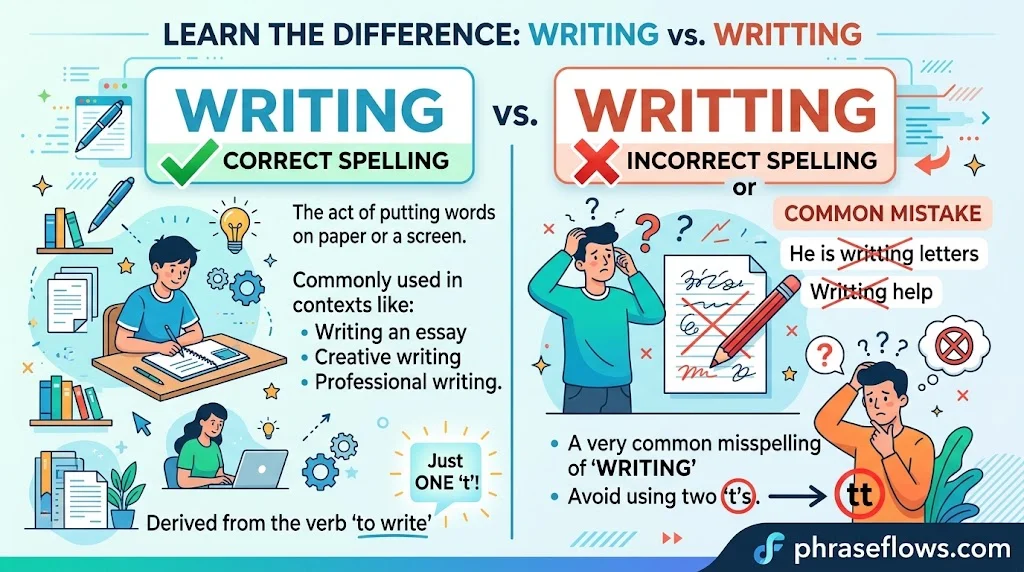

The confusion between writing vs. writting is common among English learners and experienced writers alike. Both words may look correct at first glance because they sound the same when spoken. However, only writing is the correct spelling in standard English. Whether you are writing an email, preparing an assignment, or creating a blog post, using the right spelling helps you communicate clearly and professionally.
The reason behind this spelling mistake is simple. Many people remember words like running and sitting, where the final consonant is doubled before adding -ing. They then assume that write follows the same rule. However, English spelling rules depend on how a word ends. Since write has a silent e, you remove that letter before adding -ing to form writing, not writting.
Understanding the difference between writing and writting can help you avoid common spelling errors and improve your writing skills. By learning this simple rule, practicing correct spelling, and proofreading your work, you can write with greater confidence. In this guide, you will discover why writing is correct, why writting is a mistake, and how to use the word correctly in everyday and formal communication.
Writing vs. Writting: Which Is Correct?
Writing is the correct spelling in standard English. Writting is an incorrect form that results from adding an unnecessary second t. Although people may use this misspelling in informal messages or online searches, it isn’t an accepted alternative spelling.
The correct spelling comes from the verb write. When you add the suffix -ing, you remove the final silent e and attach the ending. You don’t double the letter t.
Here’s a quick comparison:
| Spelling | Correct or Incorrect? | Explanation |
| Writing | Correct | The standard -ing form of write. |
| Writting | Incorrect | Adds an unnecessary second t. |
| Writeing | Incorrect | Keeps the final e before -ing. |
| Write | Correct | The base form of the verb. |
| Wrote | Correct | The simple past tense of write. |
| Written | Correct | The past participle of write. |
For example:
- Correct: She is writing a letter to her teacher.
- Incorrect: She is writting a letter to her teacher.
- Incorrect: She is writeing a letter to her teacher.
Both incorrect versions make the same basic mistake in different ways. The first doubles the t, while the second keeps the silent e.
According to Cambridge Dictionary’s English spelling guide, verbs ending in e generally drop that letter before taking the -ing ending. The guide specifically includes write → writing as an example.
Cambridge Dictionary
What Does Writing Mean?
The word writing refers to the act or skill of expressing ideas, information, feelings, or stories through written language. You can write by hand, type on a keyboard, or use another method to produce written words.
The word comes from the verb write, but its exact role depends on how you use it in a sentence. It can function as a gerund, which acts like a noun, or as a present participle, which helps form verb tenses.
For example, consider these two sentences:
- Writing takes practice. Here, writing acts as a noun and refers to the activity itself.
- Maya is writing a story. Here, writing forms part of the present continuous verb phrase.
Although both sentences use the same word, each gives it a different grammatical function. Understanding this distinction helps you use writing correctly in everyday communication.
Writing as a Gerund
A gerund is a verb form ending in -ing that functions as a noun. It can serve as the subject or object of a sentence, or appear after certain verbs and prepositions.
Consider these examples:
- Writing helps me organize my thoughts.
- Daniel enjoys writing short stories.
- She improved her English through regular writing.
- They talked about writing a book together.
- My favorite hobby is writing.
In the first example, writing names an activity and acts as the subject. In the second, it follows the verb enjoys. In the third, it identifies an activity through which someone improved a skill.
Notice that the spelling stays the same in every example. Whether writing acts as a noun or appears after another verb, you should never change it to writting.
Writing as a Present Participle
A present participle is the -ing form of a verb. It commonly appears in continuous tenses to describe an action that is happening at a particular time.
For example:
- She is writing an email to her manager.
- I am writing my final assignment.
- They were writing notes during the lecture.
- He has been writing articles for several months.
In these sentences, writing works with an auxiliary verb such as am, is, were, or has been. Together, these words describe an ongoing action.
The spelling rule doesn’t change with the tense. Whether you’re writing now, describing something that happened earlier, or discussing an activity that has continued over time, writing remains the correct form.
Why Is Writting Incorrect?
The spelling writting is incorrect because English doesn’t double the final t when forming the -ing form of write. Instead, the word follows the silent e deletion rule.
This mistake often happens when people apply a familiar spelling pattern to the wrong word. For example, sit becomes sitting and run becomes running. Someone who remembers those words might assume that write should become writting.
However, English uses different spelling patterns for different word endings. The verb write already ends in a silent e, so you remove that letter before adding -ing. You don’t need to add another t.
Compare these sentences:
| Incorrect Sentence | Correct Sentence |
| I am writting a report. | I am writing a report. |
| She enjoys writting poems. | She enjoys writing poems. |
| They are writting their homework. | They are writing their homework. |
| He kept writting in his notebook. | He kept writing in his notebook. |
| We were writting a new article. | We were writing a new article. |
The correction is the same every time: replace writting with writing.
This matters in school assignments, job applications, business emails, and published content. A spelling error may distract readers or make a document look less polished. Using the standard form helps you communicate clearly.
Why Does Write Become Writing Instead of Writting?
The difference becomes easier to understand when you look at how English forms words with suffixes. A suffix is a group of letters added to the end of a word to create a new form or change its grammatical role.
In this case, -ing turns the verb write into its present participle or gerund form. However, you must adjust the original spelling before attaching the suffix.
The correct process is:
WRITE
Start with the base verb
Remove the silent e
WRIT + ING
Add the suffix -ing
WRITING
Correct spelling
The process is straightforward: write → writing. You remove the final e and add -ing. The original t remains a single letter.
The Silent E Rule
Many English words end with a silent e. The letter doesn’t usually make a separate sound, but it can influence the pronunciation of the vowel before it. When you add a suffix beginning with a vowel, such as -ing, you often drop the final e.
Here are common examples:
| Base Verb | Correct -ing Form |
| Write | Writing |
| Make | Making |
| Take | Taking |
| Drive | Driving |
| Hope | Hoping |
| Smile | Smiling |
| Dance | Dancing |
| Use | Using |
For example, make becomes making, not makeing. Similarly, hope becomes hoping, not hopeing.
These words follow the same general pattern as write. Learning a few examples can help you recognize the rule when you encounter an unfamiliar verb.
However, English spelling has exceptions. Some words retain the final e to preserve pronunciation or distinguish one word from another. For instance, dye becomes dyeing to distinguish it from dying, the -ing form of die. Therefore, it’s helpful to learn the general rule alongside common exceptions.
Cambridge Dictionary
+1
When Do You Double the Final Consonant?
The consonant-doubling rule explains why some verbs take two identical consonants before -ing. In many short verbs that end in a consonant-vowel-consonant pattern, the final consonant doubles when you add a suffix such as -ing.
For example:
| Base Verb | Correct -ing Form |
| Sit | Sitting |
| Run | Running |
| Stop | Stopping |
| Get | Getting |
| Plan | Planning |
| Write | Writing |
The first five verbs follow a consonant-doubling pattern. The final consonant doubles in each case. Write, however, ends in a silent e, so it follows a different rule.
Remember this useful distinction:
- Silent e: Remove the final e before adding -ing in forms such as write → writing.
- Consonant doubling: Double the final consonant in forms such as sit → sitting.
You shouldn’t combine the two patterns. Doing so creates the incorrect spelling writting.
Writing vs. Writting Examples in Sentences
Examples make spelling rules easier to apply because they show how a word works in real situations. The following sentences demonstrate the correct use of writing in academic, professional, and everyday contexts.
Correct Usage of Writing
Use writing whenever you refer to the activity of writing or describe an ongoing action involving the verb write.
Academic examples
- Sarah is writing an essay about climate change.
- The students spent an hour writing their answers.
- Regular writing helps learners organize their ideas.
- He has been writing his research paper all week.
Professional examples
- I’m writing an email to confirm the meeting.
- Our team is writing a report for the client.
- She specializes in writing clear product descriptions.
- The editor is writing notes for the next revision.
Everyday examples
- My brother enjoys writing in his journal.
- I’m writing a birthday card for my friend.
- He was writing a shopping list when I called.
- They spent the afternoon writing songs together.
Each sentence uses the same standard spelling. The context changes, but the word doesn’t.
Incorrect Usage of Writting
The following examples show mistakes you should avoid. Each incorrect sentence includes the corrected version.
| Incorrect | Correct |
| She is writting a novel. | She is writing a novel. |
| I enjoy writting stories. | I enjoy writing stories. |
| He was writting a letter. | He was writing a letter. |
| We are writting an article. | We are writing an article. |
| Writting takes patience. | Writing takes patience. |
The best way to catch this error is to check the word’s base form. If the verb is write, its -ing form is writing. You don’t need to double the t.
A Practical Case Study: Correcting a School Assignment
Imagine a student submits this paragraph:
I enjoy writting stories because it helps me express my ideas. Last weekend, I was writting a short story about a family adventure.
The paragraph communicates its meaning clearly, but it contains the same spelling mistake twice. Correcting those errors produces a more polished version:
I enjoy writing stories because it helps me express my ideas. Last weekend, I was writing a short story about a family adventure.
What can you learn from this example? First, a spelling mistake can appear more than once in the same piece of writing. Second, checking the base verb can help you correct every occurrence. Finally, proofreading is most effective when you look for specific patterns rather than reading only for meaning.
This is a simple example, but the same technique works when reviewing emails, reports, essays, and website content.
Common Words Related to Write and Writing
The verb write has several forms, and each one serves a different purpose. Learning these forms can help you avoid spelling mistakes beyond the writing vs. writting confusion.
| Verb Form | Correct Spelling | Example |
| Base form | Write | I write in my journal daily. |
| Third-person singular | Writes | She writes excellent stories. |
| Simple past tense | Wrote | He wrote a letter yesterday. |
| Past participle | Written | I have written three pages. |
| Present participle | Writing | They are writing an essay. |
Notice that writing, wrote, and written have different spellings. You can’t swap them freely because each form has its own grammatical role.
For example, you would say, “She is writing a letter,” rather than “She is wrote a letter.” The first sentence describes an ongoing action, while the second uses the wrong verb form for that structure.
Similarly, written appears with auxiliary verbs in sentences such as “She has written a letter.” Understanding these distinctions helps you choose the correct form based on the meaning you want to express.
Writing vs. Writting: Is There a British or American Difference?
Some English words have different spellings in British and American English. For example, British English generally uses colour and centre, while American English uses color and center.
However, writing is spelled the same way in both varieties of English. Neither British nor American English accepts writting as a standard alternative.
| British English | American English |
| Writing | Writing |
| Color / colour: colour | Color |
| Center / centre: centre | Center |
| Traveling / travelling: travelling is common | Traveling |
| Organize | Organize |
The examples in the table illustrate genuine regional differences, except for writing, which remains unchanged. Some words also vary according to publishing style or dictionary preference.
Therefore, you don’t need to worry about regional spelling preferences when choosing between writing and writting. Writing is correct regardless of your preferred variety of English.
Read More: Laid vs. Layed: Difference and Usage in English Grammar
How to Remember the Correct Spelling of Writing
You don’t need to memorize a long grammar lesson to remember this word. A few simple techniques can help you spell it correctly whenever you write.
Remember the Silent E Rule
The easiest trick is to remember this transformation:
Write → Writing
Remove the final e and add -ing. Don’t double the t.
You can reinforce the pattern with similar words:
- Make → Making
- Take → Taking
- Drive → Driving
- Hope → Hoping
- Write → Writing
When you see a verb ending in a silent e, consider whether the suffix requires you to remove that letter. This habit can prevent many common spelling mistakes.
Compare Writing With Sitting
Another useful technique is to compare words that follow different spelling patterns.
| Word | Spelling Change | Correct Form |
| Write | Drop final e | Writing |
| Sit | Double final t | Sitting |
| Run | Double final n | Running |
| Make | Drop final e | Making |
| Stop | Double final p | Stopping |
This comparison helps you recognize why writing doesn’t need a second t. The correct spelling depends on the base verb and its spelling pattern.
Proofread Before Submitting Your Work
Even experienced writers make typing mistakes. A quick review can help you catch errors before you submit an assignment, send an email, or publish an article.
Try these practical steps:
- Check the base verb: Ask yourself whether the original word is write.
- Look at the ending: Confirm that the final e has disappeared before -ing.
- Search for repeated mistakes: Use your document’s search feature to locate instances of writting.
- Use a spell-checker: Tools in common word processors can flag many misspellings.
- Read the sentence again: Confirm that the spelling and grammar fit the intended meaning.
Spell-checking tools can be helpful, but they shouldn’t replace careful proofreading. They may miss errors when a misspelled word resembles another valid word.
Common Mistakes to Avoid When Using Writing
Understanding the correct spelling is only part of the process. You should also recognize the mistakes that commonly lead to incorrect forms.
Doubling the T Unnecessarily
The most obvious error is writing writting instead of writing. This usually happens when someone applies the consonant-doubling pattern from words such as sitting and running.
To avoid it, remember that write ends in a silent e. Remove that letter before adding -ing.
Keeping the Final E
Another common mistake is writing writeing. This form preserves the final e even though the standard spelling rule calls for removing it.
For example:
- Incorrect: I am writeing a report.
- Correct: I am writing a report.
The same principle applies to many other verbs, including make, take, and drive.
Confusing Writing With Written
Although writing and written come from the same base verb, they serve different grammatical functions.
- Writing: She is writing a story.
- Written: She has written a story.
- Wrote: She wrote a story yesterday.
Choose the form that matches the sentence structure. Adding an extra t to writing won’t make it equivalent to written.
Conclusion:
The correct spelling is writing, while writting is a common spelling mistake. The difference comes from a simple English spelling rule: when adding -ing to write, remove the silent e instead of doubling the final consonant. Remembering this rule can help you avoid spelling errors in emails, school assignments, blog posts, and professional documents. With regular practice and proofreading, you can use writing correctly and communicate with greater confidence.
FAQs:
1. Is it writing or writting?
Writing is the correct spelling. Writting is incorrect and is not accepted in standard English.
2. Why is writing spelled with one t?
The verb write ends in a silent e. You remove the e before adding -ing, giving you writing. You do not double the t.
3. What is the difference between writing and writting?
Writing is the correct form of the verb write with the -ing ending. Writting is a spelling error and should not be used in formal or standard writing.
4. Why do people spell writing as writting?
People often confuse the spelling with words such as running and sitting, which double their final consonants before adding -ing. However, write follows a different spelling rule.
5. What is the root word of writing?
The root word is write, a verb meaning to form words, letters, or symbols to communicate information.




1 thought on “Writing vs. Writting: Which Is the Correct Spelling?”