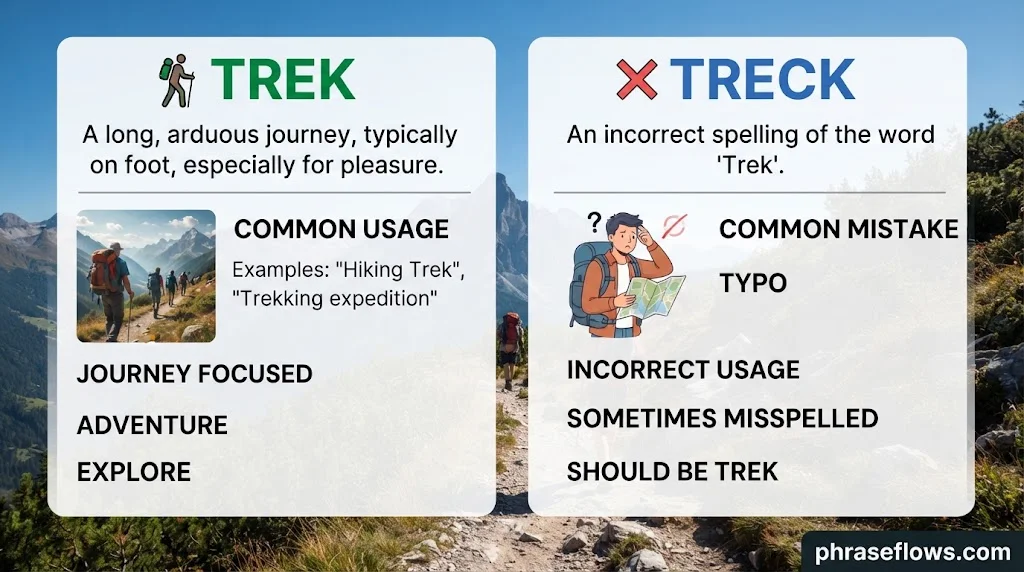

Many English learners pause when they see Trek vs Treck because the two spellings look and sound almost the same. The difference is only one letter, but that small change matters in written English. Trek is the correct spelling, while Treck is generally an incorrect spelling. This confusion often appears in casual writing, online searches, social media posts, and travel-related content.
The word trek has a clear meaning and is commonly used for a long or difficult journey, especially one involving hiking, exploration, or outdoor travel. You may see it in travel blogs, adventure guides, academic writing, and everyday communication. Understanding the correct spelling can help English learners, students, bloggers, and travel writers improve their writing accuracy and avoid a common spelling mistake.
In this guide, you’ll learn the difference between Trek and Treck, understand the correct usage, and see practical examples that make the distinction easy to remember. We’ll also look at why people confuse these spellings and how choosing the right word can make your writing clearer, more natural, and more confident.
Trek vs Treck: Which One Is Correct?
Trek is the correct standard spelling. When you mean a long, tiring, or difficult journey or walk, use trek.
| Word | Correct for this meaning? | Part of speech | Example |
| Trek | Yes | Noun/verb | We went on a mountain trek. |
| Treck | No | — | Treck is generally a misspelling of trek. |
| Trekked | Yes | Past tense/past participle | They trekked through the forest. |
| Trekking | Yes | Present participle/gerund | She enjoys trekking. |
| Treks | Yes | Plural noun/verb | Several treks leave from the village. |
So, if you’re writing “We went on a long treck,” the correct version is:
We went on a long trek.
The important point is that treck isn’t simply an alternative spelling of trek in standard modern English. Adding the c doesn’t create a different accepted form with the same meaning.
What Does Trek Mean?
The word trek describes a long journey or walk that usually requires some effort. It often brings to mind mountains, forests, remote trails, or challenging terrain.
However, the word doesn’t have to describe an outdoor adventure. In informal English, people also use trek for an ordinary journey that feels long or tiring.
For example:
- The hikers began their trek before sunrise.
- It was a difficult trek through the mountains.
- The cabin is a three-hour trek from the nearest road.
- Getting to the other side of the city was quite a trek.
- They trekked through the forest for several hours.
Cambridge Dictionary defines trek as a long walk, especially across difficult terrain such as hills, mountains, or forests. It also recognizes the informal use for a long or tiring walk. Cambridge Dictionary: Trek
Trek as a Noun
As a noun, trek names the journey itself.
Consider this sentence:
The trek to the mountain village took six hours.
Here, trek refers to the journey.
You can use the word with many descriptive terms:
- long trek
- difficult trek
- mountain trek
- challenging trek
- overnight trek
- remote trek
- forest trek
- two-day trek
The noun can also appear in everyday conversation:
The walk from the parking lot to the stadium was a trek.
This doesn’t necessarily mean the person was hiking. It simply emphasizes that the distance felt considerable.
Trek as a Verb
Trek can also function as a verb. In this form, it means to travel or walk a long distance, often under challenging conditions.
For example:
- We trekked through the hills.
- They trekked across the valley.
- The group trekked into the forest.
- She trekked along the mountain trail.
- The explorers trekked toward the remote settlement.
The surrounding words help establish the route or destination.
The hikers trekked across the rocky landscape.
In this sentence, trekked describes the action of traveling through the landscape.
What Does Treck Mean?
When someone writes treck while referring to a long journey or walk, they normally mean trek.
In standard English, treck isn’t the accepted spelling for this definition. That’s why dictionaries such as Cambridge list trek rather than treck for this meaning.
The mistake is understandable. English contains many familiar words ending in -ck, including track, back, pack, and check. That pattern can make treck look convincing.
Still, spelling patterns aren’t always predictable in English.
Is Treck a Word?
The safest answer is: don’t use “treck” as a replacement for “trek” in standard English.
If you’re writing an essay, article, school assignment, travel description, email, or other formal text, choose trek.
For example:
Incorrect for the intended meaning:
We completed a difficult treck through the mountains.
Correct:
We completed a difficult trek through the mountains.
The same correction applies to related forms. You should write trekking, not trecking, and trekked, not trecked.
Trek vs Treck: Key Differences
The difference between trek vs treck is mainly a matter of standard spelling and usage.
| Feature | Trek | Treck |
| Standard spelling | Yes | No, for this meaning |
| Means a long journey/walk | Yes | Not as a standard form |
| Noun | Yes | No |
| Verb | Yes | No |
| Past tense | Trekked | Trecked is incorrect for trek |
| -ing form | Trekking | Trecking is incorrect for trek |
| Recommended in formal writing | Yes | No |
The distinction is straightforward: trek is the established English word.
Trek vs Treck in Different Parts of Speech
One reason the word causes confusion is that its spelling changes when you add certain endings.
Noun: Trek
As a noun, trek refers to the journey itself.
The trek through the mountains lasted all day.
Verb: Trek
As a verb, trek describes the act of traveling.
We trek through the hills every summer.
Past Tense: Trekked
The past tense is trekked.
The team trekked through the valley yesterday.
Notice that the k doubles before the -ed ending.
Present Participle: Trekking
The -ing form is trekking.
They are trekking through the national park.
Again, the k doubles.
Plural: Treks
The plural noun is simply treks.
The guide leads several treks each year.
This gives you an easy reference:
trek → treks → trekked → trekking
Not:
treck → trecks → trecked → trecking
Why Is It “Trekked” and “Trekking” Instead of “Trecked” and “Trecking”?
This is one of the most useful spelling points to understand.
When you add -ed or -ing to trek, the final consonant k doubles:
- trek + ed → trekked
- trek + ing → trekking
The extra k doesn’t mean the word contains a c. In fact, the correct spelling still contains no c.
This follows a common English spelling pattern involving short words that end in a single consonant after a stressed vowel. Similar patterns appear in words such as:
- stop → stopped
- run → running
- plan → planned
- shop → shopping
- swim → swimming
The exact spelling rules have exceptions, but trek follows the familiar doubling pattern.
Cambridge Dictionary gives trekked as the past form and trekking as the present participle of trek. Cambridge Dictionary: Trek
A Quick Spelling Trick
Think of the word as a family:
TREK → TREKKED → TREKKING
The K does the doubling when necessary. A C never appears.
That’s a more reliable memory aid than trying to remember treck as a possible spelling.
Examples of Trek in Sentences
Seeing the word in different contexts makes its meaning much clearer.
Trek as a Long Walk
The final trek to the summit was harder than expected.
Here, trek refers to a physically demanding walk.
Trek as a Journey
The remote village is a day’s trek from the main road.
The word emphasizes the distance and effort involved.
Trek as a Verb
The researchers trekked through the forest to reach the study site.
Here, trekked describes the act of traveling.
Trek in Everyday Conversation
The bus stop is a bit of a trek from my house.
This use is less adventurous. The speaker simply means the bus stop is a fairly long walk away.
Trek in Figurative Language
Completing the long project felt like a trek through unfamiliar territory.
Writers can use trek figuratively to describe a demanding process or extended experience.
The underlying idea remains the same: a journey that takes time or effort.
Incorrect Examples With Treck
If you’re unsure whether you’ve used the right spelling, look for the letter c.
| Incorrect | Correct |
| We went on a mountain treck. | We went on a mountain trek. |
| The treck lasted five hours. | The trek lasted five hours. |
| They trecked across the valley. | They trekked across the valley. |
| She enjoys trecking in the hills. | She enjoys trekking in the hills. |
| Several trecks leave every morning. | Several treks leave every morning. |
The correction isn’t complicated. Remove the c and use the standard form of trek.
Trek vs Hike: Are They the Same?
Trek and hike overlap in meaning, but they aren’t always interchangeable.
A hike usually means a walk, especially one taken outdoors for exercise or enjoyment. A trek often puts more emphasis on the length, difficulty, or demanding nature of the journey.
Compare these examples:
We went on a short hike around the lake.
This sounds like a relatively ordinary recreational walk.
We went on a three-day trek through the mountains.
The second sentence suggests a longer and more demanding journey.
The distinction isn’t absolute. A long hike can certainly be described as a trek. Context determines which word sounds most natural.
Cambridge’s thesaurus groups trek with words including hike while maintaining the idea of a long or difficult walk. Cambridge Thesaurus: Trek
Trek vs Journey: What’s the Difference?
Journey is the broader word.
A journey can happen by:
- car
- bus
- train
- plane
- boat
- bicycle
- foot
A trek tends to suggest a long, demanding, or tiring journey, particularly one involving walking.
For example:
Our journey from Chicago to Denver took most of the day.
This doesn’t imply that anyone walked.
But:
The final trek to the campsite took three hours.
That wording creates a stronger impression of physical effort.
So while a trek can be a journey, not every journey is a trek.
Common Words Related to Trek
The word has several useful forms and combinations.
Trekking
Trekking refers to the activity of making long walks or journeys, often outdoors.
Trekking through the mountains requires careful planning.
Trekker
A trekker is someone who goes on treks.
The trail attracts experienced trekkers from around the world.
Trekking Trail
A trekking trail is a route used for long-distance walking or hiking.
Mountain Trek
A mountain trek is a trek involving mountainous terrain.
Long Trek
A long trek emphasizes the distance or duration of the journey.
These combinations show why learning the base spelling matters. Once you know trek, many related expressions become easy to spell.
Common Mistakes With Trek
Mistake: Writing Treck Instead of Trek
This is the most common error.
Wrong: treck
Right: trek
Don’t add the c.
Mistake: Writing Trecking
Because treck looks like a plausible base word, some writers extend the error.
Wrong: trecking
Right: trekking
The correct spelling doubles the k.
Mistake: Writing Trecked
The past tense follows the same pattern.
Wrong: trecked
Right: trekked
Mistake: Confusing Trek With Track
Trek and track are completely different words.
Track can refer to a path, route, mark, or the act of following something.
Trek refers to a long or difficult journey or walk.
For example:
We followed the track through the woods.
We went on a three-hour trek through the woods.
The two words can appear in the same sentence:
The hikers followed the narrow track during their long trek.
Mistake: Treating Trek and Travel as Exact Synonyms
Travel is much broader than trek.
You can travel across a country by plane. You can travel to work by car. Neither necessarily involves a trek.
Use trek when the idea of a lengthy or demanding journey matters.
Trek in Travel and Outdoor Writing
The word trek appears frequently in descriptions of outdoor activities because it conveys more than simple movement.
Compare:
We walked to the campsite.
with:
We made a long trek to the campsite.
The second sentence gives the reader a stronger sense of distance and effort.
Travel writers often use trek when describing journeys through mountains, forests, deserts, and other challenging environments. The word can make a route sound more demanding without requiring exaggerated language.
For example, a travel description might mention a multi-day trek, a high-altitude trek, or a remote mountain trek.
That makes trek particularly useful when the journey itself is an important part of the experience.
Read More: Wise vs. Wize: Usage and Mistakes Explained
How to Remember the Correct Spelling of Trek
A simple memory trick can save you from the trek vs treck mistake.
Remember:
A trek needs no C.
Then connect it with its common forms:
trek → trekked → trekking
If you see an extra c, stop and check the spelling.
Another useful approach is to associate trek with trekking. You probably recognize trekking as the standard spelling. Once you remove -king, the base word becomes trek.
Trek vs Treck: Quick Decision Guide
Use this quick guide whenever you’re unsure.
- Talking about a long walk? Use trek.
- Describing a difficult journey? Use trek.
- Talking about the activity? Use trekking.
- Describing something that happened in the past? Use trekked.
- Talking about more than one? Use treks.
- Thinking about writing treck? Change it to trek.
The Simple Rule
Trek is correct. Treck is not the standard spelling for this meaning.
That’s the entire spelling distinction in one sentence.
Conclusion:
The correct spelling is trek, not treck. A trek usually refers to a long or difficult journey, especially one involving hiking, exploration, or outdoor activities. Although “treck” may appear in online searches, casual writing, or social media, it is generally considered a spelling mistake in standard English.
Remembering this simple difference can improve your writing accuracy and help you avoid confusion in professional, academic, and everyday writing. Whenever you need the word for a journey or challenging trip, choose trek with confidence.
FAQs:
Is “treck” a correct English word?
No. Treck is generally considered an incorrect spelling. The standard English spelling is trek.
What does “trek” mean?
Trek means a long or difficult journey, especially one made on foot. It is often used when talking about hiking, travel, exploration, and outdoor activities.
Is it “trek” or “treck”?
The correct spelling is trek. You should use “trek” in formal, academic, professional, and everyday writing.
Why do people spell trek as “treck”?
The mistake probably happens because trek and “treck” look and sound similar. Some writers may add an extra c because of familiar English spelling patterns.
Can I use “treck” in casual writing?
It is better to avoid “treck” even in casual writing. Use trek to keep your spelling accurate and your writing clear.




1 thought on “Trek vs Treck: Which Spelling Is Correct? Meaning, Usage, and Examples”