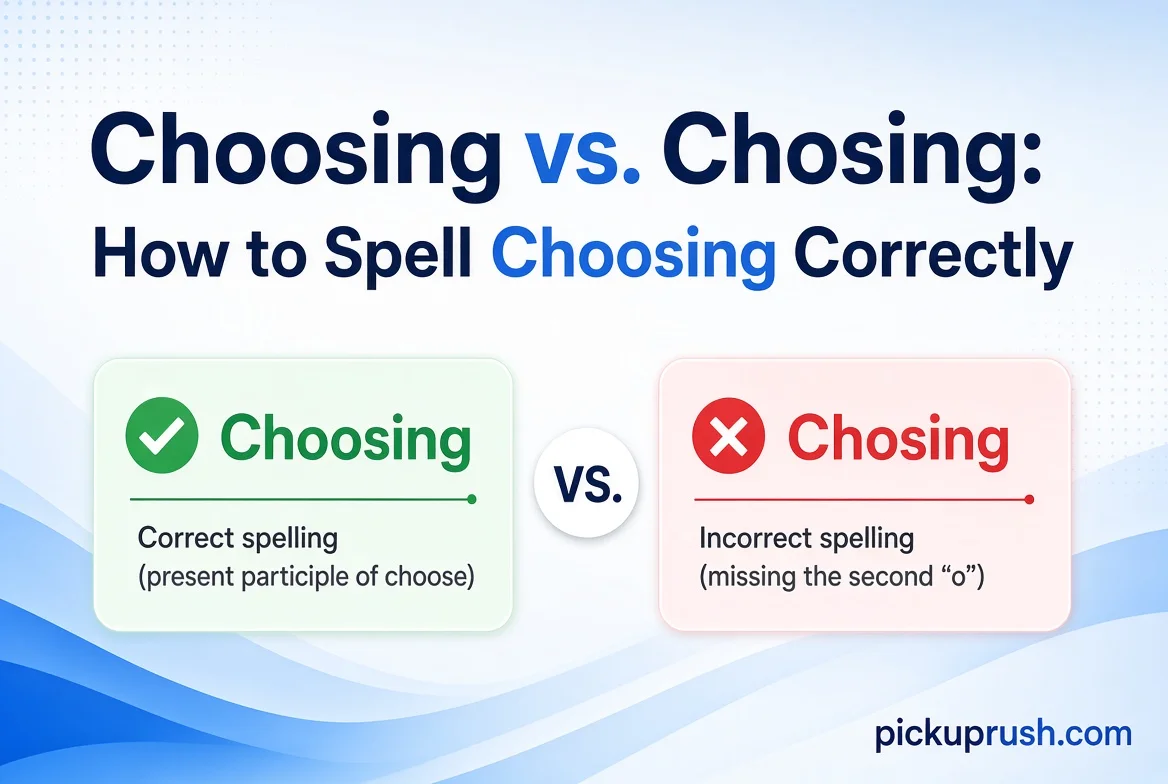

Have you ever paused while writing and wondered whether choosing or chosing is the correct spelling? You’re not alone. Choosing vs. Chosing: How to Spell Choosing Correctly is a common spelling question because both forms look similar at first glance. However, only choosing is correct in standard English, while chosing is a common misspelling.
The confusion usually comes from the word chose, which is the past tense of choose. Since chose has one “o,” it can seem natural to assume that adding -ing should create “chosing.” But English word formation works differently here. The correct present participle is choosing, because it is formed from the base verb choose, which keeps both “o” letters before the -ing suffix is added.
Knowing this small spelling difference can make your writing clearer and more accurate. In this guide, you’ll learn the meaning, pronunciation, verb forms, and proper usage of choosing, along with practical examples that show how it works in real sentences. Once you understand the connection between choose, chose, and choosing, this common spelling confusion becomes much easier to avoid.
Choosing vs. Chosing: Which Spelling Is Correct?
The correct spelling is choosing.
Chosing is incorrect in standard English. It doesn’t represent a separate word or a different grammatical form. Instead, it’s usually a spelling mistake caused by dropping one of the two o’s in choose.
Compare the forms:
- Correct: choosing
- Incorrect: chosing
The spelling becomes easier to understand when you start with the base verb:
choose + -ing = choosing
The oo in choose remains in the word. The final silent e disappears before the -ing ending is added.
| Form | Correct? | Explanation |
| choosing | ✅ Yes | Correct -ing form of choose |
| chosing | ❌ No | Common misspelling |
| chooseing | ❌ No | Incorrectly keeps the final e |
| chooshing | ❌ No | Adds an unnecessary h |
| choossing | ❌ No | Adds an unnecessary s |
This distinction matters because choosing appears frequently in everyday English. You might talk about choosing a meal, choosing a college, choosing a career, choosing a color, or choosing between two possibilities.
Why Is “Choosing” Spelled With Two O’s?
The spelling of choosing comes directly from the verb choose.
When you add -ing to a verb ending in a silent e, English often drops that final e.
For example:
- make → making
- write → writing
- take → taking
- decide → deciding
- choose → choosing
Notice what happens with choose. The final e disappears, but the oo stays.
So:
choose → choos + ing → choosing
The spelling doesn’t become chosing because the two o’s aren’t part of the silent-e ending. They belong to the core spelling of choose.
This small distinction explains the entire spelling issue.
The spelling pattern behind choosing
A useful way to remember the word is to separate the base word from its ending:
CHOOSE
Remove the final e:
CHOOS
Add -ING:
CHOOSING
That gives you the correct form.
A common mistake is to think that the word loses an extra letter when the -ing ending arrives. It doesn’t. Only the final e disappears.
Memory rule: Keep the oo from choose, drop only the final e, and add -ing.
This rule also helps prevent another common error: chooseing. Since the final e is silent, it doesn’t remain before -ing.
Choosing: Meaning and Definition
Choosing is the -ing form of the verb choose. It refers to the act of selecting or deciding between possibilities.
When you choose something, you select it from available options. When you’re choosing, the selection process is happening or is being discussed as an activity.
For example:
- I am choosing a new backpack.
- She is choosing between two universities.
- Choosing the right words can change the meaning of a sentence.
- They spent an hour choosing a movie.
The word can describe both a physical selection and a decision.
You can choose a shirt from several shirts. You can also choose to study instead of playing games. In the second case, choosing describes a decision or course of action.
Common meanings of choosing
Depending on context, choosing can involve:
- Selecting an object: choosing a book
- Making a decision: choosing what to do
- Selecting between alternatives: choosing between two options
- Expressing a preference: choosing tea over coffee
- Deciding on an action: choosing to stay
- Making a long-term decision: choosing a career
The underlying idea remains the same: selecting one possibility from others.
How to Use “Choosing” in a Sentence
You can use choosing in several grammatical structures. Understanding these patterns makes the word easier to use naturally.
Choosing as part of a continuous verb
One common use appears with forms of be, such as am, is, are, was, and were.
Examples:
- I am choosing a birthday gift.
- He is choosing a seat.
- We are choosing our team members.
- They were choosing which route to take.
Here, choosing forms part of the verb phrase and describes an action in progress.
Choosing as a gerund
Choosing can also function as a gerund, which means an -ing form acting as a noun.
For example:
Choosing carefully can prevent mistakes.
In this sentence, choosing carefully acts as the subject.
More examples include:
- Choosing a topic was harder than expected.
- Choosing between the two options took time.
- Choosing the right words requires care.
- Choosing wisely can save money.
Although the word still comes from the verb choose, its role in these sentences is noun-like.
Choosing with “to”
English commonly uses choosing to + verb when someone decides to take a particular action.
Examples:
- She is choosing to study at home.
- He is choosing to wait.
- They are choosing to work together.
- I am choosing to focus on the most important task.
The structure is:
choosing + to + base verb
So you might write choosing to stay, but not choosing to staying.
Choosing between options
Another frequent structure is choosing between.
Examples:
- I’m choosing between two jackets.
- She had trouble choosing between the two answers.
- We spent the afternoon choosing between several destinations.
You can also use choosing A over B when one option wins out against another.
- He is choosing quality over price.
- She chose experience over convenience.
Choosing vs. Choose vs. Chose vs. Chosen
The word choosing belongs to a group of forms that come from the irregular verb choose. Because choose doesn’t follow the regular -ed pattern in the past tense, learners sometimes mix these forms up.
Here’s the difference:
| Word | Grammatical role | Example |
| choose | Base/present form | I choose the blue notebook. |
| choosing | Present participle/gerund | I am choosing the blue notebook. |
| chose | Simple past | I chose the blue notebook yesterday. |
| chosen | Past participle | I have chosen the blue notebook. |
These forms have different jobs.
Choose refers to the base or present form:
I usually choose the window seat.
Choosing describes an ongoing action or functions as a gerund:
I am choosing a window seat.
Chose is the simple past:
I chose the window seat yesterday.
Chosen is the past participle and usually appears with an auxiliary verb:
I have chosen the window seat.
One useful point stands out: choosing and chose aren’t interchangeable. Their spellings may look related, but their grammatical functions differ.
Choosing vs. Chosing: Common Spelling Mistakes
The most common error is simply dropping one o:
chosing ❌
The correct form is:
choosing ✅
However, other variations can appear when someone tries to spell the word based on pronunciation or an incorrect spelling rule.
Common incorrect forms
- chosing ❌
- chooseing ❌
- chooshing ❌
- choossing ❌
- choosing ✅
The safest approach isn’t to memorize every incorrect version. Remember the correct transformation instead:
choose → choosing
Once you know that pattern, the incorrect forms become easy to spot.
Choosing vs. Chosing: Quick Comparison
| Feature | Choosing | Chosing |
| Standard spelling | Yes | No |
| Comes from choose | Yes | Intended to, but misspelled |
| Uses oo | Yes | No |
| Uses -ing | Yes | Yes, incorrectly |
| Suitable for formal writing | Yes | No |
| Used in standard American English | Yes | No |
| Example | She is choosing a dress. | Incorrect spelling |
There isn’t a meaning difference between these two forms because chosing isn’t a standard alternative to choosing.
If you see chosing in an email, essay, article, or message, the writer almost certainly intended choosing.
Easy Ways to Remember the Correct Spelling of Choosing
A small spelling trick can save you from repeatedly checking the word.
Start with:
CHOOSE
Now remove only the final E:
CHOOS
Then add:
ING
The result is:
CHOOSING
The important part is OO. Think of it as a pair that stays together.
A simple memory trick
Remember this phrase:
“Choose keeps its two O’s when choosing.”
The phrase connects the base word with its -ing form.
You can also remember the three-step pattern:
choose → choos → choosing
Don’t remove either o. Don’t keep the final e. Just remove the silent e and add -ing.
Why pronunciation can cause confusion
English spelling doesn’t always match pronunciation letter for letter. That’s one reason choosing can feel less obvious when you hear it than when you see it.
The oo sound in choose remains connected to the spelling. When people write quickly, they may focus on how the word sounds rather than how its base form is spelled.
For spelling accuracy, however, pronunciation shouldn’t replace the written pattern.
Choosing in American English
In American English, choosing is the standard spelling.
You won’t normally find chosing listed as a separate standard spelling in major English dictionaries. For authoritative definitions and usage information, you can check resources such as Merriam-Webster’s entry for “choose” and Cambridge Dictionary’s entry for “choose”.
The correct spelling remains the same across ordinary writing situations.
You’ll use choosing in:
- School assignments
- Essays
- Emails
- Workplace documents
- Applications
- Online articles
- Text messages
- Social media posts
- Professional communication
Of course, informal digital writing contains plenty of typos. That doesn’t turn chosing into an accepted alternative.
Why correct spelling matters
A single missing letter usually doesn’t prevent someone from understanding your meaning. Still, repeated spelling errors can distract readers and make polished writing look rushed.
Imagine a resume containing:
“Responsible for chosing suppliers.”
The meaning is obvious. Yet the spelling error is avoidable.
The polished version is:
“Responsible for choosing suppliers.”
The difference is only one letter, but accuracy matters when you’re presenting your writing professionally.
Choosing in Everyday English: Examples
Because choosing describes selection and decision-making, you’ll encounter it in countless situations.
School and education
- Choosing a research topic can take time.
- Students are choosing their project partners.
- She is choosing which class to take next semester.
Shopping
- I’m choosing between two pairs of shoes.
- He spent several minutes choosing a laptop.
- Choosing a product based only on price isn’t always wise.
Food
- We are choosing what to order for lunch.
- She had difficulty choosing between the two desserts.
- Choosing fresh ingredients can improve a meal.
Work
- The manager is choosing a new software system.
- Choosing the right candidate requires careful review.
- The team is choosing between several possible solutions.
Everyday decisions
- I’m choosing to stay home tonight.
- They are choosing a different route.
- Choosing what to watch shouldn’t take an hour!
These examples show that choosing works naturally in both casual and formal contexts.
A Closer Look at the Grammar of “Choosing”
From a grammatical perspective, choosing is a present participle when it forms part of a progressive verb construction.
For example:
She is choosing a new phone.
Here, is choosing is the verb phrase. The action is presented as ongoing.
However, choosing can also act as a gerund:
Choosing a new phone can be difficult.
In that sentence, choosing a new phone functions as the subject.
This distinction is useful because the same -ing form can serve different grammatical purposes.
Choosing as a participle
They are choosing a restaurant.
Choosing as a gerund
Choosing a restaurant took longer than expected.
The spelling stays exactly the same in both cases.
Choosing vs. Chosing: A Practical Case Study
Consider a student writing this sentence:
“I am chosing a topic for my presentation.”
The intended meaning is perfectly clear. The problem lies in the spelling.
The student started with choose but removed too much before adding -ing. The correct transformation is:
choose → choosing
Therefore, the corrected sentence becomes:
“I am choosing a topic for my presentation.”
Now consider a different sentence:
“Choosing a topic for a presentation can be difficult.”
Here, choosing works as a gerund and serves as the subject of the sentence.
This example demonstrates an important point: once you learn the correct spelling, you can use choosing across several grammatical structures without changing its spelling.
Read More: Unaffected vs. Uneffected: Which Word to Use Correctly?
Facts About the Word “Choosing”
A few quick facts make the distinction easier to remember:
- Choosing comes from the verb choose.
- Choose is an irregular verb.
- The simple past form is chose.
- The past participle is chosen.
- Choosing is the correct -ing form.
- The spelling retains the oo from choose.
- The final silent e in choose drops before -ing.
- Chosing is a common misspelling.
- Choosing works as both a present participle and a gerund.
- The correct spelling is the same in standard American English.
Conclusion:
Choosing is the correct spelling, while chosing is a common misspelling that should be avoided in standard English. The confusion mainly comes from the past tense chose, which has only one “o.” However, choosing comes from the base verb choose, so both “o” letters remain when the -ing suffix is added. Remembering this simple rule can help you improve your spelling accuracy and write with more confidence.
Once you understand the difference between choose, chose, and choosing, there is little reason to second-guess the correct form. Whether you’re writing a sentence, an email, an article, or a professional document, use choosing when you need the -ing form of choose.
FAQs:
Is choosing the correct spelling?
Yes. Choosing is the correct spelling in standard English. Chosing is considered a misspelling.
Why is choosing spelled with two o’s?
Choosing comes from the base verb choose, which contains two o’s. When the -ing suffix is added, both o’s remain, giving us choosing.
Is chosing a word?
No. Chosing is not the standard English spelling of the word. It is a common spelling mistake for choosing.
What is the difference between choose, chose, and choosing?
Choose is the present or base form, chose is the past tense, and choosing is the present participle or -ing form.
How can I remember the spelling of choosing?
A simple trick is to remember that choosing comes from choose, not chose. Keep both o’s from choose, then add -ing: choose + ing = choosing.



1 thought on “Choosing vs. Chosing: How to Spell Choosing Correctly”