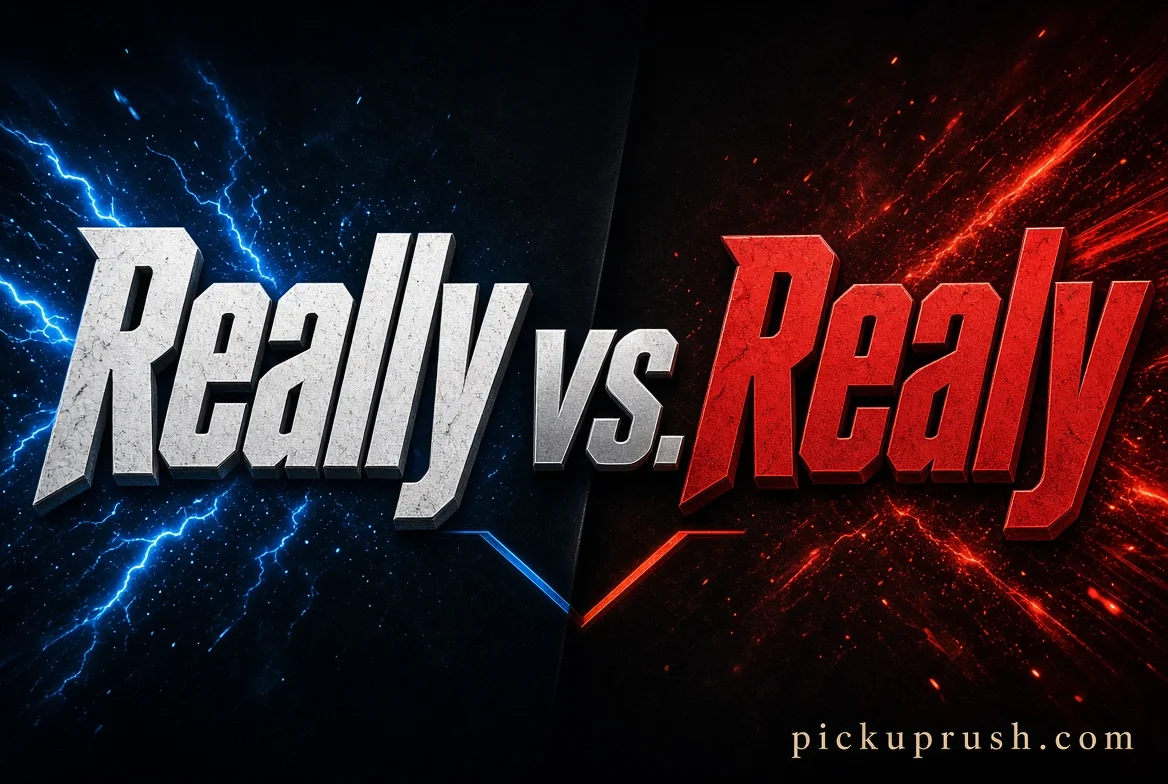

Really vs. Realy: Which Is Correct? Proper Spelling and Usage is a common spelling question because both forms look almost identical. The main difference is one letter: really has a double l, while realy has a missing l. In standard English, really is the correct spelling, and realy is an incorrect misspelling. This small detail can cause confusion, especially for English learners and anyone who is still learning common English spelling rules.
The usage of really is straightforward once you understand its spelling pattern. A simple practical memory trick is to remember the double l before the final y. The mistake often happens during fast typing, when the extra l is easy to overlook. As a result, realy may appear in emails, essays, professional writing, an email, an essay, a social media post, or a professional document. Checking the correct spelling before submitting your writing can help eliminate this common typing error.
Using the correct form improves writing accuracy, grammar, clarity, and credibility. It also supports better overall writing quality and helps you communicate ideas clearly in everyday communication and written communication. If realy keeps sneaking into your writing, there is no need for trouble or frustration. This is a small mistake that happens often, and recognizing the one letter difference makes it much easier to spot and correct.
Really vs. Realy: Which Spelling Is Correct?
Really is the correct standard spelling. Realy is a misspelling.
The easiest way to remember this is to see how the word is formed:
real + ly = really
The base word real already ends in l. When -ly is added, the resulting spelling is really, with the two l’s appearing next to each other.
| Spelling | Correct? | Explanation |
| really | ✅ Yes | Standard English spelling |
| realy | ❌ No | Common misspelling |
| reallly | ❌ No | Contains an extra l |
| reely | ❌ No | Incorrect spelling and word formation |
Consider these examples:
- Correct: She is really talented.
- Incorrect: She is realy talented.
- Correct: I really enjoyed the concert.
- Incorrect: I realy enjoyed the concert.
The mistake doesn’t change the intended meaning. A reader will usually understand what you meant. Still, realy remains an error in standard English writing, so it should be corrected.
What Does Really Mean?
Really has several meanings depending on its position and context. Cambridge Dictionary lists uses connected with truth, certainty, emphasis, degree, and surprise.
Here are the most important uses.
Really Means “Very” or “Very Much”
One of the most common uses of really is to intensify an adjective or adverb.
For example:
- The movie was really interesting.
- This problem is really difficult.
- She runs really quickly.
- That restaurant is really popular.
- I really like this book.
In these sentences, really increases the strength of the word or idea that follows it.
Compare:
The test was difficult.
with:
The test was really difficult.
The second sentence gives the reader a stronger sense of the speaker’s reaction.
Really Means “Actually” or “In Fact”
Really can also focus attention on what is true rather than what someone might assume.
For example:
- What really happened?
- I don’t really know the answer.
- She didn’t really understand the instructions.
- That’s what he really wanted.
- Did they really finish the project?
Here, really isn’t simply making something stronger. Instead, it points toward the actual situation or truth.
Cambridge describes this use as referring to what is true about a situation or what happens in fact.
Really Can Express Surprise
You can also use really as a short response.
For example:
“I got the job.”
“Really?“
The speaker isn’t simply asking for information. The word can communicate surprise, interest, disbelief, or curiosity, depending on tone and context.
That’s why punctuation matters:
- Really? — surprise or uncertainty
- Really! — strong reaction
- Really. — can sound firm, skeptical, or serious depending on context
A single word can carry quite a bit of meaning when the situation and tone change.
Why Is Really Spelled With Two Ls?
The spelling becomes much easier once you recognize the word’s structure.
Really comes from real plus the adverb-forming ending -ly:
real + ly → really
The important detail is that the l at the end of real remains. The l beginning the suffix -ly follows it. That gives you:
r-e-a-l-l-y
So the correct spelling contains two consecutive l’s.
This explains why realy is incorrect. It drops one of those letters and breaks the standard spelling pattern.
A Simple Spelling Memory Trick
Think of the word in two pieces:
REAL + LY
Don’t try to memorize really as a random six-letter sequence. Remember its building blocks instead.
REAL already has an L.
LY adds another L.
Therefore:
REAL + LY = REALLY
It’s a small trick, but it can prevent a very common typo.
Really as an Adverb: Proper Usage
Really usually functions as an adverb. Its exact effect depends on the word or phrase it modifies.
Really for Emphasis
Place really before an adjective when you want to make the description stronger.
Examples:
- It was a really cold morning.
- That’s a really useful suggestion.
- She made a really smart decision.
- The instructions are really clear.
You can also place it before certain adverbs:
- He finished really quickly.
- She answered really confidently.
- They worked really carefully.
In each case, really adds emphasis without changing the basic meaning of the sentence.
Really to Emphasize a Verb
Really can modify a verb and show that an action, feeling, or intention is genuine or strong.
For example:
- I really like this song.
- We really need more time.
- She really wants to win.
- They really appreciate your help.
Notice how really comes before the main verb in these examples.
Cambridge’s grammar guidance specifically notes that really can emphasize something and can give particular importance to a verb.
Really in Questions
Questions containing really often carry an extra layer of meaning.
Compare:
Did she say that?
with:
Did she really say that?
The first question simply asks whether she said it. The second suggests doubt, surprise, or a need to confirm the information.
More examples include:
- Is that really true?
- Did you really finish already?
- Do you really believe that?
- Are they really coming today?
The word can therefore change the emotional flavor of a question without changing its basic grammatical structure.
Really in Informal Conversation
Really appears frequently in everyday conversation.
People use it to show enthusiasm, doubt, surprise, agreement, or emphasis:
- “I passed my exam.”
- “Really? That’s great!“
Or:
- “I don’t really know.”
Or:
- “That was really good.”
This doesn’t mean really is limited to casual English. It also works perfectly well in many forms of formal and academic writing. The important factor is how it is being used, not simply whether the setting is formal.
Really vs. Realy in a Sentence
The difference is straightforward: use really, never realy, when you mean the standard English adverb.
| Incorrect | Correct |
| I am realy tired. | I am really tired. |
| This is realy important. | This is really important. |
| She realy likes music. | She really likes music. |
| Did you realy see him? | Did you really see him? |
| The movie was realy funny. | The movie was really funny. |
The incorrect form usually happens because the writer remembers the sound of the word rather than its spelling.
That can happen especially when typing quickly. Your fingers may produce realy before you consciously notice that one l has disappeared.
Really vs. Real: What’s the Difference?
Although real and really look closely related, they don’t normally perform the same grammatical job.
Real is commonly an adjective. It describes a noun.
Really is primarily an adverb. It can modify an adjective, adverb, verb, or an entire idea depending on context.
Compare these sentences:
- This is a real problem.
- This problem is really serious.
- She is a real professional.
- She works really professionally.
Here’s a useful comparison:
| Word | Typical role | Example |
| real | Adjective | That is a real opportunity. |
| really | Adverb | That opportunity is really valuable. |
The distinction matters because adding -ly changes more than spelling. It creates a different grammatical form.
Really vs. Very: Are They the Same?
Really and very can overlap when they intensify adjectives.
For example:
- The room is very cold.
- The room is really cold.
Both sentences tell the reader that the room has a high degree of coldness.
However, they aren’t interchangeable in every situation.
Really can do things that very generally cannot. It can emphasize verbs:
I really like this book.
You wouldn’t normally replace it with:
I very like this book.
That sentence doesn’t work in standard English.
Really can also mean actually or in fact:
What really happened?
Using very in that position would completely change the sentence and make it ungrammatical.
So while the two words overlap as intensifiers, really has a wider range of uses. Cambridge specifically identifies meanings of really that include both “very or very much” and references to truth or actual circumstances.
How to Remember the Spelling of Really
The most reliable trick is simple:
REAL + LY = REALLY
If you remember real, you already have the first four letters.
Then add -ly:
real + ly → really
Quick Memory Rules
- Remember the double L.
- Think REAL + LY.
- Don’t write realy.
- Don’t add three l’s as in reallly.
- When in doubt, look for the base word real.
A useful visual trick is to mentally underline the two l’s:
reaLLy
That makes the spelling pattern easier to spot while proofreading.
Common Misspellings of Really
Although realy is the main spelling mistake in this comparison, other errors can appear too.
Realy
Realy is the most direct misspelling. It removes one of the two l’s.
❌ She is realy happy.
✅ She is really happy.
Reallly
Some writers go in the opposite direction and add an extra l.
❌ The movie was reallly good.
✅ The movie was really good.
Reely
This version changes the spelling based on how someone thinks the word sounds.
❌ I reely enjoyed it.
✅ I really enjoyed it.
The lesson is simple: pronunciation isn’t a reliable guide to every letter in English spelling.
Really: Pronunciation and Spelling
In US English, Cambridge gives the pronunciation of really as /ˈriː.ə.li/. It also lists a shorter pronunciation, /ˈriː.li/, in its American dictionary material.
That variation helps explain why some learners find the spelling confusing. Natural speech can make the word sound compact, especially in fast conversation.
Still, pronunciation doesn’t change the standard spelling.
Whether you pronounce every syllable clearly or say the word more quickly in conversation, the written form remains:
really
Not:
realy
This is a useful general spelling lesson: English pronunciation and English spelling don’t always match letter for letter.
Is “Realy” Ever Correct?
For the standard English adverb meaning actually, truly, or very, realy is not the correct spelling.
If you see realy in an online post, message, comment, or document, it will generally be a spelling mistake when the writer intended really.
There can always be unusual cases involving proper names, usernames, branding, or deliberately altered spellings. Those aren’t evidence that realy is the standard spelling of the English word.
For normal writing, the safe choice is clear:
Use really.
Really in American English
Really is a standard word in American English. It appears in everyday speech, professional communication, educational writing, journalism, and many other contexts.
The American English entry from Cambridge identifies uses including “very or very much,” statements about what is true, emphasis on verbs, and expressions of surprise.
That means you don’t need to avoid really simply because it sounds conversational.
However, good writing still depends on variety. If every sentence contains really, the word can lose its impact.
For example:
The presentation was really good.
The results were really impressive.
The speaker was really confident.
The conclusion was really clear.
Nothing is grammatically wrong here. Yet the paragraph becomes repetitive.
Depending on the context, you could replace some instances with more precise wording:
- excellent
- impressive
- clear
- convincing
- highly effective
- remarkably strong
The goal isn’t to eliminate really. It’s to use it when it adds something useful.
Examples of Really Used Correctly
Here are examples covering the major meanings and grammatical uses of really.
Emphasis
- The assignment was really challenging.
- She gave a really thoughtful answer.
- That was a really useful explanation.
Truth or Actuality
- What really happened?
- I don’t really understand the problem.
- That’s what he really meant.
Strong Feeling
- I really appreciate your help.
- She really enjoys reading.
- We really want to finish today.
Surprise
- “Really? You finished already?”
- “Really? I didn’t know that.”
Doubt or Confirmation
- Is that really necessary?
- Did they really agree to the plan?
- Are you really sure?
Negative Statements
Really can also soften certain negative statements:
- I don’t really like it.
- I’m not really sure.
- We don’t really need another meeting.
Cambridge notes that really can make a negative utterance less direct.
A Practical Case Study: Catching “Realy” in Everyday Writing
Imagine a student finishes an assignment and writes:
“The experiment was realy interesting because the results were unexpected.”
The intended meaning is perfectly clear. However, realy is still misspelled.
A quick proofreading pass catches the problem:
“The experiment was really interesting because the results were unexpected.”
Now consider a professional email:
“I realy appreciate your time.”
The correction is equally simple:
“I really appreciate your time.”
This shows why the mistake deserves attention. Realy usually doesn’t create confusion about meaning, but it can make otherwise polished writing look careless.
The fix takes only one letter.
Read More: Choosing vs. Chosing: How to Spell Choosing Correctly
Really vs. Realy: Quick Comparison
| Feature | Really | Realy |
| Standard spelling | ✅ Yes | ❌ No |
| Meaning | Actually, truly, very, very much | No standard meaning as this word |
| Part of speech | Primarily adverb | — |
| Correct in formal writing | ✅ Yes | ❌ No |
| Correct in everyday writing | ✅ Yes | ❌ No |
| Contains double L | ✅ Yes | ❌ No |
| Example | She is really kind. | She is realy kind. ❌ |
The difference is therefore not a matter of American versus British spelling. It isn’t a case where both forms are accepted regional variants. Really is the standard spelling.
How to Avoid the Really/Realy Spelling Mistake
A few simple habits can make the error almost disappear.
- Remember “real + ly.” This is the clearest spelling rule.
- Look for the double L. If you see only one, check the word.
- Proofread short words. Common words often escape attention because your brain recognizes the intended meaning.
- Use spell-checking tools. They can catch accidental omissions while you focus on the content.
- Read your writing aloud. The sound may not expose the missing letter, but reading slowly can help you notice awkward or repeated wording.
- Learn the word as a complete spelling pattern. Don’t rely only on pronunciation.
One particularly useful habit is to pause whenever a familiar word looks “almost right.” Small spelling errors often hide in exactly that category.
FAQs:
Is “really” or “realy” correct?
Really is the correct spelling. Realy is a misspelling and should not be used in standard English writing.
Why do people spell “really” as “realy”?
The mistake usually happens because writers accidentally leave out one l. Since “really” contains two consecutive l letters, fast typing can make the word easy to misspell.
What does “really” mean?
Really can mean “in fact,” “truly,” or “actually.” It can also strengthen an adjective or adverb, as in “really important” or “really quickly.”
Is “really” a formal word?
Yes. Really is a standard English word that works in both casual and formal writing. However, in highly formal contexts, alternatives such as truly, actually, or indeed may sometimes fit better depending on the sentence.
What is the difference between “really” and “very”?
Both words can add emphasis, but they aren’t always interchangeable. Really often expresses stronger personal emphasis or surprise, while very commonly intensifies an adjective or adverb.
For example:
- “She is really happy.”
- “She is very happy.”
- “Did you really say that?”
In the final example, very wouldn’t have the same meaning.
Conclusion:
When choosing between really vs. realy, always use really. The correct spelling contains two l’s: r-e-a-l-l-y. Although “realy” is a common typing mistake, it isn’t the standard spelling of the word.
A simple way to remember it is to connect really with real and then add -ly. Once you remember the double l, the spelling becomes much easier. Whether you’re writing an email, school assignment, social media post, or professional document, choosing really keeps your writing accurate, clear, and polished.


1 thought on “Really vs. Realy: Which Is Correct? Proper Spelling and Usage”