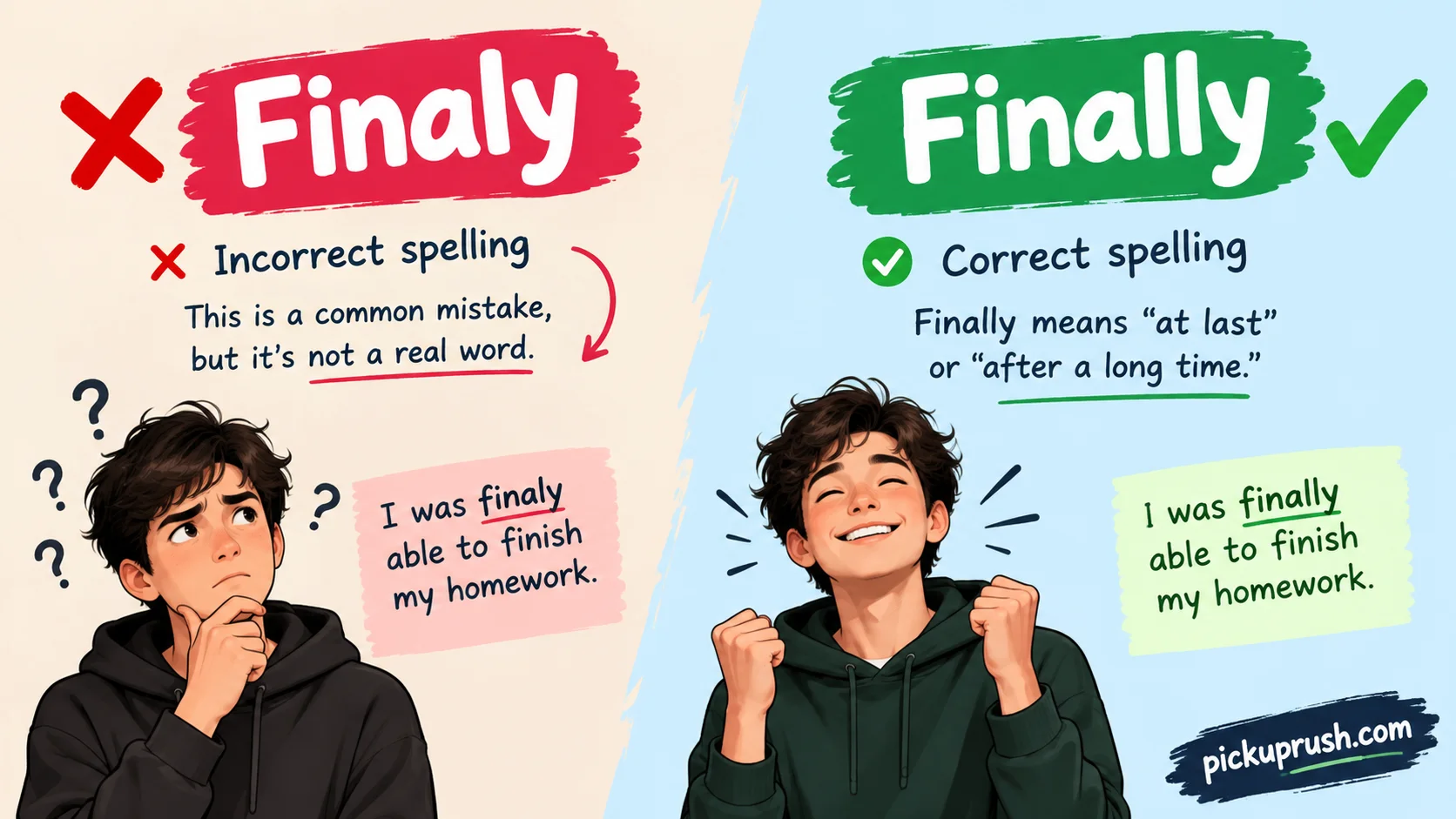

Have you ever typed a sentence, looked at the screen, and suddenly wondered whether it should be Finaly or Finally? This small spelling difference causes common confusion for many writers, students, and English learners. The correct form is Finally, while Finaly is a common misspelling caused by leaving out one l. Although the mistake looks minor, using the right spelling can improve your writing clarity, accuracy, and confidence in everyday English writing.
The word Finally is used in many situations. It can describe something that happens after a long time, at last, or in the end, and it can also introduce the last point in a sequence or discussion. You will see it in emails, essays, blog posts, professional messages, and everyday conversations. Understanding its meaning, pronunciation, grammar, and usage makes it easier to choose the correct form whenever you write.
In this guide, Finaly vs. Finally: Differences, Correct Spelling, Meaning, and Usage will be explained with clear examples and simple rules. You will learn why Finally has two l’s, how the final + ly pattern helps you remember the spelling, and how to use the word naturally in both formal and informal writing. By understanding this simple spelling rule, you can avoid a common mistake and make your writing easier for readers to understand.
Finaly vs. Finally: Quick Answer
The difference between finaly and finally is mainly a matter of spelling. Finally is the correct standard English spelling, while finaly is a misspelling.
Here is the simple answer:
- Finally ✅ Correct
- Finaly ❌ Incorrect
For example:
We finally finished the project.
Not:
We finaly finished the project.
The correct spelling contains two consecutive l’s:
f-i-n-a-l-l-y
If you’re writing an article, email, school assignment, report, or professional message, always use finally.
Finaly vs. Finally at a Glance
| Word | Standard English? | Meaning | Example |
| Finally | Yes | At last, eventually, or as the last point | “She finally arrived.” |
| Finaly | No | Misspelling of finally | “She finaly arrived.” |
So, there isn’t a special situation where finaly becomes the correct alternative. If you mean the standard English word, write finally.
Is “Finaly” a Word?
In standard English, finaly is not the correct spelling of the adverb finally. Dictionaries list finally as the standard form.
The mistake usually happens when someone mentally changes final into an adverb but forgets that the spelling retains the additional l before -y.
Compare the correct forms:
- final → finally
- real → really
- usual → usually
- actual → actually
These examples show why spelling can sometimes be tricky. English doesn’t always let you predict every word simply from pronunciation.
The safest approach is to remember the complete spelling of finally rather than relying entirely on how the word sounds.
Why Is “Finaly” Easy to Misspell?
The spelling mistake is understandable. When you say finally aloud, the two l’s don’t sound like two separate letters. Your ear can’t tell you that the word needs two written l’s.
Typing quickly can make the problem worse. A writer may know the correct word perfectly well yet accidentally leave out one letter.
Another reason is the appearance of the base word final. Someone may think:
final + y = finaly
But the standard spelling follows:
final + ly = finally
That small difference accounts for the extra l.
What Does “Finally” Mean?
Finally is an adverb with several related meanings. The exact meaning depends on the context in which you use it.
It can describe something that happens after a delay, introduce the last point in a sequence, or describe something that has been settled definitively.
Let’s look at each use.
Finally Meaning “At Last”
One of the most common uses of finally is to describe something that happens after waiting, difficulty, effort, or delay.
For example:
We finally reached the hotel.
The sentence suggests that reaching the hotel took some time or required patience.
Here are a few more examples:
- She finally found her missing keys.
- The rain finally stopped.
- He finally solved the difficult problem.
- The bus finally arrived.
- They finally agreed on a date.
In each example, finally draws attention to the point when something eventually happened.
The word often carries a subtle sense of relief or completion. If someone says, “I finally finished my assignment,” the sentence usually suggests that finishing it took longer or required more effort than expected.
Finally Meaning “As the Last Point”
Finally can also introduce the last point in a series, argument, explanation, or set of instructions.
For example:
First, check the information. Next, compare the results. Finally, submit the report.
In this sentence, finally doesn’t necessarily mean that the writer waited a long time. Instead, it tells the reader that this is the last step.
This use is common in:
- Essays
- Presentations
- Speeches
- Instructions
- Reports
- Explanations
- Business documents
For example:
Finally, remember to save a copy of the document.
The word helps organize information and gives the reader a clear sense of sequence.
Finally Meaning “Definitively”
In some contexts, finally means that something has been settled in a definite or conclusive way.
For example:
The contract has not been finally approved.
Here, finally approved suggests approval in a definitive sense rather than a temporary or preliminary decision.
This use tends to appear more often in formal, legal, institutional, or professional writing than in everyday conversation.
Why Is “Finally” Spelled With Two Ls?
The easiest way to understand the spelling is to connect finally with the word final.
Think of it as:
final + ly = finally
The original l at the end of final remains. Then the l that begins the ending -ly follows it.
That gives you:
final + ly → finally
Not:
final + y → finaly
This is one of the simplest ways to remember the correct spelling.
A Simple Spelling Memory Trick
If you’re unsure whether finally has one or two l’s, break it into two parts:
FINAL + LY
Now put them together:
FINALLY
This trick works because the base word remains visible inside the longer word.
You can also remember the phrase:
Final plus ly gives you finally.
Once you associate the word with this pattern, finaly becomes easier to spot as a spelling error.
Finaly vs. Finally: Key Differences
The key difference between finaly vs. finally is spelling rather than meaning.
| Feature | Finally | Finaly |
| Correct standard spelling | Yes | No |
| Part of speech | Adverb | Misspelling |
| Meaning | At last, eventually, or as the last point | No standard meaning as the intended word |
| Formal writing | Appropriate | Incorrect |
| Casual writing | Appropriate | Still incorrect |
| Example | “We finally arrived.” | “We finaly arrived.” ❌ |
This distinction is important because some spelling comparisons involve two legitimate words with different meanings. Finaly vs. finally isn’t one of those cases.
Instead, finaly is simply an incorrect spelling of finally.
Finally in a Sentence
Knowing how to spell finally is only part of using it well. Its position in a sentence can affect emphasis and naturalness.
Finally at the Beginning
You can place finally at the beginning of a sentence when you’re introducing the last point in a sequence.
Finally, we need to review the conclusion.
Finally, check that all the information is correct.
Finally, add the remaining ingredients.
When finally introduces a sentence in this way, a comma normally follows it.
This structure makes the sequence easy for the reader to follow.
For example:
First, gather the materials. Next, prepare the workspace. Finally, begin the experiment.
The reader immediately understands that the third step is the last one.
Finally in the Middle
When finally means that something happened after a delay, it often appears in the middle of the sentence.
She finally answered the question.
We finally reached an agreement.
The children finally fell asleep.
This position sounds natural because finally directly modifies the action.
Compare:
She finally answered the question.
with:
She answered the question finally.
The first version usually sounds more natural when you’re emphasizing that the answer came after waiting.
Finally at the End
You can sometimes place finally at the end of a sentence.
They reached an agreement finally.
This isn’t necessarily grammatically impossible, but it can sound less natural depending on the sentence.
In many everyday situations, the following version flows better:
They finally reached an agreement.
The best position depends on the intended emphasis and the overall rhythm of the sentence.
15+ Examples of “Finally” Used Correctly
Seeing the word in different contexts makes its usage easier to understand.
Examples Meaning “At Last”
- We finally found the keys under the couch.
- The train finally arrived after a long delay.
- She finally completed her science project.
- After several attempts, they finally solved the puzzle.
- He finally decided which course to take.
- The weather finally improved.
- Our team finally reached the destination.
- I finally understood what the instructions meant.
- The mechanic finally fixed the problem.
- After weeks of practice, she finally mastered the technique.
Examples Meaning “As the Last Point”
- Finally, remember to save a backup of the file.
- Finally, let’s review the main conclusion.
- Finally, check the document for spelling mistakes.
- Finally, consider whether the evidence supports the argument.
- Finally, submit the completed form before leaving.
Examples Meaning “Definitively”
- The contract has not been finally approved.
- The committee has not finally decided the matter.
- The schedule hasn’t been finally confirmed.
These examples show that finally can perform different jobs while keeping the same spelling.
Common “Finaly” vs. “Finally” Mistakes
The most common error is dropping one l.
Mistake: Writing “Finaly”
❌ We finaly completed the assignment.
✅ We finally completed the assignment.
The correction simply requires the second l.
Mistake: Using “Finaly” at the Start of a Sentence
❌ Finaly, we need to review the results.
✅ Finally, we need to review the results.
The second sentence uses the standard spelling.
Mistake: Forgetting the Second L While Typing
❌ She finaly understood the instructions.
✅ She finally understood the instructions.
This is often nothing more than a typing error. However, proofreading can catch it quickly.
A Quick Editing Test
Whenever you see finaly, ask yourself whether you mean:
- At last
- Eventually
- As the last point
- In a definitive sense
If you do, the standard spelling is finally.
Finally vs. Eventually
Finally and eventually sometimes overlap because both can describe something happening after a period of time.
Consider:
After several delays, the plane eventually left.
Now compare:
After several delays, the plane finally left.
Both sentences make sense. However, finally often puts more emphasis on the fact that the waiting or difficulty has reached an end.
Eventually focuses more on the idea that something happened at some point after a period of time.
A useful comparison is:
| Word | Common emphasis |
| Finally | The final point, completion, or something happening after waiting |
| Eventually | Something happening after some time |
| In the end | The eventual result or outcome |
Context determines which expression sounds most natural.
Finally vs. At Last
Finally and at last can both describe something that happens after waiting.
For example:
We finally got home.
We got home at last.
The basic meaning is similar. However, at last can express stronger emotion, especially relief or impatience.
Consider:
At last! The bus has arrived.
That sounds more emotionally charged than a simple statement such as:
The bus has finally arrived.
Both expressions are useful, but finally tends to fit more smoothly into ordinary sentences.
Finally vs. Lastly
Finally and lastly are similar when they introduce the last point in a list.
For example:
First, we’ll discuss cost. Second, we’ll examine quality. Finally, we’ll consider delivery time.
You could also write:
First, we’ll discuss cost. Second, we’ll examine quality. Lastly, we’ll consider delivery time.
Both can work in this kind of sequence.
However, finally has a broader range of meanings. It can also describe something happening after a delay.
We finally reached the hotel.
You wouldn’t normally replace finally with lastly here:
We lastly reached the hotel. ❌
That sentence doesn’t convey the intended meaning naturally.
Finally vs. In the End
Finally and in the end can both refer to an eventual conclusion, but their emphasis can differ.
Consider:
We considered several options and in the end chose the first one.
Here, in the end focuses on the final result of the decision-making process.
Now consider:
We finally chose the first option.
This can suggest that reaching the decision took time or effort.
A simple distinction is:
- Finally often highlights reaching a final point.
- In the end often highlights the eventual result.
- Eventually often highlights something happening after time has passed.
These aren’t rigid rules. Natural English allows some overlap between them.
Finaly vs. Finally in Formal and Informal Writing
The spelling finally remains correct regardless of the level of formality.
Academic Writing
Finally, the evidence supports the proposed explanation.
Business Writing
The revised contract was finally approved.
Professional Communication
Finally, please review the attached information before the meeting.
Everyday Conversation
I finally finished cleaning my room.
Online Writing
Finally, here’s the answer you’ve been looking for.
The context changes, but the spelling doesn’t.
Finaly doesn’t become acceptable simply because you’re writing casually. A text message may contain abbreviations or informal expressions, but if you’re using the standard English word, the spelling remains finally.
A Small Case Study: One Missing Letter
Consider this short paragraph:
I finaly finished the report. Finaly, I can relax.
The reader can probably understand what the writer means. However, both instances contain the same spelling mistake.
Now correct them:
I finally finished the report. Finally, I can relax.
The meaning stays exactly the same. The writing simply becomes correct and polished.
This illustrates an important point about spelling mistakes. They don’t always make a sentence impossible to understand. Instead, they can interrupt the reader’s experience and reduce the overall quality of otherwise good writing.
In academic and professional contexts, those small details matter.
How to Remember the Correct Spelling of Finally
If you regularly confuse finaly vs. finally, use a simple memory strategy.
Remember “Final + Ly”
The easiest method is:
FINAL + LY = FINALLY
Don’t think:
FINAL + Y
Think:
FINAL + LY
That automatically gives you the second l.
Look for Two Ls
When proofreading the word, visually check the middle:
FINA LL Y
The two l’s should appear together.
Connect Finally With Final
The word finally contains the complete word final at its beginning.
FINAL + LY
Once you remember that relationship, the spelling becomes much easier.
Practice With a Sentence
Instead of memorizing the spelling by itself, use it in a natural sentence:
I finally finished my work.
Repeated exposure to the correct spelling makes the incorrect finaly look unusual.
Read More: Waring vs Wearing: Differences, Meaning, and Correct Usage With Examples
Finaly vs. Finally: Quick Grammar Check
Use this checklist when proofreading:
- Is the spelling finaly? Change it to finally.
- Do you mean at last? Finally may fit.
- Are you introducing the last point? Finally works.
- Are you describing something happening after difficulty? Finally can work.
- Are you describing a definitive decision? Finally may fit depending on context.
- Are you introducing the last item in a list? Finally or lastly may work.
- Are you describing an eventual result? Consider finally, eventually, or in the end based on the meaning.
Finaly vs. Finally Cheat Sheet
| Meaning or purpose | Best choice |
| At last | Finally |
| After a long delay | Finally |
| As the last point | Finally |
| Definitively | Finally |
| Last item in a list | Finally or lastly |
| Something happening after time passes | Finally or eventually |
| Eventual result | Finally or in the end, depending on context |
| “Finaly” | Incorrect spelling |
Conclusion:
The difference between Finaly and Finally is simple: Finally is the correct spelling, while Finaly is a misspelling. The easiest way to remember it is final + ly = finally, which gives the word its two l’s. Finally is commonly used to show that something happens at last, in the end, or after a long wait, and it can also introduce the last point in a sequence or discussion. Remembering this simple spelling pattern can help you avoid mistakes and write with greater accuracy, clarity, and confidence.
FAQs:
Is Finaly a correct spelling?
No. Finaly is an incorrect spelling in standard English. The correct spelling is Finally, with two l’s.
Why does Finally have two l’s?
Finally comes from the word final combined with the suffix -ly. Because final already ends in l and -ly begins with l, the result is finally with two l’s.
What does Finally mean?
Finally can mean at last, in the end, or after a long time. It can also be used to introduce the final point in a list, sequence, or discussion.
How do you use Finally in a sentence?
You can use Finally to describe the completion of an event or introduce the last idea. For example: “Finally, we finished the project.” Another example is: “Finally, we need to discuss the last point.”
Is Finally formal or informal?
Finally can be used in both formal and informal writing. It is suitable for emails, essays, reports, professional communication, blogs, and everyday conversation.

1 thought on “Finaly vs. Finally: Differences, Correct Spelling, Meaning, and Usage”