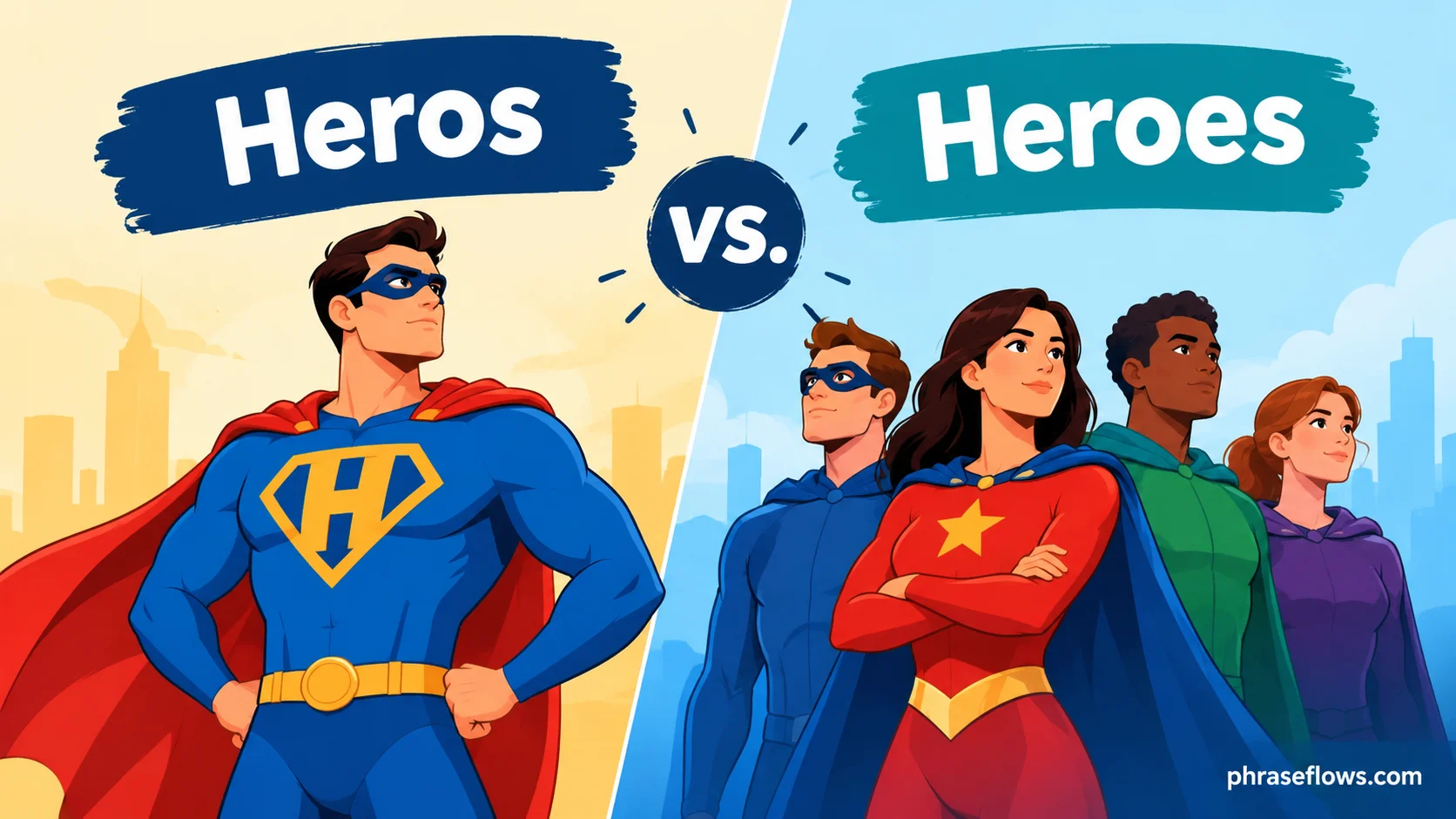

Have you ever wondered whether to write heros vs. heroes when talking about more than one hero? These two spellings may look similar, but only one is correct in standard English. The correct plural form of hero vs. heroes, while heros is a common spelling mistake. Although adding an S works for many English nouns, some words follow a different plural spelling pattern.
The confusion often comes from the way English forms plural nouns. Many words simply take an S at the end, but certain nouns ending in O need ES instead. For example, hero becomes heroes. Both forms sound the same when spoken, so pronunciation won’t help you identify the spelling error. You need to understand the spelling rule to recognize the correct form in writing.
In this guide, you’ll learn why heroes is the correct spelling, why heros is incorrect, and how to remember the difference. We’ll also look at the pluralization rule behind this word and explain how to use it in everyday messages, school assignments, articles, and professional writing. Once you understand this simple pattern, you’ll find it easier to avoid the mistake and write with greater confidence.
Heroes vs. Heros: Which Spelling Is Correct?
Heroes is the correct and standard plural spelling of hero. Use it whenever you refer to two or more people admired for their courage, achievements, or outstanding qualities.
For example, if one firefighter saves someone from danger, you might call that person a hero. When several firefighters perform similar acts, you call them heroes.
The word heros is generally considered a misspelling when someone intends to write the plural of hero. However, there’s an interesting exception in American English: heros can also appear as the plural of hero when referring to the long sandwich called a hero. This food-related usage is uncommon and doesn’t change the standard plural for people.
The Cambridge Dictionary and Oxford Learner’s Dictionaries both identify heroes as the plural form of hero.
Consider these examples:
- Correct: The firefighters became local heroes after the rescue.
- Incorrect: The firefighters became local heros after the rescue.
- Correct: Children often look up to their parents as heroes.
- Incorrect: Children often look up to their parents as heros.
The distinction is simple: when you mean brave or admirable people, always write heroes.
What Does Heroes Mean?
Heroes is the plural form of the noun hero. It describes two or more people who earn admiration through bravery, kindness, achievements, or exceptional contributions.
A hero doesn’t necessarily wear a uniform or perform a dramatic rescue. Sometimes, ordinary people demonstrate extraordinary courage through everyday actions. A teacher who supports struggling students, a volunteer who helps a community, or a person who stands up for someone being treated unfairly can all be described as heroes.
The word also appears frequently in literature, movies, history, and popular culture. In these settings, it often describes the central characters who face challenges and influence the direction of a story.
Different Meanings and Uses of Heroes
The word heroes has several meanings depending on the situation. Understanding these uses helps you choose the right word when writing.
1. People admired for bravery
Heroes often perform courageous actions when others need help. Their decisions may involve difficult circumstances, personal risks, or extraordinary determination.
Example: The rescue workers became heroes after helping families escape the flood.
2. People admired for achievements
Not every hero needs to save someone from danger. Individuals who make important discoveries, accomplish remarkable goals, or contribute to society can also become heroes.
Example: Many scientists are considered heroes because their discoveries improve people’s lives.
3. Main characters in stories
In literature and entertainment, a hero is often the central character who drives the story forward. The plural form refers to multiple central characters.
Example: The heroes of the novel work together to protect their village.
4. People who serve as role models
Someone you admire for their values, discipline, or positive influence can become one of your heroes.
Example: My grandparents are my heroes because they taught me the importance of honesty and hard work.
Examples of Heroes in Sentences
Here are additional examples showing how to use heroes naturally:
- The community honored the heroes who helped during the emergency.
- These historical heroes changed the course of their country.
- Young athletes often consider successful players their heroes.
- The movie features several heroes with different strengths.
- Teachers can become everyday heroes through their dedication to students.
- The children dressed as their favorite superheroes for the school event.
Notice that heroes works in every example because each sentence refers to more than one admired person or fictional character.
What Does Heros Mean?
Heros is not the standard plural spelling of hero when referring to people. If you write about courageous individuals, admired personalities, or fictional protagonists, you should use heroes instead.
The mistake usually happens because English speakers know that most regular nouns form their plurals by adding -s. For example:
- Book → Books
- Car → Cars
- Friend → Friends
- Teacher → Teachers
Someone might naturally apply the same pattern to hero and produce heros. Unfortunately, English spelling doesn’t follow one universal plural rule.
There is also a less common exception worth knowing. In American English, heros can refer to more than one hero sandwich. This meaning relates to food rather than courageous people.
For ordinary writing, especially school assignments, articles, emails, and professional documents, use heroes when discussing people.
Incorrect and Correct Examples of Heros
The following examples show how to correct the common spelling mistake:
| Incorrect sentence | Correct sentence |
| The heros saved the village. | The heroes saved the village. |
| Our teachers are our heros. | Our teachers are our heroes. |
| The movie celebrates real-life heros. | The movie celebrates real-life heroes. |
| Many heros inspired the younger generation. | Many heroes inspired the younger generation. |
Remember: If you’re referring to more than one person you admire, heroes is the spelling you need.
Why Is the Plural of Hero Spelled Heroes?
The reason hero becomes heroes comes from an English pluralization pattern involving certain nouns that end in -o.
Most English nouns form their plurals by adding -s. However, some nouns ending in a consonant followed by -o traditionally add -es instead.
For example:
- Hero → Heroes
- Potato → Potatoes
- Tomato → Tomatoes
- Echo → Echoes
- Torpedo → Torpedoes
The additional e isn’t decorative. It’s part of the established spelling pattern for these words.
However, don’t assume that every noun ending in -o follows this rule. English includes several exceptions, which is why checking a dictionary can save you from spelling mistakes.
How the -Es Rule Works
The basic process is straightforward:
- Start with the singular noun: hero.
- Identify its ending: the word finishes with the letter o, preceded by a consonant.
- Add -es to form the plural.
- The resulting word is heroes.
This pattern also appears in other familiar words.
| Singular | Plural |
| Hero | Heroes |
| Potato | Potatoes |
| Tomato | Tomatoes |
| Echo | Echoes |
| Torpedo | Torpedoes |
| Mosquito | Mosquitoes |
These examples show why learning individual spelling patterns is more useful than applying the regular -s rule to every noun.
Other Words That Form Their Plurals With -Es
Several common English nouns follow the same general pattern as hero. Learning these examples can help you recognize similar spelling changes.
Potato → Potatoes
A potato is a common vegetable. When referring to multiple potatoes, add -es.
Example: We bought several potatoes for dinner.
Tomato → Tomatoes
The plural of tomato also requires -es.
Example: Fresh tomatoes make the salad taste better.
Echo → Echoes
An echo occurs when sound reflects off a surface and returns to the listener.
Example: The mountain echoes carried our voices across the valley.
Torpedo → Torpedoes
A torpedo is a type of underwater weapon. Its standard plural spelling adds -es.
These words demonstrate the pattern, although English has exceptions that you’ll need to learn separately.
Words Ending in -O That Add Only -S
Not every noun ending in -o requires -es. Some words form their plurals by adding only -s.
Here are several familiar examples:
| Singular | Plural | Example |
| Photo | Photos | I printed five photos. |
| Piano | Pianos | The store sells different pianos. |
| Video | Videos | She uploaded three videos. |
| Radio | Radios | The company manufactures radios. |
| Studio | Studios | Several studios operate downtown. |
| Solo | Solos | The concert included two solos. |
This variation is one reason English pluralization can feel unpredictable.
Some nouns ending in -o accept more than one plural spelling. For example, volcanoes and volcanos are both accepted forms. The correct choice depends on the individual word and its dictionary usage.
Rather than memorizing a rule without exceptions, learn common examples and consult a reliable dictionary when you’re unsure.
Heroes vs. Heros: Key Differences
Although heroes and heros differ by only one letter, their standard usage isn’t interchangeable.
The following table highlights their main differences.
| Feature | Heroes | Heros |
| Standard spelling for people | Correct | Incorrect |
| Meaning | More than one hero | Not the standard plural for people |
| Grammatical form | Plural noun | Rare food-related plural |
| Singular form | Hero | Hero |
| Standard usage | Everyday writing | Limited sandwich-related usage |
The most important distinction concerns meaning.
When you’re writing about firefighters, historical figures, fictional characters, or inspiring individuals, choose heroes. The spelling heros has a limited use in American English for multiple hero sandwiches.
Practical Examples of the Difference
Consider these sentences:
Example 1:
- Incorrect: The heros received awards for their bravery.
- Correct: The heroes received awards for their bravery.
The corrected sentence uses the standard plural form because it describes several brave people.
Example 2:
- Incorrect: My childhood heros were famous athletes.
- Correct: My childhood heroes were famous athletes.
The word heroes correctly describes multiple people the speaker admired while growing up.
Example 3:
- Food-related usage: The deli prepared several heros for its customers.
Here, heros refers to sandwiches rather than admired individuals. This is a specialized American English usage, not the spelling to use for the ordinary plural of hero.
Common Mistakes to Avoid When Using Heroes
Even after learning the correct spelling, writers sometimes confuse heroes with other forms of the word. These mistakes often involve singular nouns, plural nouns, and possessive apostrophes.
Understanding their differences will help you write more accurately.
Heroes vs. Hero’s vs. Heroes’
These three forms look similar, but each serves a different grammatical purpose.
Hero
Hero is the singular form. Use it when referring to one person or one central character in a story.
Example: The firefighter became a hero after rescuing the family.
Hero’s
Hero’s is the singular possessive form. It shows that something belongs to one hero.
Example: The hero’s courage inspired everyone in the community.
In this sentence, the courage belongs to one particular hero.
Heroes
Heroes is the regular plural form. Use it when referring to two or more heroes.
Example: The heroes received recognition for their contributions.
Heroes’
Heroes’ is the plural possessive form. It shows that something belongs to multiple heroes.
Example: The heroes’ achievements inspired future generations.
Here, the achievements belong to several heroes.
Compare all four forms in this table:
| Word | Grammatical purpose | Example |
| Hero | Singular | The hero arrived. |
| Hero’s | Singular possessive | The hero’s story was inspiring. |
| Heroes | Plural | The heroes arrived. |
| Heroes’ | Plural possessive | The heroes’ stories were inspiring. |
Quick tip: An apostrophe usually indicates possession or a contraction. Don’t add one simply because you’re making a noun plural.
Other Common Heroes Spelling Mistakes
Writers sometimes make additional mistakes when using the word in longer sentences.
Watch out for these examples:
- Using heros instead of heroes: Remember that the standard plural for people requires -es.
- Adding an apostrophe unnecessarily: Heroes doesn’t need an apostrophe when you’re simply referring to multiple people.
- Using hero instead of heroes: Choose the singular form for one person and the plural form for multiple people.
- Confusing heroes with heroines: A heroine traditionally refers to a female hero in literature. However, hero is also widely used as a gender-neutral term.
Paying attention to these small differences can make your writing clearer and more professional.
Synonyms and Related Words for Heroes
Sometimes, repeating the same word throughout an article makes your writing feel monotonous. Using suitable synonyms can improve variety while helping you express slightly different meanings.
However, remember that synonyms aren’t always interchangeable. Each word carries its own meaning and works best in particular situations.
Here are some useful alternatives to heroes:
| Synonym | Meaning | Example |
| Champions | People who support or achieve something successfully | The champions inspired their community. |
| Role models | People whose behavior others admire | Parents can become positive role models. |
| Rescuers | People who save others from danger | The rescuers received public recognition. |
| Protectors | People who keep others safe | The protectors defended their community. |
| Legends | People remembered for remarkable achievements | These athletes became sporting legends. |
| Benefactors | People who provide help or support | The benefactors funded the local school. |
| Icons | People widely admired or recognized | These musicians became cultural icons. |
When Should You Use These Alternatives?
Choosing the right synonym depends on what you want to communicate.
For example, rescuers works well when you’re describing people who save others. However, it doesn’t always capture the broader admiration associated with heroes.
Similarly, role models emphasizes positive behavior rather than bravery. Someone can be a role model without performing a heroic act.
Use these alternatives thoughtfully. The goal isn’t simply to avoid repetition. It’s to communicate the exact meaning you intend.
Read More: Realize vs. Realise: Which Spelling Is Correct? Meaning, Differences, and Usage
A Practical Editing Example: Correcting Heros to Heroes
Imagine you’re editing a school article about people who make positive contributions to society.
The original draft contains this sentence:
“The heros of our community include teachers, doctors, volunteers, and firefighters.”
Although readers can understand the meaning, the spelling needs correction.
The revised sentence becomes:
“The heroes of our community include teachers, doctors, volunteers, and firefighters.”
Why does the revised version work?
- Correct plural form: Heroes follows the standard spelling of the noun hero.
- Clear meaning: The sentence refers to multiple admirable individuals.
- Better presentation: Correct spelling makes the article look more polished.
- Consistent usage: The writer can use the same form throughout the article.
Now consider another sentence:
“Our community heroes’ work deserves recognition.”
Here, heroes’ is correct because the sentence discusses work belonging to multiple heroes.
These examples show why spelling and grammar deserve attention together. Correcting one letter isn’t always enough. You also need to understand how the word functions within the sentence.
Conclusion:
The correct spelling is heroes, not heros. Although adding S works for many English nouns, the word hero follows a different plural pattern and takes ES. Both spellings sound the same, but only heroes is accepted in standard English. Remembering this simple rule can help you avoid spelling mistakes and improve your writing. Whether you’re writing a school assignment, a blog post, or a professional document, always use heroes when referring to more than one hero.
FAQs:
1. Is it heros or heroes?
Heroes is the correct spelling. It is the plural form of hero. Heros is a spelling error in standard English.
2. Why does hero become heroes instead of heros?
Some English nouns ending in O add ES to form their plural. The word hero follows this pattern, changing to heroes.
3. Is heros ever correct?
No. When referring to more than one hero, heros is not the standard spelling. You should always write heroes.
4. Do heros and heroes have the same pronunciation?
They are generally pronounced the same way. The difference is in their spelling, not their pronunciation.
5. What is the plural of hero in a sentence?
The plural of hero is heroes. For example: “The firefighters were heroes who helped save many people.”




1 thought on “Heros vs. Heroes: Which Spelling Is Correct?”