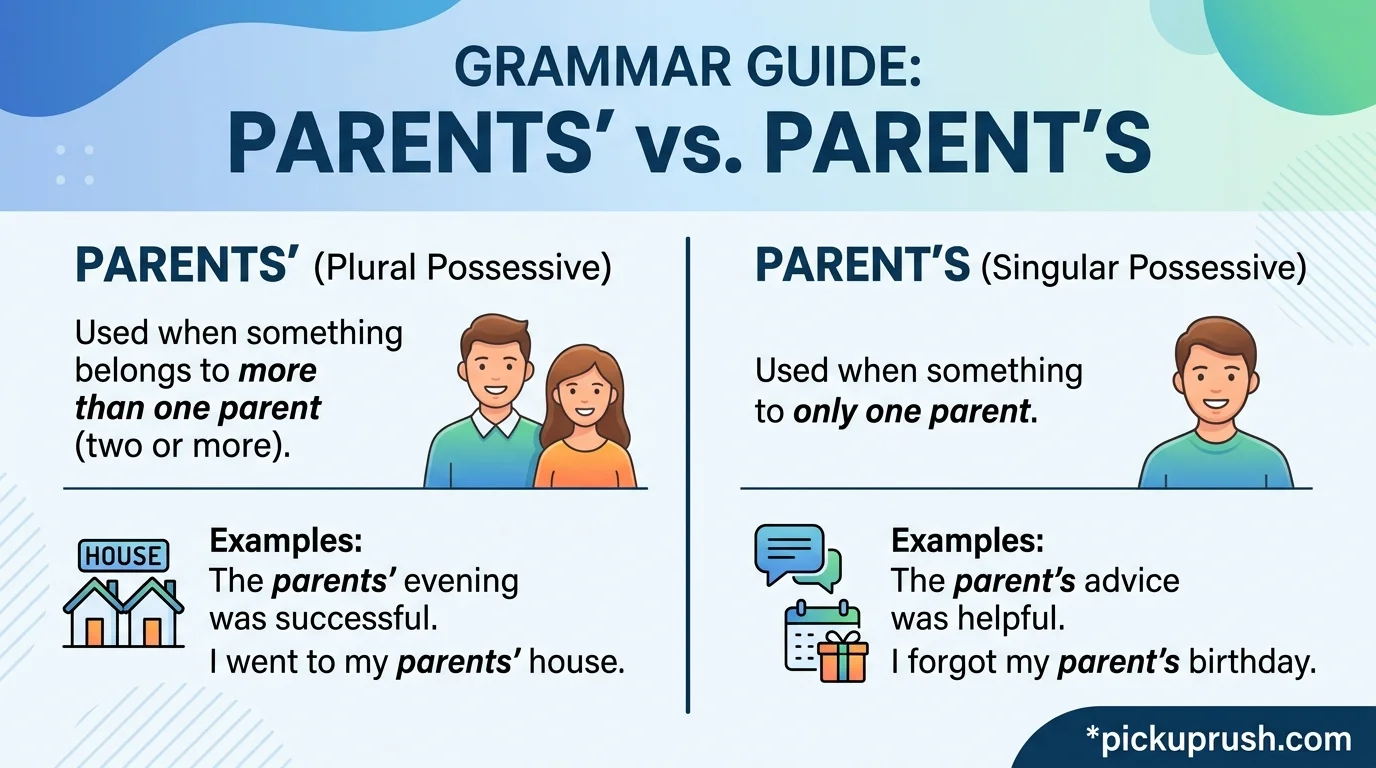

Have you ever stopped while writing because you were unsure whether to use parent’s vs. parents’? You are not alone. These two forms look almost the same, but the apostrophe changes their meaning. Parent’s refers to something belonging to one parent, while parents’ shows possession by more than one parent. The difference is small, but using the wrong form can make a sentence unclear.
The confusion often appears in emails, school forms, messages, assignments, and everyday writing. Many English learners understand the words parents and parent, but they may still hesitate when an apostrophe is involved. The good news is that the rule is quite simple once you understand how ownership, possession, and plural forms work. Knowing where to place the apostrophe can make your writing clearer and more accurate.
In this guide, you will learn the difference between parents, parent’s, and parents’ using simple explanations and practical examples. We will look at when each form is correct, how the meaning changes, and which common mistakes you should avoid. By understanding this basic English grammar rule, you can write with more clarity and avoid second-guessing your choice.
Parents vs. Parent’s vs. Parents’: Quick Comparison
Before looking at the rules in detail, it helps to see all four forms together.
| Form | Grammatical function | Meaning | Example |
| parent | Singular noun | One parent | The parent arrived early. |
| parents | Plural noun | Two or more parents | The parents arrived early. |
| parent’s | Singular possessive | Belonging to one parent | The parent’s car is outside. |
| parents’ | Plural possessive | Belonging to multiple parents | The parents’ meeting starts at six. |
The easiest way to remember the distinction is this:
Parent’s = one parent’s possession or association.
Parents’ = multiple parents’ possession or association.
The apostrophe doesn’t make parents plural. The s does that. The apostrophe shows possession or another relationship between nouns. Purdue OWL likewise explains that apostrophes form possessives and should not be added simply to make ordinary nouns plural.
What Does “Parent” Mean?
Parent is the singular form of the noun. It refers to one person who is a parent.
For example:
- The parent signed the form.
- A parent called the school.
- The child waited for their parent.
- Every parent received a notice.
There is no apostrophe because these sentences don’t express possession. They’re simply identifying one parent.
Think of parent as the basic form. You start with this word before deciding whether you need its plural or possessive form.
Parent in a Sentence
Consider:
The parent attended the conference.
This tells us that one parent attended. It doesn’t tell us that anything belongs to the parent.
Now compare:
The parent’s notebook was on the desk.
Here, parent’s tells us that the notebook belongs to or is associated with one parent.
That small apostrophe plus s carries additional grammatical information.
What Does “Parents” Mean?
Parents is the plural form of parent. It refers to two or more parents.
Examples include:
- The parents attended the meeting.
- Both parents signed the document.
- The school contacted the parents.
- Several parents raised questions.
- The children’s parents arrived later.
Notice that parents doesn’t contain an apostrophe in these examples.
That’s important because writers sometimes add an apostrophe whenever they see a word ending in s. That isn’t how English works. Apostrophes don’t normally form noun plurals. Parents is plural because of the final s, not because of an apostrophe.
Parents Does Not Automatically Mean Possession
Look at these examples:
- Parents attended the event.
- The school welcomed parents.
- Many parents asked questions.
Nothing belongs to the parents in these sentences. Therefore, there is no reason to add an apostrophe.
However:
- The parents’ meeting begins at 6 p.m.
- The parents’ questions were answered.
- The parents’ concerns were discussed.
Now the sentences describe something connected with multiple parents. That’s where the apostrophe appears.
What Does “Parent’s” Mean?
Parent’s is the singular possessive form of parent.
You use it when something belongs to, comes from, or is associated with one parent.
The basic structure is:
one parent + ’s + related noun
Examples:
- the parent’s car
- the parent’s phone
- the parent’s signature
- the parent’s decision
- the parent’s permission
- the parent’s opinion
- the parent’s responsibility
Consider this sentence:
The parent’s signature is required.
The phrase parent’s signature means the signature of one parent.
You can use the same idea with an “of” phrase:
The signature of the parent is required.
The apostrophe construction is shorter and more natural in ordinary English.
Purdue OWL recommends this kind of “of” test as one way to determine whether a noun is possessive.
Examples of Parent’s in Context
The parent’s car is parked outside.
One parent owns or uses the car.
The parent’s permission was necessary.
The permission comes from one parent.
The parent’s concern was taken seriously.
The concern belongs to or was expressed by one parent.
The parent’s name appears on the form.
The form contains the name of one parent.
In each case, parent’s identifies one parent as the person connected to the following noun.
What Does “Parents’” Mean?
Parents’ is the plural possessive form of parent.
You use it when something belongs to, comes from, or is associated with two or more parents.
The structure is:
parents + ’ + related noun
Examples include:
- the parents’ meeting
- the parents’ concerns
- the parents’ opinions
- the parents’ responsibilities
- the parents’ signatures
- the parents’ rights
- the parents’ questions
Notice something important: parents already ends in s, so you add only an apostrophe.
That’s why the forms look different:
- parent’s
- parents’
The first has ’s because parent is singular. The second has only ’ after the existing plural s.
This follows the standard possessive rule for plural nouns ending in s.
Parents’ vs. Parent’s: The Main Difference
The central distinction is simply how many parents you’re talking about.
Use Parent’s for One Parent
The parent’s signature is missing.
Only one parent’s signature is being discussed.
Use Parents’ for Multiple Parents
The parents’ signatures are missing.
The sentence refers to signatures belonging to multiple parents.
Here’s the pattern:
| If you mean… | Use… | Example |
| One parent | parent | The parent arrived. |
| More than one parent | parents | The parents arrived. |
| Something connected to one parent | parent’s | The parent’s car is here. |
| Something connected to multiple parents | parents’ | The parents’ cars are here. |
The apostrophe is therefore not just decoration. It helps readers understand number and possession at the same time.
How to Know Which Form You Need
When you’re unsure, use a simple two-step check.
First, Ask: How Many Parents?
If you’re talking about one, start with:
parent
If you’re talking about two or more, start with:
parents
Second, Ask: Is Possession or Association Involved?
If there is no possession or relationship being expressed, stop there.
- parent
- parents
If you’re showing that something belongs to or is associated with the parent, use a possessive form.
- parent’s
- parents’
This gives you a quick decision path:
One parent → parent
Multiple parents → parents
One parent + possession → parent’s
Multiple parents + possession → parents’
Parents’ vs. Parent’s in Common Phrases
Some expressions appear frequently in schools, childcare settings, family communication, and formal documents. These are worth learning because you’ll often encounter them in real writing.
| Singular possessive | Plural possessive |
| parent’s permission | parents’ permission |
| parent’s meeting | parents’ meeting |
| parent’s concern | parents’ concerns |
| parent’s responsibility | parents’ responsibilities |
| parent’s opinion | parents’ opinions |
| parent’s signature | parents’ signatures |
| parent’s question | parents’ questions |
| parent’s decision | parents’ decisions |
The meaning changes according to the number of parents involved.
For instance:
The parent’s permission was required.
This points to permission from one parent.
The parents’ permission was required.
This points to permission from multiple parents.
The difference may seem tiny on the page, but it can matter in a formal document where precision is important.
When “Parents’” Is Correct With a Singular Noun
One common source of confusion is the phrase parents’ meeting.
Some writers wonder why meeting is singular while parents’ is plural possessive. The answer is simple: the two words perform different jobs.
Meeting tells you what the event is.
Parents’ tells you who the event is associated with.
So:
The parents’ meeting begins at 6 p.m.
There is one meeting associated with multiple parents.
The same pattern appears in phrases such as:
- parents’ association
- parents’ committee
- parents’ room
- parents’ newsletter
- parents’ conference
A singular noun following a plural possessive doesn’t make the possessive singular.
For example, teachers’ lounge can refer to one lounge used by multiple teachers. Likewise, parents’ meeting can refer to one meeting involving multiple parents.
When “Parent’s” Is Correct Even When Multiple Parents Exist
Another subtle point is that a sentence can mention several parents while still requiring the singular possessive parent’s.
For example:
The two parents discussed one parent’s decision.
There are two parents in the sentence. However, the decision belongs to one specific parent.
Another example:
The parents respected one parent’s opinion.
The word parents is plural because multiple parents are involved. But parent’s is singular possessive because the opinion belongs to one parent.
This distinction is useful because the number of parents in the entire sentence doesn’t determine the possessive form. What matters is the number of owners associated with the specific noun.
Parents vs. Parents’: A Useful Distinction
The difference between parents and parents’ deserves special attention.
Compare:
Parents attended the meeting.
Here, parents is simply the subject of the sentence.
Now:
The parents’ meeting was crowded.
Here, parents’ modifies meeting and shows a relationship between the parents and the meeting.
Another pair makes the distinction clearer:
Parents expressed concerns.
The parents’ concerns were discussed.
In the first sentence, parents performs an ordinary plural-noun function.
In the second, parents’ indicates that the concerns belong to or come from multiple parents.
Remember This Rule
Parents = plural
Parents’ = plural possessive
That’s the heart of the distinction.
Parent’s vs. Parents’: A Useful Distinction
The easiest way to distinguish these forms is to look at the apostrophe position.
Parent’s
The apostrophe comes before the s:
parent + ’s = parent’s
This is the standard singular possessive pattern.
Example:
The parent’s signature is on the document.
Parents’
The apostrophe comes after the s:
parents + ’ = parents’
This is the standard plural possessive pattern for a plural noun ending in s.
Example:
The parents’ signatures are on the document.
A quick visual trick can help:
parent’s → one
parents’ → more than one
The s after the apostrophe in parent’s is part of the possessive ending. The s before the apostrophe in parents’ is the plural ending.
Common Mistakes With Parents’ and Parent’s
Even experienced writers can make apostrophe mistakes when typing quickly. These errors become easier to avoid once you know what causes them.
Mistake: Using Parent’s for Multiple Parents
Incorrect:
The parent’s meeting begins at six.
If the meeting involves multiple parents, the possessive form should be:
The parents’ meeting begins at six.
The meeting is associated with multiple parents.
Mistake: Using Parents’ for One Parent
Incorrect:
The parents’ signature is required.
If only one parent’s signature is needed, write:
The parent’s signature is required.
The singular possessive form matches one parent.
Mistake: Adding an Apostrophe Just to Make Parents Plural
Incorrect:
All parent’s should attend.
Correct:
All parents should attend.
The sentence doesn’t express possession. It simply refers to multiple parents.
An apostrophe isn’t a shortcut for pluralization. Standard grammar resources specifically warn against using apostrophes to form ordinary noun plurals.
Mistake: Assuming Every Word Ending in S Needs an Apostrophe
This is another common trap.
Compare:
- The parents arrived.
- The parents’ cars arrived.
The first sentence needs no apostrophe. The second does because parents’ shows possession or association.
A Practical “Of” Test for Parent’s and Parents’
When you’re stuck, try replacing the possessive phrase with an “of” phrase.
For example:
The parent’s car.
Can you say:
The car of the parent?
Yes. The phrase expresses a possessive relationship.
Now try:
The parents’ car.
You can interpret it as:
The car of the parents.
Again, the possessive relationship is clear.
This test doesn’t solve every grammatical question in English, but it can help you recognize when an apostrophe is functioning as a possessive marker. Purdue OWL specifically recommends turning a phrase into an “of the…” construction when checking for possession.
Real-World Examples of Parents’ vs. Parent’s
These forms appear in everyday situations more often than you might realize.
School Communication
The parent’s signature is required on the permission slip.
One parent’s signature is being requested.
The parents’ meeting will take place on Thursday.
The meeting involves multiple parents.
Family Discussion
The parent’s decision affected the child.
The decision belongs to one parent.
The parents’ decision affected the child.
The decision belongs to multiple parents.
Administrative Forms
Please provide the parent’s phone number.
One parent’s number is requested.
Please provide both parents’ phone numbers.
The form requests numbers belonging to multiple parents.
Community Events
The parents’ committee organized the event.
Multiple parents make up the committee.
One parent’s suggestion changed the schedule.
Only one parent’s suggestion is being identified.
A Short Case Study: Why the Apostrophe Matters
Imagine a school sends this notice:
Parents Meeting: Friday at 5 p.m.
This wording may be understood as a simple heading, but if the intended meaning is a meeting associated with parents, standard possessive punctuation would normally produce:
Parents’ Meeting: Friday at 5 p.m.
Now imagine the school writes:
Parent’s Meeting: Friday at 5 p.m.
That form suggests a meeting associated with one parent rather than parents collectively.
The difference is only one apostrophe position. Still, punctuation helps communicate the intended grammatical relationship.
This is why apostrophes matter in practical writing. They’re small marks that can carry useful information.
Parent’s, Parents’, and Possessive Pronouns
It’s also helpful to distinguish these possessive nouns from possessive pronouns.
Compare:
- the parent’s car
- the parents’ car
- their car
- his car
- her car
Possessive pronouns such as his, her, its, their, yours, and ours don’t normally use apostrophes. Purdue OWL lists possessive pronouns separately from possessive nouns and notes that they don’t require apostrophes to show possession.
This means you shouldn’t write:
their’s
Instead, write:
theirs
Similarly, its is possessive without an apostrophe while it’s is normally a contraction for it is or it has.
Although this isn’t directly part of the parents’ vs. parent’s distinction, knowing the broader apostrophe system helps prevent related errors.
A Quick Reference Guide
Keep this four-part chart handy:
| Word | Meaning | Example |
| parent | One parent | The parent called. |
| parents | Two or more parents | The parents called. |
| parent’s | Something belonging to one parent | The parent’s phone rang. |
| parents’ | Something belonging to multiple parents | The parents’ phones rang. |
The fastest question to ask yourself is:
How many parents are connected to the thing I’m describing?
Read More: Worshipped vs. Worshiped: Difference and Usage Explained
Practice: Choose the Correct Form
Test your understanding with these sentences. Choose parent, parents, parent’s, or parents’.
- The ______ signature was required before the trip.
- Both ______ attended the ceremony.
- The ______ meeting begins at 7 p.m.
- The child waited for their ______.
- Several ______ asked about the new schedule.
- The ______ phone was left in the classroom.
- The school distributed a notice to all ______.
- The ______ concerns were discussed during the meeting.
- One ______ opinion differed from the others.
- The ______ responsibilities can vary from family to family.
Answer Key
| Sentence | Correct answer | Why |
| 1 | parent’s | One parent’s signature is meant. |
| 2 | parents | More than one parent attended. |
| 3 | parents’ | The meeting is associated with multiple parents. |
| 4 | parent | The sentence refers to one parent without possession. |
| 5 | parents | Several means more than one. |
| 6 | parent’s | The phone belongs to or is associated with one parent. |
| 7 | parents | The notice goes to multiple parents. |
| 8 | parents’ | The concerns come from multiple parents. |
| 9 | parent’s | The opinion belongs to one parent. |
| 10 | parents’ | The responsibilities are associated with multiple parents. |
A Simple Rule to Remember
If apostrophes usually make you pause, don’t overthink this pair.
Remember four forms:
- Parent = one parent
- Parents = more than one parent
- Parent’s = something belonging to one parent
- Parents’ = something belonging to more than one parent
The most important detail is the position of the apostrophe.
Parent’s has the apostrophe before the s because the noun is singular.
Parents’ has the apostrophe after the s because the noun is already plural.
That’s consistent with the standard rule for forming possessives from plural nouns that end in s.
Conclusion:
Understanding parents, parent’s, and parents’ becomes much easier once you focus on number and ownership. Parents is the plural form and simply means more than one parent. Parent’s is the singular possessive form used when something belongs to one parent, while parents’ is the plural possessive form used when something belongs to more than one parent. The apostrophe is the key punctuation mark that helps show possession and changes the meaning of the sentence.
The simplest way to choose the correct form is to ask yourself whether you are talking about one parent or more than one. Once you apply this basic rule, the difference becomes natural and you can avoid common grammar mistakes in emails, school forms, messages, and everyday writing.
FAQs:
Is “parents” the same as “parent’s”?
No. Parents is the plural form of parent and means more than one parent. Parent’s is a possessive form showing that something belongs to one parent.
What does “parent’s” mean?
Parent’s means that something belongs to, relates to, or is connected with one parent. For example, “The parent’s signature is required” refers to the signature of one parent.
What does “parents’” mean?
Parents’ is the possessive form of the plural noun parents. It shows that something belongs to or relates to more than one parent. For example, “The parents’ meeting starts at six” refers to a meeting involving multiple parents.
How can I remember the difference between “parent’s” and “parents’”?
Think about the number of parents first. Parent’s has an apostrophe before the s because it refers to one parent. Parents’ has the apostrophe after the s because it refers to more than one parent.
Is “parents’s” correct?
No. Parents’s is not the standard possessive form. When parents is already plural and ends in s, you normally add only an apostrophe to form the possessive: parents’.


1 thought on “Parents’ vs. Parent’s: Differences and Correct Usage”