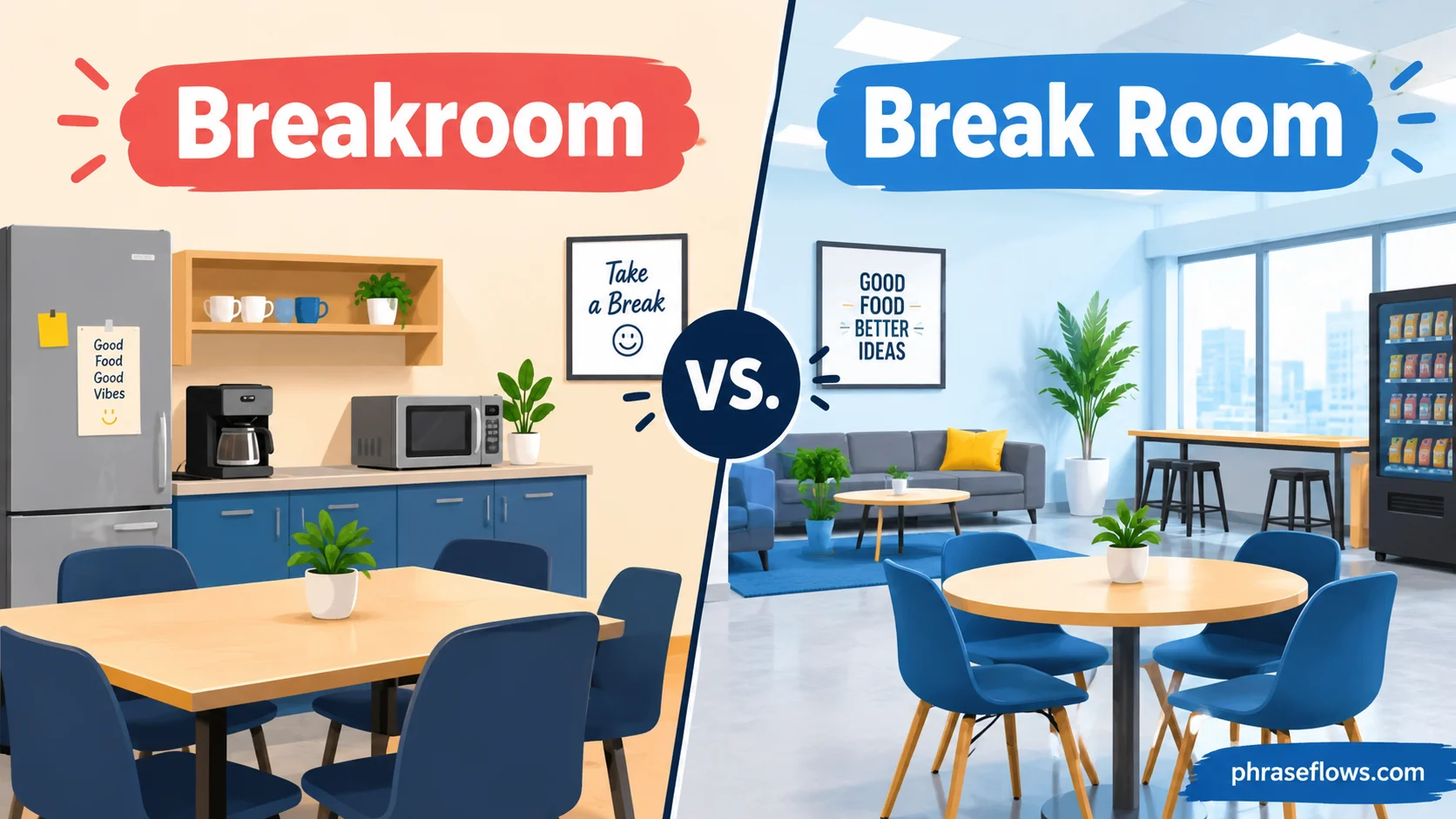

The English language has many words that can be written together or separately, which can sometimes cause confusion. One common example is breakroom vs. break room. Both forms are used to describe a place where employees can relax, eat, or take a short break during work. However, knowing which spelling to choose can make your writing clearer and more consistent.
The main difference between breakroom and break room is their spelling. Break room, written as two words, is widely used in general English writing, while breakroom appears in some workplace materials, company documents, and informal contexts. The preferred form may depend on the dictionary or style guide you follow. Checking your chosen reference can help you use the correct form for your audience and situation.
Understanding breakroom vs. break room is useful when writing emails, workplace notices, reports, or everyday sentences. For example, you might write, “The staff gathered in the break room after lunch.” If your organization prefers breakroom as one word, follow that style consistently. Learning how both forms are used will help you avoid spelling mistakes and communicate your message with confidence.
Breakroom vs. Break Room: The Quick Answer
The main difference between breakroom and break room is their spelling, not their meaning. Both expressions describe a designated area where people can spend time during a break from work.
However, the two forms don’t have exactly the same standing in general writing. Break room is the widely established open compound, while breakroom is a recognized alternative. Dictionary.com lists breakroom with break room as an alternative spelling.
Dictionary.com
+1
Here’s a quick comparison.
| Feature | Break Room | Breakroom |
| Spelling | Two words | One word |
| Meaning | A room used for work breaks | A room used for work breaks |
| Word type | Open compound noun | Closed compound noun |
| General American English | Preferred standard form | Accepted variant |
| Professional writing | Recommended default | Use when the chosen style supports it |
| Example | Employees ate lunch in the break room. | Employees ate lunch in the breakroom. |
Quick rule: Use break room unless your organization’s style guide or established naming convention calls for breakroom.
You don’t need to change the meaning of your sentence when switching between these spellings. The choice simply reflects a spelling preference.
What Does Break Room Mean?
A break room is a designated space where employees can step away from their regular duties for a short period. People commonly use it to eat, drink coffee, relax, or chat with coworkers.
You might find a break room in an office building, factory, hospital, warehouse, retail store, or school. Its size and facilities depend on the workplace, but its main purpose is to give people a place to take breaks.
For example, a small office might provide a table, chairs, a refrigerator, and a microwave. A larger workplace might also have vending machines, a coffee station, comfortable seating, and lockers.
Common uses of a break room
People use a break room for several everyday activities:
- Eating meals: Employees can sit down for lunch or enjoy a snack between tasks.
- Drinking coffee or tea: A coffee station gives coworkers a convenient place to prepare drinks.
- Relaxing: Workers can take a short pause away from their desks or workstations.
- Socializing: Coworkers can talk casually without interrupting meetings or focused work.
- Taking scheduled breaks: Employees can use the room during their designated rest periods.
- Sharing workplace information: Some employers display notices, schedules, or announcements in the room.
A break room doesn’t have to be large or elaborate. Even a simple room with a few chairs and a table can serve its purpose.
Break room in everyday sentences
Here are some natural examples:
- I left my lunch in the break room refrigerator.
- The manager asked everyone to keep the break room clean.
- We usually drink coffee in the break room before our afternoon shift.
- There’s a new microwave in the break room.
- She met her coworker in the break room during lunch.
- Please put your dishes away before leaving the break room.
Each example uses break room as a noun describing a physical place. The two words work together to identify the room’s purpose.
What Does Breakroom Mean?
Breakroom is the closed-compound spelling of the same workplace term. It refers to a room where employees can rest, eat, or spend time during a break.
The spelling joins break and room into a single word. This doesn’t create a new meaning or describe a different kind of facility.
For instance, the sentence below uses the closed form:
The employees gathered in the breakroom before their shift began.
The sentence communicates the same idea as The employees gathered in the break room before their shift began.
Dictionary.com recognizes breakroom as an entry and gives break room as an alternative spelling. This supports treating the one-word form as a variant rather than automatically labeling it a mistake.
Dictionary.com
+1
Where does the spelling breakroom appear?
You may encounter breakroom in several contexts:
- Informal workplace messages: An employee might write, “I’ll leave the documents in the breakroom.”
- Internal company materials: Some organizations use the closed form consistently.
- Product descriptions: Businesses may use the term when describing coffee makers, refrigerators, or other workplace supplies.
- Online articles: Writers and publishers sometimes choose the one-word version.
- Signs and labels: A workplace may use Breakroom on a sign or in a facility label.
Seeing breakroom in a company document doesn’t mean the organization has made an error. It may reflect its preferred spelling.
Nevertheless, if you’re writing for a general audience and don’t have a specific style guide to follow, break room remains the practical default.
Breakroom vs. Break Room: Understanding Compound Nouns
Why do we write bedroom as one word but living room as two? The answer lies in how English compound nouns develop and how dictionaries record their established spellings.
A compound noun combines two or more words to express a single idea. Depending on the word, writers may spell the compound as one word, two words, or occasionally with a hyphen.
Consider these examples:
| Compound noun | Spelling type | Example |
| Bedroom | Closed compound | The bedroom needs new curtains. |
| Classroom | Closed compound | The classroom is ready. |
| Living room | Open compound | We watched a movie in the living room. |
| Dining room | Open compound | Dinner is in the dining room. |
| Break room | Open compound | She left her notebook in the break room. |
| Breakroom | Closed compound variant | He went to the breakroom for coffee. |
The important point is that English doesn’t have one universal rule for joining compound nouns. Some combinations become single words over time, while others retain their spaces. Dictionaries and established editorial practices help writers choose the appropriate form.
Why does break room have two spellings?
The word break can refer to a short period of rest or an interruption in an activity. The word room refers to a space within a building.
Together, they form a compound noun that describes a room intended for breaks. The meaning remains clear whether the words appear separately or as a single word.
Dictionary.com recognizes both spellings, and other dictionary references identify breakroom as a less common variant.
Dictionary.com
+1
This is why you shouldn’t automatically treat every closed compound as an improvement over its open form. The spelling depends on established usage rather than personal preference alone.
Break Room vs. Breakroom: Which Spelling Should You Use?
Choosing the right spelling becomes easier when you consider where and why you’re writing.
For most everyday and professional writing, break room is the best default. It works well in articles, workplace policies, employee handbooks, business emails, and school assignments.
The closed form breakroom may also be appropriate when an organization uses it consistently or when you need to match an existing name or document.
Use break room in these situations
Choose the two-word spelling when you’re:
- Writing a formal report or business proposal.
- Preparing an employee handbook or workplace policy.
- Publishing an article for a general American audience.
- Completing a school assignment.
- Writing instructions for employees or visitors.
- Unsure which spelling your publication prefers.
For example:
Employees must keep the break room clean and return shared dishes to the kitchen area.
The wording is direct, clear, and suitable for a workplace policy.
When is breakroom appropriate?
The closed form can work when it matches the established style of a business, publication, or internal document.
For example:
The company recently renovated its breakroom and installed new coffee machines.
This sentence is understandable, and the spelling reflects a recognized variant. There’s no need to change it solely because the word appears without a space.
A practical workplace example
Imagine a company updating its employee handbook. The old version uses breakroom in several sections, while the new version uses break room throughout.
Neither spelling necessarily changes the policy’s meaning. However, switching between the two forms without a reason can make the handbook look inconsistent.
The editorial solution is simple:
- Select the preferred spelling.
- Apply it consistently across the document.
- Follow the company’s style guide when one exists.
- Review headings, signs, captions, and body text before publishing.
Consistency matters more than repeatedly switching between two recognized variants.
Examples of Break Room and Breakroom in Sentences
Seeing both forms in context makes their relationship easier to understand. The examples below show how each spelling works in everyday American English.
Examples using break room
The following sentences use the standard two-word form.
- The employees gathered in the break room before the morning meeting.
- I left my water bottle on the table in the break room.
- Our office has a small break room with a refrigerator and microwave.
- Please turn off the coffee maker before leaving the break room.
- The manager posted the updated schedule outside the break room.
- We discussed the new project during lunch in the break room.
- The company added comfortable chairs to the break room.
- A notice on the break room door explains the cleaning schedule.
Notice how break room functions as a single unit of meaning. The word break describes the room’s purpose, while room identifies the place.
Examples using breakroom
These examples illustrate the accepted closed spelling.
- The staff gathered in the breakroom after their shift.
- New coffee supplies are stored in the breakroom cabinet.
- The company renovated its breakroom last summer.
- A cleaning checklist hangs inside the breakroom.
- The breakroom has enough seating for several employees.
The sentences communicate the same ideas as their two-word equivalents. The difference lies in spelling rather than grammar or meaning.
Common spelling mistakes and corrections
| Sentence | Recommendation | Explanation |
| Employees ate lunch in the break room. | Correct | Uses the standard open compound. |
| Employees ate lunch in the breakroom. | Acceptable | Uses the recognized closed variant. |
| Employees ate lunch in the break-room. | Usually avoid | The hyphen is generally unnecessary. |
| The break room is clean, but the breakroom needs supplies. | Revise for consistency | Use one spelling throughout unless there’s a clear reason to distinguish them. |
| Please clean the break room before leaving. | Correct | Clear and natural workplace writing. |
One detail deserves attention: the hyphenated form break-room is generally unnecessary when the expression functions as an ordinary noun. Unless a specific style guide requires it, choose break room or the recognized variant breakroom.
Break Room vs. Similar Workplace Terms
A break room is not the only place where employees can eat, relax, or spend time away from their desks. Several related terms describe similar spaces, but their meanings aren’t always interchangeable.
Understanding these differences helps you choose the most accurate word for your sentence.
Conclusion:
Understanding Breakroom vs. Break Room: Which Spelling Is Correct? helps you write more clearly and avoid confusion. Both forms are used to describe a place where employees can relax, eat, or take a short break at work. However, break room, written as two words, is widely preferred in general English writing, while breakroom appears in some workplace materials and organizational styles. When choosing between them, check your dictionary or style guide and stay consistent throughout your writing. Using the appropriate spelling makes your workplace emails, reports, and notices easier to read and understand.
FAQs:
Is breakroom one word or two?
Break room is commonly written as two words in general English. However, breakroom is also used by some organizations and businesses.
Is break room the correct spelling?
Yes, break room is a widely accepted spelling. It refers to a place where employees can relax, eat, or take a break during work.
What is the difference between breakroom and break room?
The main difference is the spelling. Breakroom combines the words, while break room keeps them separate. Both forms refer to the same type of workplace space.
Should I write breakroom or break room in a professional email?
In most professional writing, break room is a safe choice. However, follow your organization’s preferred spelling if its internal documents use breakroom.
What is an example of break room in a sentence?
Here is an example: “The employees gathered in the break room to enjoy their lunch.” The sentence uses the two-word form to describe a shared workplace area.




1 thought on “Breakroom vs. Break Room: Which Spelling Is Correct?”