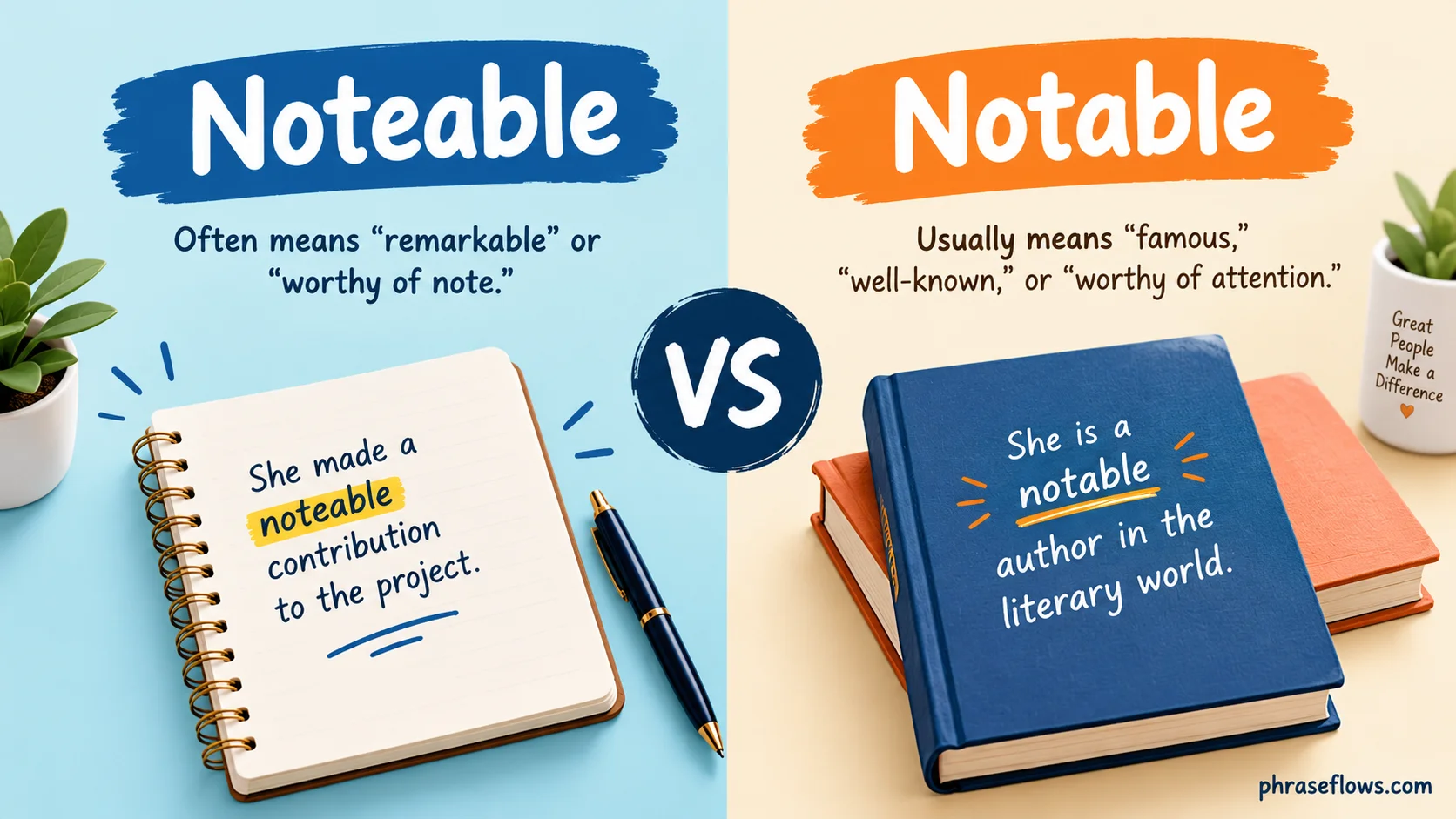

Noteable vs. notable is an easy spelling mix-up. At first glance, noteable looks reasonable because it resembles the word note. However, the standard English spelling is notable, without the extra e.
If you’re writing an essay, email, report, article, or professional document, use notable. Dictionaries recognize notable as an adjective meaning important, interesting, or worthy of attention. It can also function as a noun in a more formal or literary sense for an important or famous person.
The difference is only one letter, but that letter matters. Notable is the correct form, while noteable is generally a spelling error. This guide explains the difference, meaning, pronunciation, grammar, examples, related words, and the situations where notable works best.
Noteable vs. Notable: Which One Is Correct?
Notable is the correct spelling.
Noteable is not the standard spelling of the English word. If you see noteable in ordinary writing, it is usually an accidental extra e.
| Spelling | Correct? | Meaning |
| Notable | ✅ Yes | Important, interesting, or worthy of attention |
| Noteable | ❌ No | Common misspelling of notable |
| Notably | ✅ Yes | Especially or importantly; the adverb form of notable |
For example:
- Correct: She made a notable contribution to the project.
- Incorrect: She made a noteable contribution to the project.
The correct spelling is straightforward: N-O-T-A-B-L-E.
Cambridge Dictionary defines notable as something important and deserving attention, particularly because it is very good or interesting. It also records notable as a noun for an important or famous person.
Quick Answer
Notable is correct. Noteable is incorrect.
That is the key distinction to remember.
What Does Notable Mean?
Notable is primarily an adjective. You use it to describe someone or something that deserves attention because of its importance, quality, achievement, or distinctive nature.
For example:
- She had a notable career in medicine.
- The museum contains a notable collection of paintings.
- There was a notable improvement in the team’s performance.
- The report identifies several notable differences.
- He made a notable contribution to the community.
The word doesn’t necessarily mean famous. Something can be notable because it is especially important or interesting even when relatively few people know about it.
Cambridge gives examples such as a notable collection, a notable achievement, and something being notable for a particular feature.
The Core Idea Behind Notable
Think of notable as meaning:
“This deserves your attention.”
That attention might come from importance, quality, achievement, unusual characteristics, or historical significance.
For example, a small local library might have a notable collection of rare manuscripts. The collection doesn’t need to be famous worldwide. Its unusual value makes it worthy of attention.
Why Is “Noteable” Incorrect?
The spelling noteable seems tempting because English contains the word note. Someone might naturally reason that note + able should become noteable.
That reasoning doesn’t produce the standard spelling of this word.
The established English word is notable, with the letters arranged as:
not + able → notable
You should not insert an additional e between the t and a.
This is one of those spelling traps where a familiar word creates a misleading visual pattern. English has many words whose spelling can’t be predicted simply by attaching a suffix to another familiar word.
A Simple Way to Remember It
Remember this:
Notable has one “e” after the “l,” not before the “a.”
Correct:
notable
Incorrect:
noteable
If you’re unsure while writing, check the spelling before submitting your work. In formal writing, the extra e can make an otherwise polished sentence look careless.
Why Do People Spell Notable as “Noteable”?
The error is understandable. English spelling often contains patterns that encourage reasonable-looking guesses.
One major source of confusion is the word note.
Because note is spelled n-o-t-e, writers sometimes carry that final e into notable. The resulting spelling looks familiar:
note + able = noteable
But English doesn’t use that spelling for the adjective notable.
Another factor is pronunciation. The word doesn’t clearly announce every letter in its spelling when spoken. Cambridge lists the US pronunciation as approximately /ˈnoʊ.t̬ə.bəl/.
That means the spelling needs to be learned visually as well as through pronunciation.
A Useful Memory Trick
Associate notable with note-worthy rather than with note.
If something is notable, it is worthy of notice.
So remember:
Notable = worthy of notice.
That connection makes the correct spelling easier to recall.
Notable: Meaning, Part of Speech, and Word Forms
The most common use of notable is as an adjective.
Notable as an Adjective
As an adjective, notable describes something important, distinguished, interesting, or worthy of attention.
Examples:
- She achieved a notable result.
- The building has several notable architectural features.
- His research produced a notable breakthrough.
- There has been a notable change in public opinion.
Notable as a Noun
In formal or literary English, notable can also work as a noun.
In this sense, a notable is an important or famous person.
For example:
- Several local notables attended the ceremony.
- The event attracted political and cultural notables.
Cambridge specifically records this noun usage and defines it as an important or famous person.
Notably as an Adverb
Notably is the adverb form.
It means especially, importantly, or in a way that deserves attention.
For example:
- Several countries participated, notably Canada and Japan.
- The company has grown notably over the past year.
- The new version is notably faster.
Cambridge classifies notably as an adverb and gives uses such as “most notably” for highlighting an especially important example.
How to Use Notable Correctly
The word notable works naturally in several common sentence patterns.
Notable Before a Noun
The most familiar structure places notable directly before a noun.
Examples:
- a notable achievement
- a notable difference
- a notable figure
- a notable contribution
- a notable exception
- a notable increase
- a notable feature
- a notable event
This construction is common in academic, journalistic, business, and everyday writing.
Notable After a Linking Verb
You can also use notable after verbs such as is, was, seems, and became.
Examples:
- Her contribution was notable.
- The improvement was particularly notable.
- The difference became notable after several months.
- His performance was notable for its consistency.
Notable for
The pattern notable for is especially useful when explaining why something deserves attention.
Examples:
- The region is notable for its diverse wildlife.
- The building is notable for its unusual design.
- The study is notable for its large sample size.
- The author is notable for her detailed historical research.
Cambridge specifically lists notable for as a standard usage pattern.
Notable vs. Notably
Although notable and notably look almost identical, they have different grammatical jobs.
| Word | Part of speech | Main function | Example |
| Notable | Adjective | Describes a noun | It was a notable achievement. |
| Notably | Adverb | Modifies a verb, adjective, or statement | The results notably improved. |
Consider these two sentences:
She made a notable contribution.
Here, notable describes the contribution.
She contributed notably to the project.
Here, notably modifies the way she contributed.
The distinction becomes easier when you identify what the word modifies.
Notable usually describes a person or thing.
Notably describes how, to what degree, or in what especially important respect something happens or stands out.
Notable vs. Noticeable
Notable and noticeable overlap in meaning, but they aren’t perfect substitutes.
Notable usually emphasizes importance, distinction, or significance.
Noticeable focuses more directly on something being easy to see, hear, detect, or perceive.
| Word | Main idea | Example |
| Notable | Worthy of attention because it matters or stands out | She made a notable contribution. |
| Noticeable | Easy to detect or perceive | There was a noticeable change in his voice. |
For example, a scientist might make a notable discovery because the discovery matters greatly.
Meanwhile, a small change in temperature might be noticeable even if it has little broader significance.
Compare These Sentences
Notable:
The researcher made a notable contribution to cancer research.
The emphasis is on the importance of the contribution.
Noticeable:
There was a noticeable change in the patient’s voice.
The emphasis is on the fact that the change could clearly be detected.
The words can sometimes overlap, but the emphasis differs.
Notable vs. Famous
It’s tempting to treat notable and famous as synonyms. That’s not always accurate.
Famous means known and recognized by many people.
Notable means worthy of attention because of importance, quality, achievement, or interest.
Someone can therefore be notable without being famous.
Imagine a university researcher whose work significantly advances a narrow scientific field. The researcher may be notable among specialists without being a household name.
Likewise, a historical document can be notable because of its importance even if the general public has never heard of it.
The Difference in One Line
Famous = widely known.
Notable = worthy of attention.
Those ideas can overlap, but they aren’t identical.
Notable vs. Remarkable
Remarkable is another close synonym.
Cambridge defines remarkable as something unusual or special that is therefore surprising and worth mentioning.
The distinction often comes down to emphasis.
- Notable → important or worthy of attention.
- Remarkable → unusual, impressive, or surprising.
Compare:
The historian made a notable contribution to the field.
This sounds measured and professional.
The historian made a remarkable contribution to the field.
This sounds stronger and more expressive.
In academic writing, notable can be useful when you want to recognize importance without sounding overly enthusiastic.
Common Mistakes With Notable
Several errors regularly appear around this word.
Writing “Noteable”
Incorrect:
The study produced a noteable result.
Correct:
The study produced a notable result.
The extra e doesn’t belong in the standard spelling.
Confusing Notable With Noticeable
Incorrect in a context focused on significance:
The discovery was noticeable for changing the field.
Better:
The discovery was notable for changing the field.
If you’re talking about something that can easily be detected, however, noticeable may be the better choice.
Using Notably Instead of Notable
Incorrect:
She received a notably award.
Correct:
She received a notable award.
An award is a noun. It needs the adjective notable here.
You could use notably in a different structure:
She performed notably well during the competition.
Assuming Notable Always Means Famous
A person doesn’t have to be globally famous to be notable.
For example:
The professor is a notable expert in medieval architecture.
The sentence emphasizes professional distinction. It doesn’t necessarily claim that millions of people know the professor.
Noteable vs. Notable Examples
Examples make the spelling distinction much easier to remember.
Correct Examples With Notable
- The university has a notable history of scientific research.
- She made a notable contribution to the project.
- The report identified several notable differences.
- His work represents a notable achievement.
- The museum contains a notable collection of manuscripts.
- There was a notable improvement in performance.
- The building is notable for its unusual architecture.
- He became a notable figure in the industry.
- The proposal contains several notable advantages.
- The team achieved a notable victory.
Incorrect Examples With Noteable
These examples contain the common spelling error:
- ❌ The researcher made a noteable discovery.
- ❌ She achieved a noteable result.
- ❌ The building has a noteable design.
- ❌ There was a noteable improvement.
- ❌ He became a noteable figure.
Correct them by removing the unnecessary e:
- ✅ The researcher made a notable discovery.
- ✅ She achieved a notable result.
- ✅ The building has a notable design.
- ✅ There was a notable improvement.
- ✅ He became a notable figure.
Noteable vs. Notable: Quick Comparison
| Feature | Notable | Noteable |
| Standard spelling | ✅ Yes | ❌ No |
| Standard dictionary word | ✅ Yes | ❌ No |
| Common use | Adjective and sometimes noun | Spelling error |
| Meaning | Important, interesting, or worthy of attention | — |
| Example | A notable achievement | A noteable achievement ❌ |
| Use in formal writing | Recommended | Avoid |
The simplest rule is:
Always choose notable when you mean worthy of attention or recognition.
How to Remember the Correct Spelling of Notable
Spelling becomes easier when you attach the word to an idea rather than memorizing isolated letters.
Try this connection:
Notable → worthy of notice
The word notice can help you remember the concept. If something deserves your attention, it can be notable.
Another useful trick is to visualize the word without the extra e:
NOTABLE
Then compare it with the common mistake:
NOTEABLE ❌
The incorrect version looks as though note has simply been joined to able. That’s precisely what makes it tempting.
When in doubt, remember that the standard word is notable, not noteable.
Notable in American English
Notable is standard in American English. The spelling does not require an American-specific change.
British English also uses notable.
The pronunciation differs somewhat between US and UK English, but the spelling remains the same. Cambridge lists the US pronunciation as /ˈnoʊ.t̬ə.bəl/ and the UK pronunciation as /ˈnəʊ.tə.bəl/.
So whether you’re writing for an American, British, Canadian, or other English-speaking audience, notable is the safe standard spelling.
Pronunciation of Notable
In American English, notable is pronounced approximately:
/ˈnoʊ.t̬ə.bəl/
The first syllable receives the main stress.
The pronunciation can vary slightly across English varieties, but the spelling remains notable. Cambridge distinguishes the US and UK pronunciations while retaining the same written form.
Pronunciation also helps explain why the spelling can cause confusion. The spoken word doesn’t make the written sequence immediately obvious to every learner.
That’s why remembering the visual form notable is useful.
Synonyms for Notable
The best synonym depends on what you want to emphasize.
| Synonym | Best used when you mean… |
| Significant | Important or meaningful |
| Remarkable | Unusual or impressive |
| Prominent | Important, well-known, or highly visible |
| Distinguished | Respected because of achievement or status |
| Important | Having substantial value or effect |
| Exceptional | Unusually good or different |
| Memorable | Likely to be remembered |
| Noteworthy | Deserving attention |
For example, significant often emphasizes importance or impact. Cambridge defines it as meaning important or noticeable in relevant contexts.
Remarkable, by contrast, often adds the idea of something being unusual or surprising.
Prominent can emphasize fame, importance, or visibility.
Meanwhile, noteworthy is extremely close to notable and means deserving attention because something is important or interesting.
Choosing the Right Synonym
Consider the sentence:
She made a notable contribution.
You could replace notable with significant if the contribution had an important impact.
You could use remarkable if you want to stress how unusual or impressive it was.
You could use distinguished if you’re emphasizing the person’s high level of achievement or reputation.
The words overlap, but each one adds a slightly different shade of meaning.
Antonyms of Notable
The opposite of notable depends on the context.
Possible antonyms include:
- Unremarkable
- Ordinary
- Insignificant
- Inconspicuous
- Minor
- Unimportant
For example:
The event was notable for its historical importance.
A natural opposite might be:
The event was unremarkable and attracted little attention.
However, there isn’t one universal antonym for every use of notable. Context determines the best choice.
Notable in Common Phrases and Expressions
Certain combinations with notable appear frequently in polished English.
A Notable Achievement
This describes an accomplishment worthy of recognition.
Winning the award was a notable achievement.
A Notable Difference
This highlights a meaningful or clearly important distinction.
Researchers observed a notable difference between the two groups.
A Notable Figure
This describes someone important or distinguished in a particular field.
She became a notable figure in modern architecture.
A Notable Exception
This identifies an exception that deserves special attention.
Most departments followed the policy, with one notable exception.
A Notable Contribution
This describes work that makes an important contribution to a field, organization, or project.
His research made a notable contribution to environmental science.
A Notable Increase
This indicates a meaningful rise.
The company recorded a notable increase in sales.
Notable for
This structure identifies the particular reason something deserves attention.
The city is notable for its historic architecture.
These patterns make notable particularly useful in essays, reports, journalism, academic writing, and professional communication.
A Practical Case Study: Choosing Between Notable and Noticeable
Consider a sentence describing a research project:
The researchers observed a notable change in the results.
This suggests that the change matters or deserves attention.
Now consider:
The researchers observed a noticeable change in the results.
This emphasizes that the change was easy to detect.
The difference may seem tiny. However, the choice affects the sentence’s meaning.
If the writer wants to emphasize importance, notable is stronger.
If the writer wants to emphasize detectability, noticeable is more precise.
That distinction becomes valuable when writing academically or professionally because precise word choice can prevent ambiguity.
Read More: Unkept vs. Unkempt: Difference and Usage
Why Correct Spelling Matters
A single extra letter can change how polished your writing appears.
When readers encounter noteable, they may understand what you mean. However, they can also recognize it as a spelling mistake. In formal writing, repeated spelling errors can distract from otherwise strong ideas.
Using notable correctly keeps your writing clean and conventional.
This matters especially in:
- School assignments
- College essays
- Research papers
- Business reports
- Resumes
- Cover letters
- Website content
- Professional emails
- Editorial writing
Correct spelling isn’t merely cosmetic. It helps readers focus on your message rather than stopping to question the wording.
Conclusion:
Understanding the difference between noteable and notable is simple once you learn the correct spelling. Notable is the standard and accepted spelling in American English. It describes someone or something that deserves attention because of its importance, achievements, or unusual qualities. Noteable is a common misspelling and should be avoided in formal writing, academic work, and professional communication.
For example, you should write, “She made a notable contribution to the project,” rather than “She made a noteable contribution to the project.” Remember that notable drops the e from note before adding -able. Using the correct spelling helps your writing look polished, clear, and professional.
FAQs:
Is It Noteable or Notable?
Notable is the correct spelling. Noteable is a misspelling that people sometimes use because they associate the word with note.
What Does Notable Mean?
Notable means worthy of attention or notice because of importance, distinction, or achievement. For example, “The scientist made a notable discovery.”
Why Is Noteable Incorrect?
Noteable is incorrect because standard English uses notable for this meaning. The accepted spelling doesn’t retain the e from note.
How Do You Use Notable in a Sentence?
You can use notable to describe a person, achievement, event, or feature that deserves attention. For example, “The city is known for its notable historical landmarks.”
What Is a Synonym for Notable?
Common synonyms for notable include remarkable, significant, prominent, distinguished, and ** noteworthy**. Choose the synonym that best fits your sentence and intended meaning.




1 thought on “Noteable vs. Notable: Correct Spelling and Usage”