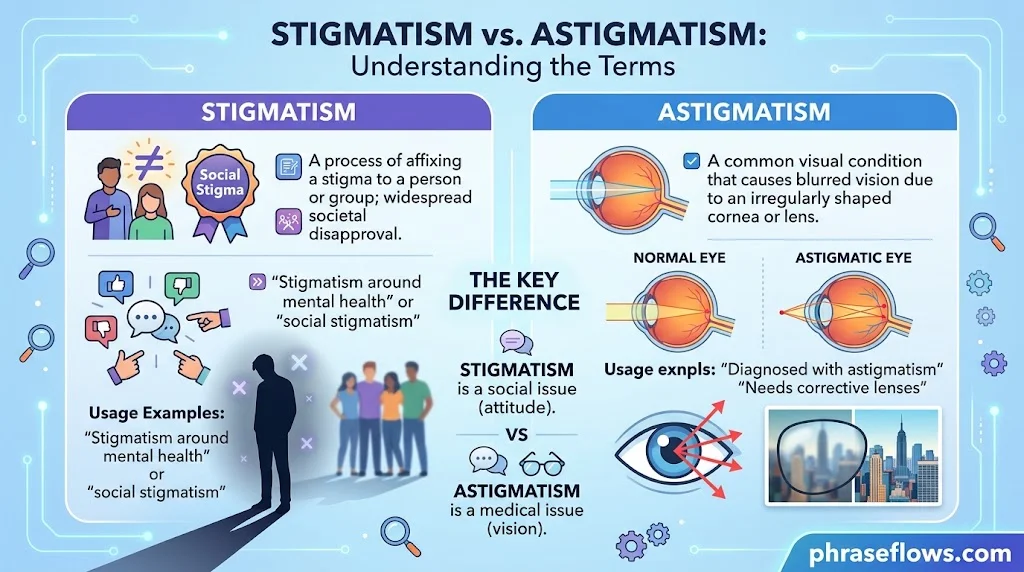

Have you ever heard someone say they have stigmatism when talking about their eyesight? You’re not alone. These two words look similar, sound somewhat alike, and can easily cause confusion. However, when you’re discussing a common vision condition, astigmatism is the correct medical term.
The difference between stigmatism and astigmatism goes beyond a single letter. Astigmatism describes a refractive error that affects how the eye focuses light. By contrast, stigmatism isn’t the standard medical term for this condition, although the word may appear in specialized or historical contexts. Understanding the distinction helps you write accurately, communicate clearly with an eye-care professional, and avoid a common spelling mistake.
Whether you’re checking the correct spelling, learning the meaning, or trying to understand an eye prescription, this guide explains the difference with simple definitions, practical examples, and useful facts.
Stigmatism vs. Astigmatism: What Is the Difference?
The main difference between stigmatism and astigmatism is their meaning and accepted usage. When referring to the eye condition that can make objects appear blurry or distorted, astigmatism is the established medical term.
People sometimes drop the first letter a when saying or writing the word. This mistake may spread through casual conversations, online searches, and everyday discussions about glasses. However, the familiar mistake doesn’t make stigmatism an interchangeable spelling of astigmatism.
Here’s a quick comparison:
| Feature | Stigmatism | Astigmatism |
| Correct term for the eye condition | No | Yes |
| Standard medical usage | Not the accepted name for this condition | Widely accepted medical term |
| Meaning | An uncommon word with specialized or historical uses related to stigma | A refractive error involving the eye’s focusing system |
| Common context | Mistaken usage or specialized discussions | Eye examinations, prescriptions, and vision care |
| Correct example | Avoid using it for the eye condition | “My optometrist diagnosed me with astigmatism.” |
| Spelling | Stigmatism | Astigmatism |
The simple rule: If you’re talking about a vision problem that affects how the eye focuses light, use astigmatism.
For example, write, “I wear glasses because I have astigmatism,” rather than, “I wear glasses because I have stigmatism.” The first sentence uses the standard medical term.
What Does Astigmatism Mean?
Astigmatism is a common refractive error that occurs when the cornea or the lens inside the eye has an irregular curvature. This shape affects how light bends as it enters the eye, preventing it from focusing properly on the retina.
The retina is the light-sensitive tissue at the back of the eye. It receives focused light and helps convert it into signals that the brain interprets as images. When the eye doesn’t focus light correctly, objects may look blurry or distorted.
Think of the eye as a camera. A camera needs its lens to focus light correctly to produce a sharp picture. Similarly, your eye relies on the cornea and lens to direct light toward the retina. If their curvature varies in a way that affects focusing, the resulting image may lack clarity.
According to the American Optometric Association, astigmatism can result from an irregularly shaped cornea or from the curvature of the eye’s internal lens.
Astigmatism can affect people of different ages. Some people have a mild degree that causes few noticeable problems, while others experience blurred vision that requires correction.
Common Symptoms of Astigmatism
Astigmatism doesn’t cause the same symptoms in everyone. Some people notice vision problems during everyday activities, while others discover the condition during a routine eye examination.
Common symptoms include:
- Blurred vision: Objects may look unclear at close or distant ranges.
- Distorted vision: Letters, lines, or shapes may appear stretched or uneven.
- Headaches: Visual effort can contribute to headaches, particularly after prolonged focusing.
- Eyestrain: Reading, studying, or using a computer may leave your eyes feeling tired.
- Squinting: You may squint in an attempt to make objects appear clearer.
- Difficulty seeing clearly at night: Some people notice reduced clarity or visual distortion in dim conditions.
These symptoms don’t automatically mean you have astigmatism. Other vision problems can produce similar effects, so an eye examination is the best way to identify the cause.
For example, a student who struggles to read text on a classroom board may have astigmatism, nearsightedness, or another vision issue. The symptom alone doesn’t establish a diagnosis.
What Causes Astigmatism?
Astigmatism usually relates to the shape of the cornea or the internal lens. Instead of having a curvature that focuses light evenly, one or both structures may bend light differently across various directions.
Several factors can contribute to astigmatism:
- Natural eye development: Astigmatism commonly develops during childhood.
- Genetics: Family history can influence the likelihood of having the condition.
- Eye injury: Damage to the eye may change its shape or focusing characteristics.
- Eye surgery: Certain surgical procedures can alter corneal curvature.
- Underlying eye conditions: Keratoconus, a condition in which the cornea becomes thinner and bulges outward, can cause irregular astigmatism.
In many cases, the exact reason for an individual’s eye shape isn’t clear. Astigmatism can also change over time, which makes regular eye examinations useful.
One common misconception is that reading in dim light, sitting close to a television, or using a phone causes astigmatism. These activities aren’t established causes of the condition.
How Is Astigmatism Diagnosed and Corrected?
An optometrist or ophthalmologist can diagnose astigmatism through a comprehensive eye examination. The examination helps determine whether your eyes focus light correctly and whether corrective lenses could improve your vision.
Depending on your needs, the examination may include:
- Visual acuity testing: Reading letters or identifying symbols on an eye chart helps assess how clearly you see.
- Refraction testing: The professional checks different lens strengths to determine which correction provides clearer vision.
- Corneal curvature measurements: Instruments such as a keratometer measure the curvature of the cornea.
- Corneal mapping: In some cases, corneal topography creates a detailed map of the corneal surface.
Treatment depends on the degree of astigmatism, its effect on your vision, and your individual circumstances.
Common options include:
- Prescription glasses: Specially designed lenses compensate for the eye’s focusing error.
- Contact lenses: Toric soft lenses and certain rigid lenses can correct astigmatism.
- Refractive surgery: Selected people may qualify for procedures that change the cornea’s shape to improve focusing.
Mild astigmatism may not require correction if it doesn’t affect vision significantly. However, an eye-care professional should determine whether treatment is appropriate, especially for children whose visual development may be affected.
For further information, consult Moorfields Eye Hospital’s guide to astigmatism diagnosis and treatment.
What Does Stigmatism Mean?
The word stigmatism is much less common than astigmatism, particularly in modern medical writing. It isn’t the accepted medical name for the refractive error discussed in this article.
The word’s form is related to stigma, a term that can describe a mark or, in social contexts, a negative label attached to a person or group. In specialized or historical contexts, stigmatism may refer to concepts associated with stigma or marking. Its precise meaning depends on the context in which it appears.
This distinction matters because similar-looking words don’t necessarily share the same definition. The presence or absence of the initial a changes which term you’re using.
If you’re writing about blurred vision, eye examinations, glasses, or contact lenses, astigmatism is the word you need. If you encounter stigmatism in an older text or a specialized discussion, check the surrounding context before deciding what the author means.
Is Stigmatism a Real Word?
Stigmatism may appear in specialized, historical, or technical contexts, but it isn’t the standard term for the common refractive error of the eye.
That distinction is more useful than simply labeling the word universally wrong. A word can have a legitimate use in one context while being incorrect in another.
Consider these examples:
- Incorrect for the eye condition: “The eye doctor diagnosed him with stigmatism.”
- Correct for the eye condition: “The eye doctor diagnosed him with astigmatism.”
- Context-dependent usage: A specialized text may use stigmatism in a discussion related to stigma or marking.
When editing an article about vision, use astigmatism consistently. This choice follows established medical terminology and helps readers understand the information without confusion.
Stigmatism vs. Astigmatism: Spelling and Pronunciation
The easiest way to distinguish the two words is to pay attention to the beginning of astigmatism.
Astigmatism begins with the letter sequence a-s-t-i. By contrast, stigmatism begins with s-t-i. Leaving out the initial a creates the spelling confusion.
Because the words share most of their letters, the mistake can be easy to overlook during proofreading. A spell-checker may also fail to catch a real word used in the wrong context. That’s why checking the meaning matters as much as checking the spelling.
How Do You Spell Astigmatism Correctly?
The correct spelling is:
A-S-T-I-G-M-A-T-I-S-M: ASTIGMATISM
A useful memory trick is to associate the first letter A with astigmatism and eye care. This isn’t a medical rule, of course, but it can help you remember which spelling to use when discussing vision.
You can also remember the complete word in a familiar sentence:
“My eye examination showed that I have astigmatism.”
Writing the word in context makes it easier to recognize and remember than studying the letters in isolation.
How Is Astigmatism Pronounced?
In US English, astigmatism is commonly pronounced uh-STIG-muh-tiz-um. The strongest emphasis falls on the second syllable.
The word has several syllables, so people who haven’t encountered it often may shorten it or leave out the opening vowel sound. That can contribute to the mistaken form stigmatism.
When speaking with an eye-care professional, try to use the complete word. If you’re unsure how to pronounce it, you can also spell it out or refer to the term on your prescription.
Why Do People Confuse Stigmatism and Astigmatism?
Several factors help explain this common error:
- Similar spelling: Both words contain most of the same letters.
- An unfamiliar medical term: People may hear astigmatism long before they learn to spell it.
- Casual pronunciation: The opening vowel sound may be reduced in everyday speech.
- Word familiarity: People may recognize the word stigma and mistakenly connect it to the eye condition.
- Repeated online errors: A misspelling can become familiar when people encounter it in informal posts or search queries.
The solution is straightforward: learn the full spelling and connect it to its definition. Once you understand that astigmatism concerns how the eye focuses light, the correct term becomes easier to recall.
How to Use Astigmatism in a Sentence
The word astigmatism usually appears in discussions about eye health, vision testing, corrective lenses, and medical diagnoses. You can use it in formal writing as well as ordinary conversation.
Here are some examples:
- “My optometrist diagnosed me with astigmatism during a routine eye examination.”
- “Astigmatism can make letters appear blurred or distorted.”
- “She wears prescription glasses to correct her astigmatism.”
- “The optometrist checked for astigmatism before recommending contact lenses.”
- “A person can have astigmatism alongside nearsightedness.”
- “The student’s new glasses helped correct the vision problems caused by astigmatism.”
Each example uses the term to describe the refractive error or its correction.
Common Incorrect Uses of Stigmatism
The most common mistake occurs when someone uses stigmatism as a shortened form of astigmatism.
| Incorrect sentence | Correct sentence | Explanation |
| “I have stigmatism.” | “I have astigmatism.” | The correct medical term begins with a. |
| “Stigmatism makes my vision blurry.” | “Astigmatism makes my vision blurry.” | Astigmatism is the recognized term for this refractive error. |
| “My glasses correct my stigmatism.” | “My glasses correct my astigmatism.” | The corrected sentence uses standard eye-care terminology. |
| “The doctor tested me for stigmatism.” | “The doctor tested me for astigmatism.” | The second sentence accurately describes the vision assessment. |
| “Can contact lenses help with stigmatism?” | “Can contact lenses help with astigmatism?” | Certain contact lenses can correct astigmatism. |
Remember that the correction applies specifically when discussing the eye condition. If stigmatism appears in a specialized text with another meaning, evaluate that use separately rather than automatically replacing it.
Stigmatism vs. Astigmatism: Examples in Everyday Contexts
Understanding a definition is helpful, but seeing the word in real situations makes the distinction easier to apply.
Imagine someone notices that road signs look unclear while driving with a family member. The family member suggests getting an eye examination. If an optometrist identifies the refractive error, the conversation should use astigmatism.
The same rule applies in school assignments, health articles, online discussions, and prescription explanations.
| Situation | Example of correct usage |
| Medical appointment | “My doctor checked whether I have astigmatism.” |
| Eyeglass prescription | “My prescription includes a correction for astigmatism.” |
| Family conversation | “I have astigmatism, so I wear corrective lenses.” |
| School assignment | “Astigmatism is a refractive error that affects the eye’s focusing ability.” |
| Health article | “An eye examination can help identify astigmatism.” |
| Online search | “What are the symptoms of astigmatism?” |
A Practical Example: Correcting the Word in Context
Consider this short example.
Original sentence: “I visited an eye doctor because I thought I had stigmatism.”
Revised sentence: “I visited an eye doctor because I thought I had astigmatism.”
The revision corrects the terminology without changing the intended meaning. However, the sentence still describes a suspicion rather than a confirmed diagnosis. Only the eye examination can establish whether the person actually has astigmatism.
This small distinction demonstrates two useful writing habits: choose the correct word and avoid presenting an unconfirmed medical condition as a fact.
Read More: Breakroom vs. Break Room: Which Spelling Is Correct?
Astigmatism vs. Other Common Vision Terms
Astigmatism is one of several refractive errors. Although these conditions can produce similar symptoms, they don’t all involve the same focusing problem.
Understanding the differences helps you use medical terms accurately without treating them as interchangeable.
Astigmatism vs. Myopia
Myopia, commonly called nearsightedness, makes distant objects appear blurry. It generally occurs when the eye’s focusing power or length causes light to focus in front of the retina.
Astigmatism, by comparison, involves an irregular curvature of the cornea or lens that causes light to focus unevenly.
A person may have both conditions. For example, someone might struggle to read a classroom board because of myopia and also experience distortion caused by astigmatism.
Astigmatism vs. Hyperopia
Hyperopia, or farsightedness, is a refractive error in which nearby objects may be harder to see clearly. Depending on its degree, it can affect distance vision too.
Astigmatism differs because the eye’s curvature causes light to focus differently across various directions. Both conditions can occur in the same person and may require corrective lenses.
Astigmatism vs. Presbyopia
Presbyopia is an age-related change that makes it harder to focus on nearby objects. It develops as the eye’s internal lens becomes less flexible over time.
Astigmatism concerns the eye’s refractive shape, while presbyopia involves the reduced ability to adjust focus for close work.
These conditions can coexist. For instance, an older adult may need lenses that address both astigmatism and difficulty focusing on nearby text.
| Vision term | Main issue | Common effect |
| Astigmatism | Irregular curvature of the cornea or lens | Blurred or distorted vision |
| Myopia | Light focuses in front of the retina | Distant objects appear blurry |
| Hyperopia | Focusing power or eye length affects near vision | Nearby objects may appear blurry |
| Presbyopia | Reduced ability to focus at close range with age | Reading and other close tasks become harder |
These descriptions are simplified explanations. A comprehensive eye examination can identify which refractive errors are present and determine the appropriate correction.
Common Mistakes to Avoid When Writing Stigmatism and Astigmatism
Even a short spelling article can become misleading if it treats related terms as identical. Keep these points in mind when writing about the difference.
- Don’t omit the initial A. Use astigmatism when referring to the eye condition.
- Don’t treat similar spelling as proof of identical meaning. The two forms aren’t interchangeable in medical writing.
- Don’t diagnose from symptoms alone. Blurred vision and headaches can have several causes.
- Don’t confuse astigmatism with stigma. They serve different purposes in ordinary usage.
- Don’t assume every case requires treatment. Mild astigmatism may not significantly affect vision.
- Don’t suggest that screen use causes astigmatism. Ordinary reading and screen use aren’t established causes of the condition.
- Don’t promise that one treatment suits everyone. The right correction depends on the individual’s eyes and vision needs.
For clear writing, define the term once, use it consistently, and support medical claims with reliable sources. The NHS overview of astigmatism provides a useful starting point for understanding symptoms and common treatments.
Conclusion:
The difference between stigmatism and astigmatism comes down to spelling, meaning, and usage. Astigmatism is the correct medical term for a common refractive error that affects how the eye focuses light. It can cause blurred or distorted vision and may be corrected with glasses, contact lenses, or suitable surgical procedures.
Although stigmatism may appear in specialized or historical contexts, it isn’t an alternative spelling of the eye condition. Remember the initial A in astigmatism to avoid this common mistake. Whether you’re writing an article, discussing an eye prescription, or learning about vision problems, using the correct term helps you communicate clearly and accurately.
FAQs:
Is It Stigmatism or Astigmatism?
Astigmatism is the correct term when referring to the eye condition that affects how light focuses on the retina. Stigmatism isn’t the standard medical term for this condition.
Is Stigmatism a Real Word?
Yes, stigmatism may appear in specialized or historical contexts. However, it isn’t an accepted alternative spelling of astigmatism when discussing vision problems.
What Does Astigmatism Mean?
Astigmatism is a refractive error caused by an irregular curvature of the cornea or the eye’s lens. It can make objects appear blurry or distorted at different distances.
What Causes Astigmatism?
Astigmatism usually results from the natural shape of the cornea or lens. Genetics, eye injuries, certain eye conditions, and some surgical procedures can also contribute to changes in the eye’s curvature.
Can Astigmatism Be Corrected?
Yes. Prescription glasses and contact lenses can correct astigmatism by helping light focus more accurately on the retina. Some people may also qualify for refractive surgery after an eye-care professional evaluates their vision and overall eye health.



1 thought on “Stigmatism vs. Astigmatism: Difference, Meaning, Spelling, and Usage”