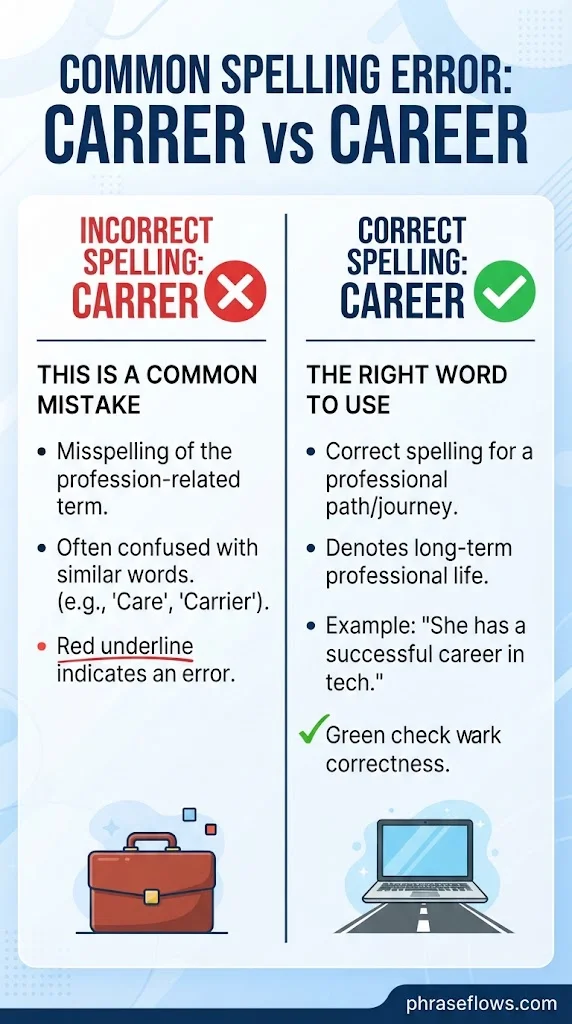

If you’ve ever typed carrer and then stopped to wonder whether it should be career, you’re not alone. Carrer vs Career: The Correct Spelling and Difference is a common spelling question because the two words look almost identical. One small missing e can make a professional sentence look incorrect, especially when you’re writing about your professional life or working journey.
The correct spelling is career. It refers to a person’s occupation, professional path, or the work they do over time. Carrer is generally a spelling error when you mean career. The confusion can become even greater because carrier is a real English word with a different meaning, and its pronunciation can sometimes add to the mix-up.
In this guide, you’ll learn the difference between carrer and career, how career is used in sentences, and why the spelling matters in everyday writing. Whether you’re preparing a resume, school assignment, cover letter, or professional profile, knowing the correct form will help you write with greater accuracy and confidence.
Carrer vs Career: Which One Is Correct?
Career is the correct spelling.
The spelling carrer isn’t the standard English form of the word that refers to someone’s professional life. If you write carrer when you mean career, you should correct it.
| Word | Status | Meaning | Example |
| Career | Correct | A person’s profession or working life | She wants a career in medicine. |
| Carrer | Incorrect in this context | Usually a misspelling of career | She wants a carrer in medicine. ❌ |
The important point is simple: don’t treat carrer and career as two interchangeable English spellings.
For example:
- ❌ He is building a successful carrer.
- ✅ He is building a successful career.
- ❌ She chose a carrer in education.
- ✅ She chose a career in education.
- ❌ What carrer do you want to pursue?
- ✅ What career do you want to pursue?
The corrected version uses career every time.
What Does Career Mean?
The word career usually refers to the work or series of jobs a person has during their working life. It often carries the idea of progress, development, experience, and long-term direction rather than simply describing one job.
Cambridge defines career as the job or series of jobs someone has during their working life, particularly when the person progresses toward better positions or develops within a profession.
For example, someone might begin as a junior designer, become a graphic designer, move into an art director role, and eventually manage a creative department. Those positions form part of that person’s career.
Consider these sentences:
She started her career in journalism after college.
His career in engineering lasted more than three decades.
I’m considering a career in software development.
In each sentence, career describes a broader professional journey.
Career as a Noun
The most common use of career is as a noun.
It can describe:
- A person’s professional life
- A particular field of work
- A long period spent working in a profession
- A sequence of jobs or professional positions
- Professional progress and development
For example:
Job:
She got a job at a local newspaper.
Career:
She built a career in journalism.
A job can be one position. A career can include many positions over many years.
That’s why saying someone has “three careers” can make sense even if that person has held dozens of individual jobs.
Career as a Verb
Here’s a less familiar fact: career can also function as a verb.
As a verb, career means to move quickly and often uncontrollably, especially when describing a vehicle or another moving object. Cambridge gives examples involving vehicles moving rapidly and without control.
For example:
The car careered down the hill.
The truck careered into the barrier.
This meaning has nothing to do with employment.
That makes career an interesting word because the same spelling can describe both professional life and rapid uncontrolled movement.
Why Is Carrer Incorrect?
The main problem with carrer is that it contains the wrong letter pattern for the standard English word career.
The correct spelling is:
C-A-R-E-E-R
The common incorrect spelling is:
C-A-R-R-E-R
Notice the difference:
| Correct | Incorrect |
| career | carrer |
| C-A-R-E-E-R | C-A-R-R-E-R |
| Contains ee before the final r | Contains rr after the first a |
This mistake can happen because English spelling and pronunciation don’t always line up perfectly. When people hear a word rather than see it written, they may reconstruct its spelling incorrectly.
The word career has the same basic pronunciation in American English regardless of whether it refers to employment or rapid movement. Cambridge lists the US pronunciation as /kəˈrɪr/.
So if you’re unsure, don’t rely entirely on how the word sounds. Remember its written form:
career = care + er
That visual pattern can make the spelling easier to recall.
Carrer vs Career Spelling Breakdown
A quick letter-by-letter comparison makes the difference obvious.
Correct spelling: Career
C-A-R-E-E-R
The middle of the word contains ee:
car + ee + r
Incorrect spelling: Carrer
C-A-R-R-E-R
This version puts rr together immediately after the a.
That’s the key spelling mistake.
A useful memory trick is to think:
Your career needs two E’s.
The phrase isn’t a grammatical rule. It’s simply a convenient spelling reminder.
When you type career, look for the ee in the middle.
Career Meaning and Examples
The word career appears in many everyday contexts. You might encounter it at school, at work, in news reports, on professional websites, or while talking about future plans.
Here are some of the most useful applications.
Career in Professional Life
A career can describe the broader path someone follows through employment.
Examples include:
- She began her career as a teacher.
- He changed careers after discovering a passion for technology.
- Her legal career has taken her to several cities.
- He’s building a career in finance.
- The promotion marked an important moment in his career.
Notice that these examples don’t necessarily refer to one particular job.
Instead, career gives you the bigger picture.
Career in Education
Students often encounter career when discussing future plans.
Common expressions include:
- career choice
- career goals
- career planning
- career path
- career development
- career opportunities
- career prospects
For example:
The course helped students explore different career options.
Here, career refers to possible professional directions rather than one specific position.
Career in Sports and Entertainment
The word also works naturally when discussing athletes, actors, musicians, writers, and other public professionals.
Examples:
The player enjoyed a long professional career.
The actor’s career began with small television roles.
The musician released several albums during her career.
In these contexts, career can cover years or even decades of professional activity.
Common Phrases With Career
Learning common combinations can help you recognize and use the correct spelling naturally.
| Phrase | Meaning | Example |
| Career path | The direction of someone’s professional development | She has a clear career path. |
| Career choice | A decision about what work to pursue | Teaching was his career choice. |
| Career goals | Professional aims a person wants to achieve | She set ambitious career goals. |
| Career development | Growth of skills and professional experience | Training supports career development. |
| Career change | Moving from one professional field to another | He made a career change at 30. |
| Career opportunity | A chance to advance or develop professionally | The internship created a career opportunity. |
| Career growth | Progress in professional skills or responsibilities | The role offers strong career growth. |
| Career advice | Guidance about professional decisions | She asked her mentor for career advice. |
| Career prospects | Future opportunities for professional progress | The degree improved his career prospects. |
| Successful career | A professional life marked by achievement or progress | She had a successful career in medicine. |
These phrases also reveal why spelling matters. If you accidentally write carrer, the error appears repeatedly across professional writing.
Carrer vs Career: Example Sentences
Seeing the difference in complete sentences makes the rule easier to remember.
Incorrect Examples With Carrer
The following sentences contain the common spelling mistake:
- ❌ He wants to build a carrer in business.
- ❌ She started her carrer after graduating.
- ❌ What carrer would you like to pursue?
- ❌ His carrer has taken him around the world.
- ❌ The university offers useful carrer guidance.
Each sentence should use career instead.
Correct Examples With Career
- ✅ He wants to build a career in business.
- ✅ She started her career after graduating.
- ✅ What career would you like to pursue?
- ✅ His career has taken him around the world.
- ✅ The university offers useful career guidance.
The correction is straightforward. Replace carrer with career.
Career vs Similar Words
Understanding related words can prevent another common problem: using career when a narrower word would be more accurate.
Career vs Job
A job usually refers to a specific position or paid role.
A career describes a broader professional journey.
For example:
My first job was at a bookstore.
I eventually built a career in publishing.
The bookstore position is a job. Publishing can describe the person’s larger career.
Someone can have several jobs during one career.
Career vs Profession
Profession often refers to a particular occupation or field, especially one requiring specialized education or training.
For example:
- Medicine can be a profession.
- Teaching can be a profession.
- Law can be a profession.
Career, meanwhile, focuses more on the person’s journey through work.
You might say:
She entered the medical profession.
or:
She built a long career in medicine.
Both sentences work, but they emphasize different things.
Career vs Occupation
An occupation generally means the type of work someone does.
For example:
His occupation is civil engineering.
A career can include the progression and history associated with that work.
So the words overlap, but they’re not perfect substitutes.
How to Remember the Spelling of Career
If carrer vs career keeps causing trouble, use a simple visual trick.
Remember:
career → C-A-R-E-E-R
The word contains EE in the middle.
A useful memory phrase is:
A career needs two E’s.
You can also connect the spelling to familiar expressions:
- career path
- career goal
- career change
- career development
- career opportunity
Seeing the correct form repeatedly helps reinforce its spelling.
A Quick Proofreading Trick
When proofreading a resume, application, or school assignment, search for:
carrer
If you find it, check whether you intended career.
This works especially well with digital writing because a spelling checker may catch the error. However, don’t rely entirely on automatic correction. A quick manual review can prevent embarrassing mistakes in important documents.
Pronunciation of Career
In American English, career is pronounced /kəˈrɪr/. Cambridge lists this pronunciation for US English.
The pronunciation can contribute to spelling confusion because the written ee isn’t necessarily pronounced the way a learner might expect from other words containing ee.
That’s an important reminder:
Pronunciation can help you recognize a word, but spelling must be learned separately when English doesn’t follow a predictable sound pattern.
The word has two syllables in standard American English, with the main stress on the second syllable.
Where Did the Word Career Come From?
The history of career makes the modern meaning particularly interesting.
The word ultimately traces back to Latin carraria, associated with a road or carriage road. It passed through French before developing into the English word career. A Cambridge University Press academic work on career studies notes that the word’s earlier English sense related to a course or route before its meaning developed toward a person’s course or progress through life.
That history creates a useful conceptual connection.
A career can be thought of as a person’s professional path or course through life.
Modern English uses the word mainly for professional life, but the older idea of movement along a route helps explain why the word eventually developed its broader sense.
Interestingly, career also retains a verb meaning involving rapid movement. That meaning connects more closely with the word’s older sense of moving along a course.
Career in American English
In standard American English, career is the normal spelling.
You’ll see it in expressions such as:
- career counselor
- career center
- career planning
- career development
- career goals
- career fair
- career opportunity
- career path
The spelling doesn’t change to carrer in American English.
If you’re writing a resume, college application, professional email, or academic paper, use career.
Carrer vs Career: A Quick Real-World Writing Check
Imagine a student writing this sentence:
I want to pursue a carrer in environmental science.
The intended meaning is obvious. However, the spelling still needs correction.
The polished version is:
I want to pursue a career in environmental science.
Now consider a professional profile:
She has developed a successful carrer in digital marketing.
Again, the correct version is:
She has developed a successful career in digital marketing.
The mistake doesn’t change the intended meaning, but it makes the writing look less polished.
That distinction matters in formal writing because spelling errors can distract readers from otherwise strong ideas.
Read More: Scarey vs Scary: Learn the Correct Spelling and How to Use It
Carrer vs Career: Common Questions
Is Carrer a Correct Word?
Carrer is not the standard English spelling when you mean someone’s profession or working life.
In that context, use career.
Is Career the Correct Spelling?
Yes. Career is the correct spelling for the standard English word referring to someone’s professional life, occupation, or progression through work.
For example:
She wants to pursue a career in medicine.
How Do You Spell Career?
The correct spelling is:
C-A-R-E-E-R
The easiest detail to remember is the EE in the middle.
Why Do People Spell Career as Carrer?
The error probably comes from the similarity between the two forms and from the way the word sounds.
When people write a word from memory, they sometimes substitute a familiar letter pattern for the correct one. In this case, carrer can look plausible even though standard English uses career.
What Is the Difference Between Carrer and Career?
The difference is mainly spelling.
Career is the standard English word. It means a person’s professional life, a series of jobs, or professional progress. Carrer is generally a misspelling when someone intends to write career.
Carrer vs Career: Key Facts at a Glance
| Question | Answer |
| Correct spelling | Career |
| Common incorrect spelling | Carrer |
| US pronunciation | /kəˈrɪr/ |
| Main part of speech | Noun |
| Other uses | Verb and adjective |
| Career noun meaning | Professional life, occupation, or work progression |
| Career verb meaning | To move rapidly and uncontrollably |
| Useful memory clue | Career has EE in the middle |
| Use in US English | Career |
Final Takeaway: Carrer or Career?
When choosing between carrer vs career, the answer is clear: career is the correct spelling in standard English when you’re talking about someone’s professional life.
Remember the spelling:
C-A-R-E-E-R
The word can describe a person’s occupation, professional journey, or development over time. It can also function as a verb meaning to move rapidly and uncontrollably.
The easiest way to avoid the common mistake is to remember the EE in the middle of career.
So, if you’re writing about career goals, career development, a career change, or a successful professional life, choose career every time.
Carrer ❌
Career ✅
FAQs:
Is “carrer” a correct English word?
Carrer is generally not the correct spelling when you mean a person’s professional life or occupation. In that context, the correct spelling is career.
What is the correct spelling: carrer or career?
The correct spelling is career. Carrer is a common spelling error caused by leaving out the second e.
What does career mean?
Career means a person’s professional path, occupation, or working life. For example, someone may build a career in teaching, medicine, business, or technology.
Is carrier the same as career?
No. Carrier and career are different words with different meanings. A carrier is generally a person or thing that carries something, while a career relates to professional work or a working path.
How can I remember the spelling of career?
A simple way to remember it is to focus on the double e in career. If you are writing about someone’s professional life or occupation, career is the form you need.
Conclusion:
The correct spelling is career, not carrer. Although the two forms look very similar, carrer is generally a spelling mistake when you mean a person’s professional life, occupation, or working journey. Remembering the extra e in career can help you avoid an easy error in everyday writing.
This difference matters when you write a resume, cover letter, school assignment, application, or professional profile. If you often hesitate between carrer vs career, take a moment to check the spelling before submitting your work. Choosing career will keep your writing clear, accurate, and professional.




1 thought on “Carrer vs Career: The Correct Spelling and Difference”