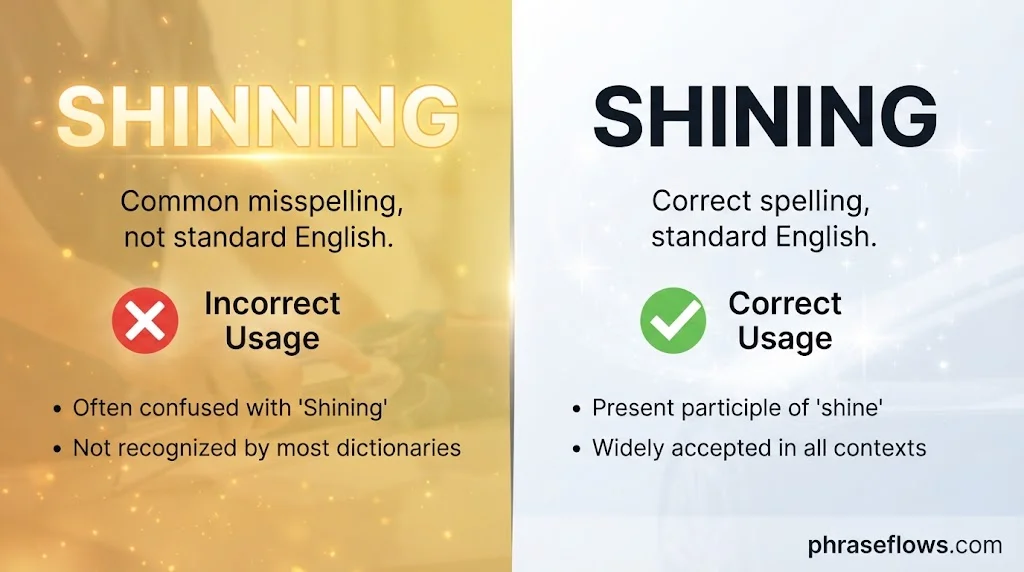

When you see shinning and shining, it is easy to think they are just two spellings of the same word. They have a similar sound and look almost identical, which can lead to confusion. However, there is an important difference between them, and knowing the correct spelling can help you avoid a common spelling error.
Shining is the correct form when you want to describe light, brightness, beauty, or excellence. It can describe something physically bright, such as a star, or someone doing exceptionally well. Shinning, on the other hand, is usually a spelling slip caused by confusion over English spelling rules and the use of double letters.
In this guide, Shinning vs Shining: Correct Spelling and Usage Explained, you will learn the correct usage of both forms, why people accidentally mix up these words, and how to use shining confidently in professional English writing. With a simple grammar rule and a few clear examples, this spelling trap becomes much easier to remember.
Shinning vs Shining: Which Spelling Is Correct?
Shining is the correct spelling when you mean giving off light, reflecting light, looking bright, or performing very well.
For example:
- The sun is shining through the window.
- Her shoes were shining after they were polished.
- He is shining in his new role.
- The stars were shining brightly overhead.
Shinning is also a real English word, but it has a completely different origin. It is the -ing form of the verb shin, which can mean to climb something by gripping it with your arms and legs.
For example:
He was shinning up the pole.
This use is relatively uncommon, especially in everyday American English. As a result, shinning often looks like a spelling mistake when someone actually means shining.
The difference at a glance
| Word | Base verb | Main meaning | Everyday use |
| Shining | Shine | Giving off or reflecting light; excelling | Very common |
| Shinning | Shin | Climbing or moving using the arms and legs | Uncommon |
The simplest rule is this:
If you mean “giving off light” or “doing exceptionally well,” use shining.
What Does “Shining” Mean?
Shining is the present participle and gerund form of shine. The verb shine has several related meanings, so shining can appear in both literal and figurative contexts.
Its most familiar meaning involves light. Something can shine when it produces light or when it reflects light that comes from another source.
The word also has a figurative meaning. Someone can be shining when they show unusual talent, skill, confidence, or success.
Here are the main uses.
Shining as Giving Off or Reflecting Light
The most common meaning involves brightness or light.
The sun can shine. A star can shine. A lamp can shine. A polished surface can shine because it reflects light.
Consider these examples:
- The moon was shining over the lake.
- A bright lamp was shining across the room.
- The polished table was shining in the afternoon light.
- The stars were shining above the mountains.
The exact source of the light doesn’t always matter. In ordinary usage, shining can describe both emitting light and reflecting light.
For instance, a freshly polished car doesn’t create its own light. Its surface reflects light, so you can still say that the car is shining.
Shining as Performing Exceptionally Well
English also uses shining in a figurative sense.
When someone is shining, they may be performing particularly well or displaying an impressive quality. You might hear this expression at school, work, sports events, or performances.
Examples include:
- Maya is shining in her science class.
- The young player is shining this season.
- She was shining during the school performance.
- His creativity is really shining through in this project.
This meaning doesn’t involve physical light. Instead, shining suggests that someone’s abilities or qualities stand out.
That’s similar to saying that someone is standing out or excelling.
Shining as Looking Bright or Polished
Shining can also describe an object that has a bright, polished, or reflective appearance.
You might talk about:
- shining shoes
- shining floors
- shining metal
- shining windows
- shining armor
For example:
The freshly polished shoes were shining under the lights.
Here, shining describes the appearance of the shoes. It doesn’t mean that the shoes produce their own light.
What Does “Shinning” Mean?
Shinning comes from the verb shin, which has a less familiar meaning: to climb or move up something by using your hands, arms, legs, or feet for support.
The verb is related to the noun shin, which refers to the front part of the lower leg. In the climbing sense, shin has developed into a separate verb.
Its -ing form is therefore:
shin → shinning
The final consonant doubles before -ing in this formation.
For example:
The climber was shinning up the narrow pole.
The word is grammatically legitimate in this context. However, most people encounter it far less often than shining.
That’s why context matters.
If someone writes:
The sun is shinning.
They almost certainly mean:
The sun is shining.
But if a sentence says:
The boy was shinning up the tree trunk.
The spelling may be intentional because the writer is using the verb shin.
Shining vs Shinning: The Key Difference
The easiest way to understand shinning vs shining is to forget the extra letter for a moment and identify the base verb.
Shining comes from shine.
Shinning comes from shin.
Those are two different verbs.
| Form | Base verb | What it describes |
| Shining | shine | Light, brightness, reflection, excellence |
| Shinning | shin | Climbing or moving with the limbs |
This distinction is more important than simply counting the letters.
For example, in:
The stars are shining.
The base verb is shine.
In:
He was shinning up the pole.
The base verb is shin.
So although the words differ by only one letter, their meanings aren’t interchangeable.
Why Is “Shining” Spelled With One N?
The spelling becomes much easier once you look at the base word shine.
The verb is:
shine
When English adds -ing to a verb ending in a silent e, the final e is normally dropped:
shine + ing → shining
The result is shining, not shinning.
You can see the same general spelling pattern in several familiar verbs:
| Base verb | + -ing | Correct form |
| shine | shine + ing | shining |
| write | write + ing | writing |
| make | make + ing | making |
| take | take + ing | taking |
| drive | drive + ing | driving |
This explains why the word doesn’t need a doubled n.
Why “Shinning” Looks Tempting
English has many verbs that double their final consonant before adding -ing.
For example:
- run → running
- sit → sitting
- swim → swimming
- stop → stopping
That pattern can make shinning look plausible.
However, shine follows a different spelling pattern because it ends in a silent e.
The spelling isn’t:
shine → shinning
It’s:
shine → shining
The extra n belongs to the separate verb shin.
How to Use “Shining” in a Sentence
Shining works in several grammatical structures.
One common pattern uses a form of be:
- The sun is shining.
- The stars were shining.
- The lights are shining brightly.
- The moon was shining over the water.
You can also use shining as a participle describing a noun:
- a shining star
- a shining surface
- shining shoes
- a shining example
It can also appear in figurative expressions:
- She is shining in mathematics.
- His leadership skills are shining through.
- The student is shining this semester.
More Examples of “Shining”
Literal use:
The sunlight was shining through the curtains.
Reflective use:
The silver was shining after it was cleaned.
Figurative use:
Her dedication is shining through in every assignment.
Descriptive use:
He wore a pair of shining black shoes.
These examples all connect to the verb shine.
How to Use “Shinning” in a Sentence
Use shinning only when the intended verb is shin.
Because this meaning is uncommon, the surrounding context should make the climbing action clear.
Examples include:
The children were shinning up the old fence.
He practiced shinning up the pole during training.
The climber was shinning up the narrow post.
In these sentences, shinning has nothing to do with brightness.
If you replace it with shining, the meaning changes dramatically.
Compare:
The sun was shining.
with:
The athlete was shinning up the pole.
The first sentence concerns light. The second concerns climbing.
Shining vs Shinning in Different Contexts
Context provides one of the quickest ways to choose the right spelling.
Light and Brightness
Use shining.
- The sun is shining.
- The stars are shining.
- The flashlight is shining on the wall.
- The polished floor is shining.
Using shinning in these sentences would normally be incorrect.
Success and Talent
Use shining.
- She is shining in her new position.
- The team is shining this season.
- His talent is shining through.
- The student is shining in mathematics.
Here, shining means performing exceptionally well or standing out.
Climbing
Shinning can be correct when it comes from shin.
- He was shinning up the pole.
- They were shinning up the steep structure.
This is a much less common use than shining.
Everyday Conversation
In ordinary conversations and writing, shining is overwhelmingly more likely to be the word you need.
If you’re talking about sunshine, stars, polished objects, success, or someone’s abilities, choose shining.
Common Mistakes With Shinning and Shining
The most frequent errors happen when writers add an unnecessary n to shining.
“The Sun Is Shinning”
Incorrect:
The sun is shinning.
Correct:
The sun is shining.
The verb is shine, so its present participle is shining.
“Her Shoes Are Shinning”
Incorrect:
Her shoes are shinning.
Correct:
Her shoes are shining.
The shoes reflect light. They aren’t climbing anything.
“She Is Shinning in Class”
Incorrect:
She is shinning in class.
Correct:
She is shining in class.
The figurative meaning of shining comes from shine and refers to excellent performance.
Assuming Every Verb Doubles a Letter
Another common mistake is applying the consonant-doubling rule too broadly.
English spelling doesn’t work by simply doubling the last consonant of every verb.
Compare:
- shine → shining
- run → running
- write → writing
- swim → swimming
The spelling of the base verb determines what happens.
An Easy Trick to Remember Shining
There’s a simple memory trick:
If it comes from “shine,” it becomes “shining.”
Think about the meaning first.
If something gives off light, reflects light, or stands out because of excellence, use:
SHINING
If someone is climbing with their arms and legs, the uncommon word shinning may be appropriate.
A quick mental check can help:
Light? → shining.
Excellent performance? → shining.
Climbing with the limbs? → possibly shinning.
This distinction covers most situations you’ll encounter.
Shinning vs Shining Examples Side by Side
| Sentence | Correct word | Why? |
| The sun is ___ brightly. | shining | The sun gives off light. |
| The stars were ___ above us. | shining | The stars appear bright. |
| Her shoes were ___ after polishing. | shining | The shoes reflect light. |
| He is ___ in his new role. | shining | He is performing very well. |
| She was ___ up the pole. | shinning | The verb shin means to climb in this context. |
| The moon was ___ over the lake. | shining | The moon appears to give off or reflect light. |
| The student is ___ in science. | shining | The student is doing exceptionally well. |
| The children were ___ up the structure. | shinning | The sentence uses the climbing sense of shin. |
The important point is that shinning isn’t an alternative spelling of shining.
Each word belongs to a different verb.
Shine, Shining, Shone, and Shined
Understanding the other forms of shine can make shining even easier to remember.
The verb shine has different past-tense and past-participle forms depending partly on the meaning and variety of English being used.
Common forms include:
- shine — base form
- shining — present participle/gerund
- shone — common past form for emitting or reflecting light
- shined — commonly used in some contexts, especially when referring to polishing something or excelling
Examples:
The sun shines brightly in the morning.
The sun is shining brightly.
The sun shone through the clouds.
For polishing, shined is also common:
He shined his shoes before the ceremony.
The important spelling point remains the same: shine + ing = shining.
Shining as an Adjective
Shining doesn’t always function as part of a progressive verb construction. It can also work as an adjective.
For example:
She wore a shining dress.
Here, shining describes the dress.
English also uses the word in figurative expressions:
- shining example
- shining achievement
- shining star
- shining personality
- shining reputation
The phrase shining example is particularly common. It means a person or thing that provides an excellent example of a particular quality.
For instance:
Her dedication made her a shining example of teamwork.
No literal light is involved. The adjective suggests that the person’s qualities stand out.
Shining vs Gleaming vs Glowing
Several English words describe light or brightness, but they don’t mean exactly the same thing.
| Word | Typical sense |
| Shining | Giving off or reflecting light; standing out figuratively |
| Gleaming | Reflecting bright light from a smooth or polished surface |
| Glowing | Giving off a soft, warm, or steady light |
For example, you might describe polished metal as gleaming.
A lamp can be glowing softly.
The sun can be shining.
These words overlap, but choosing the most precise one can make your writing stronger.
Is “Shinning” Ever Correct?
Yes. Shinning can be a correct English word when it functions as the present participle of shin in its climbing sense.
However, this doesn’t make shinning a valid alternative to shining.
Consider the two sentences:
The sun is shining.
The boy is shinning up the pole.
Both spellings can be correct because they come from different verbs.
The first comes from shine.
The second comes from shin.
This distinction also explains why spell-checkers and readers may react strongly to shinning. If the surrounding sentence doesn’t clearly indicate climbing, readers will often assume you intended shining.
Why the Extra N Matters
One letter can change the base word, pronunciation context, and meaning.
That’s why treating shinning as a simple spelling variation isn’t accurate.
Think of it this way:
SHINE
│
+ ING
│
▼
SHINING
Light / excellence
SHIN
│
+ ING
│
▼
SHINNING
Climbing sense
The words may look similar, but their paths are different.
This is a useful lesson in English spelling: similar-looking words don’t necessarily share the same grammatical origin.
Conclusion
When comparing shinning vs. shining, the correct spelling depends on the meaning you want to express. In most situations involving light, brightness, success, or excellence, the correct word is shining.
Shining is the present participle of shine. You can use it to describe something that gives off or reflects light, such as a shining star or shining surface. It can also describe someone who performs exceptionally well, as in “She is a shining example of dedication.”
Shinning, with two n’s, is also a real word, but it has a completely different meaning. It is the present participle of shin, meaning to climb or move using the shins or legs. For example, “He was shinning up the pole” uses the word correctly.
The easiest way to remember the difference is simple: shine → shining, while shin → shinning. If you’re talking about light, brilliance, or excellent performance, choose shining. If you’re talking about climbing with your legs or shins, shinning may be the correct form.
Read More: Carrer vs Career: The Correct Spelling and Difference
Frequently Asked Questions About Shinning vs. Shining
Is “shinning” or “shining” correct?
Both words are correct, but they have different meanings. Shining comes from shine and relates to light, brightness, or excellence. Shinning comes from shin and refers to climbing or moving using the legs or shins.
Is “shinning” a real word?
Yes. Shinning is a legitimate word, but it is much less common than shining. It is the present participle of shin, meaning to climb by gripping or using the legs.
What is the correct spelling for “giving off light”?
The correct spelling is shining.
For example:
The shining moon lit up the night sky.
Shinning would be incorrect in this context.
What is the difference between shinning and shining?
Shining means producing or reflecting light or performing exceptionally well. Shinning means climbing or moving by using the shins or legs.
| Word | Meaning | Example |
| Shining | Giving off or reflecting light; excellent or outstanding | The stars were shining brightly. |
| Shinning | Climbing or moving using the legs or shins | He was shinning up the pole. |
Why does shining have only one “n”?
The spelling follows the verb shine. When shine takes the -ing ending, the final e is dropped:
shine → shining
The word does not become shinning.
Why does shinning have two “n’s”?
Shinning comes from the verb shin, which ends in a consonant. Adding -ing produces:
shin → shinning
The doubled n belongs to the spelling of this form.
Is “shinning” a common spelling mistake for “shining”?
Yes. Because shinning and shining look almost identical, writers sometimes add an extra n when they mean shining. This is especially common when writing quickly.
If you’re describing light, brightness, or excellence, remember:
Shine → shining
Can “shining” describe a person?
Yes. Shining can describe someone who performs exceptionally well or demonstrates outstanding qualities.
For example:
She is a shining example of determination.
The phrase shining example is
Conclusion:
When comparing shinning vs. shining, both words are real English words, but they have different meanings and uses. Shining is the correct form when you mean giving off light, reflecting light, or performing exceptionally well. For example, you can say, “The stars are shining brightly” or “She is shining in her new role.”
Shinning, on the other hand, comes from the verb shin, which means to climb something by gripping it with your arms and legs. Although this word is uncommon in everyday writing, it is a legitimate form in contexts such as climbing a pole or tree.
The key is to match the spelling with the meaning. If you’re talking about light, brightness, excellence, or success, use shining. If you’re talking about climbing with your arms and legs, shinning can be correct.
FAQs:
Is “shinning” a correct word?
Yes. Shinning is a correct word when it comes from the verb shin, meaning to climb using your arms and legs. However, it is much less common than shining.
Is “shining” the correct spelling?
Yes. Shining is the standard spelling when the verb is shine. It can describe something producing or reflecting light, or it can describe someone performing exceptionally well.
What is the difference between shinning and shining?
Shinning means climbing something by gripping it with your arms and legs. Shining means producing or reflecting light and can also mean performing very well or standing out.
| Word | Meaning | Example |
| Shinning | Climbing using the arms and legs | He was shinning up the pole. |
| Shining | Giving off or reflecting light | The moon was shining brightly. |
Why is “shining” spelled with one “n”?
The verb shine forms its present participle by adding -ing. The final e is dropped before adding the suffix:
shine → shining
It doesn’t become shinning because the base word already ends with ne, not a single consonant that requires doubling.
Can “shinning” and “shining” be used interchangeably?
No. They have different meanings, so you shouldn’t substitute one for the other. Use shining for light, brightness, or exceptional performance. Use shinning only when referring to the action of climbing by gripping a surface with the limbs.




1 thought on “Shinning vs Shining: Correct Spelling and Usage Explained”