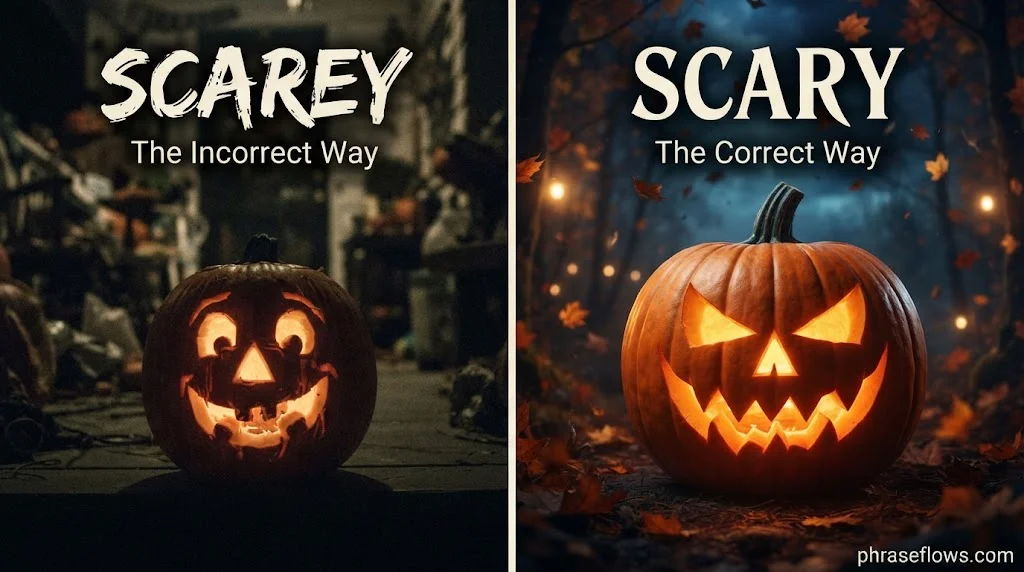

If you have ever paused while writing scarey vs scary, you are not alone. Both forms look believable at first, especially when you are typing quickly or relying on how the word sounds. However, scary is the standard spelling used in modern English, while scarey is a less common variant that you may still encounter in some dictionaries or older British English usage.
Understanding the difference is useful because spelling can affect how clear and professional your writing looks. Scary means something that causes fear or makes you feel scared, and you will see it regularly in everyday, academic, and professional writing. Learning the correct form also helps you avoid a common mistake and use the word confidently in real-life situations.
In this guide, you will learn how scarey and scary differ, when to use each form, and why scary is usually the safest choice. You will also see practical examples and simple explanations that make the spelling easier to remember. By the end, you should feel more confident about choosing the right form without second-guessing yourself.
Scarey vs Scary: Which One Is Correct?
Scary is the standard and correct spelling in modern American English.
Scarey is generally considered a misspelling or nonstandard variant. You may encounter it in informal online writing, old texts, names, or other contexts, but it isn’t the spelling to choose for standard English.
Here’s the basic distinction:
| Spelling | Standard US English | Word type | Meaning |
| Scary | Yes | Adjective | Causing fear or alarm |
| Scarey | No, generally nonstandard | Intended adjective | Usually intended to mean “scary” |
For example:
That movie was scary.
That’s the standard form.
Writing:
That movie was scarey.
would normally be corrected to:
That movie was scary.
The important point is simple: use scary when you want to describe something that frightens or worries someone.
What Does “Scary” Mean?
Scary is an adjective that describes something capable of causing fear, alarm, or apprehension.
It comes from the verb scare, which means to frighten someone or cause them to feel afraid.
The level of fear doesn’t have to be extreme. Something can be slightly unsettling and still be called scary.
For example:
- A horror movie can be scary.
- A sudden loud noise can be scary.
- Getting lost in an unfamiliar place can be scary.
- A dangerous situation can be scary.
- A strange story can sound scary.
- An unexpected event can become scary.
The word also works in informal conversation. Someone might say, “That was scary!” after a near accident or an unexpected event.
Scary Can Describe Different Kinds of Fear
The word doesn’t only apply to ghosts, monsters, and horror films.
You can use scary for:
- Physical danger: “That was a scary drive.”
- Uncertainty: “Waiting for the results was scary.”
- Unexpected events: “The sudden power outage was scary.”
- Fiction: “The novel has a scary ending.”
- Places: “That abandoned building looks scary.”
- Sounds: “I heard a scary noise outside.”
This flexibility makes scary a common adjective in everyday English.
Why Is “Scary” Spelled Without the “E”?
The spelling makes more sense when you start with the base word scare.
The transformation is:
scare → scary
The final e in scare disappears before the -y ending is added.
That’s why the standard spelling isn’t scarey.
This is one of those English spelling patterns that can seem unintuitive at first. English contains many words whose spelling changes when you add a suffix. The spelling of the original word doesn’t always remain completely intact.
Think of it this way:
scare + y → scary
rather than:
scare + y → scarey
The first version is the established standard form.
Why “Scarey” Looks Reasonable
The confusion is understandable because the word scare visibly ends in e.
A writer might naturally think:
scare + y = scarey
That reasoning looks straightforward. English spelling, however, doesn’t always work through simple letter-by-letter addition.
The established adjective is scary, so the final e isn’t retained.
Is “Scarey” a Word?
This question needs a little nuance.
You may find scarey in dictionaries, historical sources, informal writing, or particular names and usages. Its appearance in a source doesn’t automatically mean it’s the preferred spelling in contemporary standard American English.
For normal modern writing, scary is the form you should choose.
This distinction matters because English contains many historical, regional, archaic, and nonstandard spellings. A word can appear somewhere without being the best choice for formal or everyday standard writing.
If you’re writing:
- A school assignment
- A blog post
- A professional email
- A report
- An article
- A social media post
- A formal document
use scary.
A Practical Rule
If you’re trying to say that something causes fear, write:
scary
Don’t use scarey simply because the base word is scare.
Scary: Meaning, Grammar, and Related Word Forms
Understanding related words can prevent another common mistake.
| Word | Part of speech | Basic meaning | Example |
| Scare | Verb | To frighten someone | The noise scared me. |
| Scare | Noun | A frightening experience | That gave me a scare. |
| Scary | Adjective | Causing fear | The movie was scary. |
| Scared | Adjective | Feeling fear | I was scared. |
| Scariness | Noun | The quality of being scary | The scariness increased near the ending. |
These words belong to the same word family, but they don’t perform the same grammatical job.
Scare
Scare can function as either a verb or a noun.
As a verb:
The thunder scared the child.
As a noun:
That sudden sound gave me a scare.
Scary
Scary describes the thing, situation, experience, or event that produces fear.
The thunderstorm was scary.
Scared
Scared describes the person or other being experiencing fear.
The child was scared.
That difference is crucial.
Scary vs Scared: What’s the Difference?
Scary and scared are closely related, but they describe different sides of an emotional experience.
A simple way to remember the distinction is:
Something is scary. Someone is scared.
For example:
- The haunted house is scary.
- I am scared inside the haunted house.
- The sound was scary.
- The sudden noise scared me.
- The situation looked scary.
- Everyone became scared.
The same basic principle appears with many English adjectives ending in -ing and -ed.
Compare:
| Causes the feeling | Experiences the feeling |
| The movie was scary. | I was scared. |
| The story was frightening. | The audience was frightened. |
| The situation was worrying. | She was worried. |
| The result was surprising. | They were surprised. |
So if you write “I am scary” when you mean “I am afraid,” you’ve changed the meaning.
“I am scary” means that you cause fear in other people.
“I am scared” means you are experiencing fear.
How to Use “Scary” in a Sentence
Because scary is an adjective, you can use it in several common sentence patterns.
Before a Noun
You can place scary directly before a noun.
Examples:
- We watched a scary movie.
- She told us a scary story.
- That was a scary experience.
- They heard a scary sound.
- He described a scary situation.
Here, scary modifies the noun that follows it.
After a Linking Verb
You can also place scary after verbs such as is, was, seems, and looks.
Examples:
- The movie was scary.
- That sound is scary.
- The situation seems scary.
- The abandoned house looks scary.
- The storm became scary.
This construction is extremely common in everyday English.
In Comparative and Superlative Forms
You can compare different things using scarier and scariest.
Examples:
- This movie is scarier than the first one.
- The second chapter was scarier than the opening.
- That was the scariest part of the story.
The forms are:
scary → scarier → scariest
Notice that the y changes to i before -er or -est.
Scary vs Scarey: Side-by-Side Comparison
The fastest way to settle the spelling question is to compare the two forms directly.
| Feature | Scary | Scarey |
| Standard spelling | Yes | No, generally |
| Used in standard US English | Yes | Generally avoided |
| Part of speech | Adjective | Usually intended as an adjective |
| Meaning | Causing fear or alarm | Usually intended to mean scary |
| Example | “That was a scary story.” | “That was a scarey story.” |
| Recommended for formal writing | Yes | No |
If you’re unsure while writing, choose scary.
It’s the familiar standard form that readers expect.
Scary Pronunciation
Scary is commonly pronounced approximately like:
SKAIR-ee
It has two syllables:
scary → scair-y
The first syllable receives the primary stress.
The pronunciation is another reason some writers may become uncertain about the spelling. However, pronunciation doesn’t tell you whether the written e from scare should remain.
English has plenty of words where spelling and pronunciation don’t map perfectly onto each other. The safest approach is to learn scary as its own standard spelling.
Common Mistakes With “Scary”
Even after learning the correct spelling, a few related errors can still cause trouble.
Writing “Scarey”
This is the main spelling mistake.
Incorrect: The story was scarey.
Correct: The story was scary.
Confusing “Scary” and “Scared”
Remember the difference:
The situation is scary.
The person is scared.
This small distinction can dramatically change what a sentence means.
Keeping the Final “E”
Some writers assume that every form of scare must retain the e.
That’s not the case with scary.
The accepted spelling is:
scare → scary
Using “Scary” When You Mean “Afraid”
If you’re describing someone’s emotional state, scared will often be the right word.
For example:
I was scared when I heard the noise.
Not:
I was scary when I heard the noise.
The second sentence suggests that the speaker was frightening to other people.
Easy Ways to Remember the Correct Spelling
A quick memory trick can save you from making the same mistake again.
Remember “Scare → Scary”
The simplest method is to memorize the transformation:
scare → scary
The final e disappears before y.
Use the Meaning Test
Ask yourself:
“Am I describing something that causes fear?”
If the answer is yes, scary is probably the word you need.
For example:
The thunder was scary.
If you’re describing the person experiencing the fear:
I was scared.
Keep This Three-Word Family in Mind
Scare → scary → scared
Each word has a distinct role:
- Scare = frighten or a frightening event
- Scary = causes fear
- Scared = feels fear
This simple framework handles most everyday situations.
Scary in American English vs British English
The spelling scary remains standard in both American English and British English.
There isn’t an American-versus-British spelling difference here like there is with some words such as color/colour or center/centre.
So whether you’re writing for a US audience or a British audience, scary is the normal spelling.
For this reason, switching to scarey doesn’t make your writing more British or more formal. It simply introduces a spelling that standard contemporary English generally doesn’t use.
Examples of Correct “Scary” Usage
Seeing the word in different contexts makes its usage easier to recognize.
Everyday Examples
- That dog looked scary, but it was actually friendly.
- The sudden noise was scary.
- Driving through the storm became scary.
- That empty building looks scary at night.
- The story has a surprisingly scary ending.
Horror and Fiction Examples
- The movie was scary without relying on constant jump scares.
- She chose a scary book for the weekend.
- The author created a scary atmosphere through suspense.
- That scene was much scarier than I expected.
- It was the scariest chapter in the novel.
Situational Examples
- Losing your phone in an unfamiliar place can be scary.
- The sudden change in weather was scary.
- Hearing footsteps when you’re alone can feel scary.
- The situation looked scary at first.
- What seemed frightening initially turned out to be manageable.
These examples show that scary doesn’t have to describe supernatural events. It can describe anything that creates fear or serious concern.
Examples of the Common “Scarey” Misspelling
The following examples show the type of mistake to avoid.
| Nonstandard spelling | Standard spelling |
| That was a scarey movie. | That was a scary movie. |
| The noise sounded scarey. | The noise sounded scary. |
| It was a scarey experience. | It was a scary experience. |
| The house looks scarey at night. | The house looks scary at night. |
| That story is scarey. | That story is scary. |
The correction is straightforward in every case: replace scarey with scary.
Read More: Stared vs. Starred: How to Use Each Word Correctly
A Closer Look at the Spelling Pattern
Why does English remove the e here?
The answer lies partly in the way English handles suffixes and established word forms. The spelling of a base word doesn’t always survive unchanged when another ending is added.
The adjective scary has become firmly established in English with this spelling. Modern writers don’t construct it by simply attaching the letter y to the complete written form of scare.
Instead, the accepted form is:
scare + y → scary
This isn’t merely a matter of personal preference. Standard spelling conventions are based on established usage, dictionaries, historical development, and the forms that English speakers have settled on over time.
That’s why scary looks slightly different from the base word scare.
Quick Rule for Scarey vs Scary
If you only remember one thing from this article, remember this:
Use “scary” when you mean something that causes fear.
The key forms are:
- Scary = causing fear
- Scared = experiencing fear
- Scare = to frighten someone or a frightening experience
- Scarey = generally avoid in standard US English
Quick Reference
| If you mean… | Use… |
| Something causes fear | Scary |
| Someone experiences fear | Scared |
| Someone frightens another person | Scare |
| A frightening experience | A scare |
| The quality of being scary | Scariness |
Once you understand these distinctions, the spelling becomes much easier to remember.
Conclusion:
When it comes to Scarey vs Scary, scary is the standard and most widely accepted spelling in modern English. It describes something that causes fear or makes someone feel scared. Although scarey can appear as a variant spelling, it is much less common and may feel informal or dated. For everyday, academic, professional, and international writing, choosing scary is the safest option.
The easiest way to remember the difference is to connect scary with words such as scared and frightening. Once you become familiar with its correct spelling and use it in real sentences, you are less likely to hesitate or mix up the two forms.
FAQs:
Is “scarey” a correct spelling?
Scarey is recorded as a variant spelling in some dictionaries, but scary is the standard spelling used in modern English.
Is “scary” or “scarey” more common?
Scary is much more common in modern everyday English and is the preferred choice for most types of writing.
What does “scary” mean?
Scary means frightening or causing fear. For example, a horror movie can be described as scary.
Should I use “scarey” in academic writing?
It is better to use scary in academic writing because it is the standard modern spelling and is widely recognized by English readers.
Is “scarey” a spelling mistake?
Not necessarily. Some dictionaries recognize scarey as a variant, but using scary avoids confusion and is generally the better choice.




1 thought on “Scarey vs Scary: Learn the Correct Spelling and How to Use It”