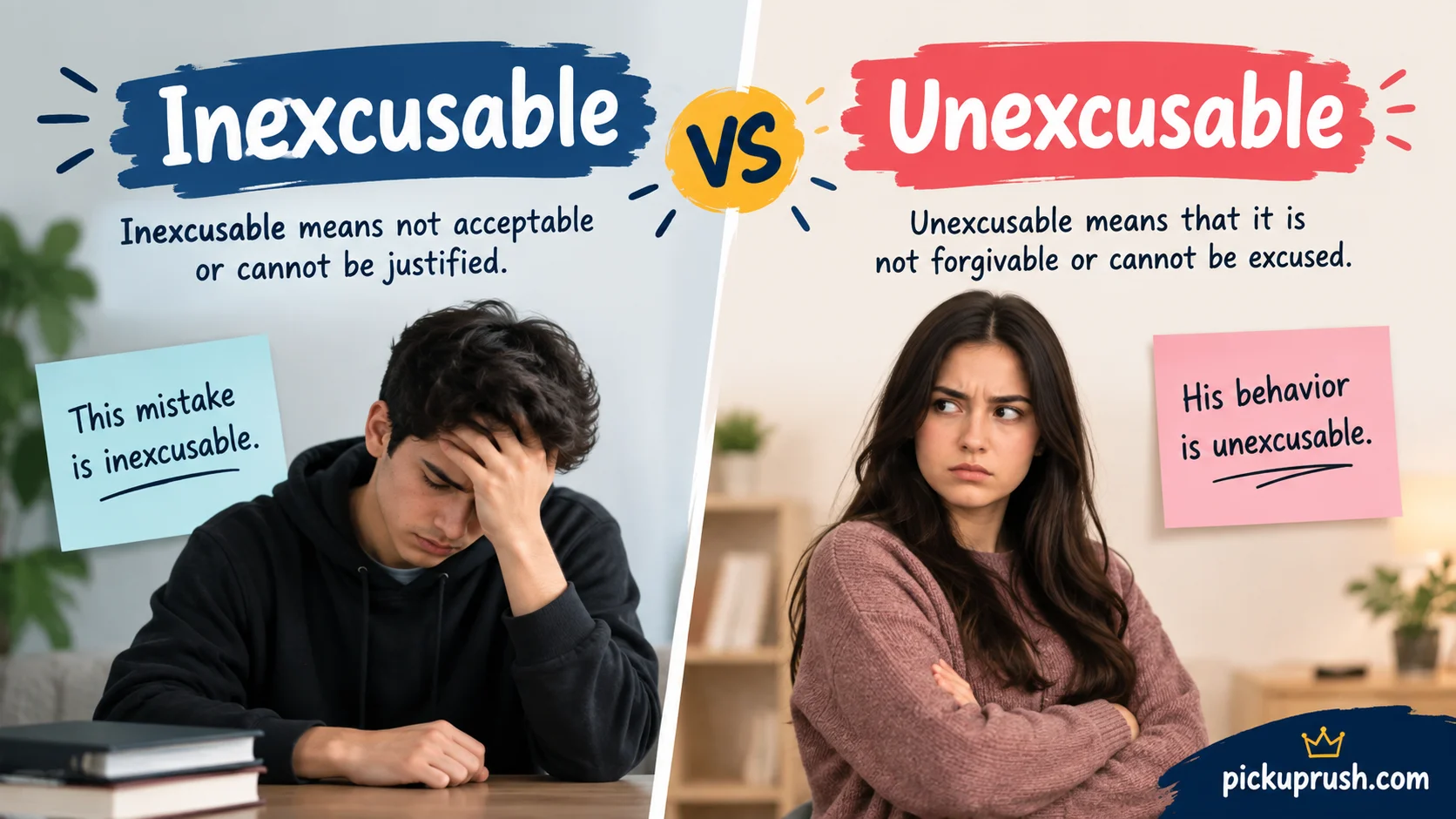

Choosing between inexcusable and unexcusable can be confusing because both words appear to express the same idea. They describe something that cannot reasonably be justified, forgiven, or accepted. However, inexcusable is the standard and much more common form in modern English, while unexcusable is rare and may sound unusual to many readers.
The difference mainly comes from how English uses prefixes and how word usage develops over time. Both forms can be understood, but their frequency and familiarity are not the same. In everyday conversations, academic writing, professional documents, and formal communication, inexcusable is generally the form you will encounter most often. Knowing this distinction can help you avoid confusion and choose words more naturally.
In this guide, you’ll learn the meaning, definitions, difference, correct usage, examples, and common mistakes related to inexcusable vs. unexcusable. We’ll also look at how the words work in real sentences and why modern English strongly favors one form. By the end, you’ll have a clearer understanding of which word fits your writing and communication.
Inexcusable vs. Unexcusable: Quick Answer
Inexcusable is the standard and much more familiar choice in contemporary US English.
Unexcusable is an attested word, but it’s uncommon. It generally expresses the same basic meaning as inexcusable: something that cannot reasonably be excused or justified.
| Feature | Inexcusable | Unexcusable |
| Part of speech | Adjective | Adjective |
| Basic meaning | Not capable of being excused or justified | Essentially the same |
| Modern usage | Common | Uncommon |
| Familiarity | High | Low |
| Suitable for general writing | Yes | Usually avoid |
| Meaningful modern distinction | None in ordinary use | None in ordinary use |
So, if you’re deciding which spelling to put in your sentence, choose inexcusable in most situations.
For example:
The delay was inexcusable.
That sentence sounds natural to modern English speakers. Replacing inexcusable with unexcusable may still communicate the intended meaning, but the wording feels much less conventional.
What Does Inexcusable Mean?
Inexcusable is an adjective that describes something that cannot reasonably be excused, forgiven, accepted, or justified.
Cambridge Dictionary defines inexcusable in terms of behavior or actions that are too bad to be accepted or forgiven.
The word carries a strong judgment about the situation. If someone calls an action inexcusable, they’re saying that the circumstances don’t provide a satisfactory reason for overlooking it.
Consider these examples:
- His rude behavior was inexcusable.
- The company admitted that the error was inexcusable.
- Leaving the equipment unsecured was inexcusable.
- The unexplained delay became inexcusable after several warnings.
- Treating a customer that way was completely inexcusable.
Notice that inexcusable doesn’t necessarily mean the person acted intentionally. A serious mistake can be called inexcusable even when nobody deliberately caused it.
The Strength of “Inexcusable”
One important point often gets overlooked: inexcusable is a strong word.
Calling something inexcusable goes beyond saying it was inconvenient, disappointing, or unfortunate. It suggests that the problem crossed a line where a reasonable explanation isn’t enough.
Compare these statements:
- “The delay was unfortunate.”
- “The delay was unacceptable.”
- “The delay was inexcusable.”
Each sentence becomes stronger in tone. The final one communicates a particularly firm criticism.
That’s why you should use the word carefully. If a friend arrives five minutes late because of an unexpected traffic problem, inexcusable might sound unnecessarily harsh. If an organization repeatedly ignores an important safety requirement, however, the word may fit the situation much better.
What Does Unexcusable Mean?
Unexcusable is an adjective that means essentially not excusable or not capable of being excused.
Its structure looks straightforward:
un- + excusable = unexcusable
Because un- frequently creates negative adjectives in English, such as unacceptable, unfair, and unreasonable, unexcusable may seem perfectly logical.
However, English doesn’t always choose the most predictable combination of prefixes and base words.
Historical dictionary evidence records unexcusable as a word. The 1828 Webster dictionary, for example, includes an entry for unexcusable and discusses its relationship with inexcusable. That evidence is important because it shows that simply saying “unexcusable isn’t a word” is too absolute.
The practical issue isn’t whether a reader can understand unexcusable. Most readers can. The issue is that inexcusable is overwhelmingly the more familiar form in ordinary modern writing.
Examples of Unexcusable
You might encounter sentences such as:
- The conduct was unexcusable under the circumstances.
- Such negligence is unexcusable.
- His refusal to correct the mistake seemed unexcusable.
The intended meaning is clear.
Still, modern readers are much more accustomed to:
- The conduct was inexcusable under the circumstances.
- Such negligence is inexcusable.
- His refusal to correct the mistake seemed inexcusable.
That familiarity makes inexcusable the safer choice for contemporary writing.
Inexcusable vs. Unexcusable: What’s the Actual Difference?
The biggest source of confusion is that the two words don’t have a useful meaning difference in normal modern usage.
Difference in Meaning
Inexcusable and unexcusable can both describe something that cannot reasonably be excused.
For example:
The mistake was inexcusable.
The intended idea is that the mistake was too serious to justify or overlook.
If you substitute unexcusable, the basic meaning remains understandable:
The mistake was unexcusable.
The problem isn’t a dramatic change in meaning. Instead, the second version sounds unusual because unexcusable isn’t the conventional form most readers expect.
Difference in Usage
This is where the distinction becomes useful.
Inexcusable is established, familiar, and widely used. You’ll find it in everyday speech, journalism, professional writing, dictionaries, books, and formal criticism.
Unexcusable, on the other hand, is relatively rare in contemporary usage.
Think of the two forms as roads leading to the same destination. One is a well-used highway. The other exists, but far fewer people travel it.
Difference in Word Formation
The spelling difference comes from the prefixes:
- in- + excusable → inexcusable
- un- + excusable → unexcusable
Both in- and un- can create negative meanings in English. However, you can’t always choose either prefix freely.
English word formation depends heavily on historical development and established usage. A form can look perfectly logical yet remain uncommon because speakers have already settled on another form.
That’s why knowing the actual word isn’t always as simple as applying a prefix formula.
Why Is Inexcusable More Common Than Unexcusable?
English vocabulary develops through use rather than through a perfectly organized system.
You can see this throughout the language. English contains many pairs where one form became conventional while another seemingly logical alternative remained rare or disappeared from everyday use.
With inexcusable, centuries of usage helped establish the form that modern readers recognize immediately.
Historical dictionary evidence is particularly useful here. Webster’s 1828 dictionary includes unexcusable, but its entry connects the word with inexcusable. This demonstrates that the less familiar form has a history rather than being a random modern invention.
Modern dictionaries also clearly establish inexcusable as the ordinary word. Cambridge Dictionary lists inexcusable as an adjective, reinforcing its status in contemporary English.
The lesson is simple: logical word formation doesn’t always determine the form that becomes standard in everyday use.
How to Use Inexcusable Correctly
Once you know that inexcusable is the normal form, using it becomes straightforward.
“It Is Inexcusable to…”
This structure works when you want to criticize an action.
Examples:
- It is inexcusable to ignore repeated safety warnings.
- It is inexcusable to treat people disrespectfully.
- It is inexcusable to submit knowingly false information.
The structure focuses attention on the action rather than only the person who performed it.
“It Was Inexcusable That…”
You can also use inexcusable to describe a particular situation or event.
Examples:
- It was inexcusable that the problem went unreported.
- It was inexcusable that the staff received no warning.
- It was inexcusable that the error remained unresolved for weeks.
This construction often appears in formal criticism because it clearly identifies the situation being judged.
“Inexcusable” Before a Noun
You can place inexcusable directly before a noun.
Common combinations include:
- an inexcusable mistake
- inexcusable behavior
- an inexcusable delay
- an inexcusable failure
- inexcusable negligence
- an inexcusable error
- inexcusable treatment
- an inexcusable decision
For example:
The manager apologized for the inexcusable delay.
Here, inexcusable modifies the noun delay.
“Inexcusable” After a Linking Verb
The adjective can also follow verbs such as be, seem, and remain.
Examples:
- The behavior was inexcusable.
- The decision seemed inexcusable.
- The failure remains inexcusable.
- Her treatment of the customer was completely inexcusable.
This pattern is especially common when you want to make a direct statement about an action or situation.
Inexcusable vs. Unexcusable in Sentences
Seeing the forms side by side makes the usage difference easier to remember.
| Situation | Less common form | Conventional form | Better choice |
| Describing behavior | His behavior was unexcusable. | His behavior was inexcusable. | Inexcusable |
| Describing a mistake | It was an unexcusable mistake. | It was an inexcusable mistake. | Inexcusable |
| Describing negligence | The negligence was unexcusable. | The negligence was inexcusable. | Inexcusable |
| Formal complaint | The delay was unexcusable. | The delay was inexcusable. | Inexcusable |
| General conversation | That treatment was unexcusable. | That treatment was inexcusable. | Inexcusable |
The table isn’t saying that every historical occurrence of unexcusable is grammatically meaningless. Instead, it highlights the modern usage preference.
Common Spelling Mistakes Related to Inexcusable
The correct spelling is:
inexcusable
Several mistakes occur because writers aren’t sure how excuse changes when the negative prefix appears.
Inexcuseable
Inexcuseable is a common spelling error.
The correct form is:
inexcusable
There’s no extra e between excuse and -able.
Inexscusable
Another mistake is inserting an s after inex-:
❌ inexscusable
✅ inexcusable
The word comes from excuse, so keeping the spelling pattern visible helps.
Inexcusabley
When you need the adverb, don’t simply add -y.
The correct adverb is:
inexcusably
For example:
The employee acted inexcusably.
Here, inexcusably tells you how the action occurred.
Common Mistakes Writers Make
Saying “Unexcusable Isn’t a Word”
This claim is too broad.
Historical dictionary evidence documents unexcusable, so it’s more accurate to describe it as an uncommon or nonpreferred form in modern general usage.
The distinction matters because dictionaries preserve words that may have limited, historical, regional, or specialized use.
Assuming Both Forms Have Different Meanings
There’s no useful everyday distinction such as “inexcusable means morally wrong while unexcusable means impossible to explain.”
That would create a difference that ordinary usage doesn’t support.
In general, both forms express the idea of something that cannot be excused.
Choosing Unexcusable Because “Un-” Looks More Logical
It’s tempting to reason:
excusable → unexcusable
That pattern makes sense on the surface. English has many words formed with un-.
Yet vocabulary isn’t a mathematical equation. Established usage determines which formations become normal.
Inexcusable is the form readers are accustomed to seeing.
Using Inexcusable for Every Minor Problem
Because inexcusable carries strong criticism, it shouldn’t become a catch-all word for ordinary inconveniences.
Consider the difference:
“The restaurant took ten extra minutes to prepare the order.”
Calling that delay inexcusable could sound excessive unless there were additional circumstances that made the delay especially serious.
A better word might be unexpected, inconvenient, or frustrating.
However, if a serious problem results from repeated negligence, inexcusable may accurately communicate the severity of the situation.
When Should You Use Inexcusable?
Use inexcusable when you want the standard modern form.
It’s appropriate in:
- School assignments
- Business writing
- Professional emails
- Reports
- Formal complaints
- Articles
- Everyday conversations
- Editorial writing
- Personal writing
For example:
The repeated failure to address the safety issue was inexcusable.
That’s clear, natural, and immediately understandable.
If you’re editing a piece of modern writing and find unexcusable, consider replacing it with inexcusable unless there’s a specific historical or stylistic reason to preserve the original wording.
When Might You Encounter Unexcusable?
You may still come across unexcusable, particularly when reading older material or unusual individual usage.
Possible contexts include:
- Historical dictionaries
- Older books
- Historical documents
- Quoted material
- Uncommon modern usage
- Discussions about English word formation
If you encounter the word, don’t assume the sentence is automatically meaningless. Context usually makes the intended meaning obvious.
For example:
The conduct was unexcusable.
A modern reader can readily understand that the writer means the conduct couldn’t be excused.
However, if you’re writing the sentence yourself, inexcusable is the conventional choice.
Inexcusable vs. Unexcusable: Which One Should You Use?
For modern US English, the practical rule is easy:
Use “inexcusable.”
You don’t need to avoid unexcusable because its meaning is incomprehensible. Rather, inexcusable is the familiar and established form, which makes it the better choice for most modern communication.
A quick decision guide:
- Writing a modern article? Use inexcusable.
- Writing a school assignment? Use inexcusable.
- Writing a professional email? Use inexcusable.
- Editing formal content? Prefer inexcusable.
- Reading an old text containing “unexcusable”? Understand it from context.
- Discussing historical vocabulary? You may mention unexcusable as an attested form.
The key distinction is conventionality, not a major difference in definition.
Inexcusable vs. Unexcusable: Memory Trick
Here’s an easy way to remember the preferred form:
Excusable → Inexcusable
Think of these as a familiar pair.
When you want to express the opposite of excusable, reach for inexcusable rather than automatically adding un-.
You can also remember the phrase “an inexcusable mistake.” It’s such a common-looking combination that it helps reinforce the spelling.
Inexcusable vs. Unexcusable: Real-World Usage
Imagine you’re writing a complaint about a service problem.
You could write:
“The delay was unexcusable.”
The reader will probably understand the sentence. However, the wording may feel unusual.
Now compare:
“The delay was inexcusable.”
The second sentence follows the conventional modern pattern. It sounds more polished and natural without changing the basic message.
This small example illustrates an important principle of English writing: being understandable isn’t always the same as using the most conventional expression.
Good word choice often means selecting the form your readers expect.
Read More: Symptomatology vs Symptomology: Differences and Usage
A Closer Look at “Excusable” and “Inexcusable”
Understanding the base word makes the relationship easier to remember.
Excusable describes something that can be forgiven, overlooked, or justified because there is a reasonable explanation.
Inexcusable reverses that idea.
| Word | Meaning | Example |
| Excusable | Able to be forgiven or justified | The minor error was excusable. |
| Inexcusable | Not reasonably able to be forgiven or justified | The repeated negligence was inexcusable. |
| Unexcusable | Essentially the same negative meaning, but uncommon | The conduct was described as unexcusable. |
The contrast is especially useful because the prefix in- functions as a negative element here.
Conclusion:
When choosing between inexcusable and unexcusable, inexcusable is the standard and more widely used form in modern English. Both words can express something that cannot be justified, forgiven, or accepted, but unexcusable is rare and may sound unusual to many readers. For clear and natural communication, especially in academic, professional, and everyday writing, inexcusable is generally the better choice. Understanding this small difference can help you avoid common mistakes and use English vocabulary with greater confidence.
FAQs:
Is inexcusable the correct word?
Yes. Inexcusable is the standard and widely accepted word in modern English. It describes something that cannot reasonably be justified, forgiven, or accepted.
Is unexcusable a real word?
Yes. Unexcusable is a dictionary-listed adjective, but it is much less common than inexcusable and can sound unusual in modern writing.
What is the difference between inexcusable and unexcusable?
The two words have essentially the same meaning. The main difference is usage and familiarity: inexcusable is far more common, while unexcusable is rare and dated in many contexts.
Which should I use in professional writing?
Use inexcusable in most professional writing. It is familiar to readers and works naturally in emails, reports, assignments, articles, and other formal documents.
Can inexcusable and unexcusable be used interchangeably?
They can sometimes express the same idea, but they aren’t equally common. Inexcusable is the more natural choice for modern English and is generally preferred when you want clear, familiar wording.




1 thought on “Inexcusable vs. Unexcusable: Difference, Meaning, and Correct Usage”