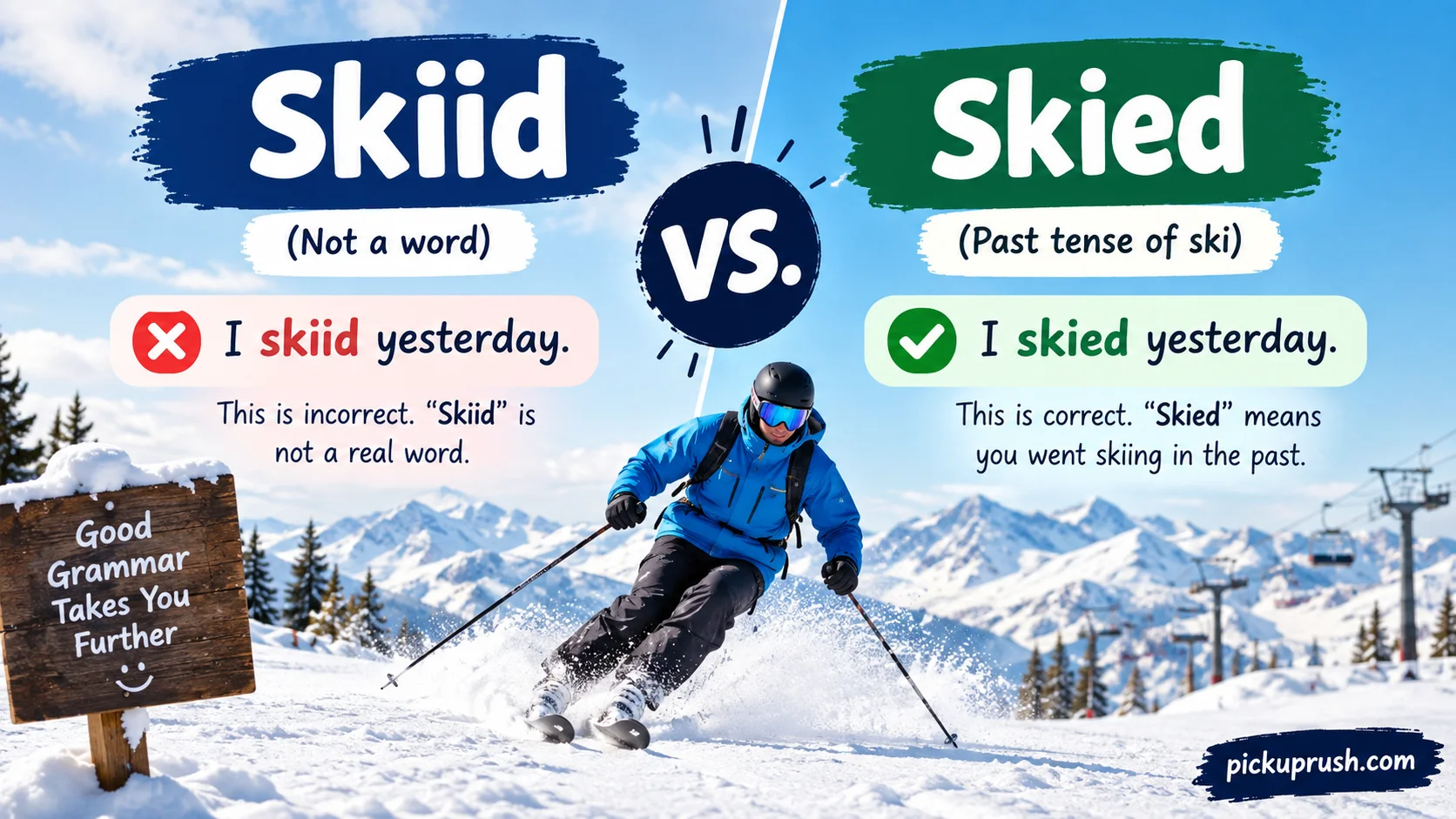

When you come across Skiid vs. Skied: Difference, Correct Spelling, and Usage, the choice may seem confusing at first. Both forms look similar, but they don’t have the same status in English spelling. Skied is the standard form used when talking about a past action involving the verb ski, while skiid is an incorrect spelling that often appears because of the way the word sounds or looks.
This small spelling issue can become a common grammar trap for learners, writers, and even fluent English users. When you’re writing quickly, it’s easy to pause and wonder whether skiid or skied is the right choice. Knowing the correct spelling helps you write with greater clarity and avoid an unnecessary error, whether you’re working on everyday writing, an email, or a school assignment.
Understanding the difference is useful because skied has a clear grammatical role as the past tense and past participle of ski. Once you understand this usage, you can recognize the correct form more confidently and avoid the same mistake in future writing. In the sections ahead, we’ll look at the meaning, grammar, examples, and practical usage of skied in simple terms.
Skiid vs. Skied: The Quick Answer
Skied is correct. Skiid is not the standard English spelling.
The verb ski follows this pattern:
ski → skied
The standard dictionaries agree on this form. Oxford lists skied as both the past simple and past participle of ski. Cambridge gives the same forms.
So if you want to say that someone went skiing yesterday, write:
- Correct: We skied yesterday.
- Incorrect: We skiid yesterday.
The extra i in skiid doesn’t belong there.
Skiid vs. Skied at a Glance
| Form | Correct? | Use | Example |
| ski | Yes | Base form | I want to ski. |
| skis | Yes | Present tense with he, she, or it | She skis every winter. |
| skied | Yes | Past tense | We skied yesterday. |
| skied | Yes | Past participle | They have skied there before. |
| skiing | Yes | -ing form | We are skiing today. |
| skiid | No | Nonstandard spelling | ❌ We skiid yesterday. |
| skiied | No | Incorrect spelling | ❌ We skiied yesterday. |
What Does “Skied” Mean?
Skied is the past tense and past participle of the verb ski. The verb ski means to move across snow using skis, usually as a sport or recreational activity. Oxford and Cambridge both give this basic meaning and list skied among the verb’s standard forms.
For example:
- I skied down the mountain.
- We skied all morning.
- She skied with her family last winter.
- They skied down the slope together.
In each sentence, the skiing happened in the past.
The word can also appear in perfect constructions:
- I have skied in Colorado.
- She has skied there several times.
- They had skied for hours before the weather changed.
The form stays skied. It doesn’t change to skiid.
Why Is “Skiid” Incorrect?
The easiest way to understand the spelling is to look at the standard verb forms together.
Ski has the following basic forms:
ski → skis → skiing → skied
The past form is skied, not skiid.
The unusual-looking spelling probably causes confusion because skiing contains two is:
ski + ing → skiing
That doesn’t mean the past form follows the same visual pattern:
ski + ed → skied
In other words, don’t copy the spelling pattern of skiing when forming the past tense.
Why “Skiing” Has Two I’s
The word skiing keeps the final i of ski and adds the suffix -ing:
ski + ing = skiing
That produces the sequence ii.
The past form works differently:
ski + ed = skied
This gives ie rather than ii.
That’s why these two words look different:
- skiing
- skied
Both are correct. They simply use different verb endings.
Is “Skiid” Ever the Correct Past Tense?
For standard English, no.
When the verb ski needs a past-tense form, dictionaries give skied. Oxford specifically lists skied as the past simple and past participle, while Cambridge identifies skied as both forms as well.
So these sentences should be written as follows:
- ❌ We skiid down the slope.
- ✅ We skied down the slope.
- ❌ She skiid in the mountains.
- ✅ She skied in the mountains.
- ❌ They skiid all afternoon.
- ✅ They skied all afternoon.
If you see skiid in an informal post or an unedited piece of writing, it doesn’t make the spelling a standard alternative. In polished English, skied is the form to use.
Ski vs. Skied vs. Skiing
Understanding the entire family of forms makes the spelling much easier to remember.
“Ski” — The Base Form
Use ski when the verb follows certain helping verbs or when you’re talking about the activity in the present or general sense.
Examples:
- I ski every winter.
- They want to ski tomorrow.
- We can ski after lunch.
- Did you ski last weekend?
Notice something important: after did, can, and want to, the verb remains ski.
“Skied” — The Past Form
Use skied when the action happened in the past.
Examples:
- I skied yesterday.
- She skied last weekend.
- We skied in Colorado last year.
- They skied until the lifts closed.
This is the form that creates the most confusion in the skiid vs. skied question.
“Skiing” — The -ing Form
Use skiing when describing an action in progress or referring to skiing as an activity.
Examples:
- We are skiing today.
- She enjoys skiing.
- They were skiing when the snow started.
- Skiing can be a demanding winter sport.
Cambridge lists skiing as the present participle of ski and skied as the past tense and past participle.
Skiid vs. Skied in Past-Tense Sentences
The easiest test is to ask whether the action has already happened.
If the answer is yes, skied is usually what you need.
Examples
Present:
I ski every winter.
Past:
I skied last winter.
Future:
I will ski next winter.
This simple pattern also shows why the helping verb matters.
When will appears, use the base form:
will ski
Not:
❌ will skied
Likewise, when did appears in a question, use ski:
Did you ski yesterday?
Not:
❌ Did you skied yesterday?
The past marker is already carried by did.
Common Grammar Mistakes With “Ski”
Spelling isn’t the only issue. Writers sometimes use the wrong verb form after a helping verb.
“Did You Skied?” vs. “Did You Ski?”
This is a common mistake.
Correct:
Did you ski yesterday?
Incorrect:
Did you skied yesterday?
Why? Did already places the question in the past. English then uses the base form of the main verb.
Compare:
- Did you ski?
- Did she ski?
- Did they ski?
Not:
- ❌ Did you skied?
- ❌ Did she skied?
- ❌ Did they skied?
“Will Ski” vs. “Will Skied”
The same basic principle applies after will.
Correct:
We will ski tomorrow.
Incorrect:
We will skied tomorrow.
The word will takes the base form ski.
“Can Ski” vs. “Can Skied”
After can, use ski.
Correct:
She can ski very well.
Incorrect:
She can skied very well.
This pattern also works with other modal verbs:
- might ski
- should ski
- could ski
- would ski
- may ski
“Have Skied” vs. “Have Ski”
After have, has, or had in a perfect construction, use the past participle.
Correct:
I have skied there before.
Incorrect:
I have ski there before.
So remember:
have + skied
not:
❌ have + ski
Correct and Incorrect Examples
A quick correction table can make the rules easier to remember.
| Incorrect | Correct | Reason |
| ❌ We skiid yesterday. | ✅ We skied yesterday. | Skied is the standard past form. |
| ❌ She skiied last winter. | ✅ She skied last winter. | Don’t add another i. |
| ❌ Did you skied there? | ✅ Did you ski there? | Use the base form after did. |
| ❌ We will skied tomorrow. | ✅ We will ski tomorrow. | Use the base form after will. |
| ❌ She can skied well. | ✅ She can ski well. | Use the base form after can. |
| ❌ I have ski there before. | ✅ I have skied there before. | Use the past participle after have. |
| ❌ I am skied today. | ✅ I am skiing today. | Use -ing for an action in progress. |
These examples reveal an important point: the correct form depends on the grammar around the verb.
Why “Skied” Looks Unusual
At first glance, skied can look strange because English readers often expect a simple -ed ending to create something like skied visually. The word also sits beside skiing, which has two consecutive is.
That combination makes the spelling easy to second-guess.
Think of the forms as separate pieces instead of trying to make them look alike:
| Base | Form | Result |
| ski | present | ski |
| ski | third-person present | skis |
| ski | past | skied |
| ski | past participle | skied |
| ski | -ing form | skiing |
Once you see the complete pattern, skiid becomes much easier to reject.
Skied as Both Past Tense and Past Participle
One useful feature of skied is that the same form serves two grammatical jobs.
Simple Past
The simple past describes a completed action in the past:
We skied in Utah last February.
The skiing happened at a definite past time.
Past Participle
The same word appears after have, has, or had:
We have skied in Utah before.
Here, skied is the past participle.
Another example:
They had skied for three hours before taking a break.
Oxford lists skied as both the past simple and past participle.
That means you don’t need a separate word for the past participle. Skied handles both roles.
Skied vs. Skiing: Don’t Mix Them Up
The difference between skied and skiing comes down to grammatical function and timing.
“We Skied Yesterday”
This describes a completed action.
We skied yesterday.
The activity is finished.
“We Are Skiing Today”
This describes an activity in progress.
We are skiing today.
The sentence focuses on the current activity or an arrangement around the present.
“We Enjoy Skiing”
Here, skiing names the activity.
We enjoy skiing.
It’s similar to talking about another activity:
- We enjoy hiking.
- We enjoy swimming.
- We enjoy skiing.
Quick Comparison
| Sentence | Form | Main idea |
| We ski every winter. | Base/present | Habit |
| We skied yesterday. | Past | Completed action |
| We are skiing today. | -ing form | Current activity |
| We have skied there before. | Past participle | Past experience |
| We will ski tomorrow. | Base after will | Future |
How to Use “Skied” in Real Writing
The word skied appears naturally in many kinds of writing.
Travel Writing
We skied in Colorado during our winter vacation.
The sentence describes a completed travel experience.
Personal Stories
I skied for the first time when I was a teenager.
The past tense works because the event happened earlier.
Sports Writing
The competitors skied through the course before crossing the finish line.
Here, skied describes an athletic action that took place.
Casual Messages
We skied all morning and grabbed lunch afterward.
The word fits naturally into everyday conversation too.
The important thing is that the spelling doesn’t change just because the writing style changes.
A Useful “Ski” Verb Pattern
Instead of memorizing only one word, learn the entire pattern.
ski → skis → skied → skiing
Each form has a clear role.
- ski — base form
- skis — third-person singular present
- skied — past tense
- skied — past participle
- skiing — present participle and gerund
This approach is more useful than simply memorizing that skiid is wrong. It gives you a working model for building sentences.
A Simple Memory Trick for “Skiid vs. Skied”
Here’s the easiest rule to keep in mind:
Ski + ed = skied
When you need the past form, think skied, not skiid.
Then remember that skiing is different because the ending is -ing:
ski + ing = skiing
So the two correct forms are:
- skied
- skiing
Not:
- ❌ skiid
- ❌ skiied
A quick three-sentence pattern can reinforce the distinction:
I ski in winter.
I skied last winter.
I am skiing this winter.
That’s the whole pattern in action.
Practice: Choose the Correct Form
Try completing these sentences before checking the answers.
- We ___ down the mountain yesterday.
- She enjoys ___ during the winter.
- Did you ___ last weekend?
- They have ___ in Colorado before.
- I want to ___ tomorrow.
- He was ___ when the weather changed.
- Maria ___ with her friends last year.
- We can ___ after lunch.
Answers
- skied
- skiing
- ski
- skied
- ski
- skiing
- skied
- ski
The pattern becomes much easier once you look at the word that comes before the verb.
Skiid vs. Skied: Common Questions
Is “skiid” a correct word?
Skiid is not the standard past-tense spelling of ski. The standard form is skied. Major dictionaries list skied as the past tense and past participle of ski.
What is the past tense of “ski”?
The past tense is skied.
Present: I ski every winter.
Past: I skied last winter.
Is “skiied” correct?
No. Skiied is not the standard spelling. The correct form is skied.
Is “skied” the past participle of “ski”?
Yes. Skied works as both the simple past and past participle.
For example:
- I skied yesterday.
- I have skied there before.
- I had skied there once before.
Oxford and Cambridge both identify skied as the past participle of ski.
Why does “skied” have an “e”?
The standard past form is skied. The spelling reflects the established form of the verb rather than copying the appearance of skiing.
The important thing to remember is the complete form:
ski → skied
Should you write “I skied” or “I skiid”?
Write I skied.
✅ I skied down the hill yesterday.
❌ I skiid down the hill yesterday.
Read More: Inexcusable vs. Unexcusable: Difference, Meaning, and Correct Usage
Skiid vs. Skied: Final Comparison
| Question | Answer |
| Is skiid standard English? | No |
| Is skied correct? | Yes |
| Past tense of ski | skied |
| Past participle of ski | skied |
| Present/base form | ski |
| Third-person singular | skis |
| -ing form | skiing |
| Correct sentence | We skied yesterday. |
| Incorrect sentence | We skiid yesterday. |
Final Takeaway: Skiid vs. Skied
The skiid vs. skied question has a straightforward answer: skied is the correct standard form.
Use ski for the base form, skis for third-person singular present, skied for the simple past and past participle, and skiing for the -ing form. Oxford and Cambridge both document this verb pattern.
The biggest trap is the spelling of skiing. Because that word contains two is, it can make skiid look reasonable. But the forms don’t follow the same spelling pattern.
The simplest rule is worth remembering:
When you need the past form of “ski,” write “skied,” not “skiid.”
Once that distinction sticks, this particular spelling problem becomes a quick one to solve.
Conclusion:
The difference between skiid vs. skied is simple once you know the correct spelling. Skied is the standard past tense and past participle of the verb ski. Skiid is not the standard English spelling.
Use skied when you’re describing someone who went skiing in the past. For example, “She skied down the mountain last winter” uses the correct form. The spelling may look unusual because the verb ski ends in i, but English forms the past tense as skied, not skiid.
When writing about skiing, stick with skied in formal writing, schoolwork, articles, emails, and everyday communication. Remembering the correct form will help you avoid one of those small spelling mistakes that can easily slip into a sentence.
FAQs:
Is “skiid” a correct spelling?
No. Skiid isn’t the standard English spelling. The correct past tense and past participle of ski is skied.
Is it “skied” or “skiid”?
Skied is correct. For example: “They skied in Colorado last year.” Skiid is a misspelling.
What is the past tense of “ski”?
The standard past tense of ski is skied.
Present: I ski every winter.
Past: I skied last winter.
Past participle: I have skied several times.
Why is “skied” spelled with “ie”?
The word ski forms its past tense by adding -ed, producing skied. It doesn’t double the final i, so skiid isn’t the standard form.
Can “skied” be used as a past participle?
Yes. Skied works as both the simple past tense and the past participle.
- We skied all afternoon.
- We have skied on that slope before.
- She had skied there many times.




1 thought on “Skiid vs. Skied: Difference, Correct Spelling, and Usage”