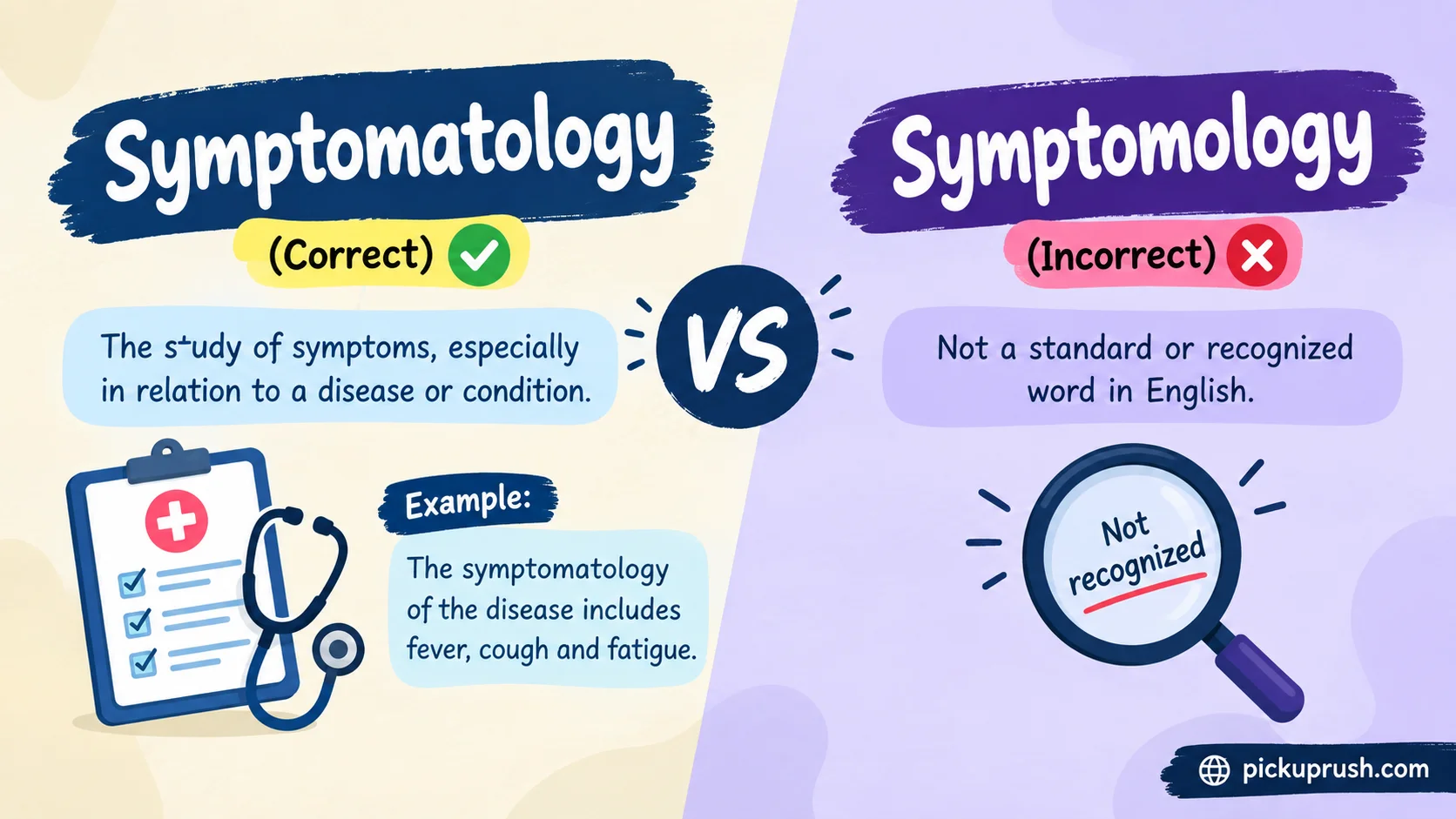

If you’ve ever stopped to wonder about Symptomatology vs Symptomology: Differences and Usage, you’re not alone. These two terms look and sound very similar, which makes them easy to confuse, especially when you’re writing about health, disease, or patient care. A small spelling difference can make you pause and wonder which term is appropriate in a medical report, research paper, or academic assignment.
Symptomatology is the established term used in medical and scientific contexts. It can describe the study of symptoms or the overall pattern and collection of symptoms linked to a particular disease or condition. Symptomology is also found in some sources, but it is generally treated as a less formal variant. Knowing this distinction can help you avoid common spelling and usage mistakes.
In this guide, you’ll learn the practical difference between symptomatology and symptomology, including their meanings, usage, and appropriate contexts. You’ll also see clear examples that show how these terms work in real sentences, making it easier to choose the correct word confidently in professional and everyday writing.
Symptomatology vs Symptomology: Quick Answer
Symptomatology is the more established and conventional term, particularly in medical, scientific, and academic writing. It can refer to the study or description of symptoms or to the collective symptoms and symptom patterns associated with a disease or patient.
Symptomology is also a documented English word. Some dictionaries treat it as a variant or informal form of symptomatology. Therefore, it isn’t accurate to automatically call symptomology a spelling mistake.
| Term | Meaning | Typical use |
| Symptomatology | The study or description of symptoms; the collection or pattern of symptoms | Medical, clinical, scientific, academic |
| Symptomology | A variant referring to symptomatology or the study of symptoms | Less conventional; context-dependent |
| Symptoms | Individual signs or experiences associated with a condition | General and professional writing |
For formal writing, symptomatology is generally the safer conventional choice. If your goal is maximum clarity for a broad audience, however, symptoms may be even better when the technical term isn’t necessary.
What Does Symptomatology Mean?
Symptomatology Definition
Symptomatology is a noun associated with the study, description, and classification of symptoms. It can also describe the overall collection or pattern of symptoms seen in a particular disease, disorder, or patient.
That second meaning matters because people sometimes assume that symptomatology can only mean “the study of symptoms.” In medical literature, the word can describe the symptoms themselves as a collective clinical pattern.
For example:
The patient’s symptomatology changed after treatment began.
Here, symptomatology doesn’t mean that someone was studying symptoms as an academic subject. It refers to the patient’s overall symptom pattern.
The word can also describe a field or area of clinical observation:
The course covered the symptomatology of several neurological disorders.
In this sentence, the focus is on understanding and describing the symptoms associated with those disorders.
Symptomatology in Medical Context
Medicine often needs words that describe more than one isolated symptom. A patient might experience fatigue, pain, nausea, dizziness, sleep problems, or changes in concentration. Looking at these experiences together can reveal a broader clinical pattern.
That’s where symptomatology becomes useful.
For instance, saying:
- “The patient had headaches.”
is straightforward.
Saying:
- “The patient’s neurological symptomatology included headaches, dizziness, and visual disturbances.”
provides a more technical description of the overall symptom presentation.
The word appears across many areas of health and research. You’ll encounter phrases such as:
- clinical symptomatology
- psychiatric symptomatology
- depressive symptomatology
- neurological symptomatology
- respiratory symptomatology
- disease symptomatology
However, technical language isn’t automatically better. If you’re writing for patients or a general audience, symptoms may communicate the same idea more clearly.
Examples of Symptomatology in a Sentence
Here are several examples showing how the word works:
- The researchers examined the symptomatology associated with the disorder.
- The patient’s symptomatology included persistent fatigue and difficulty sleeping.
- Changes in clinical symptomatology were recorded during the follow-up period.
- The study compared the symptomatology of patients with different diagnoses.
- The physician reviewed the patient’s symptomatology before considering additional testing.
Notice that symptomatology can describe either an organized clinical picture or the study and description of symptoms.
What Does Symptomology Mean?
Symptomology Definition
Symptomology refers to the same general subject area: symptoms and their study or description. It is an attested form of the word, although it has less conventional status than symptomatology in many formal contexts.
Collins English Dictionary lists symptomology in relation to symptomatology. This is important because it demonstrates that the shorter-looking form isn’t simply an accidental typo.
The word follows a pattern that feels intuitive to English speakers:
symptom + -ology = symptomology
The suffix -ology commonly appears in words associated with a field of study. That structure may explain why writers sometimes naturally produce symptomology.
Is Symptomology a Real Word?
Yes. Symptomology is a documented word, so describing it as universally incorrect would be misleading.
The more useful question is whether it’s the best choice for your particular context.
In a casual discussion, the distinction may barely matter. In a medical journal, academic paper, clinical report, or formal health publication, established terminology matters more. Readers in those settings may expect symptomatology because it has a long history of use in medical language.
Think of it this way: two roads can lead to the same destination, but one may be the road your audience expects you to take.
Examples of Symptomology in a Sentence
Here are examples of how symptomology may appear:
- The article discusses the symptomology associated with the condition.
- Researchers examined changes in the disorder’s symptomology.
- The clinician documented the patient’s symptomology during the evaluation.
- The report describes the common symptomology observed in affected individuals.
These sentences are understandable because the intended meaning is clear from context.
For highly formal medical writing, though, symptomatology is usually the more established form.
Symptomatology vs Symptomology: Key Differences
The biggest mistake is to assume that these words describe two completely different medical concepts. They generally don’t.
The important difference is usage and conventionality, not a sharp difference in meaning.
| Feature | Symptomatology | Symptomology |
| Part of speech | Noun | Noun |
| Relates to | Symptoms and their study or description | Symptoms and their study or description |
| Can describe symptom patterns? | Yes | Yes, depending on usage |
| Dictionary documentation | Broadly established | Documented as a variant by some dictionaries |
| Medical usage | Well established | Less conventional |
| Academic writing | Common choice | More context-dependent |
| General audience | May sound technical | May sound technical |
| Simpler alternative | Symptoms | Symptoms |
Are Symptomatology and Symptomology Synonyms?
In contexts where symptomology is used to mean symptomatology, the two terms are effectively synonymous.
Neither word should automatically be assigned a completely different definition simply because the spelling differs.
For example:
The study examined the symptomatology of the disorder.
and:
The study examined the symptomology of the disorder.
Both sentences communicate the idea that the study concerns the disorder’s symptoms or symptom pattern.
The difference is primarily one of established usage and register.
That distinction becomes especially important in professional writing. A word can be understandable and documented while still being less conventional for a particular audience.
Symptomatology vs Symptomology in Medical and Academic Writing
When you’re preparing a medical report, research paper, academic assignment, clinical publication, or scientific article, symptomatology is generally the more conventional choice.
Why?
Because formal writing benefits from terminology that readers in the field already recognize. Established terminology reduces unnecessary distraction. Your reader can focus on the actual findings rather than wondering whether an unfamiliar variant was intentional.
For example, this sounds natural in formal medical prose:
The study evaluated changes in depressive symptomatology over the observation period.
Using symptomology doesn’t necessarily make the sentence meaningless. It simply uses a less conventional form.
When “Symptoms” Is Better
Sometimes the best alternative isn’t either word.
If you’re writing for ordinary readers, symptoms is often clearer:
The most common symptoms include fatigue, headaches, and nausea.
You could technically use symptomatology in a more technical construction, but doing so may add complexity without adding useful information.
A good writing principle is simple:
Use specialized terminology when it adds precision. Use plain language when it communicates the same idea more clearly.
Why Do People Confuse Symptomatology and Symptomology?
The Similarity in Word Formation
The two words share the same beginning:
symptom-
They also end with a form associated with fields of knowledge:
-ology
The difference appears in the middle:
- symptomatology
- symptomology
That small difference can easily disappear during fast writing or editing.
The Role of “Symptom”
The confusion also comes from the familiar word symptom.
English contains many words formed with -ology, including:
- biology
- psychology
- pathology
- neurology
- cardiology
Because symptomology looks like a straightforward combination of symptom and -ology, it can feel more immediately logical.
However, symptomatology has its own established history and structure. Familiarity with word-building patterns doesn’t always tell you which historical form became standard in a professional field.
Historical Background of Symptomatology
The history of symptomatology helps explain why the longer form remains established.
Etymological references trace the term to medical Latin symptomatologia. The English word has been documented since the 18th century, giving it a long history in medical terminology.
The underlying word symptom itself comes through Latin symptoma from Greek symptōma, broadly referring to something that happens or befalls someone.
So symptomatology isn’t simply an unnecessarily long version of symptomology. It developed through an established medical and linguistic tradition.
How to Use Symptomatology Correctly
Because symptomatology has more than one documented sense, context determines its exact meaning.
Common Medical Patterns
You’ll often see the word used in constructions such as:
- the symptomatology of the disease
- clinical symptomatology
- psychiatric symptomatology
- changes in symptomatology
- depressive symptomatology
- neurological symptomatology
For example:
Researchers analyzed changes in the participants’ clinical symptomatology throughout the study.
Here, the phrase refers to changes in the participants’ overall clinical symptoms.
Another example:
The clinician reviewed the patient’s symptomatology before developing a treatment plan.
Again, the word refers to the broader presentation of symptoms.
Don’t Use It When “Symptoms” Is Clearer
Consider these two sentences:
The patient’s symptomatology included a mild headache.
The patient had a mild headache.
The second sentence is much simpler. If you’re writing for a general audience, it may be preferable.
The technical word makes more sense when you’re discussing a pattern, classification, comparison, or clinical profile rather than merely naming one symptom.
How to Use Symptomology Correctly
If you choose symptomology, use it as a noun referring to symptoms or their study and description.
For example:
The researchers examined the symptomology associated with the condition.
The word is grammatically functioning as a noun, just as symptomatology does.
However, consider your audience before using it. If your readers expect conventional medical terminology, symptomatology will usually be the less distracting choice.
If you’re editing an existing text, don’t automatically replace every occurrence of symptomology with symptomatology. First determine whether the original writer used the word intentionally and whether the surrounding publication has a terminology style guide.
Symptomatology vs Symptomology in a Sentence
Seeing the terms side by side makes the usage difference easier to understand.
With Symptomatology
The patient’s symptomatology changed during the six-week observation period.
This is a natural formal construction. It refers to the patient’s overall symptom pattern.
With Symptomology
The report describes the symptomology associated with the condition.
This is also understandable and uses symptomology as a noun.
A Simpler Version
The report describes the symptoms associated with the condition.
For a general audience, this version may be the clearest of all.
The lesson isn’t that longer words are automatically more professional. Precision and clarity matter more than complexity.
Symptomatology vs Symptomology vs Symptoms
These three choices are worth separating because they serve slightly different writing needs.
| Term | Best understood as | Example |
| Symptoms | Individual signs or experiences | The patient reported three symptoms. |
| Symptomatology | The study, description, or overall pattern of symptoms | The study examined the patient’s symptomatology. |
| Symptomology | A documented variant related to symptomatology | The paper discusses the condition’s symptomology. |
When to Choose Each One
Choose symptoms when:
- You’re writing for a general audience.
- You’re listing individual symptoms.
- Plain language is more useful than medical terminology.
- The broader concept of symptom patterns isn’t important.
Choose symptomatology when:
- You’re writing formal medical or academic material.
- You’re describing an overall symptom pattern.
- You’re discussing the classification or study of symptoms.
- Your audience expects established clinical terminology.
Consider symptomology when:
- The context already uses that terminology.
- You’re discussing a source that uses the term.
- Your publication or field accepts the variant.
- You have a reason to preserve the original wording.
Common Mistakes With Symptomatology and Symptomology
Assuming Symptomology Is Always Wrong
This is the most obvious mistake. Symptomology is documented, so it shouldn’t automatically be marked as a spelling error.
Instead, ask whether it fits the intended register.
Assuming the Words Have Completely Different Meanings
The spelling difference doesn’t create two unrelated medical concepts. In relevant contexts, symptomology functions as a variant connected to symptomatology.
Treating Symptomatology as Only “The Study of Symptoms”
That’s incomplete.
The word can also refer to the collective symptoms or symptom pattern associated with a disease or patient.
Using Technical Language When Plain Language Works
A sentence doesn’t become more accurate simply because it contains a longer medical term.
If “symptoms” communicates the intended meaning, it may be the stronger choice.
Using One Form Without Considering Your Audience
A medical researcher and a patient-facing health writer may need very different language.
A research paper might discuss clinical symptomatology. A patient information page might simply discuss symptoms.
A Practical Case Study: Choosing the Right Term
Imagine an academic researcher is writing about changes in symptoms during a clinical study.
The researcher could write:
Participants experienced changes in symptomatology during the study.
This works because the sentence discusses the overall symptom profile rather than one isolated symptom.
Now imagine the same information appears on a patient information page:
Participants experienced changes in their symptoms during the study.
The second version is easier for most readers.
Finally, suppose an existing historical paper uses symptomology. An editor encounters this sentence:
The authors described the symptomology of the disorder.
The editor shouldn’t automatically assume the author made a spelling mistake. The term is documented. Whether to change it depends on the publication’s style, audience, and preferred terminology.
This illustrates an important point: good editing requires context, not just a dictionary-style right-or-wrong test.
What Dictionaries Say About Symptomatology and Symptomology
Major reference sources help clarify why the issue isn’t simply a spelling error.
Cambridge Dictionary defines symptomatology in relation to the symptoms of a disease or medical condition. Cambridge Dictionary: Symptomatology
Collins English Dictionary documents symptomatology and also identifies symptomology as a related form. Collins Dictionary: Symptomatology
Dictionary.com gives symptomatology meanings connected with the study of symptoms and the collection of symptoms characteristic of a disease. Dictionary.com: Symptomatology
Etymological references also provide useful historical context. Etymonline traces the English history of symptomatology and records its connection with medical Latin. Etymonline: Symptomatology
These sources support an important distinction: dictionary status and preferred professional usage aren’t always exactly the same thing.
Key Facts About Symptomatology vs Symptomology
Keep these points in mind when you’re choosing between the two forms:
- Symptomatology is a well-established medical term.
- It can refer to the study or description of symptoms.
- It can also refer to a collection or pattern of symptoms.
- Symptomology is documented in English and shouldn’t automatically be treated as a typo.
- The two terms can overlap substantially in meaning.
- Symptomatology is generally more conventional in formal medical and academic writing.
- Symptoms is often the clearest choice for general readers.
- The correct choice depends on context, audience, and register.
Conclusion:
Understanding Symptomatology vs Symptomology: Differences and Usage becomes much easier once you know how each term is normally used. Symptomatology is the established term in medical and scientific writing and can refer to the study, collection, or pattern of symptoms linked to a disease or condition. Symptomology appears in some references, but it is generally treated as a less formal variant. For clinical reports, research papers, and other formal writing, choosing symptomatology can help you maintain clear and standard medical terminology.
The key is to focus on context rather than letting similar spelling cause confusion. Once you understand the distinction, you can use the appropriate term with greater confidence and avoid unnecessary second-guessing in your writing.
FAQs:
Is symptomatology the correct word?
Yes. Symptomatology is the established term commonly used in medical and scientific writing to discuss symptoms and their patterns or study.
Is symptomology a real word?
Yes. Symptomology appears in dictionaries and other reference sources, but it is generally considered a less formal variant of symptomatology.
What does symptomatology mean?
Symptomatology can refer to the study of symptoms or to the collection and pattern of symptoms associated with a disease or medical condition.
Can symptomatology and symptomology be used interchangeably?
They may sometimes be used with the same general meaning, but their standardness and formality differ. Symptomatology is the safer choice for formal medical and academic writing.
Which should I use in a research paper?
For a research paper, clinical report, or other formal scientific document, symptomatology is generally the preferred term.




1 thought on “Symptomatology vs Symptomology: Differences and Usage”