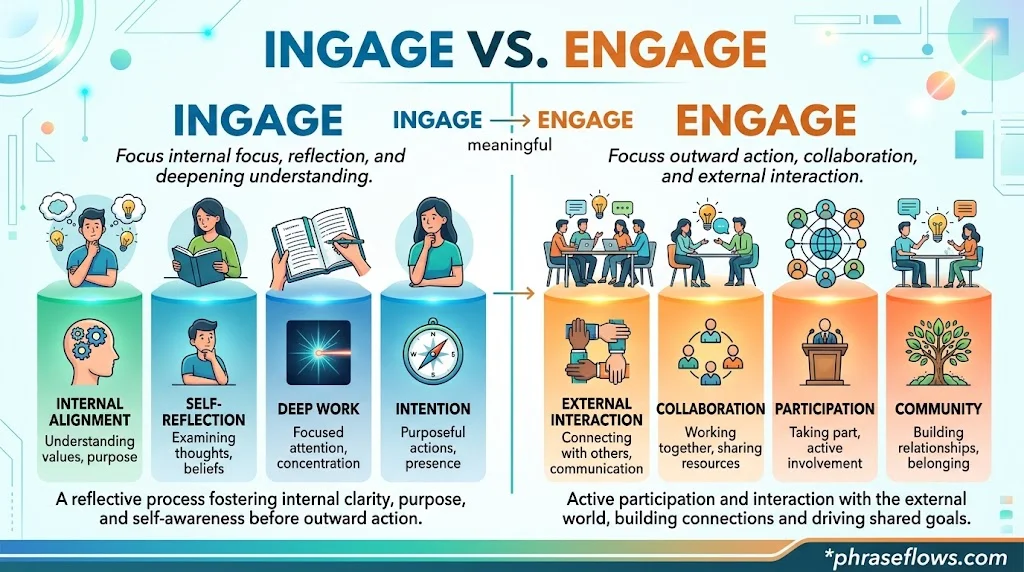

When you’re writing an email, preparing an assignment, or creating website content, a small spelling mistake can change how polished your writing looks. Ingage vs. engage is a good example because both forms look plausible, especially if you’re spelling the word based on how it sounds.
The correct spelling in modern standard English is engage. You can use it when talking about participating in an activity, attracting someone’s attention, hiring a professional, or connecting parts of a machine. The spelling ingage is an obsolete historical variant rather than an accepted alternative for everyday modern writing.
Although the difference comes down to one letter, understanding the words’ history and usage helps you avoid similar mistakes. You’ll also learn how to use engage in different sentence structures, distinguish it from engagement, and recognize when a similar-looking word serves a different purpose.
Ingage vs. Engage: Which Spelling Is Correct?
Engage is the correct spelling for contemporary American English and British English. If you want to describe involvement, interaction, or the act of hiring someone, choose engage.
The spelling ingage appears in historical English, but it isn’t the standard form used in modern communication. You might encounter it in an old text or as part of a company or product name. Those exceptions don’t make it interchangeable with the modern verb.
Here’s a quick comparison:
| Feature | Engage | Ingage |
| Modern spelling | Correct | Nonstandard |
| Everyday usage | Common | Rare |
| Historical usage | Established spelling | Obsolete variant |
| Meaning in modern English | To involve, participate, attract, or hire | No separate standard modern meaning |
| Use in professional writing | Recommended | Avoid unless it’s a proper name or historical quotation |
| American and British English | Standard in both | Not a standard regional alternative |
The easiest rule to remember is simple: use engage in modern writing unless you’re reproducing a historical spelling or referring to a name that officially uses Ingage.
For example:
- Correct: The teacher encouraged students to engage in the discussion.
- Incorrect: The teacher encouraged students to ingage in the discussion.
The second sentence contains a spelling error in ordinary modern English. Replacing ingage with engage fixes it.
What Does Engage Mean?
The word engage has several meanings, so its exact definition depends on the situation. It can describe taking part in an activity, drawing someone’s attention, hiring a professional, or connecting mechanical parts.
Understanding these meanings helps you choose the right word instead of relying on spelling alone.
Engage Means to Become Involved
One common meaning of engage is to participate in something or become involved in an activity. You can engage in a conversation, a debate, a project, or a community program.
The word often suggests active participation rather than simply being present. For example, someone who listens carefully and contributes ideas engages in a discussion more directly than someone who merely sits in the room.
Consider these examples:
- Students should engage in classroom discussions to develop their communication skills.
- The volunteers engage in community projects throughout the year.
- She engaged in a thoughtful conversation about environmental protection.
- Employees who engage in training often gain a clearer understanding of workplace procedures.
Notice the usual structure in these examples: engage in + activity. This pattern works well when you describe participation in an event, process, or pursuit.
Engage Means to Attract or Hold Attention
Have you ever read a book that made you forget about everything around you? That book probably managed to engage your attention.
In this sense, engage means to interest someone, hold their attention, or encourage them to become mentally involved. Teachers, writers, speakers, and marketers often use the word this way.
For example:
- The speaker used real-life stories to engage the audience.
- Interactive lessons can engage students more effectively than repetitive exercises.
- The article engages readers with clear explanations and practical examples.
- The documentary engaged viewers through compelling interviews.
This meaning is especially useful in education and content creation. A lesson can present accurate information without engaging students. Similarly, an article can contain useful facts but still struggle to hold a reader’s attention.
The distinction matters because providing information and engaging an audience aren’t exactly the same thing. Strong communication aims to do both.
Engage Means to Hire Someone
In professional English, engage can mean to hire or formally arrange for someone’s services. The word often appears in business documents, legal writing, and formal correspondence.
For instance:
- The company decided to engage an independent consultant.
- The family engaged an attorney to review the agreement.
- The organization engaged a specialist to evaluate its software.
- The publisher engaged an editor to review the manuscript.
This use sounds more formal than simply saying hire. However, it remains useful when the arrangement involves professional services or a specific assignment.
For everyday conversations, you can often use hire instead. In a formal proposal, engage a consultant may fit the tone better.
Engage Means to Connect or Activate
In technical and mechanical contexts, engage can describe connecting components so they work together or putting a mechanism into operation.
For example:
- Press the control to engage the mechanism.
- The gears engage when the machine starts operating.
- The driver engaged the clutch before changing gears.
This meaning differs from participating in a discussion, but the underlying idea is similar: something becomes connected, involved, or active.
When you encounter engage in a technical manual, look at the surrounding words. References to gears, clutches, switches, and mechanisms usually point to this mechanical meaning.
Engage Means to Enter a Conflict or Competition
The verb can also describe entering a confrontation or taking part in a contest. This use is more common in formal, military, sporting, or historical contexts.
Examples include:
- The teams engaged in a close contest.
- The opposing forces engaged in battle.
- The athletes engaged in a demanding competition.
In these sentences, engage suggests active participation in a challenging encounter. The surrounding context determines whether the word refers to a friendly competition, a serious dispute, or a military conflict.
What Does Ingage Mean?
Ingage is an obsolete spelling of engage. It appeared in older English writing, but modern writers generally use engage instead. The two spellings don’t represent separate standard verbs with different meanings.
Historical texts help explain why ingage sometimes appears in dictionaries and online searches. For example, the historical spelling occurs in works from the early 18th century, including Thomas d’Urfey’s The Old Mode & the New (1703) and Lady Damaris Masham’s Occasional Thoughts (1705). These examples show that ingage wasn’t simply a modern typing mistake. Oxford Advanced Learner’s Dictionary also identifies ingage as an earlier spelling of engage. Oxford’s entry for engage provides further information about the word’s history.
Oxford Learner’s Dictionaries
+1
However, historical use doesn’t mean a spelling remains appropriate today. English spelling changes over time, and forms that once appeared in print can fall out of standard usage.
Think of ingage as a spelling you might study when reading historical documents, not one to use when writing a modern business email.
Why You Might Encounter Ingage Today
There are a few reasons this spelling might appear:
- Historical documents: Older books and manuscripts sometimes preserve spellings that modern readers rarely use.
- Typing mistakes: Someone may accidentally type ingage when they mean engage.
- Brand names: A company or product may deliberately use Ingage as its name.
- Search results: Websites may discuss the spelling because people want to know whether it’s correct.
The context tells you how to interpret it. If you’re reading an old document, ingage may reflect the spelling conventions of its time. If you’re writing a current report, use engage.
Why Do People Confuse Ingage and Engage?
The confusion is understandable. Both spellings contain the same letters after the first vowel, and the difference can be easy to overlook when typing quickly.
Still, several factors explain why the mistake occurs.
Similar Pronunciation
The standard pronunciation of engage is /ɪnˈɡeɪdʒ/ in the Oxford Learner’s Dictionary, with the main stress on the second syllable. The initial sound can resemble the short vowel in words beginning with in-, which may lead some writers to choose the wrong first letter.
Oxford Learner’s Dictionaries
Pronunciation alone doesn’t always tell you how to spell an English word. Consider these examples:
- Enough: The first letter is e, even though the word begins with a sound that can be confusing to learners.
- Invite: The word begins with i and has a different vowel pattern.
- Engage: The standard spelling begins with e, even though its initial sound may sound similar to in in some accents.
The lesson is simple: learn the spelling of the whole word rather than guessing from its opening sound.
Confusion About English Spelling Patterns
English borrows words from several languages, including French and Latin. As a result, spelling doesn’t always follow a single, predictable pattern.
The word engage has a French origin. The Online Etymology Dictionary traces it to Old French engagier, associated with making a pledge or binding oneself by a promise. Over time, the English word developed meanings related to involvement, employment, attention, and conflict.
Etymology, Origin & Meaning
Knowing this background helps explain why engage has its established spelling. However, you don’t need to memorize its full history to use it correctly.
Typing Errors and Autocorrect
Sometimes, the mistake has nothing to do with vocabulary knowledge. You might type too quickly, miss a letter, or overlook an error while reviewing a paragraph.
Autocorrect can help, but it doesn’t catch every problem. Spell-check tools may also overlook errors when a misspelled word resembles a name or appears in a specialized context.
For example:
- Incorrect: The presentation will ingage new customers.
- Correct: The presentation will engage new customers.
A quick proofreading pass can catch this kind of error. Pay particular attention to words you’ve typed from memory rather than copied from a reliable source.
Historical Spellings and Brand Names
Not every appearance of Ingage is an error. A business might choose that spelling for its official name, just as a product may use unusual capitalization or a modified word.
For example, if a company officially calls its service Ingage, you should preserve that spelling when discussing the company. You wouldn’t automatically change a registered or established name to Engage.
The distinction is between a proper noun and an ordinary verb. Brand names follow the chosen name of the organization or product, while standard English spelling governs ordinary sentences.
Ingage vs. Engage: Examples of Correct and Incorrect Usage
Examples make the difference easier to remember. In each sentence below, engage is the correct modern spelling when the intended meaning involves participation, attention, or professional services.
Examples in Everyday Conversation
| Incorrect usage | Correct usage |
| I want to ingage in the conversation. | I want to engage in the conversation. |
| She knows how to ingage people. | She knows how to engage people. |
| We should ingage with the community. | We should engage with the community. |
| The game helped ingage the children. | The game helped engage the children. |
The corrected sentences sound natural because engage fits the intended meaning. The error lies in the spelling, not in the basic sentence structure.
Examples in Academic Writing
Students and teachers often use engage to describe participation in learning activities.
- Correct: Students engage with the reading material before class.
- Correct: The teacher encouraged everyone to engage in the debate.
- Correct: The research team engaged participants in a series of interviews.
- Incorrect: The lecturer asked students to ingage with the topic.
In academic writing, the word can describe both mental involvement and active participation. However, be specific about what the person actually does. A student might read, discuss, analyze, or engage with a text, depending on the intended meaning.
Examples in Business and Professional Writing
In business communication, engage can describe customer interaction or the hiring of professional services.
- Correct: Our team wants to engage more customers through helpful content.
- Correct: The company engaged a consultant to review its marketing strategy.
- Correct: Managers should engage employees in decisions that affect their work.
- Incorrect: We plan to ingage an experienced designer.
The first example describes attracting customer participation. The second uses engage to mean hiring someone for a particular task. Although the meaning changes, the spelling stays the same.
Examples in Technical Writing
Technical writing uses engage to describe how parts connect or mechanisms begin working.
- Correct: Engage the clutch before moving the vehicle.
- Correct: The gears engage when the mechanism operates properly.
- Correct: The switch engages the locking mechanism.
- Incorrect: The gears fail to ingage properly.
In these examples, engage isn’t about conversation or attention. It describes a mechanical relationship. This is a useful reminder that one word can have several meanings without changing its spelling.
How to Use Engage Correctly in a Sentence
Choosing the correct spelling is only the first step. To write naturally, you should also understand how engage works with other words.
Engage Someone in Something
Use engage + person + in + activity when you want to describe involving someone in an activity or conversation.
Examples:
- The teacher engaged the students in a discussion.
- She engaged her guests in conversation.
- The manager engaged the team in a planning session.
Here, the person or group comes directly after the verb. The phrase beginning with in identifies the activity.
Engage in Something
Use engage in + activity when the subject participates in an activity or process.
Examples:
- They engage in regular exercise.
- The organization engages in environmental research.
- We engaged in a detailed discussion.
This structure emphasizes the activity itself. It’s common in academic, professional, and everyday English.
Engage With Someone or Something
Use engage with when describing interaction with a person, an idea, a subject, or a piece of content.
Examples:
- Readers engage with articles that answer their questions.
- The students engaged with the material.
- The organization wants to engage with local residents.
The distinction is subtle but useful. Engage in a discussion focuses on participating in the discussion, while engage with an idea emphasizes interacting with or considering that idea.
Engage Someone or Something
You can also use engage with a direct object, without in or with.
Examples:
- The speaker engaged the audience.
- The company engaged an outside consultant.
- The mechanism engages the gears.
The object helps explain what the verb means in that sentence. The audience receives the speaker’s attention-grabbing efforts, the consultant provides professional services, and the gears connect mechanically.
What Are the Different Forms of Engage?
One reliable way to avoid spelling mistakes is to learn a word’s related forms. When you understand how engage changes in different grammatical situations, you’re less likely to write ingaged or ingaging by mistake.
| Word form | Correct spelling | Example sentence |
| Base form | Engage | We engage with our readers. |
| Third-person singular | Engages | She engages the audience. |
| Past tense | Engaged | They engaged in the discussion. |
| Past participle | Engaged | The students have engaged with the material. |
| Present participle | Engaging | The teacher is engaging the class. |
| Noun | Engagement | Employee engagement supports teamwork. |
| Opposite action | Disengage | Disengage the mechanism before inspection. |
| Renewed involvement | Reengage | The activity helped reengage the students. |
The spelling follows a consistent pattern in these common forms:
- Add -s to form engages.
- Add -d to form engaged.
- Replace the final e with -ing to form engaging.
- Use engagement when you need the related noun.
Notice that engaged and engaging don’t keep the final e from the base form. However, engagement retains it before the suffix.
Engage vs. Engaged
Engage is the base form, while engaged is the past-tense form and past participle.
Compare these sentences:
- Present: We engage with customers every day.
- Past: We engaged with customers yesterday.
- Present perfect: We have engaged with hundreds of customers.
The correct past-tense spelling is engaged, not ingaged or engageed.
Engage vs. Engaging
The word engaging describes an action in progress or something that attracts interest.
For example, you might say, “The presenter is engaging the audience.” You could also describe a book as “an engaging read.”
In both cases, engaging relates to involvement or attention. Remember to drop the final e before adding -ing.
Engage vs. Engagement
Although the words share the same root, they serve different grammatical purposes.
Engage is a verb. It describes an action. Engagement is a noun that refers to involvement, participation, a commitment, or an agreement to marry, depending on the context.
For example:
- Verb: The company wants to engage its customers.
- Noun: Customer engagement has increased.
- Verb: They agreed to engage a specialist.
- Noun: The specialist’s engagement lasted three months.
The right choice depends on what the sentence needs. If you’re describing an action, engage may fit. If you’re naming the activity or relationship, engagement may be more appropriate.
Is Engage Spelled Differently in American and British English?
No. Engage is the standard spelling in both American and British English. You don’t need to change the first letter when switching between these varieties.
Some English words genuinely have different regional spellings. For example, American English generally uses color, while British English uses colour. Similarly, organize and organise follow different conventions in some varieties of English.
However, engage doesn’t have that kind of standard regional variation. Writing ingage in an American article doesn’t make it American English, and using it in a British document doesn’t make it British English.
If you’re writing for a US audience, keep the spelling engage consistent throughout your article, email, or report.
Is Ingage Ever Acceptable?
Although ingage isn’t the standard modern spelling, a few situations justify preserving it.
In Historical Writing
If you’re quoting an old document, you may need to retain the original spelling. Changing ingage to engage could alter the historical text you’re reproducing.
For example, a researcher discussing an old manuscript might write:
The manuscript uses the historical spelling ingage where modern English uses engage.
This sentence explains the spelling without suggesting that readers should adopt it today.
When quoting historical sources, follow the source’s wording and any relevant editorial guidelines. If you modernize the spelling, make that choice clear when accuracy requires it.
In Company and Product Names
A business may use Ingage as its official name. In that situation, preserve the name exactly as the organization presents it.
For example:
- “The company operates under the name Ingage.”
- “The document refers to Ingage’s software platform.”
These sentences use Ingage as a proper noun rather than as the ordinary verb engage.
Before correcting an unfamiliar spelling in a document, check whether it refers to a person, organization, or product. A word that looks unusual isn’t necessarily a typo when it forms part of an official name.
In Contemporary Everyday Writing
If you aren’t quoting a historical source or using an official name, choose engage.
Use it in:
- School assignments
- Business emails
- Blog posts and articles
- Professional reports
- Social media posts
- Marketing materials
- Academic papers
There’s no need to use ingage to make your writing sound distinctive. The standard spelling communicates your meaning clearly and avoids distracting readers.
Common Mistakes to Avoid When Using Engage
Spelling engage correctly becomes easier when you watch for related errors and grammatical mix-ups.
| Common mistake | Correct form | Explanation |
| Ingage | Engage | The standard modern spelling begins with e. |
| Ingaged | Engaged | The past-tense form retains the standard spelling. |
| Ingaging | Engaging | Drop the final e and add -ing. |
| Engageed | Engaged | Add -d rather than -eed. |
| Engagment | Engagement | Include the second e before -ment. |
| Disengadge | Disengage | Preserve the correct spelling of the base word. |
| Reingage | Reengage | The standard form for renewed involvement is reengage. |
Using Engage In and Engage With Interchangeably
These expressions overlap, but they don’t always emphasize the same thing.
Consider the following examples:
- “She engaged in a debate.” This emphasizes her participation in the debate.
- “She engaged with the argument.” This emphasizes her interaction with the ideas.
- “She engaged the audience.” This means she attracted or held the audience’s attention.
The difference isn’t simply a spelling rule. It involves meaning and sentence structure. Choosing the right expression helps your writing sound more precise.
Relying Entirely on Spell-Check
Spell-checking tools can catch many mistakes, but they aren’t a substitute for proofreading. They may overlook unusual names or fail to explain why a particular word doesn’t fit the sentence.
For better results, check both spelling and meaning. Ask yourself whether engage describes the action you intend to express.
Read More: Home Made vs. Homemade: Which Is Correct? Meaning, Spelling, and Examples
How to Remember the Correct Spelling of Engage
You don’t need an elaborate memory trick to distinguish ingage from engage. A few simple habits can make the correct spelling stick.
Remember the opening letters: EN. When you mean to involve someone, attract attention, participate, or hire a professional, begin with en-.
Try these practical techniques:
- Learn the word in context: Memorize a sentence such as “We engage with our readers.”
- Practice related forms: Write engage, engaged, engaging, and engagement together.
- Read your sentences aloud: Listening to your writing can help you spot awkward wording, although it won’t always reveal a spelling mistake.
- Use a dictionary: Check an unfamiliar word instead of guessing from its sound.
- Proofread common errors: Search your draft for ingage, especially if you typed the article quickly.
Here’s a short practice exercise:
Choose the correct spelling in each sentence.
1. The speaker wanted to ___ the audience.
ingage
engage
2. The students ___ in a lively discussion.
engaged
ingaged
3. The book was interesting and ___.
engaging
ingaging
Check answersTry again
Practicing the word in complete sentences is more useful than memorizing isolated letters. It helps you recognize the correct form when you need it.
Conclusion:
When comparing ingage vs. engage, engage is the correct spelling in modern standard English. It means to participate in an activity, attract someone’s attention, hire a professional, or connect mechanical parts. Although ingage appeared in historical English, it isn’t a standard spelling for everyday writing today.
To avoid mistakes, remember the correct forms: engage, engaged, engaging, and engagement. Whether you’re writing a school assignment, business email, or blog post, using engage will keep your writing clear, accurate, and professional.
FAQs:
Is Ingage or Engage Correct?
Engage is the correct spelling in modern English. Ingage is an obsolete historical variant and shouldn’t replace engage in contemporary writing.
What Does Engage Mean?
Engage means to become involved in an activity, attract someone’s attention, hire a professional, or connect a mechanism. Its exact meaning depends on the context.
Is Ingage an Old-Fashioned Spelling?
Yes, ingage appeared in older English texts as a spelling of engage. However, modern English uses engage as the standard form.
Is Engage Spelled the Same in American and British English?
Yes. Engage is the standard spelling in both American and British English. Neither variety uses ingage as a standard alternative.
What Are the Past Tense and Present Participle of Engage?
The past tense of engage is engaged, while the present participle is engaging. For example, “They engaged in the discussion” and “She is engaging the audience.”




1 thought on “Ingage vs. Engage: Which Spelling Is Correct?”