
Have you ever wondered whether to write coaches or coach’s? Although these words look almost identical, they serve different grammatical purposes. Choosing the wrong form can change your sentence’s meaning, especially when you’re talking about sports teams, instructors, training sessions, or something that belongs to a coach.
The good news is that the difference between coaches vs. coach’s is easy to understand once you know how plural nouns, possessive nouns, and contractions work. You don’t need to memorize complicated grammar rules. Instead, focus on what you want to say and how the word functions in your sentence.
In this guide, you’ll learn when to use coaches, coach’s, and coaches’. You’ll also find practical examples, comparison tables, common mistakes, and simple tests to help you choose the correct form every time.
Coaches vs. Coach’s: What’s the Difference?
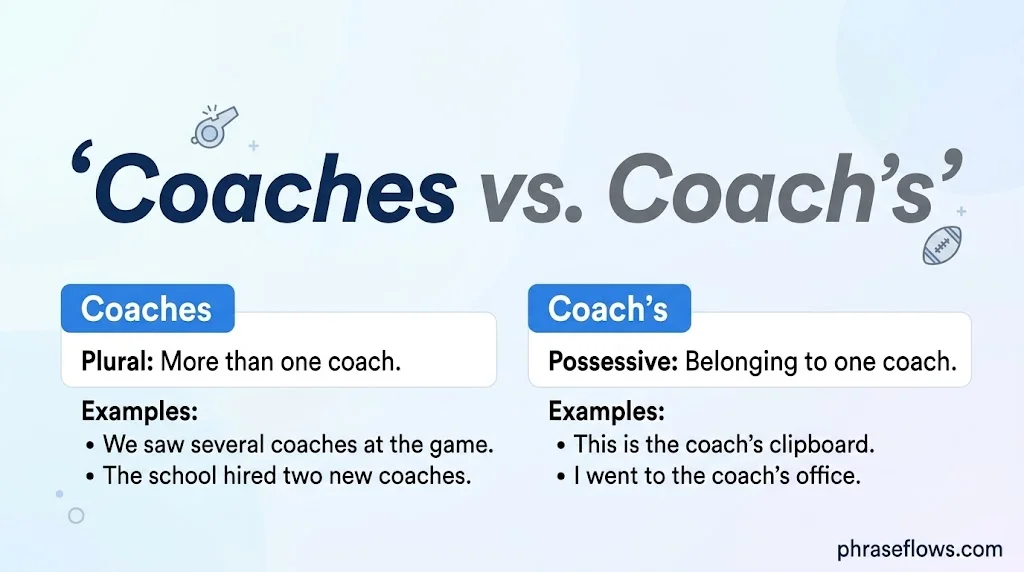
The main difference between coaches and coach’s lies in their grammatical function. Coaches usually refers to more than one coach, but it can also describe what one person does when training someone. In contrast, coach’s shows possession by one coach or serves as a contraction of coach is or coach has.
Consider these examples:
- Coaches: The coaches attended the training session.
- Coach’s: The coach’s office is next to the gym.
- Coaches’: The coaches’ meeting starts at 3 p.m.
Each sentence uses a different grammatical form. The first refers to several coaches. The second identifies an office associated with one coach. The third indicates that a meeting belongs to or involves multiple coaches.
Here’s a quick comparison:
| Word | Grammatical function | Meaning | Example |
| Coaches | Plural noun | More than one coach | The coaches arrived early. |
| Coaches | Verb | Trains or guides someone | She coaches young athletes. |
| Coach’s | Singular possessive noun | Belonging to one coach | The coach’s plan worked. |
| Coach’s | Contraction | Coach is or coach has | The coach’s ready to begin. |
| Coaches’ | Plural possessive noun | Belonging to multiple coaches | The coaches’ plans differ. |
The easiest rule to remember: Use coaches for multiple coaches, coach’s for one coach’s possession or a suitable contraction, and coaches’ for possession involving multiple coaches.
What Does Coaches Mean?
The word coaches has two common grammatical uses. It can be the plural form of the noun coach, or it can be a verb describing the act of training, teaching, or guiding someone.
Understanding the difference between these uses helps you write sentences that communicate your meaning clearly.
Coaches as a Plural Noun
When you talk about two or more coaches, use coaches without an apostrophe. English forms the plural of most nouns by adding -s or -es. Because coach ends in -ch, you add -es to form its standard plural.
For example:
- The coaches discussed the team’s performance.
- Three coaches attended the school meeting.
- The basketball coaches organized a practice session.
- Several coaches volunteered to help the young players.
- The head coach introduced the new coaches to the team.
In each sentence, coaches refers to multiple people. No apostrophe is necessary because the word simply identifies more than one coach.
The same rule applies whether you’re discussing sports instructors, career coaches, fitness coaches, or people who help others develop particular skills.
Remember: A regular plural doesn’t need an apostrophe. Writing coach’s when you mean several coaches changes the grammatical meaning.
Coaches as a Verb
Coaches also works as a verb. It is the third-person singular form of coach, which means to train, guide, or help someone improve a skill.
Use this form when the subject is he, she, it, or a singular noun.
Examples include:
- She coaches the school’s volleyball team.
- He coaches young athletes after school.
- Our instructor coaches employees on communication skills.
- The trainer coaches beginners through each exercise.
- Maria coaches students preparing for public speaking.
Notice that coaches doesn’t mean several instructors in these examples. It describes an action performed by one person.
Compare the following sentences:
| Sentence | Meaning of coaches |
| The coaches arrived before practice. | A plural noun referring to multiple people |
| She coaches the soccer team. | A verb describing what she does |
| The experienced coaches shared advice. | A plural noun referring to several instructors |
| He coaches new employees. | A verb describing his training role |
The subject helps you identify the correct meaning. If coaches names several people, it’s a noun. If it describes what someone does, it’s a verb.
Coaches in Everyday Sentences
You can use coaches in many settings beyond organized sports.
For instance, a career adviser might coach job seekers on interview skills. A music instructor might coach singers before a performance. Similarly, a business mentor might coach managers on leadership.
Consider these examples:
- The coaches prepared a new development program.
- Our school coaches students in debate and public speaking.
- Two fitness coaches designed the weekly training schedule.
- She coaches new managers through difficult workplace decisions.
- The swimming coaches reviewed each athlete’s progress.
These examples show why context matters. The spelling stays the same, but the grammatical role changes depending on how the sentence works.
What Does Coach’s Mean?
The word coach’s contains an apostrophe followed by s. It has two main uses: it can show possession by one coach, or it can shorten the expressions coach is and coach has.
The sentence tells you which meaning applies. Understanding both uses will help you avoid confusing coach’s with coaches or coaches’.
Coach’s as a Singular Possessive Noun
Use coach’s when something belongs to, relates to, or is associated with one coach. This grammatical form is called the singular possessive.
To form the possessive of the singular noun coach, add an apostrophe and s.
For example:
- The coach’s office is near the locker room.
- The coach’s instructions helped the team improve.
- I followed the coach’s advice during practice.
- The coach’s decision surprised the players.
- We reviewed the coach’s training schedule.
In these sentences, the apostrophe indicates a relationship between one coach and something else. The office belongs to the coach, the instructions came from the coach, and the decision was made by the coach.
Possession doesn’t always mean legal ownership. In grammar, a possessive noun can also show authorship, responsibility, association, or a connection between people and things.
For example, the coach’s strategy refers to a strategy developed, selected, or used by one coach. The coach doesn’t need to own the strategy as a physical object.
Coach’s as a Contraction
The word coach’s can also be a contraction. A contraction combines words by omitting certain letters and replacing them with an apostrophe.
In this case, coach’s can represent either coach is or coach has. You must examine the surrounding words to determine which expansion makes sense.
When coach’s means coach is:
- The coach’s ready for the game.
Meaning: The coach is ready for the game. - The coach’s explaining the new rules.
Meaning: The coach is explaining the new rules. - The coach’s very pleased with the team’s progress.
Meaning: The coach is very pleased with the team’s progress.
When coach’s means coach has:
- The coach’s been working with the team all season.
Meaning: The coach has been working with the team all season. - The coach’s already reviewed the schedule.
Meaning: The coach has already reviewed the schedule. - The coach’s finished preparing the players.
Meaning: The coach has finished preparing the players.
These contractions are grammatically valid, especially in conversational writing. However, the full forms may be clearer in formal reports, academic writing, or official announcements.
One important detail: coach’s doesn’t automatically indicate possession. In a sentence such as “The coach’s arrived,” the intended meaning is usually “The coach is arrived” only in an unusual or nonstandard construction, so that sentence isn’t a good everyday example. Instead, use a natural contraction such as “The coach’s here,” meaning “The coach is here.”
How to Identify the Meaning of Coach’s
When you’re unsure whether coach’s is possessive or a contraction, try replacing it with the possible full expressions.
| Sentence | Substitution | Correct interpretation |
| The coach’s office is open. | The coach is office is open. | Possessive |
| The coach’s ready. | The coach is ready. | Contraction |
| The coach’s finished the report. | The coach has finished the report. | Contraction |
| The coach’s advice was useful. | The coach is advice was useful. | Possessive |
If replacing coach’s with coach is or coach has produces a grammatical sentence with the intended meaning, you’re probably looking at a contraction. If neither expansion works, the word is likely possessive.
This simple test is especially helpful when proofreading emails, reports, and other writing.
Coaches vs. Coach’s vs. Coaches’: Understanding All Three Forms
Although coaches, coach’s, and coaches’ look similar, each serves a different purpose. The apostrophe’s position is the key to understanding the distinction.
| Form | What it means | Example |
| Coaches | Multiple coaches or the verb form | The coaches met after practice. |
| Coach’s | Possession by one coach, or a contraction | The coach’s notebook is missing. |
| Coaches’ | Possession involving multiple coaches | The coaches’ notebooks are missing. |
The difference becomes clearer when you compare sentences that use the same noun.
- The coach’s schedule: The schedule belongs to one coach.
- The coaches’ schedule: The schedule belongs to multiple coaches.
- The coaches scheduled practice: Multiple coaches arranged the practice session.
The first sentence uses a singular possessive. The second uses a plural possessive. The third uses coaches as a plural noun acting as the subject of a sentence.
When to Use Coaches’
Use coaches’ when something belongs to or is associated with two or more coaches.
To form the possessive of a regular plural noun ending in s, place the apostrophe after the final s. You don’t add another s in the standard form.
Examples include:
- The coaches’ meeting lasted an hour.
- The coaches’ offices are on the second floor.
- We reviewed the coaches’ recommendations.
- The coaches’ schedules overlap on Fridays.
- The coaches’ combined experience helped the team.
In each example, the possessive relationship involves more than one coach.
However, don’t confuse the number of coaches with the number of items. One coach can have several schedules or notebooks, while multiple coaches can share a single meeting or decision.
The number of coaches determines whether you need coach’s or coaches’, not the number of objects mentioned.
Coach’s vs. Coaches’ in Similar Sentences
Compare these pairs to see how one apostrophe changes the meaning:
Singular possession:
- The coach’s instructions were clear.
- The coach’s office has a new desk.
Plural possession:
- The coaches’ instructions were consistent.
- The coaches’ offices have new desks.
In the first group, one coach gives the instructions or has the office. In the second group, several coaches provide the instructions or have offices.
A useful proofreading habit is to identify the owner before placing the apostrophe. Ask yourself, “Am I talking about one coach or more than one?” Your answer determines the possessive form.
Coaches vs. Coach’s Examples in Different Contexts
Grammar rules become easier to remember when you see how they work in everyday situations. The following examples show how coaches, coach’s, and coaches’ fit into sports, education, and professional development.
Coaches vs. Coach’s in Sports
Sports provide some of the clearest examples because teams often work with multiple instructors while also following the directions of an individual coach.
| Example sentence | Why this form is correct |
| The coaches arrived early for practice. | Refers to multiple coaches. |
| The coach’s whistle fell onto the field. | Shows possession by one coach. |
| The coaches’ meeting begins after the game. | Shows a meeting associated with multiple coaches. |
| She coaches the junior basketball team. | Describes an action performed by one person. |
| The coach’s reviewing the players’ performance. | Contraction for “coach is.” |
Imagine a school with a basketball coach, a soccer coach, and a swimming coach. If all three attend a meeting, you write “The coaches attended the meeting.”
If you refer to the basketball coach’s personal notebook, use “The coach’s notebook.” If the notebook belongs jointly to the coaching staff, coaches’ may be appropriate.
The intended relationship determines the spelling.
Coaches vs. Coach’s in Education and Training
The same distinctions apply in schools, tutoring programs, and professional training.
For example:
- The academic coaches helped students prepare for their presentations.
- The writing coach’s feedback improved the student’s essay.
- The career coaches’ workshop covered interview techniques.
- Our instructor coaches new employees on workplace communication.
- The coach’s already explained the assignment.
The first sentence refers to several academic coaches. The second identifies feedback from one writing coach. The third describes a workshop associated with multiple career coaches.
In the fourth sentence, coaches functions as a verb. In the fifth, it contracts coach has.
These examples also demonstrate that the words aren’t limited to athletic settings. A coach can help someone improve communication, leadership, writing, career planning, or another skill.
Coaches vs. Coach’s in Emails and Reports
Workplace communication often requires precise wording because a misplaced apostrophe can create confusion.
Consider these examples:
- “The coaches will submit their reports by Friday.”
- “The coach’s report includes the latest assessment.”
- “The coaches’ reports are available in the shared folder.”
- “The coach’s ready to discuss the results.”
Each sentence communicates a different idea. The first concerns several people submitting reports. The second refers to one coach’s report. The third refers to reports associated with multiple coaches. The fourth uses a contraction.
In formal writing, expand contractions when you want a more professional tone. For example, write “The coach is ready to discuss the results” instead of “The coach’s ready to discuss the results.”
Both forms can be correct, but the expanded version often suits official correspondence better.
Common Mistakes When Using Coaches and Coach’s
Even experienced writers sometimes confuse these forms because the differences are small. Fortunately, most mistakes become easy to spot once you understand what each word expresses.
Using Coach’s for Multiple Coaches
Incorrect: The coach’s met in the conference room.
Correct: The coaches met in the conference room.
The sentence refers to multiple people, so it needs the plural noun coaches. The apostrophe in coach’s would indicate possession or a contraction, neither of which fits the intended meaning.
Using Coaches When Showing Possession
Incorrect: The coaches office was locked.
Correct: The coach’s office was locked.
If the office belongs to one coach, use the singular possessive. The plural form coaches doesn’t express ownership by itself.
If the office belongs to several coaches, write “The coaches’ office was locked.”
Confusing Coach’s With Coaches’
Incorrect: The coaches’ whistle was missing. (If only one coach owns the whistle.)
Correct: The coach’s whistle was missing.
The first version suggests that the whistle belongs to or is associated with multiple coaches. If only one coach is involved, the singular possessive is correct.
Adding Apostrophes to Ordinary Plurals
Incorrect: Three coach’s attended the workshop.
Correct: Three coaches attended the workshop.
Apostrophes don’t normally form English plurals. Use -es to pluralize coach. Save the apostrophe for possession or a contraction.
Misreading a Contraction as Possession
Consider this sentence: “The coach’s already reviewed the schedule.”
Here, coach’s means coach has, not that something belongs to the coach. The words following the contraction make its meaning clear.
By contrast, “The coach’s schedule is ready” uses the possessive form because the schedule is associated with one coach.
How to Choose Between Coaches and Coach’s
If you’re unsure which form to use, follow this quick decision process.
- Are you referring to more than one coach? Use coaches.
Example: The coaches planned the session. - Does something belong to one coach? Use coach’s.
Example: The coach’s bag is by the door. - Can you replace coach’s with coach is? If the sentence still makes sense, the contraction may be correct.
Example: The coach’s available now → The coach is available now. - Can you replace coach’s with coach has? If the sentence remains grammatical, coach’s may represent coach has.
Example: The coach’s completed the review → The coach has completed the review. - Does something belong to multiple coaches? Use coaches’.
Example: The coaches’ decision was unanimous.
A Quick Proofreading Checklist
Before submitting an assignment, sending an email, or publishing an article, ask yourself:
- Does the sentence refer to one coach or multiple coaches?
- Am I showing possession or simply using a plural noun?
- If I wrote coach’s, can I expand it to coach is or coach has?
- If multiple coaches own or share something, have I placed the apostrophe after the plural s?
- Does the final sentence communicate the meaning I intended?
These checks take only a few seconds and can prevent common grammatical errors.
Coaches vs. Coach’s: Essential Grammar Rules
The difference between these forms follows several standard English grammar rules.
Plural nouns: Add -es to coach to form coaches. This spelling follows the usual pattern for nouns ending in -ch.
Singular possessives: Add ’s to a singular noun to show possession. Therefore, one coach’s office is the coach’s office.
Plural possessives: For regular plural nouns ending in s, add an apostrophe after the final s. Therefore, a meeting involving or associated with multiple coaches may be called the coaches’ meeting.
Contractions: An apostrophe can replace omitted letters in shortened expressions. In the right context, coach’s can mean coach is or coach has.
These rules are useful beyond the word coach. You can apply the same patterns to many other English nouns.
| Singular noun | Plural noun | Singular possessive | Plural possessive |
| Teacher | Teachers | Teacher’s | Teachers’ |
| Player | Players | Player’s | Players’ |
| Student | Students | Student’s | Students’ |
| Manager | Managers | Manager’s | Managers’ |
| Coach | Coaches | Coach’s | Coaches’ |
Learning these patterns will help you handle many similar spelling and punctuation questions with confidence.
Conclusion:
Understanding the difference between coaches vs. coach’s comes down to knowing what you want to express. Use coaches when referring to multiple coaches or describing someone who trains others. Choose coach’s to show possession by one coach or to shorten coach is or coach has. When something belongs to multiple coaches, use coaches’.
Remember to check the meaning of your sentence before choosing the spelling. Once you understand these simple grammar rules, you’ll find it much easier to use coaches, coach’s, and coaches’ correctly in everyday writing.
FAQs:
Is coaches or coach’s correct?
Both spellings are correct, but they have different meanings. Coaches refers to multiple coaches or describes someone who trains others. Coach’s indicates possession by one coach or serves as a contraction of coach is or coach has.
What is the plural of coach?
The plural of coach is coaches. Add -es because the word ends in -ch. For example, “The coaches attended the team meeting.”
What is the possessive form of coach?
The singular possessive form is coach’s. Use it when something belongs to or relates to one coach. For example, “The coach’s instructions helped the players improve.”
What is the difference between coach’s and coaches’?
Coach’s indicates possession by one coach, while coaches’ indicates possession involving multiple coaches. For example, “The coach’s office is upstairs” refers to one coach, whereas “The coaches’ offices are upstairs” refers to multiple coaches.
Can coach’s mean coach is or coach has?
Yes. Coach’s can represent coach is or coach has when the sentence supports that meaning. For example, “The coach’s ready” means “The coach is ready,” while “The coach’s finished the report” means “The coach has finished the report.”




1 thought on “Coaches vs. Coach’s: Difference, Meaning, and Correct Usage”