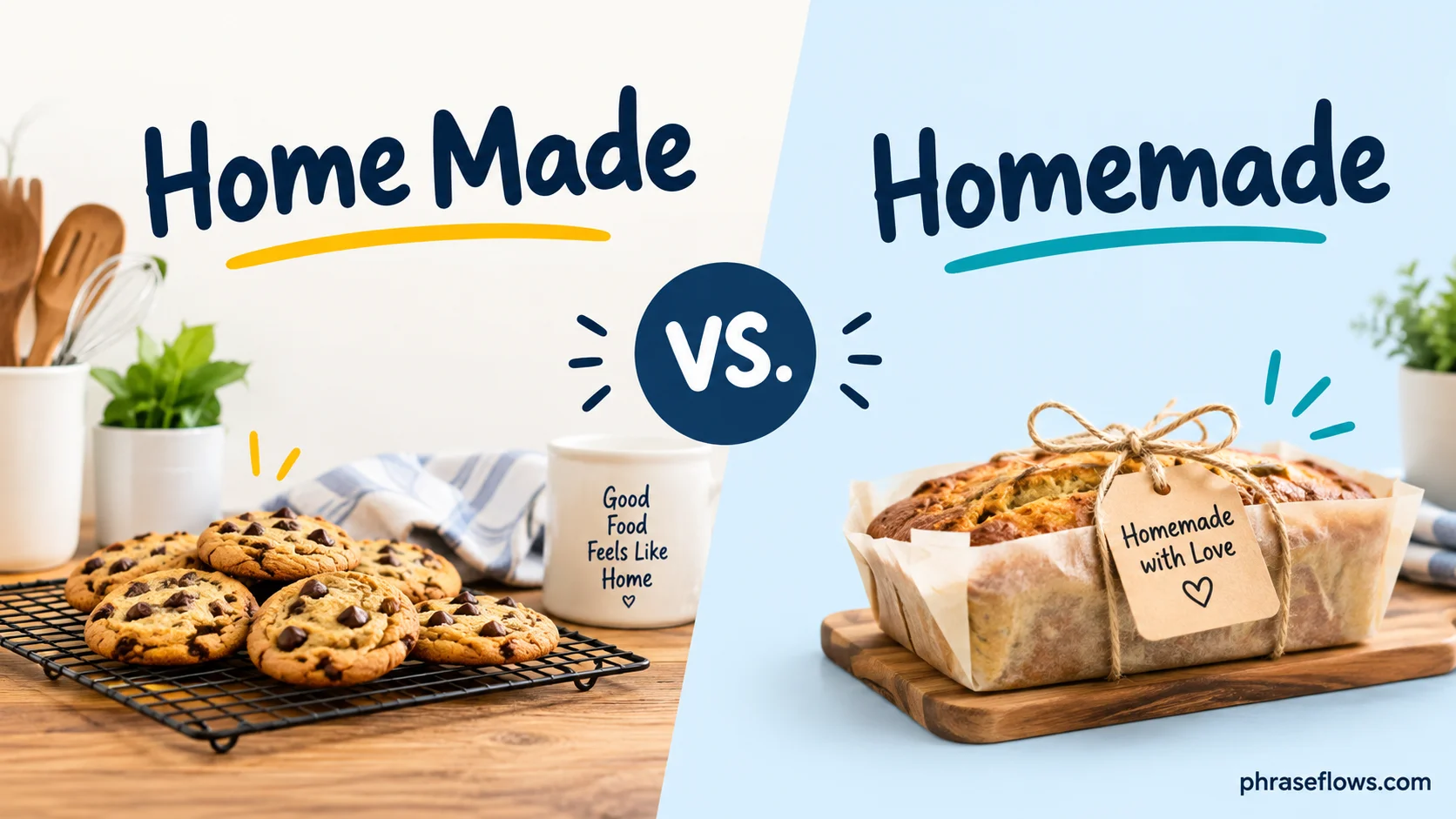

When writing about food, gifts, or things you create at home, you might wonder whether home made or homemade is the correct spelling. Both forms appear in English, but they aren’t equally common in modern American writing. Choosing the right one helps you keep your sentences clear, natural, and grammatically correct.
Homemade is the preferred spelling in American English. It describes something made or prepared at home rather than purchased as a finished product from a store. For example, you might enjoy homemade cookies, prepare homemade soup for dinner, or give a friend a homemade birthday card. In each case, the word stays together without a space or hyphen.
So, is home made ever correct, and why do some writers use home-made instead? The answer depends on the spelling convention and how the words function in a sentence. This guide explains the differences between home made vs. homemade, provides practical examples, and shows you how to choose the right form confidently in everyday writing.
Homemade vs. Home Made: Which Spelling Is Correct?
Homemade is the standard choice in modern American English. Write it as one word when describing something made at home or through someone’s own efforts.
For example, if you prepare a cake in your kitchen instead of purchasing one from a bakery, you can call it a homemade cake. Similarly, a card you create for a friend’s birthday is a homemade card.
The two-word form, home made, sometimes appears in writing. However, it isn’t the usual spelling for this meaning in contemporary American English. The hyphenated form, home-made, also exists, particularly in British English, but American writers generally favor the closed compound.
Consider these examples:
- Correct: My grandmother baked homemade bread.
- Not preferred: My grandmother baked home made bread.
- Less common alternative: My grandmother baked home-made bread.
The first sentence follows standard American usage. The second separates a word that is normally written as one, while the third uses a recognized but less common spelling variant.
Quick Comparison of Home Made vs. Homemade
| Feature | Homemade | Home made |
| Spelling | One word | Two words |
| American English | Preferred standard form | Generally avoided for this meaning |
| Meaning | Made at home or through one’s own efforts | Usually intended to express the same meaning |
| Grammar | Commonly used as an adjective | Not the standard compound spelling |
| Example | Homemade soup | Home made soup |
| Best choice for American writing | Yes | No |
Remember: When you mean that someone made something at home, choose homemade. It is the clearest and most widely accepted option for American readers.
What Does Homemade Mean?
The word homemade describes something made or prepared at home rather than purchased as a finished product from a store. It can refer to food, decorations, clothing, gifts, furniture, and many other items.
According to Cambridge Dictionary, the word means something made at home instead of bought from a store. Its use extends beyond cooking to objects and equipment that people create themselves.
definition in the Cambridge English Dictionary
+1
For example, a family might prepare homemade pizza for dinner, sew homemade decorations for a celebration, or build a homemade bookshelf for a bedroom.
The word often suggests personal effort and a more direct connection between the maker and the finished item. However, it doesn’t automatically mean that the item is healthier, cheaper, better made, or produced entirely from scratch. Those qualities depend on how the person makes it.
Examples of Homemade in Sentences
Seeing the word in context makes its meaning easier to understand. Here are several examples from everyday situations:
- Food: We served homemade cookies at the family gathering.
- Cooking: My father prepared homemade tomato sauce for dinner.
- Gifts: She gave her friend a homemade birthday card.
- Decorations: The children made homemade decorations for the party.
- Furniture: He built a homemade shelf for his books.
- Clothing: She wore a homemade costume to the school event.
- Gardening: They installed a homemade planter beside the window.
In each sentence, homemade describes an item that someone made or prepared rather than simply purchased as a finished product.
The word can also appear after a linking verb:
- The bread is homemade.
- These decorations are homemade.
- The costume looks homemade.
Notice that the spelling stays the same regardless of where the adjective appears in the sentence.
What Does Home Made Mean?
The expression home made consists of two separate words: home and made. Readers may use it when they want to describe something produced at home, but modern American English generally combines the words into homemade.
The distinction is mainly about spelling rather than meaning. Someone who writes home made bread will probably communicate the intended idea, but the standard form is homemade bread.
The two-word sequence can still appear when home and made perform separate grammatical roles in a sentence. The important point is to distinguish an ordinary combination of words from the established compound adjective.
For example:
- Standard compound: We enjoyed homemade soup.
- Standard compound: She sells homemade candles.
- Separate grammatical use: The decision was made at home.
- Less preferred compound spelling: We enjoyed home made soup.
In the third example, made belongs to the verb phrase was made, while at home tells the reader where the decision was made. The words aren’t functioning as the compound adjective homemade.
Is Home Made Ever Correct?
Yes, the two words can appear together in a sentence when their grammatical roles require separate spelling. However, when you intend to describe an item as made at home, homemade is the better choice in American English.
A historical quotation, an original title, or a publication’s established spelling conventions may also preserve an alternative form. In those cases, follow the original source or the relevant style guide.
For ordinary articles, emails, school assignments, recipes, and website content, there’s little reason to choose home made over homemade.
Homemade vs. Home Made: Key Differences in Usage
Understanding the spelling becomes easier when you look at how the word functions in real sentences. The main distinction concerns the conventional written form rather than a major difference in meaning.
Homemade is a compound adjective. It describes an item made at home or produced through someone’s own efforts. It can appear before a noun or after a linking verb.
Here are some common examples:
| Sentence | Explanation |
| She baked homemade cookies. | Homemade describes the cookies. |
| We bought homemade jam. | Homemade describes how the jam was prepared. |
| The decorations are homemade. | The adjective appears after the linking verb are. |
| His homemade desk looks sturdy. | The adjective describes the desk. |
| The meal was made at home. | Made is part of the verb phrase; at home identifies the location. |
These examples reveal an important grammar point: not every sentence containing the words home and made needs the compound adjective homemade.
When the words form the adjective, use the conventional spelling. When they belong to separate parts of a sentence, preserve their normal grammatical structure.
How to Use Homemade Correctly in a Sentence
The easiest way to use homemade correctly is to decide what you want the word to describe. In most cases, it works as an adjective that gives readers more information about a noun.
For instance, bread tells readers what the item is, while homemade bread adds information about how it was produced.
The same pattern works with hundreds of everyday nouns. You can describe a homemade meal, homemade soap, homemade furniture, or homemade gift without changing the spelling.
Homemade as an Adjective Before a Noun
The most familiar pattern places homemade directly before the noun it describes.
Examples include:
- Homemade bread: She served homemade bread with dinner.
- Homemade pizza: We prepared homemade pizza for the weekend.
- Homemade candles: He made homemade candles as gifts.
- Homemade decorations: The family hung homemade decorations around the room.
- Homemade furniture: They designed homemade furniture for their small apartment.
- Homemade gifts: I prefer giving homemade gifts on special occasions.
In each example, the adjective provides useful information without requiring an additional phrase such as made at home.
Compare these sentences:
- We ate homemade cookies after dinner.
- We ate cookies that we made at home after dinner.
Both sentences are grammatical, but the first is more concise. The compound adjective communicates the same basic idea in fewer words.
Homemade After a Linking Verb
You don’t have to place homemade before a noun. It can also follow linking verbs such as is, are, was, and looks.
For example:
- The apple pie is homemade.
- These greeting cards are homemade.
- The decorations were homemade.
- The sauce looks homemade.
Here, the adjective describes the subject rather than appearing directly before it. Its spelling doesn’t change.
This pattern is especially useful when you want to emphasize the nature or origin of an item.
Homemade in Everyday Writing
The word appears naturally in many types of writing, including recipes, personal blogs, product descriptions, and informal messages.
Consider the following examples:
In a recipe:
“Add the homemade tomato sauce to the pasta and stir until everything is evenly coated.”
In a product description:
“These homemade greeting cards feature hand-painted designs and personalized messages.”
In a personal blog:
“Every winter, our family prepares homemade soup using vegetables from the local market.”
In a casual message:
“I made homemade cookies today, so there’s plenty to share!”
Each example uses the same standard spelling. The surrounding sentence changes, but homemade remains one word.
Is Homemade Hyphenated?
In modern American English, homemade normally takes neither a hyphen nor a space.
The standard spelling is homemade, not home-made or home made. However, the hyphenated form is a recognized alternative in some varieties of English, particularly British usage. Cambridge Dictionary records both homemade and home-made in its dictionary material.
English meaning – Cambridge Dictionary
+1
This distinction matters when you’re writing for a specific audience.
| Form | Example | Guidance |
| Homemade | She baked homemade bread. | Preferred in American English |
| Home-made | She baked home-made bread. | Recognized alternative, particularly in British usage |
| Home made | She baked home made bread. | Generally avoid as a compound adjective |
Don’t add a hyphen simply because the word describes a noun. Some compound adjectives require hyphens, but homemade is already an established closed compound.
For example, write homemade apple pie, not home-made apple pie, when following standard American spelling.
Homemade vs. Handmade: What’s the Difference?
Although homemade and handmade sometimes describe the same item, they emphasize different things.
Homemade focuses on the item’s connection to home production or someone’s own efforts. Handmade focuses on the method of production: a person makes the item by hand rather than relying entirely on industrial manufacturing.
The distinction becomes clearer when you compare examples.
| Word | Main emphasis | Example |
| Homemade | Made at home or through personal effort | Homemade tomato sauce |
| Handmade | Made by hand | Handmade silver jewelry |
| Homemade and handmade | Made at home and crafted by hand | A handmade greeting card created at home |
Imagine someone preparing a birthday gift. They might bake a cake at home using a stand mixer. The cake is homemade, although a machine helps with the preparation.
Now imagine a craftsperson shaping a silver ring by hand in a professional workshop. The ring is handmade, but it isn’t necessarily homemade.
A person could also create a wooden picture frame by hand in a home workshop. In that situation, both words may apply.
The key difference is simple: homemade emphasizes where or through whose efforts something was produced, while handmade emphasizes how it was made.
Read More: Either vs. Eather: Which Is the Correct Spelling and How Do You Use It?
Common Mistakes When Using Homemade
Even a familiar word can cause spelling problems when its structure isn’t obvious. Fortunately, most mistakes involving homemade are easy to correct.
Writing Home Made as Two Words
The most common error is separating the compound adjective.
Incorrect: We served home made bread at dinner.
Correct: We served homemade bread at dinner.
The correction brings the spelling in line with standard American usage.
Adding an Unnecessary Hyphen
Some writers assume that every adjective containing two word elements needs a hyphen.
Incorrect for standard American usage: She brought home-made cookies.
Preferred: She brought homemade cookies.
The hyphenated spelling is recognized in some English varieties, but American writers generally don’t need it.
Confusing Homemade With Handmade
These words overlap, but they aren’t interchangeable in every situation.
For example, a factory might produce handmade products using skilled workers. Calling those items homemade could mislead readers about where they were produced.
Choose the word that accurately describes the item.
Assuming Homemade Means Made Entirely From Scratch
The word doesn’t always mean that someone prepared every ingredient from its raw form.
For instance, a person might make a homemade pizza using store-bought dough and packaged cheese. The pizza was assembled and baked at home, even though some ingredients were commercially produced.
If the distinction matters, add details such as made entirely from scratch or prepared at home using store-bought ingredients.
This approach gives readers a clearer picture without stretching the meaning of the word.
A Practical Example: Choosing Homemade in a Recipe Article
Imagine you’re writing a recipe post about tomato soup. You want to describe a soup prepared in your kitchen rather than purchased ready-made.
Here are three possible versions:
Preferred American spelling
“This homemade tomato soup is perfect for a chilly evening.”
Less common variant
“This home-made tomato soup is perfect for a chilly evening.”
Not preferred in American usage
“This home made tomato soup is perfect for a chilly evening.”
The first version is the best choice for an American audience. It uses the standard spelling and gives readers a clear description.
This example also shows why consistent spelling matters in online publishing. Readers should be able to focus on the recipe rather than pause over an avoidable spelling variation.
Conclusion:
When comparing home made vs. homemade, the correct choice in standard American English is homemade. It describes food, gifts, decorations, and other items made at home. Although home-made is also accepted in some varieties of English, American writers generally use the single-word form. To keep your writing clear and consistent, choose homemade for recipes, blog posts, school assignments, and everyday communication. Once you remember this simple spelling rule, you’ll know which form to use whenever the question arises.
FAQs:
Is Homemade One Word or Two?
Homemade is one word in standard American English. Use it when describing something made at home, such as homemade bread, homemade cookies, or homemade gifts.
Is Home Made Grammatically Correct?
Home made isn’t the preferred spelling when used as a compound adjective in American English. Write homemade instead. However, the words can appear separately when they serve different grammatical functions in a sentence.
Is Homemade Hyphenated?
No, homemade doesn’t normally require a hyphen in American English. The spelling home-made is also recognized, particularly in British usage, but the single-word form is the standard American choice.
What Is the Difference Between Homemade and Handmade?
Homemade emphasizes that something was made at home, while handmade emphasizes that someone crafted it by hand. For example, a cake prepared in your kitchen is homemade, while a ring crafted by hand is handmade.
Which Is Correct: Homemade Food or Home Made Food?
Homemade food is the preferred spelling in American English. Whether you’re describing homemade pizza, homemade soup, or homemade cookies, keep the word together without a space or hyphen.


1 thought on “Home Made vs. Homemade: Which Is Correct? Meaning, Spelling, and Examples”