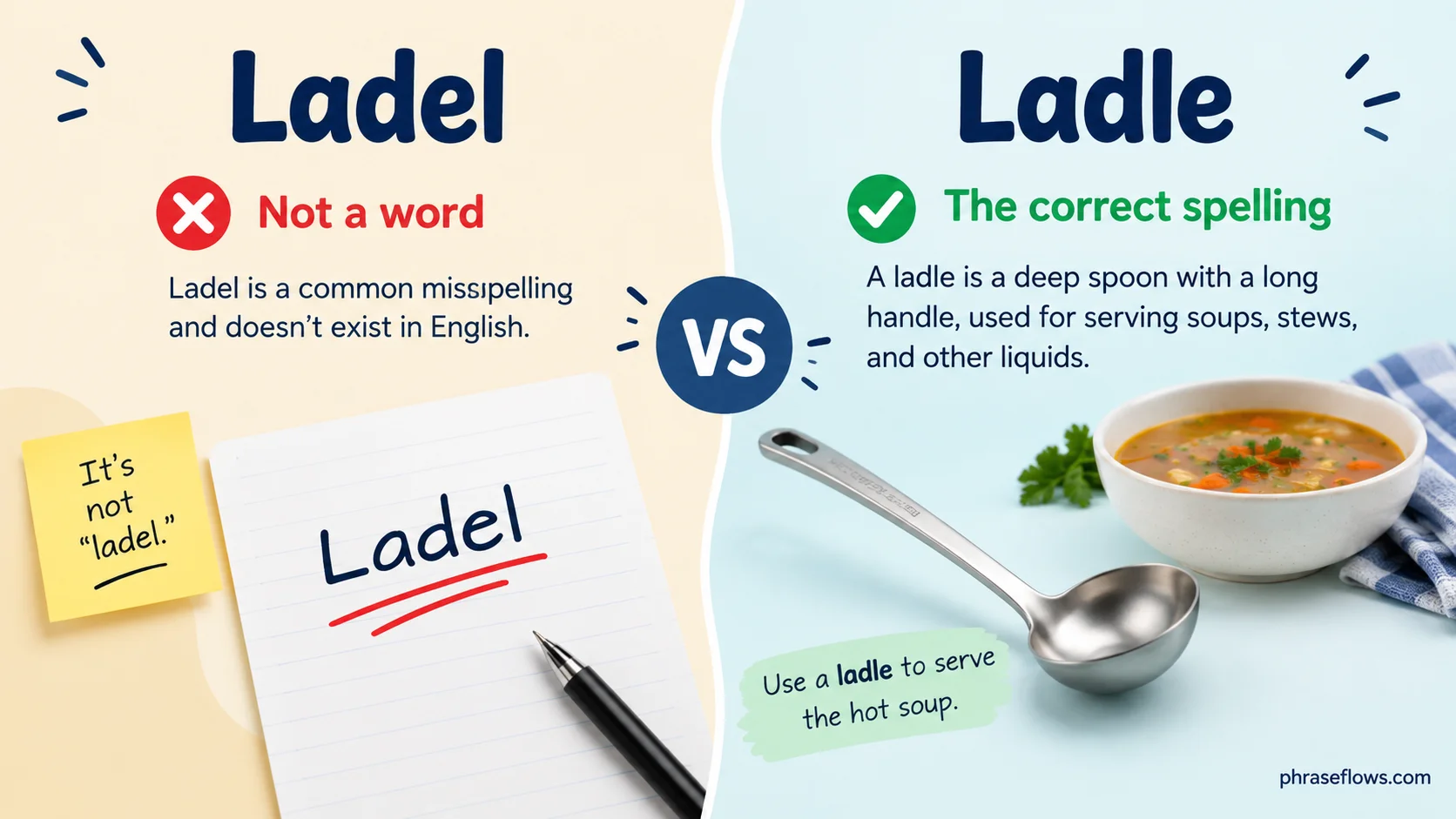

The confusion between ladel vs. ladle is a common spelling mistake in English. Although these words look similar, only ladle is the correct spelling in standard English. A ladle is a kitchen utensil used to serve soups, sauces, gravies, and other liquids. In contrast, ladel is an incorrect spelling when referring to this cooking tool.
Many people write “ladel” because the pronunciation of ladle can make its spelling confusing. This mistake often happens in everyday writing, recipe instructions, and other situations involving kitchen tools. Learning the correct spelling helps you avoid errors and communicate more clearly in both casual and professional settings.
In this guide, Ladel vs. Ladle: Difference, Meaning, and Correct Usage, you’ll learn what the word ladle means, why ladel is incorrect, and how to use the correct form in sentences. With simple explanations and practical examples, you’ll understand the difference and improve your spelling accuracy.
Ladel vs. Ladle: Which Spelling Is Correct?
Ladle is the correct spelling in modern standard English. Use it whenever you refer to the kitchen utensil or the action of serving food with that utensil. Although ladel may look plausible, it isn’t the accepted modern spelling for this meaning.
For example, imagine you’re writing instructions for a homemade chicken soup recipe. You might write, “Use a ladle to transfer the soup into serving bowls.” The sentence is clear, natural, and grammatically correct.
Writing “Use a ladel to transfer the soup” communicates the intended meaning, but the spelling is incorrect in modern standard English. A spell-checker may flag the mistake, and an editor would normally change it to ladle.
Here’s a quick comparison:
| Feature | Ladle | Ladel |
| Standard modern spelling | Correct | Generally incorrect for this meaning |
| Meaning | A deep, long-handled spoon; also a verb | No standard modern meaning as the spelling of this utensil |
| Part of speech | Noun and verb | Not the standard form for this meaning |
| Example | She used a ladle to serve soup. | She used a ladel to serve soup. |
| Recommended usage | Everyday and professional writing | Avoid for the modern English utensil |
The distinction is straightforward: write ladle, not ladel, when referring to the utensil or the related action. You don’t need to memorize two competing modern spellings because they aren’t interchangeable.
What Does Ladle Mean?
The word ladle has two common grammatical uses. It can name a kitchen utensil or describe the action of using that utensil to serve food. Recognizing the difference helps you understand how the word works in everyday sentences.
Ladle as a Noun
As a noun, a ladle is a large spoon with a long handle and a deep, cup-shaped bowl. Its design allows you to scoop up liquids and transfer them from a cooking pot into another container.
Unlike an ordinary spoon, which usually holds only a small amount of food, a ladle can carry a larger serving. Its long handle also helps you reach into deep pots while keeping your hands farther from hot contents.
You might use a ladle to serve:
- Soup: Transfer chicken noodle soup from a stockpot into individual bowls.
- Stew: Scoop beef stew and its broth into serving dishes.
- Gravy: Pour gravy over mashed potatoes without making a mess.
- Sauce: Add tomato sauce to pasta or distribute sauce over a casserole.
- Punch: Serve a suitable beverage from a large bowl at a gathering.
For example, consider this sentence: “Please pass me the ladle so I can serve the vegetable soup.”
Here, ladle names the physical object. It answers the question, “What should I use to serve the soup?”
A ladle can also serve purposes beyond an ordinary home kitchen. In industrial settings, the word can describe a large container used to transfer molten metal. The exact meaning depends on the context, but the basic idea involves a vessel that scoops or carries material.
Ladle as a Verb
As a verb, ladle means to scoop, serve, or transfer food or liquid using a ladle. Instead of naming the utensil, the word describes what someone does with it.
For example:
- The cook ladled soup into six bowls.
- She ladles gravy over the roasted vegetables.
- They are ladling stew into containers for lunch.
- Please ladle the sauce over the pasta before serving.
Notice how the word changes according to the sentence. In the first example, ladled describes a completed action. In the second, ladles describes a regular action or something happening in the present, depending on context.
English also uses the phrase ladle out in a figurative sense. For example, “The organization ladled out generous praise to its volunteers.” No one is serving food here. Instead, the phrase suggests distributing praise, often generously or in substantial amounts.
According to the Oxford Learner’s Dictionaries, the verb can describe placing food on a plate or distributing something in large quantities.
The key distinction is simple: a ladle is an object, while to ladle is an action.
What Is the Difference Between Ladel and Ladle?
The main difference concerns standard spelling, not the object itself. In modern English, ladle is the established form for the kitchen utensil and the related verb. Ladel generally appears as a spelling mistake when someone intends that meaning.
Both forms may look reasonable to someone learning English. The final letters can be confusing because the spoken word doesn’t make its spelling immediately obvious to every reader.
However, spelling conventions determine how you should write a word. Even when two spellings look similar or seem to represent the same sound, that doesn’t make them equally acceptable.
Consider these examples:
| Sentence | Status | Explanation |
| She bought a new ladle for her kitchen. | Correct | Uses the standard spelling. |
| The chef ladled soup into the bowls. | Correct | Uses the correct past-tense verb. |
| Please wash the ladel after dinner. | Incorrect for modern standard English | Replace ladel with ladle. |
| He ladled gravy over the potatoes. | Correct | Uses ladled to describe the action. |
| The ladles are stored beside the stove. | Correct | Uses the standard plural form. |
These examples show why context alone doesn’t make ladel correct. Readers may understand what you mean, but accurate spelling still matters in school assignments, articles, recipes, emails, and other edited writing.
Remember: Ladle is the standard modern spelling. Use it consistently whether you’re naming the utensil or describing its use.
Why Do People Confuse Ladel and Ladle?
Spelling mistakes often happen when a word’s written form doesn’t feel obvious from its pronunciation. Ladle presents this challenge because its final syllable sounds like an unstressed ending rather than a clearly pronounced sequence of separate letters.
When people write quickly, they may remember the general sound but place the final letters in the wrong order. That can produce ladel, even though the standard spelling is ladle.
The mistake becomes easier to avoid when you focus on the word’s actual letter sequence rather than guessing from sound.
A Simple Trick to Remember the Correct Spelling
Use this reminder:
LADLE ends with DLE, not DEL.
Break the word into two visual parts:
- LAD — the first three letters.
- LE — the final two letters.
Put them together, and you get LAD + LE = LADLE.
You can also connect the spelling to a familiar kitchen scene. Picture a ladle hanging beside a cooking pot. When you write a recipe or describe serving soup, recall that familiar object and its spelling.
For example:
- Correct: “Fill the bowl with one ladle of soup.”
- Incorrect: “Fill the bowl with one ladel of soup.”
A small memory aid can prevent repeated mistakes. More importantly, practice using the correct spelling in complete sentences instead of memorizing the letters in isolation.
How to Use Ladle Correctly in a Sentence
The best way to understand a word is to see how people use it. Because ladle works as both a noun and a verb, examples from everyday situations can help you recognize its grammatical role.
Examples of Ladle as a Noun
When ladle acts as a noun, it names the utensil. The sentence may describe where the utensil is, who uses it, or what someone does with it.
- “The ladle hangs on a hook beside the stove.”
- “Please bring a clean ladle for the soup.”
- “My mother used a large ladle to serve the stew.”
- “The stainless-steel ladle is stored in the kitchen drawer.”
- “Each guest received a bowl of soup served with a ladle.”
In each example, the word refers to a physical object. You can usually identify its role by asking, “Which item does the sentence name?”
Examples of Ladle as a Verb
When ladle acts as a verb, it describes serving or transferring food. The verb form changes to match the sentence’s tense and subject.
- “The chef ladles soup into bowls every afternoon.”
- “She ladled warm gravy over the mashed potatoes.”
- “We are ladling chili into containers for the community meal.”
- “Please ladle the broth carefully to avoid spilling it.”
- “He had ladled the sauce onto the plates before the guests arrived.”
These sentences describe actions rather than objects. The verb tells you what someone does with the food.
Incorrect and Correct Spelling Examples
A side-by-side comparison makes the difference even clearer.
| Incorrect sentence | Correct sentence |
| She picked up the ladel. | She picked up the ladle. |
| Use a ladel to serve the soup. | Use a ladle to serve the soup. |
| The cook washed three ladels. | The cook washed three ladles. |
| He ladelled the broth into bowls. | He ladled the broth into bowls. |
| She is ladleing the sauce. | She is ladling the sauce. |
The last two examples demonstrate a related grammar point. The correct past-tense form is ladled, while the present participle is ladling. English spelling rules sometimes require you to remove a final silent e before adding a suffix.
A Practical Example: Writing a Recipe
Suppose you’re writing instructions for a homemade tomato soup. Your first draft says:
“Take the ladel and ladel the soup into four bowls.”
Although readers can understand the instruction, the sentence contains a repeated spelling mistake. A corrected version reads:
“Take the ladle and ladle the soup into four bowls.”
The first use names the utensil, while the second describes the action. This example shows that the same spelling can serve two grammatical purposes without changing its basic form.
For clear recipe writing, choose precise verbs and keep instructions direct. For example, “Ladle the hot soup into four bowls and garnish with fresh basil” tells the reader exactly what to do.
Ladle Pronunciation
The word ladle is pronounced /ˈleɪ.dəl/ in both standard American and British English, according to the Cambridge Dictionary pronunciation guide.
Its first syllable carries the stress. The opening sound rhymes with the word day, while the ending contains an unstressed vowel followed by an l sound.
You can think of the pronunciation as having two syllables:
- First syllable: Sounds like lay.
- Second syllable: Sounds like the unstressed ending in label.
The pronunciation explains why some learners find the spelling confusing. The final vowel isn’t strongly emphasized, so the written sequence may not feel obvious when you hear the word.
However, pronunciation doesn’t change the standard spelling. Whether you speak American or British English, write ladle when referring to the utensil or the related verb.
Practice using the word in a sentence such as, “Please use the ladle to serve the soup.” Saying the full sentence helps you connect the pronunciation with its meaning and spelling.
What Are the Plural and Verb Forms of Ladle?
Learning the related forms of ladle will help you write more naturally. The word follows familiar English patterns, although its final e disappears in some verb forms.
| Grammatical form | Correct spelling | Example |
| Singular noun | Ladle | The ladle is clean. |
| Plural noun | Ladles | The ladles are in the drawer. |
| Base verb | Ladle | Please ladle the soup. |
| Third-person singular | Ladles | She ladles soup every day. |
| Past tense | Ladled | He ladled the broth into bowls. |
| Past participle | Ladled | She has ladled the soup already. |
| Present participle | Ladling | They are ladling the stew. |
Why Is It Ladled Instead of Ladleing?
English spelling often drops a final silent e before adding a suffix that begins with a vowel. The same pattern appears in words such as bake and baking.
The verb ladle follows this rule:
- Ladle + ed = ladled
- Ladle + ing = ladling
The result is ladled, not ladelled, and ladling, not ladleing. These forms are the standard spellings used in modern English.
What Is a Ladleful?
You may also encounter ladleful, which means the amount of food or liquid that a ladle holds. Its plural is ladlefuls.
For example, “Add two ladlefuls of broth to the rice.”
This word can be useful in recipes when you want to describe an amount measured by the utensil rather than by a cup or spoon. The exact quantity depends on the ladle’s size, so it isn’t a standardized measurement like a tablespoon or milliliter.
Read More: Soo vs. So: Difference, Meaning, and Which Spelling Is Correct?
Is Ladel Ever a Correct Spelling?
The answer requires a little historical context. Ladel is not the standard modern spelling for the kitchen utensil, but older English records contain related forms of the word.
The Oxford Learner’s Dictionaries traces ladle to Old English hlædel, from a word related to drawing or carrying material. Etymonline also records the historical development of the word through earlier English forms.
English spelling has changed over many centuries. Words that appear in older texts may use forms that differ from today’s standard spelling. That doesn’t mean those historical forms remain interchangeable with the modern word.
If you encounter ladel in an old document, historical transcription, or specialized source, examine the context before deciding whether it represents an error or a historical form. The surrounding language and publication date may help explain the spelling.
For present-day writing, however, the practical rule remains unchanged:
- Use ladle in recipes and cooking instructions.
- Use ladle in school assignments and professional writing.
- Use ladled for the past tense.
- Use ladling for the present participle.
- Avoid ladel when you mean the modern English utensil.
This distinction keeps your writing accurate without overlooking the history of the word.
Conclusion:
Understanding the difference between ladel vs. ladle helps you avoid a common English spelling mistake. Ladle is the correct spelling of the kitchen utensil used to serve soups, sauces, gravies, and other liquids. In contrast, ladel is an incorrect spelling in standard English when referring to this tool. Remembering the correct form can improve your spelling accuracy and make your writing clearer. Whether you’re writing a recipe, preparing an academic assignment, or communicating in everyday situations, using ladle correctly helps you express your ideas with confidence.
FAQs:
What is the difference between ladel and ladle?
Ladle is the correct spelling of a kitchen utensil used to serve liquids. Ladel is a misspelling and is not accepted as the standard spelling of this word.
Is ladel a correct English word?
No, ladel is not the standard English spelling for the kitchen utensil. You should use ladle in academic, professional, and everyday writing.
What does ladle mean?
A ladle is a deep spoon with a long handle and a bowl-shaped end. People use it to scoop and serve soups, sauces, gravies, and other liquid foods.
Why do people confuse ladel with ladle?
People may confuse these spellings because the pronunciation of ladle can make the final letters difficult to recognize. They may mistakenly add an extra vowel when writing the word.
How can I remember the correct spelling of ladle?
Remember that the correct spelling is L-A-D-L-E: ladle. When writing about a utensil used to serve soup or sauce, choose ladle, not ladel.




1 thought on “Ladel vs. Ladle: Difference, Meaning, and Correct Usage”