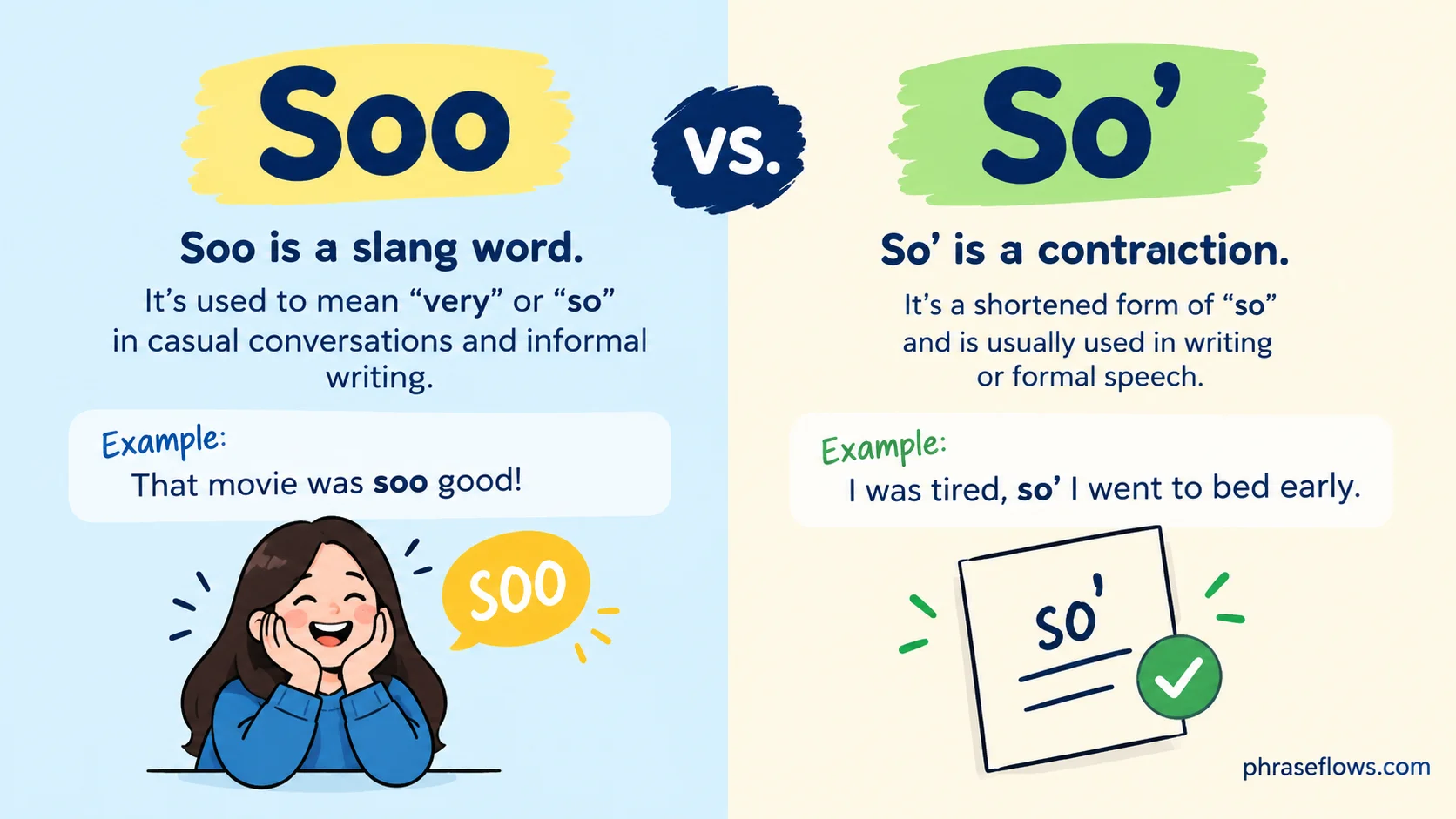

Have you ever wondered whether to write “so” vs.“soo” when expressing excitement, emphasizing a point, or sending a quick text? Both spellings appear in everyday online conversations, but they don’t serve the same purpose in standard English. Understanding the difference helps you write clearly without losing your personality.
The main difference between so vs. soo comes down to standard spelling and informal emphasis. So is the correct standard spelling in ordinary English sentences. People sometimes write soo or sooo in text messages, social media posts, and casual conversations to stretch the word and express stronger feelings. For example, “I’m so excited!” follows standard spelling, while “I’m sooo excited!” adds a playful, exaggerated tone.
However, the extra letters don’t create a new standard grammatical form. Whether you’re writing a school assignment, a professional email, or a friendly message, choosing the right spelling depends on your audience and purpose. Let’s explore the meanings, grammatical uses, examples, and common mistakes associated with soo vs. so so you can use each form appropriately.
Soo vs. So: What’s the Difference?
The key distinction between so and soo is that one is a standard English word, while the other is generally an informal spelling used for emphasis. Although readers can usually understand both in casual messages, standard writing calls for so.
The word so has several grammatical functions. It can express degree, connect ideas, introduce a result, or replace information that someone has already mentioned. For example, you might say, “The weather is so pleasant,” or “It started raining, so we went home.” In both sentences, so serves a clear grammatical purpose.
By contrast, people often use soo to make a message sound more emotional, playful, or enthusiastic. Writing “That cake looks sooo good!” emphasizes excitement more strongly than the standard spelling does. The meaning remains understandable, but the tone becomes more expressive.
| Feature | So | Soo |
| Standard English spelling | Yes | No, when used as a variation of so |
| Main purpose | Expresses degree, result, agreement, and other meanings | Adds informal emphasis or exaggeration |
| Formal writing | Appropriate | Generally inappropriate |
| Text messages | Appropriate | Common as a stylistic choice |
| Academic assignments | Correct choice | Avoid |
| Example | I’m so happy. | I’m sooo happy! |
The easiest rule to remember: Use so for standard English. Use an extended spelling such as soo or sooo only when you deliberately want an informal, expressive effect.
What Does “So” Mean in English?
The word so is more versatile than it might first appear. According to the Cambridge Dictionary, it can function as an adverb or conjunction and can also appear in several established expressions. Its meaning depends on the sentence around it.
Understanding these different uses explains why replacing so with soo can create an incorrect spelling in ordinary writing.
So as an Adverb
An adverb can modify a verb, adjective, or another adverb. When so acts as an adverb, it often means very, extremely, or to such a degree.
For example, consider the sentence, “The movie was so interesting.” Here, so emphasizes the degree of interest. It strengthens the adjective interesting without changing the basic meaning of the sentence.
You can use so in many everyday situations:
- The weather is so beautiful today.
- I’m so glad you came.
- She speaks so clearly that everyone understands her.
- This assignment is so much easier than the last one.
- The children were so excited about the trip.
Notice that so works naturally in each sentence. You don’t need additional letters to make the meaning clear. If you want extra emphasis in a casual message, you might write “I’m sooo glad you came!” However, the standard spelling remains so.
So as a Conjunction
A conjunction connects words, phrases, or clauses. When so connects two independent clauses, it often introduces a result or consequence.
For example:
It started raining, so we moved the picnic indoors.
The first part explains what happened. The second part describes the result. The word so connects these ideas and shows their relationship.
Here are more examples:
- I missed the bus, so I walked to school.
- The store was closed, so we returned the next day.
- She studied regularly, so she felt prepared for the exam.
- The road was icy, so the driver slowed down.
In each case, so links a cause or situation to its outcome. Writing soo instead would be a spelling error in standard prose, not a different grammatical choice.
Grammar tip: When so connects two independent clauses, a comma usually appears before it. For example, “The meeting ended early, so we went home.”
So as a Word That Expresses Agreement
Sometimes, so allows you to respond without repeating an entire statement. This makes conversations shorter and more natural.
Imagine that a friend asks, “Do you think the team will win?” Instead of repeating the whole idea, you can answer, “I think so.” The word so stands in for the idea that the team will win.
Other common examples include:
- “Is she coming?” — “I hope so.”
- “Will the package arrive today?” — “I believe so.”
- “Did he understand the instructions?” — “I think so.”
- “Is the library open?” — “I’m afraid so.”
The final example is grammatical, although the natural choice depends on context and whether the speaker wants to communicate a positive or negative answer.
These expressions use the standard spelling so. Writing “I think soo” isn’t the standard way to form a short answer, even in a friendly conversation.
So as a Conversational Opener
In spoken English, people often begin a sentence with so when introducing a topic, asking a question, or moving to the next point. It works as a conversational marker that helps organize a discussion.
For example:
- So, what happened after the meeting?
- So, are we ready to leave?
- So, let’s review the main points.
- So, what do you think about the idea?
This use is especially common in everyday conversation, interviews, presentations, and informal explanations. It signals that the speaker is moving the discussion forward.
The spelling doesn’t change when so begins a sentence. Whether you’re opening a presentation or sending a quick message, write so unless you’re intentionally using an exaggerated informal style.
What Does “Soo” Mean?
The spelling soo usually represents an informal, stretched version of so. Writers use it to show emphasis, enthusiasm, frustration, affection, or another strong reaction. It is especially common in digital communication, where people often use spelling and punctuation to suggest the tone of their voice.
For instance, compare these two messages:
- “I’m so happy for you.”
- “I’m sooo happy for you!”
Both communicate happiness. The second message places extra emphasis on the feeling, making it sound more enthusiastic or expressive.
In ordinary writing, however, soo isn’t the standard spelling. It is best understood as a stylistic variation rather than a separate grammatical word.
Why People Write “Soo” in Text Messages
Written conversations don’t always carry the vocal cues that help people understand speech. When someone speaks, they can emphasize a word by raising their voice, extending a sound, or changing their tone. In a text message, writers often imitate those effects by repeating letters.
For example, someone might write:
- “That puppy is soo cute!”
- “I’m sooo excited about the concert!”
- “This homework feels sooo long.”
- “Thank you sooo much for helping me!”
- “That was sooo unexpected!”
These spellings help communicate the writer’s feelings. Depending on the context, they can sound playful, dramatic, affectionate, or humorous.
Still, extra letters aren’t required to communicate emotion. Punctuation, word choice, and the surrounding message can also convey enthusiasm. “I’m absolutely thrilled!” is expressive without stretching a word.
Is “Soo” Ever a Proper Word or Name?
Yes, the spelling Soo can appear in proper names and other contexts unrelated to the informal version of so. For example, a person may have Soo as part of their name, and place names can also contain the same spelling.
Capitalization and context matter here. When Soo appears as a person’s name, you should preserve the person’s actual spelling. You shouldn’t automatically change it to So just because so is the standard English word.
The distinction is simple:
- So: The standard English word used in a sentence.
- Soo: An informal spelling of so in expressive writing, or a spelling used in a proper name or another context.
Therefore, whether Soo is appropriate depends on how you’re using it. As a substitute for the ordinary English word, it is informal. As a proper name, its spelling follows the name itself.
When Should You Use “So” Instead of “Soo”?
In most situations, so is the correct and safest choice. It works in formal writing, professional communication, school assignments, and everyday conversation. You can also use it to express excitement or emphasis without changing the spelling.
The main question is whether you want standard English or a deliberately informal effect.
Formal and Academic Writing
When writing essays, reports, research assignments, or applications, stick with so. Standard spelling keeps your work clear and appropriate for an academic audience.
For example:
Standard:
“The results were so consistent that the researchers identified a clear pattern.”
Informal:
“The results were sooo consistent that the researchers identified a clear pattern.”
The second sentence may work in a casual social post, but the extra letters distract from the formal tone of a research report. They also make the writing look less polished.
In academic work, choose words that communicate your meaning precisely. If so doesn’t provide enough emphasis, consider a more specific alternative, such as particularly, extremely, or remarkably, depending on the sentence.
Professional Emails and Business Communication
Professional writing should make your message easy to understand without relying on exaggerated spellings. Whether you’re writing to a teacher, colleague, customer, or supervisor, so is the appropriate standard form.
Compare these examples:
Professional:
“We are so pleased with your progress.”
Too informal for most professional settings:
“We are sooo pleased with your progress!!!”
The second version may sound friendly in a close personal conversation, but it can appear overly casual in a workplace email. A professional tone doesn’t have to feel cold. Clear wording and a warm message can communicate appreciation without extra letters.
Other suitable examples include:
- We are so grateful for your support.
- The instructions were so helpful.
- I’m so glad we could resolve the issue.
- The team worked so efficiently on the project.
Casual Conversations and Social Media
Informal communication gives you more freedom to play with language. On social media or in a text message, you might use soo or sooo to convey excitement, surprise, or humor.
For example:
| Standard spelling | Informal spelling | Tone |
| I’m so excited! | I’m sooo excited! | Strong enthusiasm |
| That looks so good. | That looks sooo good! | Extra excitement |
| I’m so tired. | I’m sooo tired. | Exaggerated frustration |
| Thank you so much! | Thank you sooo much! | Warm appreciation |
Both versions can communicate the intended message. The difference lies mainly in style.
However, informal doesn’t mean universally appropriate. A playful spelling may suit a message to a friend but feel out of place in a school assignment or a serious conversation. Consider your audience before using it.
Creative Writing and Character Dialogue
Writers sometimes stretch words to make fictional dialogue feel more expressive. This can help readers imagine how a character speaks or reacts to a situation.
For example:
“That was sooo unfair!” Mia exclaimed.
The extended spelling suggests that Mia is upset or exaggerating her reaction. In a novel, comic, script, or informal online story, this choice may help establish the character’s voice.
However, use the technique sparingly. If every other sentence contains stretched words, the effect becomes repetitive. A writer can often convey the same emotion through dialogue, action, or a well-chosen descriptive detail.
For example:
“That was so unfair!” Mia said, crossing her arms.
The standard spelling works just as well because the action reveals the character’s frustration. The best choice depends on the voice and style you want to create.
Soo vs. So Examples in Sentences
Examples make the difference easier to remember. The following table shows when so is the standard choice and how an extended spelling changes the tone in informal writing.
| Sentence with standard spelling | Informal variation | Explanation |
| I’m so happy. | I’m sooo happy! | The extra letters emphasize happiness. |
| That movie was so funny. | That movie was sooo funny! | The informal form adds excitement. |
| This cake is so good. | This cake is sooo good! | The second version sounds more enthusiastic. |
| I’m so tired today. | I’m sooo tired today. | The extended spelling exaggerates tiredness. |
| Thank you so much. | Thank you sooo much! | The informal form adds warmth or emphasis. |
| It was late, so we left. | It was late, soo we left. | The extended form is incorrect in standard prose. |
| I think so. | I think soo. | The standard spelling is required in this expression. |
| The instructions were so clear. | The instructions were sooo clear! | The second version is more expressive and informal. |
Notice that the informal spelling works most naturally when so emphasizes a feeling or degree. It doesn’t replace the standard spelling in ordinary grammatical constructions.
More Examples of “So” in Everyday English
The word so appears in many common expressions. Learning these phrases helps you recognize when the standard spelling is necessary.
To express degree:
- The room is so quiet.
- She was so pleased with the results.
- This book is so interesting.
To show a result:
- I forgot my umbrella, so I got wet.
- We finished early, so we went for a walk.
- The shop had closed, so we returned home.
To give a short answer:
- “Do you agree?” — “I think so.”
- “Will it work?” — “I hope so.”
- “Is that true?” — “It seems so.”
To introduce a topic:
- So, what would you like to discuss?
- So, let’s get started.
- So, where should we begin?
In each example, so performs a recognizable grammatical or conversational role. You don’t need an extra letter to make the sentence complete.
Common Mistakes When Using Soo and So
Although the difference seems small, choosing the wrong form can affect the tone and correctness of a sentence. These are the mistakes worth watching for.
Treating “Soo” as a Standard Spelling
The most common mistake is assuming that soo is simply another accepted spelling of so. In ordinary English writing, it isn’t.
Incorrect in standard writing: “The presentation was soo helpful.”
Correct: “The presentation was so helpful.”
The informal version may be understood in a casual message, but the standard spelling is the appropriate choice in edited prose.
Using “Soo” in Formal Writing
Another common mistake is carrying the habits of texting into formal work. Extended spellings may feel natural in messages, but they can distract readers in reports, applications, and academic assignments.
For example:
Informal: “We are soo grateful for your support.”
Standard: “We are so grateful for your support.”
The correction is straightforward: remove the extra letters. You don’t need to rewrite the sentence because the underlying meaning is already clear.
Assuming Extra Letters Change the Meaning
Writing sooo doesn’t usually create a different dictionary meaning. Instead, it changes the way the writer presents the message.
Compare:
- “That was so surprising.”
- “That was sooo surprising!”
The first sentence states the reaction directly. The second gives the reaction a more dramatic or playful tone.
This distinction matters because emphasis and meaning aren’t always the same thing. The extra letters can make a message feel stronger, but they don’t turn soo into a new standard grammatical form.
Replacing “So” in Fixed Expressions
Some expressions rely on the standard spelling of so. Changing it to soo can make the phrase look incorrect even when the reader understands what you mean.
Examples include:
- I think so.
- So far, so good.
- Thank you so much.
- So that everyone understands.
- It was late, so we left.
These phrases appear in everyday speech and writing. Use the conventional spelling unless you’re deliberately changing the wording for a creative or informal effect.
How to Remember the Difference Between Soo and So
You don’t need to memorize a complicated grammar rule to choose the right spelling. A simple check usually does the job: Use so for standard English and extended spellings for deliberate informal emphasis.
Before you write, ask yourself these questions:
- Is this formal writing? Use so.
- Am I connecting ideas or expressing a result? Use so.
- Am I using a common expression such as “I think so”? Use so.
- Am I writing a playful text or social media caption? An extended form may suit the tone.
- Would extra letters distract the reader? Keep the standard spelling.
For example, if you’re writing an essay about a novel, “The ending was so unexpected” is the better choice. If you’re messaging a friend about a surprise party, “The ending was sooo unexpected!” may communicate your excitement more naturally.
The key is to make the spelling serve your purpose rather than choosing it automatically.
Conclusion:
The difference between soo and so comes down to spelling and usage. So is the correct standard English spelling, while soo is an informal variation sometimes used in texting, social media, or playful writing to express emphasis. In everyday communication, people may understand both forms, but they don’t serve the same purpose in formal writing.
Use so in essays, emails, professional documents, and blog posts. For example, write “I’m so happy to see you” rather than “I’m soo happy to see you” when you want to follow standard spelling rules. Although soo can add emotion or exaggeration to a casual message, it isn’t a standard replacement for so.
Ultimately, choosing the right spelling depends on your audience and purpose. When accuracy and professionalism matter, stick with so. Save soo for informal situations where a playful or exaggerated tone fits naturally.
FAQs:
Is “Soo” or “So” the Correct Spelling?
So is the correct spelling in standard English. Soo is generally considered a nonstandard variation used for emphasis or stylistic effect in informal communication.
What Does “Soo” Mean in Texting?
In texting, soo often emphasizes the meaning or emotion behind so. For example, “I’m soo excited!” expresses stronger excitement than the standard “I’m so excited!” However, the extra letter doesn’t create a separate standard English word.
Is “Soo” a Real Word?
Soo appears in some names, place names, and specialized contexts. However, when someone uses it as an exaggerated form of so, it is generally an informal spelling rather than standard English usage.
Can I Use “Soo” in Formal Writing?
It’s best to avoid soo in formal writing. Use so in academic assignments, business emails, reports, and professional articles. The standard spelling keeps your writing clear and grammatically appropriate.
Why Do People Write “Soo” Instead of “So”?
People often add extra letters to express stronger emotions, excitement, surprise, or frustration in digital conversations. For example, “That was soo funny!” gives the sentence a playful tone. This style works in casual messages, but so remains the correct choice for standard writing.




1 thought on “Soo vs. So: Difference, Meaning, and Which Spelling Is Correct?”