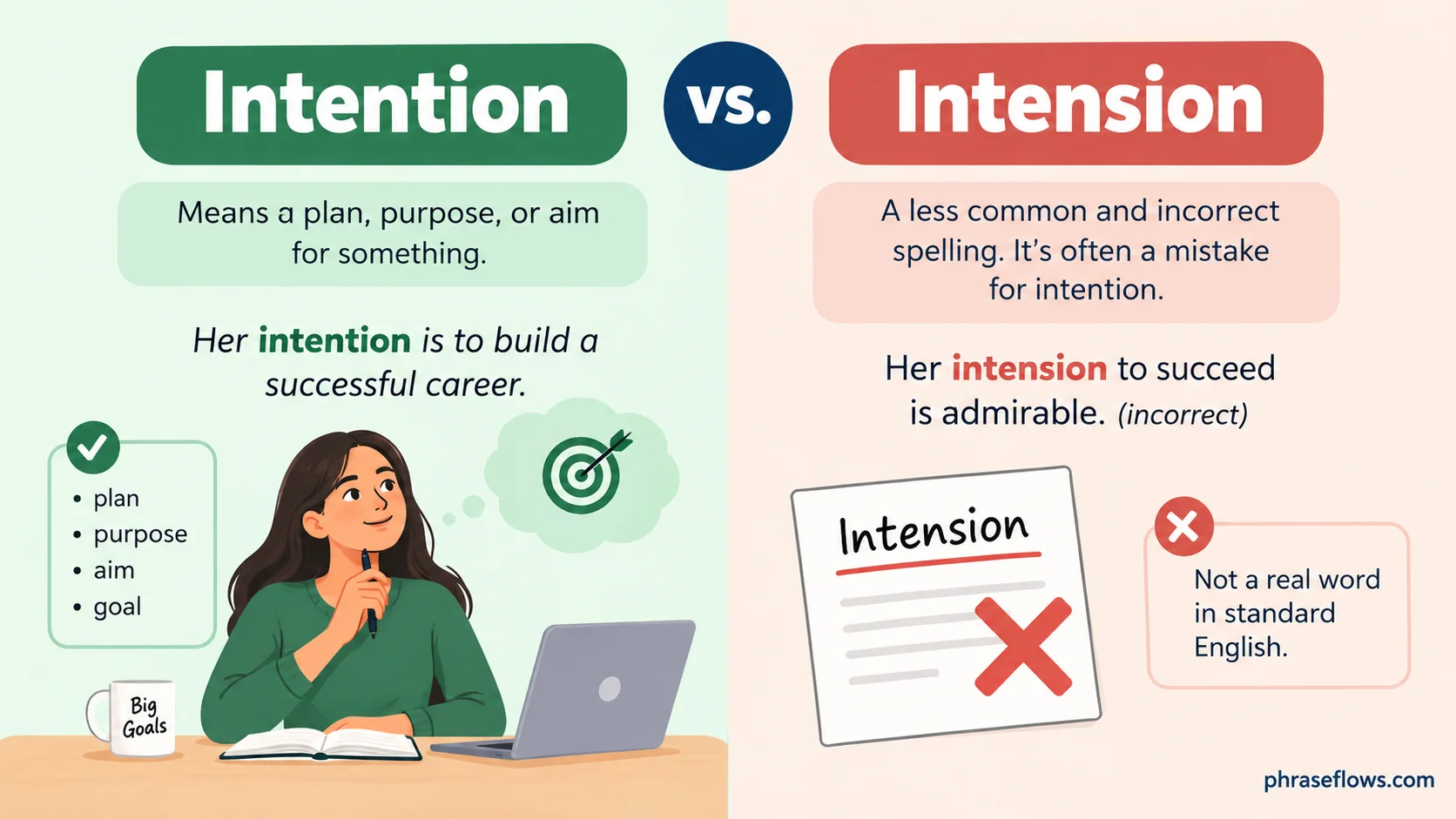

The difference between intention vs. intension can be confusing because these words look almost identical and differ by just one letter. However, they have different meanings and uses in English. Intention refers to a plan, purpose, or goal, while intension is a technical term used in fields such as philosophy, logic, and linguistics. Understanding this difference helps you choose the correct word and avoid common spelling mistakes.
You will most often encounter intention in everyday conversations, school assignments, business emails, and professional writing. For example, you might explain your intention to help someone, learn a new skill, or apply for a job. Intension, on the other hand, appears mainly in academic discussions about concepts, meanings, and the defining properties of words or symbols. Although the two terms look and sound similar, you cannot use them interchangeably.
Knowing when to use intention vs. intension makes your writing clearer and more accurate. The easiest way to remember the difference is to connect intention with what someone plans to do and intension with the meaning or properties of a concept. In this article, you’ll learn their definitions, explore practical examples, and understand how context helps you select the right word in everyday and academic writing.
Intention vs. Intension: What’s the Difference?
The main difference between intention vs. intension comes down to purpose versus conceptual meaning. Although the words differ by just one letter, they communicate different ideas.
Intention describes what someone plans, wants, or aims to do. You might talk about your intention to finish a project, help a friend, or start a business. The word appears frequently in everyday conversations and professional writing.
Intension, by contrast, describes the defining properties or characteristics associated with a concept. It appears primarily in technical discussions about language, meaning, and logic. For example, a discussion about the intension of the word triangle might examine the properties that define a triangle.
Here’s a quick comparison:
| Feature | Intention | Intension |
| Meaning | A plan, aim, or purpose | The defining properties of a concept |
| Part of speech | Noun | Noun |
| Common usage | Everyday conversations and writing | Logic, linguistics, and philosophy |
| Main focus | What someone plans or means to do | What defines a term or concept |
| Example | My intention is to study tonight. | The intension of “triangle” includes having three sides. |
| Frequency in everyday English | Very common | Uncommon |
Remember this simple rule: Use intention when discussing plans or purposes. Use intension when discussing the defining meaning of a concept.
In ordinary writing, intention will almost always be the correct choice when you want to describe a person’s plans, goals, or motives.
What Does Intention Mean?
Intention is a noun that describes a plan, purpose, aim, or desired course of action. It tells you what someone wants to do or hopes to achieve. The word can also describe the purpose behind a person’s behavior.
For instance, imagine that your friend spends the weekend helping a neighbor move into a new home. Your friend might say, “My intention was to make the move easier for them.” In this sentence, intention explains the purpose behind the action.
According to Dictionary.com, the word refers to a mental decision to pursue an action or a particular result. It can also describe the purpose behind someone’s conduct.
Dictionary.com
+1
You can use intention when discussing personal decisions, professional plans, future goals, and the reasons behind someone’s actions.
Examples of Intention in a Sentence
The best way to understand intention is to see how it works in everyday situations.
- My intention is to finish the assignment before Friday. The speaker has a clear plan.
- She had no intention of upsetting her friend. The sentence explains what she did not mean to do.
- The company announced its intention to open two new offices. The word describes a planned business action.
- His intention was to help, but his advice caused confusion. The sentence separates the person’s purpose from the result.
- We have every intention of attending the meeting. The phrase expresses a firm plan.
- The teacher asked the students to explain their intentions. The teacher wants to understand their purposes or plans.
Notice that each example involves a person’s goal, decision, motive, or intended action. That’s the central idea behind the word.
Common Expressions With Intention
English speakers use intention in several familiar expressions. Learning these phrases can help you write more naturally and avoid spelling mistakes.
| Expression | Meaning | Example |
| Good intentions | A desire to do something positive | He had good intentions when he offered advice. |
| With the intention of | For the purpose of doing something | She enrolled in the course with the intention of improving her writing. |
| Have no intention of | Have no plan or desire to do something | I have no intention of changing my decision. |
| Every intention | A firm plan or determination | They have every intention of completing the project. |
| Original intention | The first purpose or plan | Our original intention was to create a simple website. |
| Make your intentions clear | Explain your plans or aims openly | The manager made her intentions clear during the meeting. |
| Statement of intention | A statement explaining a person’s plans or aims | The applicant submitted a statement of intention. |
These expressions appear in personal conversations, workplace communication, academic writing, and formal documents. Pay particular attention to good intentions and have no intention of because writers sometimes mistakenly spell them with an s.
For example, write “She had good intentions” rather than “She had good intensions.” The first sentence uses the correct word for someone’s positive purpose.
Synonyms for Intention
Several words share a similar meaning with intention, but each has a slightly different emphasis.
- Purpose: The reason for doing something.
- Aim: The result or direction someone hopes to achieve.
- Goal: A result someone wants to reach.
- Plan: An arrangement for accomplishing something.
- Objective: A specific result someone intends to achieve.
- Intent: A person’s purpose or determination, often used in formal or legal contexts.
Consider this example: “My goal is to improve my writing, and my intention is to practice every day.”
Here, goal describes the desired result, while intention describes the planned approach. The words overlap, but they don’t always mean precisely the same thing.
What Does Intension Mean?
Intension is a specialized noun that usually refers to the characteristics or properties that define a concept. You’ll encounter it most often in logic, philosophy, linguistics, and semantics, which is the study of meaning in language.
Dictionary.com
+2
Unlike intention, this word doesn’t usually describe someone’s everyday plans. Instead, it helps explain what makes a concept what it is.
Imagine a geometry teacher explaining the word triangle. The teacher might describe a triangle as a closed, two-dimensional shape with three straight sides and three angles. These defining properties help distinguish a triangle from other geometric shapes.
In a technical discussion, you could describe those properties as part of the intension of the concept triangle.
The distinction becomes easier to remember when you compare two questions:
- Intention: What do you plan to do?
- Intension: What characteristics define this concept?
Although intension is uncommon in ordinary conversation, it is a valid word. Its technical meaning makes it useful when discussing definitions, categories, and the relationship between words and the concepts they represent.
Examples of Intension in a Sentence
Here are several examples showing how intension works in technical writing.
- The philosopher examined the intension of the term. The sentence focuses on the concept’s defining meaning.
- The intension of “triangle” includes having three sides. The sentence identifies a defining geometric property.
- The linguist studied the intension of the expression. The researcher examines the concept or meaning associated with the expression.
- The textbook explains the relationship between intension and extension. The sentence refers to two related concepts in logic and semantics.
- The researchers discussed the intension of a category before classifying its members. The sentence focuses on the properties used to define that category.
These examples share one important feature: intension describes conceptual meaning or defining characteristics rather than a person’s plan.
Intension in Logic, Linguistics, and Philosophy
The technical meaning of intension becomes clearer when you look at the fields that use it.
In logic, intension concerns the defining conditions or properties associated with a term. These properties help determine which things belong to a category.
In linguistics and semantics, intension relates to the conceptual content or meaning associated with a word or expression. Researchers use the concept when examining how language represents ideas.
In philosophy, intension helps scholars discuss concepts, definitions, and meaning. It can also play a role in examining how expressions refer to objects or describe possible situations.
For example, a researcher investigating the word bird might consider the characteristics associated with the concept. The researcher could then examine how those characteristics distinguish birds from other animals.
The exact analysis depends on the theoretical framework. Intension has a more specialized role than the everyday word intention, so use it when the context genuinely calls for that technical meaning.
Intension vs. Extension: What’s the Difference?
To understand intension more deeply, it helps to compare it with extension. These terms describe two related ways of thinking about a word or concept.
Wikipedia
+1
- Intension focuses on the defining properties or conditions associated with a concept.
- Extension focuses on the objects, individuals, or things that fall within that concept.
Consider the word triangle. Its intension involves the defining geometric properties of a triangle. Its extension includes all the individual triangles that satisfy those properties.
A second example makes the distinction easier to see.
Imagine the concept planet. Its intension involves the criteria used to define what counts as a planet within a particular scientific classification. Its extension consists of the objects that meet those criteria.
| Concept | Intension | Extension |
| Triangle | The defining geometric properties of a triangle | All shapes that qualify as triangles |
| Even number | The property of being divisible by two without a remainder | The integers that meet this condition |
| Planet | The criteria used to define a planet | The objects that meet those criteria |
| Bird | The characteristics used to define the category | The organisms classified as birds |
This distinction matters because a definition and the things that fit that definition aren’t the same. Intension describes the defining criteria, while extension identifies what falls within those criteria.
For more detail, see the discussion of extensional and intensional definitions.
When Should You Use Intention vs. Intension?
Choosing between intention and intension becomes straightforward when you identify what your sentence describes. Are you discussing someone’s plan, or are you explaining the defining meaning of a concept?
Use Intention When Discussing Plans or Goals
Choose intention when writing about a person’s purpose, motivation, decision, or planned action. This is the usual word for everyday conversations, emails, essays, reports, and business documents.
For example:
- “My intention is to improve my English.”
- “The team announced its intention to launch a new product.”
- “She acted with good intentions.”
- “He had no intention of missing the appointment.”
- “Their original intention was to keep the project simple.”
Each sentence describes a plan, purpose, or motive. You wouldn’t use intension in these situations because the sentence doesn’t discuss the defining properties of a concept.
Use Intension When Discussing the Meaning of a Concept
Choose intension when you’re writing about the defining characteristics of a term in a technical discussion.
For example:
- “The intension of the term square includes having four equal sides and four right angles.”
- “The researcher examined the intension of the category.”
- “The lecture explored intension and extension in formal logic.”
These sentences examine definitions and conceptual meaning rather than personal plans.
If you’re writing an ordinary email or blog post, you probably won’t need intension unless you’re specifically explaining the word itself or discussing a related technical subject.
A Quick Trick to Remember the Difference
Use this simple memory aid:
Intention = what you intend to do. Intension = what defines a concept.
The first connection is direct: intention and intend both relate to plans and purposes.
For intension, remember the connection with definition and meaning. When you examine the properties that define a term, intension may be the correct technical word.
This trick won’t explain every philosophical distinction, but it works well for everyday writing.
Common Mistakes When Using Intention and Intension
The biggest mistake is assuming that these words are interchangeable simply because they look and sound alike. Their meanings differ, so using the wrong one can make a sentence confusing or technically inaccurate.
Using Intension When You Mean Intention
This mistake often appears in sentences about goals, plans, and personal motives.
Incorrect: My intension is to finish the assignment today.
Correct: My intention is to finish the assignment today.
The sentence describes a planned action, so intention is the right choice.
Here are a few more corrections:
| Incorrect | Correct | Why? |
| She had good intensions. | She had good intentions. | The sentence describes her motives. |
| We have no intension of leaving. | We have no intention of leaving. | The sentence describes a plan. |
| His intension was to help. | His intention was to help. | The sentence explains his purpose. |
| They announced their intension to expand. | They announced their intention to expand. | The sentence describes a business plan. |
A spelling checker might not catch every mistake because both words exist. Always check the meaning of the sentence rather than relying entirely on automatic corrections.
Assuming Intension Is Always a Misspelling
The opposite mistake is treating intension as an incorrect spelling of intention.
That assumption isn’t accurate. Intension is a legitimate word, particularly in logic, philosophy, and linguistics. Replacing it with intention in a technical discussion can change the meaning of the sentence.
For example:
“The paper examines the intension of the term number.”
Here, the writer is discussing the concept’s defining meaning. Changing intension to intention would suggest a purpose or plan instead.
Context matters more than the similarity between the spellings.
Confusing Intension With Intensity
Another potential source of confusion is intensity, a different word that generally refers to the degree, strength, or force of something.
Compare these sentences:
- Intention: Her intention was to explain the problem.
- Intension: The philosopher examined the intension of the concept.
- Intensity: The intensity of the storm increased overnight.
The first sentence describes a purpose. The second discusses conceptual meaning. The third describes the strength of a storm.
Although intension has some less common historical or specialized senses related to intensity, those meanings aren’t the usual reason writers encounter the word today. For ordinary discussions of strength or degree, intensity is generally the clearer choice.
Dictionary.com
+1
Read More: Ladel vs. Ladle: Difference, Meaning, and Correct Usage
Intention vs. Intension: More Examples in Sentences
Side-by-side examples help you recognize the difference quickly. The following sentences show how each word fits its context.
| Intention example | Intension example |
| My intention is to learn a new skill. | The intension of the term is central to the discussion. |
| She had no intention of changing her plans. | The philosopher analyzed the intension of the concept. |
| Their intention was to simplify the process. | The textbook compares intension with extension. |
| His intention was to support the team. | The linguist examined the intension of the expression. |
| The company shared its intention to expand. | The paper explains how a term’s intension determines its application. |
Notice how the first column focuses on actions and motivations. The second focuses on concepts and their meanings.
A Practical Example: Choosing the Correct Word
Imagine that you’re writing an article about a student’s plans for college.
You write:
“The student’s intension is to study engineering.”
The sentence sounds plausible because intension resembles intention. However, the student is describing a future plan, not defining a concept.
The corrected sentence is:
“The student’s intention is to study engineering.”
Now imagine that you’re writing a philosophy paper about the meaning of knowledge. You want to discuss the characteristics that define the concept rather than a person’s plans.
In that context, a sentence about the intension of knowledge may be appropriate, depending on the paper’s theoretical framework.
These examples illustrate a useful principle: choose the word according to what you mean, not how familiar it looks.
Conclusion:
Understanding intention vs. intension is important for clear and accurate writing. Although these words look and sound similar, they have different meanings. Intention refers to a person’s purpose, plan, or goal, while intension describes the defining properties or conceptual meaning of a term in fields such as philosophy, logic, and linguistics. The easiest way to choose the correct word is to consider the context. When you mean what someone plans to do, use intention. When discussing the meaning or properties of a concept, intension may be appropriate. Remembering this distinction will help you avoid common writing mistakes and communicate your ideas more effectively.
FAQs:
What is the difference between intention and intension?
Intention means a purpose, plan, or goal behind an action. Intension refers to the properties or qualities that define a word, concept, or symbol, particularly in philosophy, logic, and linguistics.
Is intention or intension the correct spelling?
Both intention and intension are correct spellings, but they have different meanings. Use intention when discussing a plan or purpose, and use intension when discussing the defining properties of a concept.
What is an example of intention in a sentence?
An example is: My intention is to improve my English writing skills. In this sentence, intention describes a personal goal or purpose.
How is intension used in philosophy and linguistics?
In philosophy and linguistics, intension refers to the defining properties or conceptual meaning associated with a word, expression, or symbol. It helps explain what a concept means rather than simply what someone plans to do.
How can I remember the difference between intention and intension?
Remember that intention relates to what you intend to do, while intension relates to the meaning or defining properties of a concept. Checking the context before choosing a word can help you use both terms correctly.


1 thought on “Intention vs. Intension: Which Is Correct?”