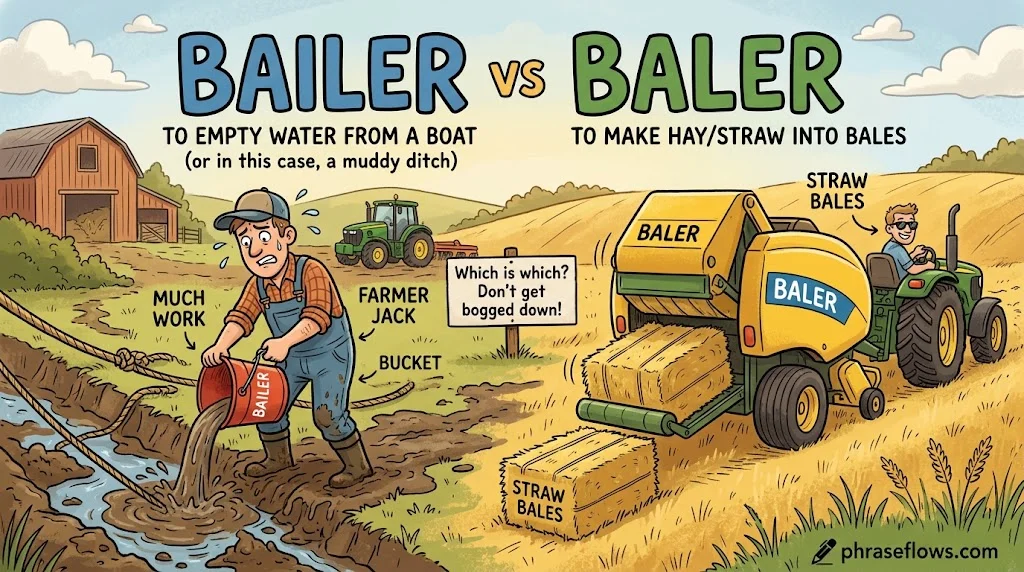

The words Bailer vs. Baler often confuse writers because they look almost identical and sound the same in many English accents. However, these words have different meanings and uses. Although both spellings are correct, choosing the right one depends on what you want to describe. Understanding their meanings will help you avoid spelling mistakes and make your writing clearer.
A bailer usually refers to a person or device that removes water from a boat or collects liquid in certain technical applications. A baler, on the other hand, is a machine that compresses materials such as hay, straw, cardboard, and paper into compact bundles called bales. For example, a sailor uses a bailer to remove water from a canoe, while a farmer operates a baler to bundle hay after harvesting.
Knowing the difference between bailer and baler makes it easier to choose the correct word in everyday writing, professional documents, and technical discussions. The easiest way to remember the distinction is to connect bailer with bail and baler with bale. In this guide, you’ll learn their definitions, common uses, sentence examples, and simple spelling tips to help you use both words correctly.
Bailer vs. Baler: Quick Difference
The simplest way to understand bailer vs. baler is to look at what each word describes. Although their spelling differs by just one letter, their meanings aren’t interchangeable.
| Feature | Bailer | Baler |
| Root word | Bail | Bale |
| Main meaning | A person or device that bails, especially by removing water | A person or machine that makes bales |
| Primary function | Removes or collects liquid | Compresses and bundles material |
| Common settings | Boating, water removal, and liquid sampling | Agriculture, recycling, and manufacturing |
| Typical examples | Boat bailer, groundwater bailer | Hay baler, cardboard baler |
| Example sentence | We used a bailer to remove water from the canoe. | The farmer used a baler to bundle the hay. |
Quick rule: Use bailer when referring to bailing water or another liquid. Choose baler when referring to equipment that compresses material into bales.
definition in the Cambridge English Dictionary
+1
For example, imagine a small boat filling with rainwater and a farm processing freshly cut hay. The person removing water needs a bailer, while the farmer needs a baler. The surrounding situation tells you which spelling belongs in your sentence.
What Does Bailer Mean?
A bailer is a noun formed from the verb bail. In boating, the verb means to remove water from a boat or another space. A bailer can therefore be a person performing that action or a tool designed to help remove the water.
On a small boat, for instance, a bailer might be a simple scoop, container, or purpose-built device. If rainwater collects inside a canoe, you can use a suitable bailer to remove it. The word focuses on the action of getting water out rather than compressing solid material.
The term also appears in specialized technical settings. Certain groundwater-sampling bailers collect liquid from wells for testing, although their design and purpose differ from those of ordinary boating tools.
Examples of Bailer in Sentences
Seeing bailer in context helps you recognize when to use it correctly.
- The sailor grabbed a bailer to remove water from the small boat.
- We kept a bailer in the canoe in case rainwater collected inside.
- The crew used a bailer to empty the water that had gathered on the vessel’s floor.
- The researcher lowered a groundwater bailer into the well to collect a sample.
- A plastic bailer rested beside the fishing boat after the crew finished cleaning it.
- The boat owner checked the bailer before taking the vessel onto the water.
In each sentence, the word refers to a person or device associated with bailing. The surrounding details make the intended meaning clear.
Common Uses of Bailer
The word bailer appears in several contexts, although its precise meaning depends on the activity.
Boating and water removal: A bailer can help remove unwanted water from a small vessel. This is particularly relevant when discussing manual water-removal tools.
Groundwater sampling: In environmental monitoring, a specialized bailer can collect water from a well. Researchers may then analyze the sample to investigate water quality.
Other liquid-removal tasks: The word can describe equipment used to remove or collect liquid in certain technical settings. The exact design depends on the application.
One important distinction: a bailer isn’t the same thing as a bilge pump. A bailer may be a simple manual tool, while a bilge pump is a pumping device designed to move water out of a vessel. Both can serve water-removal purposes, but they aren’t identical pieces of equipment.
What Does Baler Mean?
A baler is a machine that compresses loose material into compact bundles called bales. Farmers use balers to collect and bundle hay or straw, while recycling facilities use them to compress cardboard, paper, and other suitable materials.
definition in the Cambridge English Dictionary
The main purpose of a baler is to make loose material easier to handle, store, and transport. For example, a large pile of loose hay takes up considerable space. After a baler compresses it into organized bundles, the farmer can move and store the material more efficiently.
Balers come in different designs depending on the material they process and the size of the operation. Some agricultural models produce rectangular bales, while others form cylindrical bales. Industrial balers commonly compress recyclable materials into dense blocks for handling and transportation.
Examples of Baler in Sentences
Here are several examples that demonstrate the correct use of baler:
- The farmer purchased a new hay baler before the harvest season began.
- The recycling center installed a cardboard baler to reduce the space occupied by discarded boxes.
- The tractor pulled the baler across the field as workers gathered the dried hay.
- The factory uses a paper baler to compress recyclable paper into manageable bundles.
- The agricultural worker repaired the straw baler before the next day’s work.
- The warehouse operator loaded cardboard into the baler before preparing the material for collection.
Notice the shared idea: every sentence describes someone or something that makes bales. That connection is the easiest way to identify the correct spelling.
Common Types and Uses of Balers
Different balers serve different industries. Understanding these applications can help you recognize the word in technical writing and everyday reading.
| Type of baler | Main purpose | Typical setting |
| Hay baler | Compresses cut and dried hay into bales | Farms and livestock operations |
| Straw baler | Bundles straw after harvesting grain | Agricultural fields |
| Round baler | Forms cylindrical bales of suitable crop material | Hay and forage production |
| Square baler | Produces rectangular bales | Farms and agricultural businesses |
| Cardboard baler | Compresses used cardboard boxes | Warehouses and recycling centers |
| Paper baler | Bundles recyclable paper | Printing facilities and recycling plants |
| Plastic baler | Compresses suitable plastic waste | Industrial recycling facilities |
The exact machine depends on the material and the intended use. However, all these examples share one defining feature: a baler compresses material into bales.
Bailer vs. Baler: Key Differences Explained
Although the words look and sound similar, their meanings become clear when you examine their roots, functions, and common contexts.
Difference Between Bailer and Baler in Meaning
The main difference is the action each word describes.
Bailer comes from bail, which can mean removing water from a boat. The noun refers to a person or device that performs that action.
Baler comes from bale, meaning to form material into a compact bundle. The noun commonly refers to a machine that performs this task.
Consider these two examples:
The sailor used a bailer to remove water from the boat.
The farmer used a baler to compress hay into bundles.
The first sentence describes liquid removal. The second describes material compression. Switching the words would change the intended meaning.
Difference Between Bailer and Baler in Spelling
The spelling difference comes down to the base words bail and bale.
| Word | Base word | Related action | Correct example |
| Bailer | Bail | To remove water from a boat | The bailer emptied the canoe. |
| Baler | Bale | To compress material into a bale | The baler processed the hay. |
Both words use the suffix -er, which commonly identifies a person or thing that performs an action. The difference lies in the base word.
A simple spelling trick makes the distinction easier:
- Bail + er = bailer. Think about bailing water out of a boat.
- Bale + er = baler. Think about making a bale of hay.
Remember the root word, and you’ll have a reliable way to choose the correct spelling.
Difference Between Bailer and Baler in Context
Context often provides the strongest clue when you encounter these words in a sentence.
Imagine reading a boating manual. It discusses water collecting inside a small vessel and explains how to remove it. In that situation, bailer makes sense because the task involves removing water.
Now imagine reading an agricultural equipment guide. It describes a machine that gathers hay and compresses it into bundles. Here, baler is the correct choice because the machine produces bales.
Compare these phrases:
- Boat bailer: A tool used to remove water from a boat.
- Groundwater bailer: A device used to collect a groundwater sample.
- Hay baler: A machine that compresses hay into bales.
- Cardboard baler: A machine that compresses cardboard for storage or transport.
The words surrounding bailer and baler usually make their meanings obvious. When you’re uncertain, identify the action first and select the word that matches it.
Why Do People Confuse Bailer and Baler?
The confusion between bailer and baler is understandable. They differ by only one letter and share the same pronunciation in many varieties of English.
However, pronunciation isn’t always enough to determine spelling. English contains many words that sound alike but have different meanings. Writers must often rely on context to distinguish them.
Here are the main reasons people mix them up.
Similar pronunciation: In many American English accents, both words are pronounced approximately /ˈbeɪlər/. When spoken aloud, the difference may be impossible to hear.
Nearly identical spelling: The extra letter i in bailer can be easy to overlook when typing quickly.
Unfamiliar technical vocabulary: Someone who rarely encounters agricultural machinery might not immediately recognize baler. Likewise, a reader unfamiliar with boating terminology may not know bailer.
Automatic spelling checks: A spell-checker may accept both words because both are valid English words. It might not recognize that the selected word doesn’t fit the sentence.
For example, a document containing the sentence “The farmer bought a new hay bailer” may pass a basic spelling check. The problem isn’t necessarily a misspelled word; it’s the wrong word for the intended meaning.
The best solution is to check meaning as well as spelling. A dictionary can confirm that a word exists, but you must still determine whether it fits the context.
Bailer vs. Baler: Correct Usage in Everyday Writing
Choosing between bailer and baler becomes much easier when you focus on the object or action you’re describing.
If the sentence concerns water removal, a boat, or liquid collection, bailer is usually the appropriate choice. If it concerns hay, straw, cardboard, or another material being compressed into bales, use baler.
When to Use Bailer
Use bailer when referring to a person or device associated with bailing, particularly removing water from a boat.
For example:
- The canoe carried a plastic bailer beneath its seat.
- The sailor reached for the bailer after rainwater entered the boat.
- The researcher used a groundwater bailer to collect a sample.
In each example, the word fits because the context involves removing or collecting liquid.
Remember that bailer can also have specialized uses outside boating. The intended meaning depends on the field and the sentence.
When to Use Baler
Use baler when describing a machine or person that forms material into bales.
For example:
- The farmer used a hay baler during the harvest.
- The warehouse purchased a cardboard baler to handle packaging waste.
- The recycling plant operates a baler to compress suitable recyclable materials.
In these examples, the equipment compresses solid material rather than removing liquid.
If you’re writing about agricultural equipment, hay baler is the standard term. If you’re discussing machinery used to compress cardboard, cardboard baler is the appropriate expression.
definition in the Cambridge English Dictionary
Common Bailer vs. Baler Mistakes to Avoid
Some mistakes occur because writers choose a spelling based on appearance rather than meaning.
| Incorrect usage | Correct usage | Why? |
| The farmer repaired the hay bailer. | The farmer repaired the hay baler. | The machine makes hay bales. |
| The sailor grabbed the baler to remove water. | The sailor grabbed the bailer to remove water. | The tool removes water. |
| The recycling center purchased a cardboard bailer. | The recycling center purchased a cardboard baler. | The machine compresses cardboard. |
| The canoe’s baler was stored beneath the seat. | The canoe’s bailer was stored beneath the seat. | The tool removes water from the canoe. |
One useful rule is to avoid labeling either word as universally incorrect. Both spellings are legitimate; only the context determines which one belongs in a particular sentence.
Bailer vs. Baler in American and British English
American and British English use bailer and baler with the same basic distinction. The words don’t represent alternative regional spellings of one term.
In both varieties, bailer refers to someone or something that bails, especially by removing water from a boat. Baler refers to a person or machine that forms material into bales.
Pronunciation can vary slightly across regions. Nevertheless, the spelling distinction remains tied to meaning rather than nationality.
Collins English Dictionary
+1
Here are common examples:
| Expression | Meaning |
| Boat bailer | A tool used to remove water from a boat |
| Hay baler | A machine that compresses hay into bales |
| Groundwater bailer | Equipment used to collect groundwater |
| Cardboard baler | A machine that compresses cardboard |
Whether you’re writing for American or British readers, use the same basic rule: bail relates to bailing, while bale relates to making bales.
Read More: Coaches vs. Coach’s: Difference, Meaning, and Correct Usage
Easy Ways to Remember Bailer vs. Baler
Spelling rules become easier to remember when you connect each word with a familiar image or action.
Remember Bailer With Bail
Think of a small boat taking on water. Someone reaches for a scoop and throws the water over the side.
That person is using a bailer.
The connection is straightforward:
Bail → Bailer → Remove water
Whenever your sentence describes removing water from a boat, the spelling with i should come to mind.
Remember Baler With Bale
Now picture a farmer gathering dried hay and compressing it into neat bundles for storage.
The machine is a baler, and each finished bundle is a bale.
The connection is equally simple:
Bale → Baler → Make bales
This distinction also works for cardboard and paper. A recycling facility uses a baler because it compresses loose material into compact bundles.
Use the Action Test
When neither spelling looks obviously correct, ask yourself one question: What is the object doing?
- Removing water? Choose bailer.
- Compressing material into bales? Choose baler.
For example, if you’re describing a boat, ask whether the equipment removes water. If you’re describing a farm, ask whether the machinery forms bales of hay.
This quick test works well in everyday writing, professional documents, and spelling exercises.
Bailer vs. Baler: Practice Examples
Test your understanding by choosing the correct word for each sentence. Use the meaning of the sentence rather than relying on how the words sound.
Fill in each blank with bailer or baler.
- The farmer used a ______ to compress the dried hay.
- The sailor kept a ______ inside the canoe to remove water.
- The recycling facility installed a new cardboard ______.
- The researcher lowered a groundwater ______ into the well.
- The tractor pulled the ______ across the field during harvest.
- After the storm, the crew used a ______ to empty the boat.
- The warehouse uses a paper ______ to compress recyclable materials.
- The small vessel carried a manual ______ as part of its equipment.
Answer Key and Explanations
| Sentence | Correct answer | Explanation |
| Compressing dried hay | Baler | A baler makes hay bales. |
| Removing water from a canoe | Bailer | A bailer removes water. |
| Compressing cardboard | Baler | A baler compresses recyclable material. |
| Collecting groundwater | Bailer | A groundwater bailer collects liquid samples. |
| Processing hay in a field | Baler | The machine forms bales. |
| Emptying a boat | Bailer | The action involves removing water. |
| Compressing paper | Baler | The machine creates compact bundles. |
| Manual water-removal equipment | Bailer | The tool helps remove water from the vessel. |
If you answered all eight correctly, you’ve grasped the central distinction. If you missed a few, return to the root words bail and bale and connect each one with its corresponding action.
Conclusion:
Understanding the difference between bailer vs. baler helps you choose the correct spelling based on meaning and context. A bailer refers to a person or device that removes water or collects liquid, while a baler is a person or machine that compresses materials such as hay, straw, paper, or cardboard into bales. Although these words sound alike in many English accents, their meanings are quite different.
The easiest way to remember the distinction is to connect bailer with bail and baler with bale. When writing about boats or liquid removal, use bailer. When discussing farming equipment or recycling machinery, choose baler. Keeping this simple rule in mind will help you avoid common spelling mistakes and communicate your ideas clearly.
FAQs:
Is Bailer or Baler the Correct Spelling?
Both bailer and baler are correct English words, but they have different meanings. A bailer removes water or collects liquid, while a baler compresses materials into compact bundles called bales.
What Is the Main Difference Between Bailer and Baler?
The main difference lies in their functions. A bailer is associated with removing water, especially from boats, while a baler is commonly a machine that compresses hay, straw, cardboard, or paper into bales.
Is It Hay Bailer or Hay Baler?
Hay baler is the correct term for a machine that compresses cut hay into bundles. Farmers use hay balers to make hay easier to handle, store, and transport.
Is It Boat Bailer or Boat Baler?
Boat bailer is the appropriate term for a tool used to remove water from a boat. A baler makes bales of material, so it doesn’t fit this boating context.
Are Bailer and Baler Pronounced the Same?
Yes, bailer and baler are homophones in many varieties of English, meaning they sound alike but have different meanings and spellings. Because pronunciation often won’t help you distinguish them, consider the context before choosing a word.




1 thought on “Bailer vs. Baler: The Difference, Meaning, and Correct Usage”