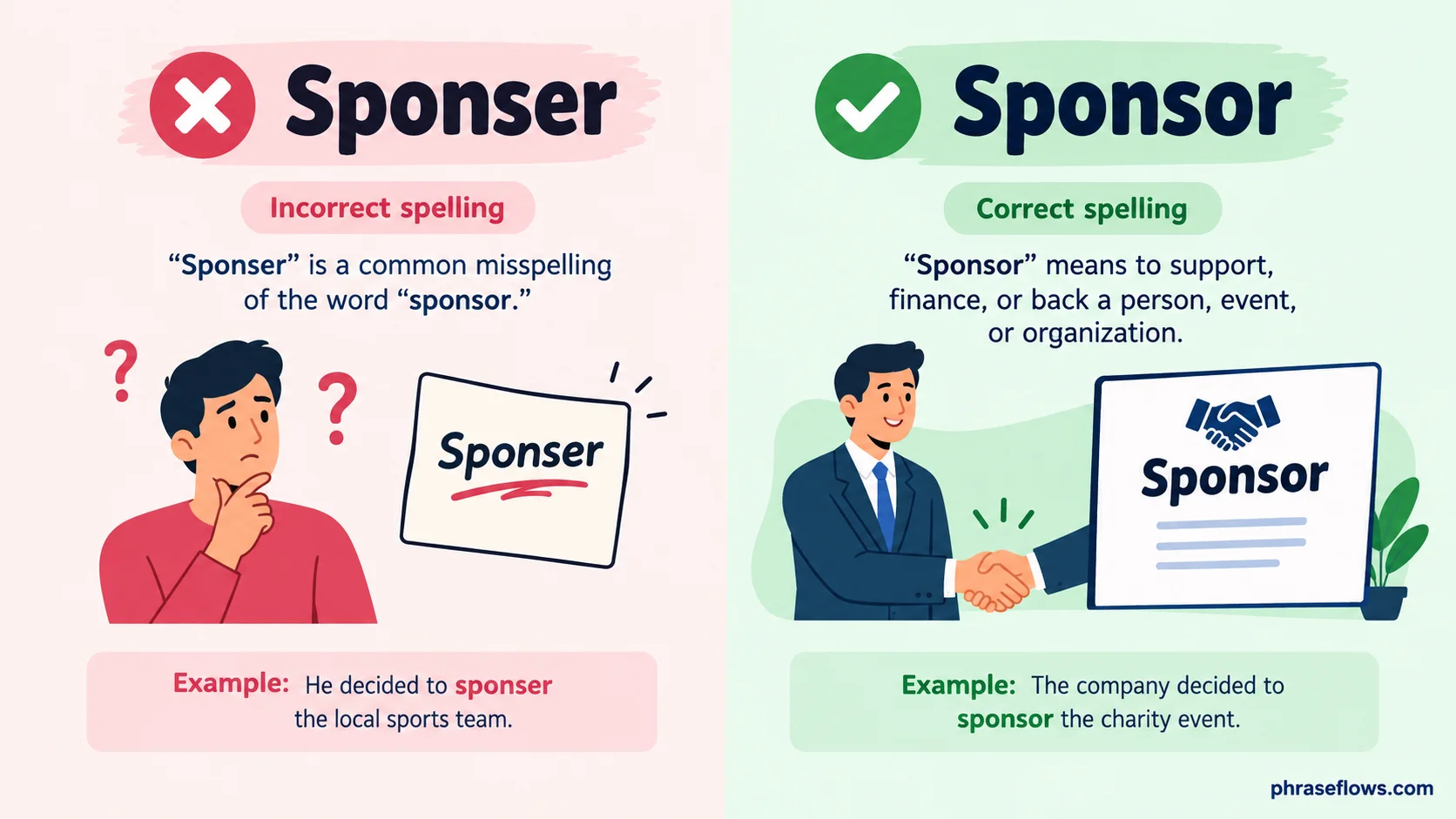

Have you ever paused over Sponser vs Sponsor and wondered which spelling is correct? You’re not alone. This is a common spelling confusion because both forms look and sound very similar. Many people accidentally write Sponser in emails, school assignments, social media posts, and professional writing. However, Sponsor is the correct spelling in standard English.
The word Sponsor has several useful meanings and can work as both a noun and a verb. It can refer to a person or company that provides money or support for an event, project, charity, or another cause. Understanding the sponsor meaning, correct spelling, pronunciation, and everyday usage can help you communicate more clearly and avoid common writing errors.
In this guide, we’ll explore the difference between Sponser vs Sponsor, explain why Sponser is considered an incorrect spelling, and look at practical examples of how Sponsor is used. You’ll also learn simple ways to remember the correct form so you can use it confidently in academic, personal, and professional writing.
Sponser vs Sponsor: Which One Is Correct?
Sponsor is the correct spelling.
Sponser is not the standard spelling of the word. When someone writes sponser, they usually mean sponsor.
| Word | Correct spelling? | Meaning | Part of speech |
| Sponsor | Yes | A person or organization that provides support or the act of providing that support | Noun and verb |
| Sponser | No | Usually an incorrect spelling of sponsor | Not a standard word |
Major English dictionaries list sponsor as the standard word. Cambridge defines sponsor as a noun for someone or an organization that supports a person, organization, or activity with money. It also lists sponsor as a verb for providing financial support or paying for an event or activity.
So, if you’re writing an email, article, school assignment, business proposal, or social media post, use sponsor.
Quick answer: Sponsor is correct. Sponser is a misspelling.
What Does Sponsor Mean?
The word sponsor has several related meanings. At its core, it describes someone who supports another person, organization, activity, or idea.
That support is often financial. However, the word can have broader meanings depending on the context.
For example:
- A company can sponsor a sports team.
- A business can sponsor an event.
- A person can sponsor someone in a charity activity.
- A politician can sponsor a bill.
- An organization can sponsor research.
- Someone can act as an official sponsor for another person in certain situations.
Oxford lists several meanings of sponsor, including a person or company that pays for an event or program, someone who supports another person’s education or training, and someone who introduces or supports a proposed law.
The meaning changes slightly with the context, but the central idea remains support.
Sponsor as a Noun
As a noun, sponsor refers to the person, company, organization, or other party providing the support.
Consider this sentence:
The company became the main sponsor of the local marathon.
Here, sponsor refers to the company that provides support.
Another example:
The tournament attracted several corporate sponsors.
The sponsors are the organizations supporting the tournament.
Common Uses of Sponsor as a Noun
You may see sponsor used in phrases such as:
- event sponsor
- corporate sponsor
- main sponsor
- official sponsor
- title sponsor
- team sponsor
- charity sponsor
- program sponsor
- research sponsor
In marketing, a sponsor may provide money or other resources in exchange for visibility or promotional benefits. Cambridge’s Business English definition specifically describes sponsors as companies or organizations that provide money for activities such as television programs, websites, and sporting events in exchange for advertising.
For example:
The company’s logo appeared on the team’s jerseys because it was the team’s sponsor.
Sponsor as a Verb
Sponsor also works as a verb. In this form, it describes the action of providing support.
For example:
The company sponsors several youth sports programs.
Here, sponsors tells us what the company does.
More examples include:
- The bank sponsored the community festival.
- A technology company sponsors the annual competition.
- Several businesses sponsored the charity event.
- The organization plans to sponsor a research project.
- Local companies sponsor educational programs.
Cambridge lists sponsor as a transitive verb and includes financial support for activities, events, sports, and people among its main uses.
What Does Sponser Mean?
In standard English, sponser is generally a misspelling of sponsor.
It doesn’t normally represent a separate word with a different definition. If you encounter sponser in an ordinary English sentence, the intended word is almost certainly sponsor.
For example:
The company will sponser the event.
The correct version is:
The company will sponsor the event.
The same correction applies to other forms:
- sponser → sponsor
- sponsered → sponsored
- sponsering → sponsoring
This distinction matters because spelling errors can affect the credibility of professional writing. A single misspelled word may not change the meaning of a sentence, but repeated errors can make a document look less polished.
Sponser vs Sponsor: Key Differences
The biggest difference is surprisingly simple: one is the standard word and the other is a misspelling.
| Feature | Sponsor | Sponser |
| Standard English spelling | Yes | No |
| Dictionary headword | Yes | No |
| Can be a noun | Yes | No |
| Can be a verb | Yes | No |
| Means a supporter | Yes | Intended meaning only |
| Used in formal writing | Yes | No |
| Used in business writing | Yes | No |
| Related forms | sponsored, sponsoring, sponsorship | Incorrect forms |
There’s therefore no real semantic battle between sponser and sponsor. The question is mainly about correct spelling and usage.
Why Do People Spell Sponsor as Sponser?
The confusion usually comes from pronunciation.
English spelling doesn’t always give you a perfect guide to pronunciation. Conversely, pronunciation doesn’t always tell you exactly how to spell a word.
When people hear sponsor, the final sound can lead them toward an -er spelling. That can make sponser look plausible, particularly for people writing the word from memory.
This is a classic example of why spelling by sound can sometimes cause problems.
Think about the difference between these two processes:
- Hearing the word: “sponsor”
- Guessing the spelling: “sponser”
- Correct written form: “sponsor”
The reliable form is the last one.
A useful way to remember it is to connect sponsor with its related words:
sponsor → sponsored → sponsoring → sponsorship
Once you remember the base spelling, the entire word family becomes easier.
Sponsor Pronunciation and Spelling
In US English, sponsor is pronounced approximately /ˈspɑːnsər/. Cambridge gives the US pronunciation as /ˈspɑːn.sɚ/.
The pronunciation helps explain the spelling confusion because the final syllable sounds like an -er sound.
However, pronunciation doesn’t change the spelling.
The word still ends in -or:
sponsor
not:
sponser
This is especially useful to remember when you’re writing quickly. If you’re unsure, think of the related noun sponsorship, which clearly keeps the sponsor spelling. Oxford and Cambridge both list sponsorship as the related noun.
How to Use Sponsor Correctly
The easiest way to understand sponsor is to see how it behaves in different situations.
Sponsor in Business and Marketing
Businesses often sponsor activities to support them while also gaining exposure for their brand.
For example:
The technology company sponsored the conference.
A sponsorship may involve money, equipment, services, promotional support, or another agreed form of assistance.
In marketing, sponsorship often has a clear exchange of value. A company provides support while receiving visibility through branding, advertising, public recognition, or association with an event.
For example:
The company became the official sponsor of the annual business conference.
Sponsor in Sports
Sports provide one of the most familiar uses of the word.
Companies may sponsor:
- Sports teams
- Athletes
- Tournaments
- Leagues
- Training programs
- Sporting venues
- Community competitions
For example:
A local business sponsors the school’s basketball team.
The company might provide uniforms, equipment, funding, or other resources.
Sponsor in Events
Events also frequently depend on sponsorship.
Concerts, conferences, festivals, charity runs, exhibitions, and community programs may all have sponsors.
For example:
Several local businesses sponsored the food festival.
In this context, the sponsor provides support while the event gives the sponsor some form of recognition or promotional exposure.
Sponsor in Education and Community Programs
Sponsorship isn’t limited to commercial advertising.
A person or organization can also support someone’s education, training, or development.
Oxford includes sponsorship of training and education among the established meanings of sponsor.
For example:
The foundation sponsors scholarships for talented students.
Here, sponsor describes financial or practical support rather than traditional advertising.
Sponsor in Digital Content
The word has also become common in digital media.
You may see sponsored content involving:
- YouTube videos
- Podcasts
- Websites
- Newsletters
- Online events
- Social media content
- Digital publications
For example:
The podcast’s latest episode was sponsored by a software company.
The company supports the content financially or commercially in exchange for agreed promotional exposure.
Common Grammar Patterns With Sponsor
Learning a few standard sentence patterns makes sponsor much easier to use correctly.
Sponsor + Object
Use sponsor directly before the thing or person receiving support.
The company sponsors the tournament.
The foundation sponsors students.
The organization sponsored the research project.
Be Sponsored By
Use this passive construction when the focus belongs on the event, project, team, or person receiving support.
The tournament was sponsored by a local bank.
The program is sponsored by several companies.
Although active voice is often clearer, this structure is perfectly natural when the sponsor itself isn’t the main focus.
Sponsor of
Use sponsor of when identifying the organization or person connected with something.
The company is the main sponsor of the event.
She is a major sponsor of the charity program.
Sponsor Someone for Something
This construction appears in contexts where someone provides support or official backing.
The company agreed to sponsor him for the training program.
The exact meaning depends on the context.
Sponsor vs Sponsorship vs Sponsored
These three forms belong to the same word family, but they don’t perform the same grammatical job.
| Word | Part of speech | Meaning | Example |
| Sponsor | Noun/verb | Supporter or act of supporting | The company is a sponsor. |
| Sponsorship | Noun | Support or sponsorship arrangement | The event received sponsorship. |
| Sponsored | Verb/adjective | Supported by a sponsor | The event was sponsored by a bank. |
| Sponsoring | Verb | Currently providing support | The company is sponsoring the event. |
Oxford lists the verb forms as sponsor, sponsors, sponsored, and sponsoring.
Notice something important: sponsored keeps the o in sponsor.
It isn’t sponsered.
Common Mistakes to Avoid
Several spelling and usage mistakes appear around this word.
Writing Sponser Instead of Sponsor
Incorrect:
The company will sponser the event.
Correct:
The company will sponsor the event.
Writing Sponsered Instead of Sponsored
Incorrect:
The tournament was sponsered by a local business.
Correct:
The tournament was sponsored by a local business.
Writing Sponsering Instead of Sponsoring
Incorrect:
The company is sponsering the competition.
Correct:
The company is sponsoring the competition.
Confusing Sponsor With Donor
A donor gives money or resources, often without expecting the promotional relationship associated with sponsorship.
A sponsor may also provide money. However, sponsorship often involves an organized relationship between the supporter and the supported activity.
The distinction isn’t absolute in every situation, but it’s useful in business and marketing contexts.
Sponser vs Sponsor Examples
The following examples show the difference clearly.
| Incorrect | Correct |
| The company will sponser the race. | The company will sponsor the race. |
| The event was sponsered by a bank. | The event was sponsored by a bank. |
| They are sponsering the team. | They are sponsoring the team. |
| We need a new sponser. | We need a new sponsor. |
| The program needs corporate sponsership. | The program needs corporate sponsorship. |
Correct Sponsor Examples
The company became the official sponsor of the tournament.
Several businesses sponsored the community event.
The charity is looking for new sponsors.
The university program receives corporate sponsorship.
The brand is sponsoring a national sports competition.
Incorrect Sponser Examples
The company agreed to sponser the team.
We are searching for a new sponser.
The event was sponsered by three businesses.
Each sentence needs the sponsor word family instead.
Sponsor in American English
For American English, the standard spelling is sponsor.
There is no standard American English spelling sponser.
Cambridge’s American English entry gives sponsor as both a noun and a verb and provides the US pronunciation /ˈspɑn·sər/.
That means you should use sponsor in:
- American school assignments
- Business emails
- Reports
- Resumes
- Marketing materials
- Websites
- News articles
- Academic writing
- Professional proposals
The spelling doesn’t need to change simply because the pronunciation sounds like it ends with an -er sound.
Is Sponser or Sponsor Better in Formal Writing?
There is only one appropriate choice in standard formal English: sponsor.
A misspelling such as sponser can distract readers and make otherwise polished writing look careless.
This becomes especially important in professional contexts. Imagine a company preparing a sponsorship proposal and repeatedly spelling its own key term as sponser. The meaning may remain obvious, but the document loses some credibility.
For formal writing, use the established forms:
- sponsor
- sponsors
- sponsored
- sponsoring
- sponsorship
A Simple Way to Remember Sponsor
Here’s an easy spelling trick:
Sponsor has “or” at the end.
Think:
spons + or = sponsor
Then connect it to:
sponsor → sponsorship
The shared sponsor base makes the spelling easier to remember.
Another useful trick is to avoid spelling the word purely from sound. English has many words whose written forms don’t perfectly match what you hear.
If you remember the spelling of sponsorship, you’ll have a strong anchor for remembering sponsor.
The Word Origin of Sponsor
The history of the word also gives an interesting clue about its spelling.
Oxford traces sponsor to the mid-17th century and ultimately to the Latin word spondere, meaning “promise solemnly.” Oxford notes that the noun entered English earlier while the verb developed later, in the late 19th century.
That history helps explain why sponsor developed as an established English form rather than sponser.
Today, the word has expanded well beyond its older formal senses. It now appears naturally in business, sports, education, charity, media, politics, and many other areas.
Sponsor vs Sponser: Quick Reference
If you’re in a hurry, this is the key information to remember:
| Question | Answer |
| Which spelling is correct? | Sponsor |
| Is sponser a standard spelling? | No |
| Can sponsor be a noun? | Yes |
| Can sponsor be a verb? | Yes |
| What is the past tense? | Sponsored |
| What is the -ing form? | Sponsoring |
| What is the related noun? | Sponsorship |
| Why does sponser cause confusion? | The pronunciation can make the spelling seem intuitive |
| Should you use sponser in formal writing? | No |
Conclusion:
The difference between Sponser vs Sponsor is simple once you know the correct spelling. Sponsor is the standard and correct form, while Sponser is a common misspelling that should be avoided in formal and everyday writing. Although both forms may sound similar when spoken, their written forms are different.
Sponsor can function as both a noun and a verb. It can describe a person or company that provides financial support, or the act of supporting an event, project, charity, or individual. Remembering the correct spelling will help you improve your writing, avoid unnecessary spelling errors, and communicate with greater confidence.
FAQs:
Is Sponser a correct spelling?
No. Sponser is an incorrect spelling and is generally considered a misspelling of Sponsor.
What is the correct spelling, Sponser or Sponsor?
Sponsor is the correct spelling in standard English. Use Sponsor in academic, professional, and everyday writing.
What does Sponsor mean?
Sponsor can mean a person or organization that provides money or support. As a verb, it means to provide or fund that support.
Is Sponsor a noun or a verb?
Sponsor can be both a noun and a verb. As a noun, it refers to a supporter. As a verb, it means to support or provide funding.
Why do people spell Sponsor as Sponser?
The mistake usually happens because the pronunciation of Sponsor can sound similar to the incorrect Sponser spelling. Familiar sounds can therefore lead people to choose the wrong written form.




1 thought on “Sponser vs Sponsor: Difference, Meaning, Spelling, and Usage”