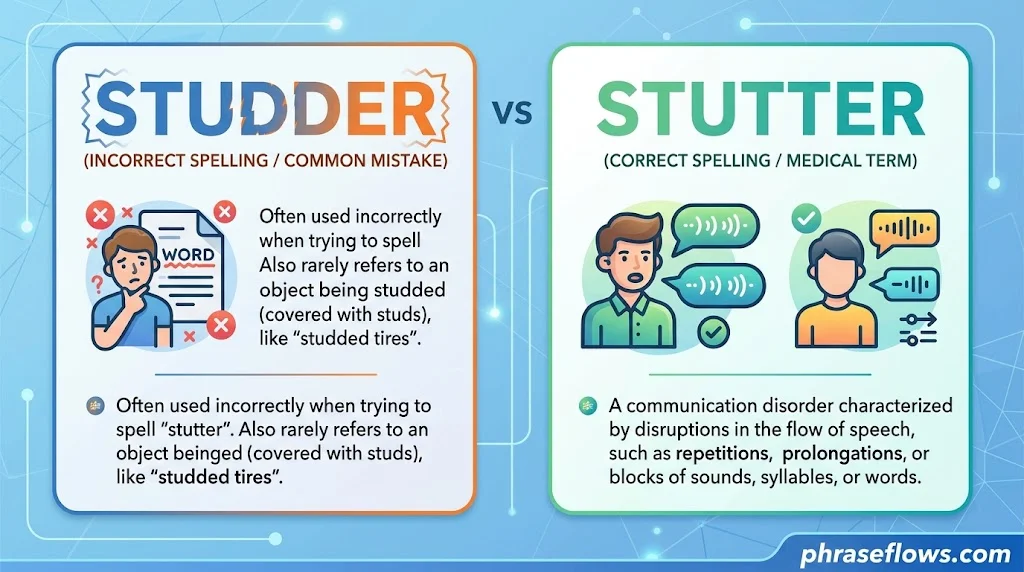

Have you ever wondered whether to write studder or stutter? These two spellings look similar, and their pronunciation may seem close enough to cause confusion. However, when you’re writing about interrupted speech, only one is the standard spelling: stutter.
The word stutter describes speech that includes repeated sounds, prolonged syllables, or interruptions that make speaking less fluent. You can use it as both a noun and a verb. By contrast, studder is generally a misspelling of stutter in this context.
Knowing the difference helps you avoid spelling mistakes in school assignments, blog posts, emails, and everyday conversations. It also helps you understand related terms such as stuttering, stuttered, and stammer. Let’s explore their meanings, correct usage, pronunciation, and examples so you can use the right word with confidence.
Studder vs. Stutter: The Key Difference
The main difference between studder and stutter is spelling accuracy. Stutter is the accepted English word for interrupted speech, while studder is not the standard spelling for that meaning.
Although the words look alike, you shouldn’t use them interchangeably in formal or informal writing. If you’re describing someone who repeats sounds or struggles to produce certain words fluently, choose stutter.
| Feature | Stutter | Studder |
| Standard spelling | Yes | No, not for the speech-related meaning |
| Meaning | To speak with repetitions, prolonged sounds, or blocks | Generally a misspelling of stutter |
| Part of speech | Noun and verb | Not the standard word for this meaning |
| Correct past tense | Stuttered | Incorrect in the intended context |
| Correct present participle | Stuttering | Incorrect in the intended context |
| Recommended usage | Standard English writing | Avoid when referring to interrupted speech |
For example:
- Correct: He began to stutter when he answered the unexpected question.
- Incorrect: He began to studder when he answered the unexpected question.
The meaning is clear in both sentences, but the spelling in the second sentence is incorrect. Use stutter whenever you mean interrupted speech.
What Does Stutter Mean?
Stutter means to speak with interruptions that affect the normal flow or rhythm of speech. These interruptions may include repeating a sound, stretching a syllable, or experiencing a pause when trying to produce a word.
According to the American Speech-Language-Hearing Association (ASHA), stuttering can involve sound or syllable repetitions, prolonged sounds, and blocks in speech. Some people also experience physical tension or emotional challenges when speaking.
Consider this example: someone wants to say, “Please pass the paper,” but repeats the opening sound of the first word before continuing. That repetition illustrates one possible form of stuttering.
However, stuttering doesn’t mean someone lacks intelligence or doesn’t know what to say. A person may understand a topic perfectly well while finding it difficult to produce certain words fluently. Speech fluency and intelligence are different things.
The word stutter has two main grammatical uses.
Stutter as a Verb
When you use stutter as a verb, you’re describing the act of speaking with interruptions or repetitions.
Here are some examples:
- He started to stutter when the teacher asked him to explain his answer.
- She tends to stutter slightly when she feels rushed during a conversation.
- “I-I-I didn’t mean that,” he said, beginning to stutter.
- The character began to stutter as he searched for the right words.
- Some people stutter more noticeably in certain speaking situations than in others.
In each sentence, stutter describes an action or a way of speaking. The verb can appear in different tenses depending on when the action happens.
Stutter as a Noun
As a noun, stutter refers to the speech pattern or condition rather than the action itself.
For example:
- He has a stutter that sometimes makes phone conversations difficult.
- Her stutter doesn’t prevent her from sharing thoughtful ideas.
- The speaker discussed his experiences with stuttering during the presentation.
- The recording captured a brief stutter in the speaker’s voice.
Notice the difference between these two sentences:
- Verb: He began to stutter during the interview.
- Noun: He has a stutter.
The first describes what he did while speaking. The second identifies a speech pattern.
Common Forms of Stutter
The word stutter changes its spelling slightly when you use it in different grammatical forms. Learning these forms can help you avoid mistakes beyond the original studder vs. stutter confusion.
| Word form | Grammatical use | Example |
| Stutter | Base verb or noun | Some people stutter when speaking. |
| Stutters | Present-tense verb or plural noun | He stutters when he feels pressured. |
| Stuttered | Past-tense verb | She stuttered while answering. |
| Stuttering | Present participle or gerund | He is stuttering less in this sentence. |
| Stutterer’s | Possessive noun form | The stutterer’s experiences deserve respect. |
The spelling follows a consistent pattern. You generally double the final t before adding -ed or -ing: stuttered and stuttering.
What Does Studder Mean?
In ordinary English writing, studder is generally an incorrect spelling of stutter when the intended meaning involves interrupted speech. If you’re describing someone who repeats sounds or struggles to get words out fluently, studder isn’t the standard choice.
You may encounter this spelling in social media comments, informal messages, search queries, or text written by someone who is unsure of the correct spelling. Seeing a word online doesn’t automatically make it an accepted alternative.
For instance:
- Incorrect: The boy began to studder during his speech.
- Correct: The boy began to stutter during his speech.
Another example:
- Incorrect: She was studdering while answering the question.
- Correct: She was stuttering while answering the question.
The same principle applies to other forms of the word. Use stuttered for the past tense and stuttering for the continuous form.
If you encounter studder in a sentence, check the context before correcting it. In most discussions about speech, the writer almost certainly means stutter. However, a word can occasionally appear as a name, a username, or a specialized term. Such unusual uses don’t change the standard spelling of the speech-related word.
Studder vs. Stutter: Example Sentences
Examples make spelling differences easier to remember. The following sentences show how to use stutter naturally in different contexts.
Correct Examples Using Stutter
- Everyday conversation: He began to stutter when everyone turned to listen.
- School setting: Maya worried that her stutter might affect her class presentation, but she shared her ideas successfully.
- Storytelling: “I thought you were leaving,” he stuttered, surprised by the sudden announcement.
- Workplace communication: The presenter continued speaking even when he began to stutter.
- General observation: Some people experience changes in their speech fluency depending on the situation.
- Past tense: She stuttered briefly before explaining what had happened.
- Present continuous: He is stuttering in the recording, but his message remains understandable.
These examples show that stutter works in descriptions, dialogue, everyday conversation, and explanatory writing.
Incorrect vs. Correct Sentences
| Incorrect sentence | Correct sentence |
| He began to studder when he felt nervous. | He began to stutter when he felt nervous. |
| She studdered during the interview. | She stuttered during the interview. |
| The child was studdering while speaking. | The child was stuttering while speaking. |
| His studder sometimes affects his speech. | His stutter sometimes affects his speech. |
| He often studders when speaking quickly. | He often stutters when speaking quickly. |
The correction is straightforward in every example: replace the incorrect form with the appropriate form of stutter.
One important point deserves attention. Don’t assume that every repeated word or hesitation means someone has a stuttering disorder. People sometimes pause, revise sentences, or repeat phrases during ordinary conversation. Persistent stuttering involves particular speech patterns and may require professional assessment when it affects communication or causes concern.
Why Do People Confuse Studder and Stutter?
The confusion between studder and stutter is understandable. Both words have similar letter patterns, and a small spelling difference can be easy to miss when you’re typing quickly.
Several factors can contribute to the mistake.
Similar-looking letters: The letters t and d appear in similar positions in the two spellings. Readers may overlook the difference when scanning a sentence.
Uncertainty about pronunciation: People sometimes spell words according to how they think the words sound. However, pronunciation alone doesn’t always reveal the correct spelling.
Typing errors: When writing quickly, you may accidentally select the wrong consonant. Spell-checking tools can help, although you should still review your writing.
Repeated exposure to misspellings: If you see studder in online comments or informal posts, you might assume it’s an accepted spelling. Repetition can make an error look familiar without making it correct.
Limited familiarity with the word: Someone who rarely uses stutter may not remember its exact spelling. Checking a dictionary can resolve the uncertainty quickly.
A useful way to avoid this mistake is to remember the correct sequence of letters: s-t-u-t-t-e-r. Once you recognize that pattern, the spelling becomes easier to recall.
Stutter Pronunciation and Spelling
The standard American English pronunciation of stutter is represented by the International Phonetic Alphabet as /ˈstʌtɚ/. The word has two syllables, and the stress falls on the first syllable.
You can hear the pronunciation and review its phonetic breakdown in the Cambridge Dictionary’s pronunciation guide.
The word begins with the consonant cluster st, followed by a vowel sound similar to the one in cup. The middle contains two written t letters, although American speakers commonly pronounce the middle t with a quick, softened sound.
This difference between spelling and sound is one reason people sometimes find English spelling confusing. A written letter doesn’t always sound exactly as a learner expects.
Is Stutter Spelled With One T or Two?
Stutter is spelled with two consecutive t’s in the middle.
The complete spelling is:
S – T – U – T – T – E – R
By comparison, studder replaces the first of those two consecutive t letters with a d. That change makes it incorrect for the standard speech-related meaning.
Here are the correct forms:
- Stutter
- Stutters
- Stuttered
- Stuttering
Remember the double-t pattern when adding endings. For example, stuttered contains three consecutive t letters across the word’s ending: the original double-t sequence followed by the t in -ed.
Stutter vs. Stammer: Are They the Same?
Stutter and stammer are closely related words that often describe similar interruptions in speech. In many contexts, you can use either term to discuss repetitions, pauses, or difficulty producing sounds fluently.
For example:
- He began to stutter while answering the question.
- He began to stammer while answering the question.
Both sentences describe interrupted speech. The preferred word may depend on the speaker, the region, or the context.
The important distinction is that stammer is a genuine alternative word, whereas studder isn’t the standard alternative spelling of stutter. If you’re choosing between the latter two spellings, use stutter.
Stutter vs. Studder in American and British English
English spelling sometimes varies between American and British usage. Words such as color and colour demonstrate how both forms can be correct in different varieties of English. However, stutter and studder don’t follow that pattern.
Stutter is a standard English word in both American and British English. Stammer is also used in both varieties, although regional preferences can differ.
| Term | American English | British English |
| Stutter | Standard spelling | Standard spelling |
| Stammer | Accepted alternative | Commonly used alternative |
| Studder | Not standard for interrupted speech | Not standard for interrupted speech |
If you’re writing for an American audience, stutter is a clear and appropriate choice. The same spelling works for British readers.
Don’t treat studder as a regional variation. It doesn’t have the same status as legitimate spelling differences such as organize and organise.
Common Mistakes to Avoid When Using Stutter
Choosing the right spelling is only part of using the word well. You should also understand its grammar and meaning.
Using Studder Instead of Stutter
This is the most obvious mistake. Always use stutter when describing interrupted speech.
- Incorrect: He studdered while introducing himself.
- Correct: He stuttered while introducing himself.
Misspelling Stuttered and Stuttering
The base word retains its double-t spelling when you add common endings.
- Correct: She stuttered during the conversation.
- Correct: He is stuttering while trying to answer.
- Incorrect: She studdered during the conversation.
- Incorrect: He is studdering while trying to answer.
Treating Every Hesitation as Stuttering
People often use filler words such as um and uh, repeat phrases, or pause to gather their thoughts. These behaviors can occur during ordinary speech.
Stuttering can involve sound repetitions, prolonged sounds, and blocks. A speech-language pathologist can help distinguish a persistent fluency disorder from typical disfluencies when an assessment is needed. The ASHA guide to typical disfluency and stuttering explains these differences.
Assuming Nervousness Is the Cause of Every Stutter
Nervousness may influence how fluent someone feels or sounds in a particular situation. However, developmental stuttering is more complex than simply feeling nervous. Genetic and neurological factors can contribute to its development.
Avoid making assumptions about a person’s speech based on one conversation.
Using Insensitive Language
A person who stutters may communicate clearly and confidently, even if certain sounds take longer to produce. Don’t interrupt, finish their sentences without permission, or make jokes about their speech.
Instead, listen patiently and focus on what they’re saying. Respectful communication matters far more than perfectly fluent speech.
Stutter Synonyms and Related Words
Several words relate to stutter, but they don’t all mean exactly the same thing. Choosing the right one helps you communicate more precisely.
| Word | Meaning | Example |
| Stammer | To speak with interruptions or repetitions | He began to stammer during the interview. |
| Hesitate | To pause before speaking or acting | She hesitated before answering. |
| Falter | To lose steadiness or confidence | His voice faltered as he spoke. |
| Disfluency | An interruption in the normal flow of speech | The speaker’s disfluency included several pauses. |
| Pause | To stop briefly before continuing | He paused to consider his response. |
| Repeat | To say something again | She repeated the first word of her sentence. |
These words overlap in some situations, but their meanings differ.
For example, someone may hesitate because they’re choosing the right words. That doesn’t necessarily mean they stutter. Likewise, a speaker whose voice falters may sound uncertain without experiencing the repetitions, prolongations, or blocks associated with stuttering.
Disfluency is a broader, more technical term. It describes interruptions in speech and can include ordinary hesitations as well as patterns associated with fluency disorders.
Read More: Well Deserved vs. Well-Deserved: Which Is Correct? Meaning, Grammar, and Examples
How to Remember the Correct Spelling of Stutter
If you often confuse studder and stutter, a simple spelling trick can help.
Remember the Double T
Write the word slowly: S-T-U-T-T-E-R. Notice the two consecutive t letters. This pattern distinguishes the standard spelling from studder.
Connect the Word With Its Meaning
Think of stutter as the word used to describe interrupted speech. Connecting the spelling to its meaning helps you recall it when writing.
Learn the Related Forms Together
Memorize these forms as a group:
- Stutter: The base word.
- Stutters: The present-tense form used with he, she, or it.
- Stuttered: The past-tense form.
- Stuttering: The continuous form or a noun describing the activity.
FAQs:
Is Studder or Stutter Correct?
Stutter is correct when referring to interrupted speech. Studder is generally a misspelling in this context. Use stutter in formal writing, schoolwork, articles, and everyday messages.
Is Studder a Real Word?
Studder isn’t the standard English spelling for the speech-related meaning of stutter. You may encounter it as a typo, an informal spelling, or part of a name. For ordinary writing about speech, use stutter.
How Do You Spell Stutter in the Past Tense?
The past tense of stutter is stuttered. For example: “He stuttered when he tried to explain the situation.” The word keeps the double-t spelling when you add -ed.
Is Stuttering the Same as Stammering?
The terms often refer to similar interruptions in speech and are frequently used as synonyms. Regional preferences and individual word choices can vary, but both are standard English terms.
What Is the Difference Between Stuttering and Hesitating?
Stuttering may involve repeated sounds or syllables, prolonged sounds, or blocks that interrupt speech. Hesitating means pausing or delaying before speaking or acting. Although the two can occur together, they don’t mean the same thing.
Conclusion:
When comparing studder vs. stutter, the choice is simple: stutter is the standard spelling for speech that includes repetitions, prolonged sounds, or blocks. Studder is generally a misspelling of this word.
You can use stutter as either a noun or a verb. Its common forms include stutters, stuttered, and stuttering. The related word stammer is also correct, while hesitate and disfluency describe different but sometimes related aspects of speech.
To avoid mistakes, remember the double-t spelling and check a reliable dictionary whenever you’re uncertain. Most importantly, use the word accurately and respectfully. Clear writing starts with the right spelling, and thoughtful communication goes beyond spelling alone.




1 thought on “Studder vs. Stutter: Which Spelling Is Correct? Meaning, Differences, and Examples”