
Have you ever wondered whether to write less than or less then in a sentence? These two expressions look almost identical, so it’s easy to mix them up when writing quickly. However, they serve different purposes, and choosing the correct word helps you communicate clearly. If you’re writing a school assignment, a professional email, or a blog post, understanding this small grammar difference can make your writing more accurate.
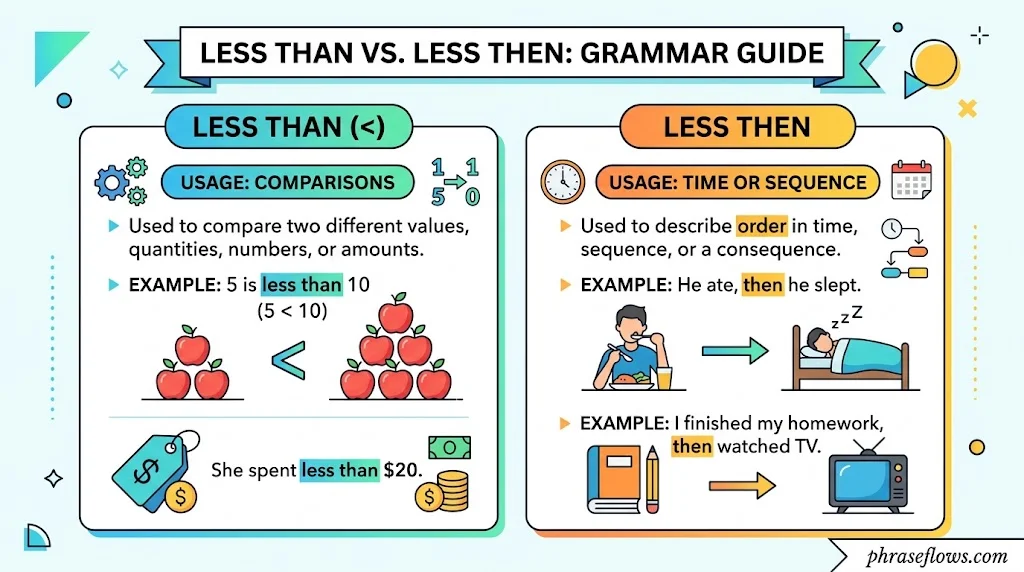
The correct phrase for comparisons is less than. You can use it when talking about numbers, prices, measurements, time, or quantities. For example, “The movie lasts less than two hours” means its running time is shorter than two hours. In contrast, then usually refers to time, sequence, or what happens next, as in “Finish your homework, then watch your favorite show.” Although both words are common in English, they aren’t interchangeable.
Understanding the difference between less than vs. less then doesn’t require complicated grammar rules. You simply need to remember that than introduces comparisons, while then often describes when something happens or what follows. In this guide, you’ll learn their meanings, explore the correct usage, review common mistakes, and discover practical examples that will help you choose the right expression confidently in everyday writing.
Less Than vs. Less Then: Quick Difference
The easiest way to remember the difference is to connect than with comparison and then with time or sequence.
| Feature | Less Than | Less Then |
| Meaning | A smaller amount, value, or degree | Not a standard phrase for comparison |
| Correct for comparisons? | Yes | No |
| Used with numbers? | Yes | Not as a substitute for than |
| Used with prices? | Yes | No |
| Used with time measurements? | Yes | No |
| Can then indicate sequence? | No; than compares | Yes, when then functions separately |
| Example | The task took less than an hour. | Finish the task, then take a break. |
The main rule: Use less than when comparing something with a quantity, limit, value, or degree. Use then when referring to what happened at a particular time or what happens next.
Consider these examples:
- Correct: The package weighs less than five pounds.
- Incorrect: The package weighs less then five pounds.
- Correct: Check the address, then send the package.
- Incorrect: Check the address, than send the package.
The words aren’t interchangeable. Choosing between them depends on what your sentence means, not simply how it sounds.
What Does Less Than Mean?
Less than is a comparative expression that indicates a smaller amount, number, value, or degree than another amount or a stated limit. It helps readers understand how two values relate to each other.
For example, if a notebook costs $3 and a backpack costs $25, you can say, “The notebook costs less than the backpack.” You’re comparing the prices of two items.
You can also use less than without naming a second item directly. In the sentence “The meeting lasted less than an hour,” the phrase compares the meeting’s duration with a one-hour limit.
Here are several everyday examples:
- The movie lasts less than two hours.
- This shirt costs less than $30.
- The room is less than 10 feet wide.
- She finished the assignment in less than 20 minutes.
- The final score was less than expected.
- The temperature dropped to less than 5 degrees Fahrenheit.
In each sentence, less than communicates that something falls below a particular amount, measurement, expectation, or standard.
Less Than in Mathematics
Mathematics uses less than to compare numerical values. Its standard symbol is **
It’s important to understand that then is a perfectly valid English word. The problem arises when writers use it in a place that requires than.
What Does Then Mean?
Then commonly refers to time, sequence, or a consequence. It helps readers understand when something happens, which action comes next, or what follows from a particular condition.
Here are its main uses.
Referring to a time
Use then to describe a particular moment in the past, present, or future.
- I lived in Chicago back then.
- The store was smaller then than it is today.
- We can discuss the details until then.
Showing a sequence of events
Use then to explain the order in which actions occur.
- First, wash the vegetables. Then, chop them.
- She finished her homework and then called her friend.
- Read the instructions, then begin the exercise.
Expressing a result or consequence
You can also use then to introduce a conclusion or explain what follows from a condition.
- If you finish early, then you can leave.
- If the weather improves, then we’ll go outside.
- The file is missing. Then we’ll need another copy.
Notice that then has a clear role in each example. It tells readers when something happens, what happens next, or what follows logically.
Why Is Less Then Usually Incorrect?
The problem becomes clear when you examine the relationship between the words.
Less indicates a smaller amount or degree in comparative expressions. Than introduces the other side of that comparison. Replacing than with then breaks the intended grammatical relationship.
Compare these examples:
| Incorrect sentence | Correct sentence |
| The trip took less then two hours. | The trip took less than two hours. |
| This phone costs less then $200. | This phone costs less than $200. |
| She is less experienced then her colleague. | She is less experienced than her colleague. |
| The box weighs less then five pounds. | The box weighs less than five pounds. |
| We received less then 100 applications. | We received less than 100 applications. |
Each corrected sentence uses than to establish a comparison.
A helpful test: Ask yourself whether the sentence compares an amount, value, or quality with another amount, value, or quality. If it does, than is the word you need.
Less Than vs. Less Then: Key Differences
Although these expressions look alike, their meanings differ because than and then serve separate grammatical purposes.
The distinction becomes easier when you focus on what the sentence communicates rather than how the words look.
| Question | Use Than | Use Then |
| Are you comparing two values? | Yes | No |
| Are you describing what happens next? | No | Yes |
| Are you referring to a past or future time? | Usually no | Yes |
| Are you comparing two qualities? | Yes | No |
| Are you explaining a result? | Not usually | Yes |
| Example | The room is smaller than ours. | We entered the room, then sat down. |
Consider this pair:
- Comparison: The second meeting lasted less than the first.
- Sequence: The second meeting ended, then everyone went home.
The first sentence compares the length of two meetings. The second describes two events in order.
Here’s another example that uses both words correctly:
“The new computer costs less than the old one, and we’ll install it next week, then transfer our files.”
In this sentence, than compares prices while then signals the next action. The words appear in the same sentence, but each performs a different job.
This distinction is especially useful when proofreading longer sentences. Rather than automatically replacing every then with than, check the meaning of each word in context.
When to Use Less Than
The phrase less than works in several common situations. Knowing these contexts makes it easier to use the expression accurately in everyday and professional writing.
Less Than for Numbers and Quantities
Use less than when you want to indicate that a number or quantity falls below a stated value.
For example:
- The class has less than 20 minutes left.
- The tank contains less than five gallons of water.
- The machine processes less than 100 units per hour.
- The distance between the buildings is less than 50 feet.
A useful detail involves less than versus fewer than. Traditional grammar guidance generally recommends fewer than for countable individual items and less than for amounts or measurements. However, established expressions often use less than with numbers of items, money, time, distance, and weight.
Merriam-Webster
For example, both “less than 10 miles” and “less than $20” are standard. In more formal prose, however, “fewer than 10 students” is often preferable because students are countable individuals.
Less Than for Money and Prices
Money is another common context for less than. The phrase helps you describe a price, budget, expense, or financial limit.
Examples include:
- The headphones cost less than $50.
- We completed the project for less than our original budget.
- You can find the replacement part for less than $15.
- The repair cost less than the mechanic initially estimated.
Imagine that you have a $100 budget for school supplies. After shopping, your total comes to $72. You could write, “I spent less than $100 on school supplies.”
The phrase communicates the financial comparison clearly. It also helps readers understand whether a purchase stays within a budget or falls below an expected cost.
Less Than for Time and Age
You can use less than to describe durations, deadlines, waiting periods, and ages.
Examples:
- The bus arrived in less than ten minutes.
- The meeting lasted less than an hour.
- The child is less than five years old.
- The application must arrive in less than two weeks.
Be careful not to confuse a time measurement with the sequence of events. For example, “The meeting lasted less than an hour” describes its duration. “The meeting ended, then we went to lunch” describes what happened afterward.
The distinction remains the same even when both sentences discuss time.
Less Than for Degrees and Measurements
Measurements often require less than because they compare a value with a limit or reference point.
Examples:
- The temperature fell to less than 32 degrees Fahrenheit.
- The package weighs less than ten ounces.
- The road is less than two miles long.
- The mixture contains less than 1% salt.
In science and technical writing, precise comparisons matter. A small difference between measurements can affect how readers interpret a result or follow an instruction.
When writing about measurements, include the appropriate unit whenever it helps readers understand the value. For instance, “less than 5” may be unclear without context, while “less than five centimeters” gives a specific measurement.
Less Than in Idiomatic Expressions
The phrase also appears in expressions that describe a quality or experience that falls below expectations.
Common examples include:
- Less than ideal: Not quite suitable or desirable.
- Less than perfect: Having flaws or imperfections.
- Less than impressed: Not very impressed.
- Less than satisfactory: Not meeting the expected standard.
Consider this sentence: “The service was less than satisfactory.”
The speaker isn’t comparing a numerical quantity. Instead, the phrase expresses a judgment that the service failed to meet expectations.
Similarly, “The weather was less than ideal for a picnic” means the conditions weren’t particularly suitable. These expressions are common in reviews, reports, everyday conversations, and professional feedback.
In all these cases, less than remains the correct form.
Common Mistakes When Using Less Than and Less Then
Even experienced writers sometimes mix up these words. The good news is that most mistakes are easy to correct once you recognize the difference between comparison and sequence.
Using Then Instead of Than in Comparisons
This is the most common error associated with less than vs. less then. Writers sometimes choose then because it looks similar to than or because they type quickly.
Incorrect: The assignment took less then 45 minutes.
Correct: The assignment took less than 45 minutes.
The sentence compares the time needed to complete the assignment with a 45-minute limit. Therefore, than is the correct choice.
Confusing Time Sequence With Comparison
Both words can appear in sentences about time, which sometimes causes confusion. However, a time-related sentence doesn’t automatically require then.
Compare these examples:
- The train arrived in less than an hour.
- The train arrived, then the passengers boarded.
The first sentence describes a duration. The second explains the order of events.
Always identify the relationship between the ideas before choosing a word.
Relying on Pronunciation Instead of Meaning
In everyday speech, than and then may sound similar. This makes the mistake easy to overlook, especially when proofreading silently.
Instead of relying on sound, examine the word’s purpose.
- If you’re comparing prices, use than.
- If you’re describing what happens next, use then.
- If you’re referring to a particular time, then may be appropriate.
- If you’re comparing two qualities, use than.
This simple habit can help you catch errors that a spell-checker might miss.
Overlooking the Error During Proofreading
A sentence can look correct at first glance even when it contains the wrong word. Since than and then are both real English words, basic spell-checking tools may not flag every incorrect substitution.
For example:
The product costs less then the original model.
The sentence contains correctly spelled words, but the comparison requires than.
When reviewing your writing, read each sentence for meaning rather than checking spelling alone. Search your document for “less then” as a final check if you suspect you’ve made this mistake repeatedly.
Easy Ways to Remember Less Than vs. Less Then
You don’t need to memorize complicated grammar rules to distinguish these words. A few simple techniques can make the correct choice easier.
Remember That Than Means Comparison
Use than when one thing is compared with another.
Examples:
- My backpack is lighter than yours.
- This route takes less than 30 minutes.
- The new version works better than the old one.
Think of than as the bridge connecting two sides of a comparison.
Remember That Then Relates to Time
Use then when discussing what happened at a particular time, what happens next, or what follows from a condition.
Examples:
- We ate dinner, then watched a movie.
- I lived there back then.
- If the store is closed, then we’ll return tomorrow.
A useful memory trick is to associate the e in then with time. This isn’t a formal grammar rule, but it can help you remember the word’s common use.
Use the Substitution Test
When you’re unsure, replace the word with a clearer expression.
For than, try “compared with”.
- This option costs less than the other one.
- This option costs less compared with the other one.
The second version sounds a little awkward, but the comparison remains clear.
For then, try “next” or “at that time”.
- Finish the report, then send it.
- Finish the report, next send it.
The substitution helps reveal the intended meaning.
Here’s a quick reference:
| If your sentence means… | Choose… |
| A smaller amount or value | Than |
| A lower price | Than |
| A shorter duration | Than |
| A comparison between qualities | Than |
| What happens next | Then |
| At a particular time | Then |
| A consequence of a condition | Then |
The simplest rule to remember is this: comparisons need than, while time and sequence often need then.
Less Than vs. Fewer Than: What’s the Difference?
Although less than and fewer than can both indicate smaller quantities, they don’t always fit the same situations.
Less than generally describes amounts, measurements, and degrees. Fewer than generally describes a smaller number of countable items.
Consider these examples:
| Less Than | Fewer Than |
| We spent less than $100. | Fewer than 10 students attended. |
| The journey took less than two hours. | Fewer than 20 books remained. |
| The bottle holds less than a liter. | Fewer than five people arrived. |
| The temperature stayed below the expected level. | Fewer than 12 applications were approved. |
The distinction is a useful guideline rather than an absolute rule. English regularly uses less than with quantities expressed as numbers, especially money, distance, time, and measurements. Expressions such as “less than 50 miles” and “less than $20” are standard.
Merriam-Webster
When you’re writing formal academic or professional content, use fewer than for clearly countable individual items when it sounds natural. Use less than for amounts, measurements, and degrees.
Most importantly, don’t confuse this choice with less than vs. less then. The word then doesn’t replace than in either expression.
Less Than vs. More Than
Another useful comparison is less than vs. more than. These expressions communicate opposite relationships.
- Less than indicates a smaller amount or value.
- More than indicates a greater amount or value.
For example:
| Less Than | More Than |
| The bag weighs less than five pounds. | The bag weighs more than five pounds. |
| The repair costs less than $100. | The repair costs more than $100. |
| The movie lasts less than two hours. | The movie lasts more than two hours. |
| She earned less than expected. | She earned more than expected. |
Both expressions use than because both make comparisons.
You can also use them to compare qualities. For example, “The revised explanation is less confusing than the original” and “The revised explanation is more detailed than the original.”
Remember that less and more change the direction of the comparison, but the word than remains the same.
Read More: Chris’s vs. Chris’: Which One Is Correct? A Complete Grammar Guide
Examples of Less Than in Sentences
The following examples show how to use less than in different situations. Pay attention to the context and the relationship being described.
Everyday Conversations
- I’ll be ready in less than ten minutes.
- The café is less than a mile from my house.
- We finished the game in less than an hour.
- This bag costs less than the one we saw yesterday.
- The movie was less entertaining than I expected.
School and Academic Writing
- The student completed the assignment in less than 30 minutes.
- The experiment lasted less than two hours.
- The class scored less than the target average.
- The research included fewer than 100 participants.
- The essay contains less than 1,000 words.
The final two examples illustrate the difference between countable participants and a measured word count. Both fewer than and less than have appropriate uses depending on what you’re describing.
Business and Budgeting
- The company spent less than its quarterly budget.
- The project took less than three weeks to complete.
- The new software costs less than the previous version.
- The department received less funding than it requested.
- The final invoice came to less than $500.
Time and Deadlines
- The application takes less than five minutes to complete.
- We have less than a day to prepare.
- The delivery arrived in less than 48 hours.
- The meeting ended in less than 30 minutes.
- She finished the task with less than an hour remaining.
Measurements and Mathematics
- Eight is less than twelve.
- The box weighs less than ten kilograms.
- The temperature fell below 20 degrees Celsius.
- The distance is less than three miles.
- The value of x is less than 15.
Figurative Expressions
- The results were less than impressive.
- His response was less than helpful.
- The conditions were less than ideal.
- The explanation was less than clear.
- The outcome proved less satisfactory than expected.
These examples show that less than doesn’t always refer to numbers. It can also compare expectations, quality, and performance.
Conclusion:
Understanding the difference between less than vs. less then helps you write clearly and avoid a common grammar mistake. Use less than when comparing amounts, numbers, prices, measurements, or degrees. For example, “The meeting lasted less than an hour” correctly describes a duration shorter than 60 minutes.
On the other hand, then refers to time, sequence, or a result. You might write, “Finish your homework, then watch a movie” to show the order of two actions. Remember this simple rule: than means comparison, while then relates to time or sequence. Apply it whenever you write, and you’ll choose the correct word with confidence.
FAQs:
Is Less Than or Less Then Correct?
Less than is correct when comparing quantities, values, or degrees. For example, “The book costs less than $20.” The phrase less then is incorrect when used to express this type of comparison.
What Is the Difference Between Than and Then?
Than introduces a comparison, as in “This road is shorter than the other one.” Then refers to time or sequence, as in “We ate dinner, then watched a movie.” Their meanings determine which word you should use.
How Do You Use Less Than in a Sentence?
Use less than before a quantity, measurement, limit, or value. For example, “She finished the assignment in less than 30 minutes.” The phrase shows that she needed fewer than 30 minutes to complete it.
Why Do People Confuse Less Than and Less Then?
People often confuse these expressions because they look similar and sound alike in everyday speech. However, than expresses comparison, while then usually refers to time or sequence. Checking the meaning of your sentence helps you choose correctly.
Can Less Than and Then Appear in the Same Sentence?
Yes, both words can appear in one sentence when they serve different purposes. For example, “The new laptop costs less than the old one, so we bought it then.” Here, than compares prices, while then refers to the time of purchase.




1 thought on “Less Than vs. Less Then: Difference, Meaning, Rules, and Examples”