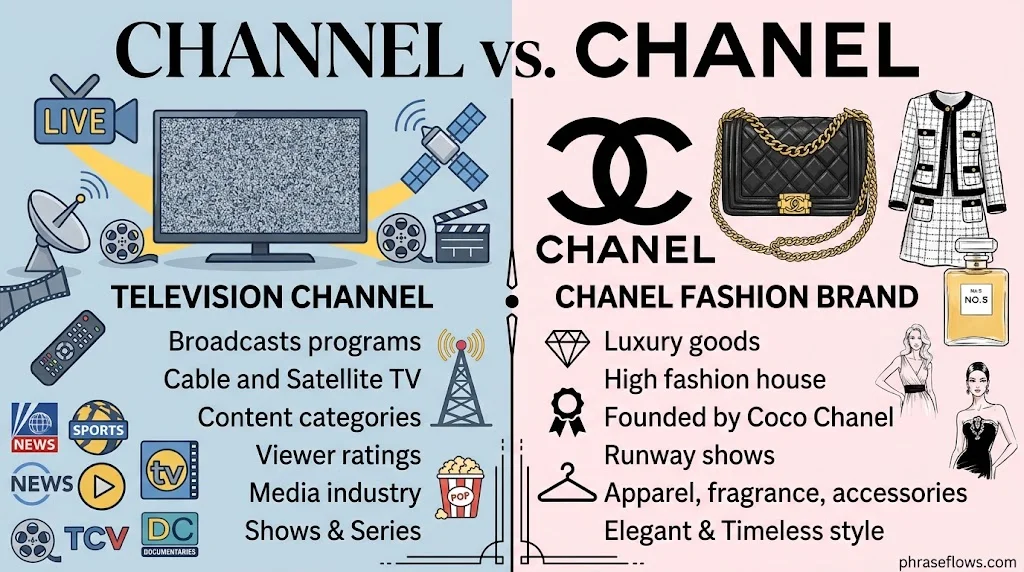

Have you ever wondered whether to write Channel vs.Chanel? These two words look similar, but they have different meanings and uses. Because their spelling differs by just one letter, it’s easy to mix them up when writing an article, sending a message, or creating online content. Understanding the difference helps you avoid spelling mistakes and express your ideas clearly.
The word channel refers to a route, medium, or passage through which something moves or travels. You might change a television channel, subscribe to a YouTube channel, or use a communication channel to share information. In contrast, Chanel is a proper noun best known as the name of the French luxury fashion house founded by Gabrielle “Coco” Chanel. The brand is famous for its fashion, fragrances, cosmetics, and accessories.
So, which spelling should you use? The answer depends on what you want to say. Although both words are correct, you can’t use them interchangeably. This guide explains the meanings of channel and Chanel, highlights their key differences, and provides clear sentence examples to help you choose the correct word with confidence.
Channel vs. Chanel: What’s the Difference?
The main difference between channel and Chanel lies in their meanings and grammatical roles. Channel usually describes a route or means through which something moves, while Chanel refers to a name, most commonly the fashion brand or its founder.
Here’s a quick comparison to help you understand the distinction.
| Feature | Channel | Chanel |
| Word type | Common noun and verb | Proper noun |
| Main meaning | A route, medium, passage, or method of directing something | A fashion house, brand name, or personal name |
| Typical contexts | Television, communication, waterways, business, and technology | Fashion, fragrances, cosmetics, and personal names |
| Capitalization | Usually lowercase unless it starts a sentence or forms part of a proper name | Capitalized when referring to the brand or a named person |
| Example | I changed the television channel. | She bought a Chanel handbag. |
| Memory clue | Think of a pathway or communication route | Think of Coco Chanel and the fashion house |
Both words are legitimate, but the sentence determines which one you need. For example, you might subscribe to a YouTube channel, but you might read a fashion article about Chanel.
Consider these examples:
- Correct: Please change the channel to the weather report.
- Correct: She wore a Chanel jacket to the event.
- Incorrect: Please change the Chanel to the weather report.
- Incorrect: She wore a channel jacket to the event.
The incorrect examples use real words in the wrong contexts. That’s why checking the meaning matters just as much as checking the spelling.
What Does Channel Mean?
The word channel has several meanings, but they share a central idea: a path, route, or means through which something passes. That something might be water, information, a television signal, a product, or even your emotions.
According to Dictionary.com, channel can describe a waterway, a navigable passage, a communication route, or a course into which something is directed. It can also function as a verb.
Dictionary.com
You’ll encounter this word in everyday conversations, professional writing, technical discussions, and online media. Its exact meaning depends on the surrounding words.
Channel as a Communication or Broadcasting Medium
One of the most familiar uses of channel involves television, radio, and digital media. A TV channel provides programming, while a communication channel gives people a way to exchange information.
For example, a television channel might broadcast the evening news, a sports event, or a documentary. In a workplace, an email channel or messaging platform can help employees share updates and coordinate tasks.
Consider these sentences:
- We watched the documentary on a history channel.
- The television channel announced its new program schedule.
- Please contact customer support through the official communication channel.
- Our teacher created a channel where students could ask questions.
- The company uses several digital channels to reach its customers.
Online creators use the word in much the same way. A YouTube channel, for instance, is a dedicated space where a creator publishes videos for viewers.
Remember: When you mean a source of information, a broadcasting service, or a way to communicate, channel is generally the correct choice.
Channel as a Waterway
A channel can also refer to a natural or artificial passage through which water flows. This meaning appears in geography, navigation, engineering, and environmental studies.
A river channel is the path occupied by a river as it flows through the landscape. An artificial channel may help direct water for irrigation, drainage, or flood management. In navigation, a channel can provide a route for boats and ships.
Examples include:
- The boat moved carefully through the narrow channel.
- Farmers directed water into a channel that supplied their fields.
- Heavy rainfall caused water to overflow the river channel.
- The ship entered the marked channel before approaching the harbor.
The word also appears in the proper name the English Channel, the body of water separating southern England from northern France. In this geographical name, Channel begins with a capital letter.
These examples demonstrate an important point: channel doesn’t always involve television or communication. Its broader meaning is a passage or route.
Channel in Business and Marketing
In business, a channel is a route through which a company reaches customers, distributes products, or communicates with an audience.
A business might sell its products through a physical store, an online shop, or a third-party retailer. Each route can serve as a sales or distribution channel.
Marketing channels work similarly. Businesses use email, social media, websites, advertisements, and other methods to share information about their products and services.
| Type of channel | What it means | Example |
| Sales channel | A way to sell products or services | A company sells products through its website. |
| Distribution channel | A route used to deliver products to customers | A manufacturer supplies products through retailers. |
| Marketing channel | A method of promoting a product or service | A business shares product updates through email. |
| Communication channel | A way to exchange information | Employees discuss a project through a messaging platform. |
| Customer service channel | A way for customers to request help | Customers contact support through live chat. |
Imagine a small clothing business that sells products through a local shop and an online store. Both are sales channels, even though customers use different routes to make a purchase.
In this context, writing Chanel instead of channel would change the intended meaning. A business can improve its marketing channels, but it wouldn’t normally improve its marketing Chanels.
Channel as a Verb
Although people often use channel as a noun, it also works as a verb. To channel something means to direct, guide, or use it for a particular purpose.
The word frequently appears when discussing emotions, energy, effort, money, and resources.
For example:
- She channeled her nervous energy into preparing for the presentation.
- The organization channeled its resources toward community projects.
- He channeled his creativity into writing short stories.
- The team channeled its efforts into improving customer service.
Notice how the verb suggests direction. Instead of allowing energy or resources to spread without a clear purpose, someone directs them toward a specific goal.
The spelling changes in some grammatical forms:
| Form | Example |
| Base form | channel |
| Third-person singular | channels |
| Past tense | channeled |
| Present participle | channeling |
In standard American English, channeled and channeling are common spellings. British English often uses channelled and channelling.
This spelling difference concerns regional conventions for the word channel. It doesn’t change the distinction between channel and Chanel.
What Does Chanel Mean?
Chanel is a proper noun best known as the name of a French luxury fashion house. The name comes from its founder, Gabrielle “Coco” Chanel, whose work helped shape modern women’s fashion.
According to the brand’s official history, Gabrielle Chanel opened her first hat boutique in Paris in 1910. She later established a couture house and introduced designs that emphasized simplicity, comfort, and freedom of movement. In 1921, she launched Chanel No. 5, a fragrance that became one of the brand’s best-known products.
CHANEL
+2
Unlike channel, which has several ordinary dictionary meanings, Chanel usually identifies a particular person, company, or brand. You will most often see it in articles about fashion, fragrances, cosmetics, handbags, and luxury accessories.
Chanel as a Fashion Brand
The fashion house uses the name CHANEL in its official branding. Its product range includes clothing, handbags, shoes, jewelry, watches, fragrances, makeup, and skin care.
When you see Chanel in a sentence about a designer product, it generally identifies the brand associated with that item.
Examples include:
- She wore a Chanel jacket to the fashion event.
- My aunt enjoys wearing Chanel perfume.
- The magazine featured a new Chanel collection.
- The boutique displayed several Chanel handbags.
- Chanel No. 5 debuted in 1921.
The brand name remains capitalized in ordinary writing because it is a proper noun. Although the company often presents its name in all capital letters, Chanel is also a standard way to write it within a sentence.
For more background, visit the official history of the House of CHANEL.
Chanel as a Personal Name
Chanel can also serve as a given name or surname. Therefore, the word doesn’t always refer to the fashion company.
For example:
- Chanel joined her classmates for a school project.
- Ms. Chanel gave a presentation about modern design.
- The article discussed Gabrielle Chanel’s influence on fashion.
In the first sentence, Chanel is a person’s given name. In the third, it refers to the fashion designer.
Context is the key. If a sentence mentions a person named Chanel, the word identifies that individual. If it discusses a fragrance or handbag, it most likely refers to the fashion brand.
Channel vs. Chanel: Key Differences Explained
Although channel and Chanel look similar, their meanings, grammatical roles, and typical contexts differ.
Understanding these differences helps you avoid spelling errors in school assignments, blog posts, business emails, product descriptions, and everyday messages.
Difference in Meaning
The most important difference concerns what each word represents.
Channel describes a passage, route, communication medium, or method of directing something. It can also function as a verb.
Chanel is a proper name associated with the fashion designer Gabrielle Chanel, the fashion house, or a person who has that name.
Compare these examples:
Please subscribe to our YouTube channel.
Here, channel describes an online platform where a creator publishes videos.
She received a Chanel handbag for her birthday.
Here, Chanel identifies the brand that made the handbag.
Switching the words would make either sentence incorrect for its intended meaning.
Difference in Spelling
The spelling difference is small but important.
- Channel: C-H-A-N-N-E-L
- Chanel: C-H-A-N-E-L
The word channel contains two n’s, while Chanel contains one n.
This difference often causes typing mistakes because the words share several letters and have similar visual patterns. If you type quickly, you might accidentally leave out an n or add one where it doesn’t belong.
A simple way to remember the distinction is to connect channel with words such as television channel, water channel, and communication channel. Associate Chanel with Coco Chanel, fashion, and fragrance.
Difference in Capitalization
Capitalization offers another useful clue.
Use channel in lowercase when it functions as an ordinary noun or verb in the middle of a sentence.
Examples:
- We changed the television channel.
- Email is an effective communication channel.
- She channeled her energy into studying.
Use Chanel with a capital C when referring to the brand or a person with that name.
Examples:
- She bought Chanel makeup.
- Chanel is a well-known luxury fashion house.
- Gabrielle Chanel influenced modern fashion.
However, remember that capitalization alone doesn’t determine the meaning. Channel also takes a capital letter at the beginning of a sentence or when it appears in a proper name, such as Channel 4.
Difference in Pronunciation
The words have different standard pronunciations in English, although accents and individual speech patterns can affect how clearly you hear the distinction.
- Channel: Commonly pronounced /ˈtʃænəl/ or /ˈtʃænl/.
- Chanel: Commonly pronounced /ʃəˈnɛl/ or /ʃæˈnɛl/, depending on accent and usage.
Dictionary.com
+1
In channel, the first sound is the ch sound, as in chair. In the commonly used English pronunciation of Chanel, the opening sound resembles the sh sound in shoe.
The stress also differs in common pronunciations: channel generally stresses the first syllable, while Chanel generally stresses the second.
If you’re unsure which word someone means, consider the subject of the conversation. A discussion about television probably involves a channel, while a conversation about luxury perfume may involve Chanel.
Channel vs. Chanel: Sentence Examples
Examples make the distinction easier to understand because they show how each word works in natural English.
Examples of Channel in Sentences
Use channel when you mean a route, communication medium, waterway, broadcasting service, or method of directing something.
- I changed the channel because the program had ended.
- Our school uses an online channel to share announcements.
- The boat traveled through a narrow channel.
- The business launched a new sales channel.
- Please send your questions through the official support channel.
- She channeled her creativity into painting.
- The engineers built a channel to direct rainwater away from the road.
- The news channel reported the results of the election.
- The team created a communication channel for project updates.
- He channeled his nervous energy into preparing for the speech.
Each sentence uses channel to describe a route or the act of directing something.
Examples of Chanel in Sentences
Use Chanel when referring to the fashion brand, its founder, or a person with that name.
- She wore a Chanel dress to the celebration.
- My mother received a Chanel fragrance as a gift.
- The magazine reviewed a new Chanel collection.
- The store displayed Chanel handbags in its window.
- Gabrielle Chanel became an influential figure in fashion history.
- Chanel No. 5 launched in 1921.
- The article explored Chanel’s contribution to modern design.
- Chanel cosmetics appeared in the beauty editor’s review.
- The customer asked about a Chanel watch.
- Chanel opened its first hat boutique in Paris in 1910.
These examples use Chanel as a proper name rather than an ordinary English word.
Examples Using Both Channel and Chanel
Sometimes, a single sentence can include both words. This provides an especially clear demonstration of their different meanings.
- The television channel aired a documentary about Chanel.
- She watched a fashion program on a cable channel that featured Chanel handbags.
- The news channel discussed the history of the Chanel fashion house.
- A YouTube channel reviewed several Chanel fragrances.
- The fashion channel interviewed a designer about Chanel’s influence on modern clothing.
In every example, channel describes the medium that carries information, while Chanel identifies the subject of that information.
Common Mistakes When Using Channel and Chanel
Even experienced writers can mix up words that look alike. The good news is that a few simple checks can prevent most mistakes.
Using Chanel Instead of Channel
This mistake often appears in writing about television, websites, or social media.
Incorrect: Please subscribe to my YouTube Chanel.
Correct: Please subscribe to my YouTube channel.
A YouTube channel is a place where creators publish videos. The word describes the platform or content outlet, not a fashion brand.
Using Channel Instead of Chanel
The opposite mistake happens when someone writes about fashion or beauty products.
Incorrect: She bought a channel handbag.
Correct: She bought a Chanel handbag.
The corrected sentence identifies the luxury fashion brand. A channel handbag would not communicate the intended brand name.
Forgetting to Capitalize Chanel
Because Chanel is a proper name, it normally needs a capital C.
Incorrect: She enjoys wearing chanel perfume.
Correct: She enjoys wearing Chanel perfume.
The same rule applies when you mention Gabrielle Chanel or the Chanel fashion house.
Assuming the Words Are Interchangeable
Some writers assume that these words are alternative spellings of the same term. They aren’t.
Incorrect: The company created a new marketing Chanel.
Correct: The company created a new marketing channel.
The corrected sentence describes a way to promote products or services. It doesn’t refer to the fashion brand.
Trusting Spell-Check Without Checking Meaning
Spell-checkers can identify many typing errors, but they don’t always recognize a word-choice problem. Both channel and Chanel are valid spellings.
For example, a spelling checker might accept the sentence “Subscribe to my YouTube Chanel” because Chanel is a legitimate name. However, the sentence still contains the wrong word.
To catch this kind of error, proofread for meaning as well as spelling. Ask yourself what the sentence is trying to describe before deciding which word belongs there.
How to Remember the Difference Between Channel and Chanel
You don’t need to memorize complicated definitions to distinguish these words. A simple memory trick can help you make the right choice.
Channel carries something; Chanel names someone or something.
Think of a channel as a path that carries water, information, signals, products, or ideas. Then connect Chanel with the fashion designer and the luxury brand.
Here are a few practical reminders:
- Television: You change the channel.
- YouTube: You subscribe to a channel.
- Business: You develop a marketing channel.
- Water: A river flows through a channel.
- Fashion: You wear Chanel clothing.
- Fragrance: You might buy Chanel No. 5.
- Personal names: Someone may have Chanel as a given name or surname.
You can also use a quick replacement test.
If you can replace the word with route, medium, or pathway without changing the intended meaning, channel is probably correct.
If you’re naming the fashion brand, its founder, or a person named Chanel, use Chanel.
For example, “The company opened a new communication ___” clearly calls for channel. By contrast, “She bought a bottle of ___ perfume” calls for Chanel.
Channel vs. Chanel: Spelling, Word Origins, and Usage
The difference between these words becomes even clearer when you consider their origins and development.
Where Does the Word Channel Come From?
The English word channel has historical roots in Middle English and Old French. Dictionary.com traces it to Old French chanel or canel and ultimately to the Latin word canalis, meaning a waterpipe or conduit.
Dictionary.com
That history fits the word’s central meaning. A channel provides a passage through which something can travel.
Over time, English expanded the word’s use beyond waterways. Today, a channel can carry television signals, digital information, business communications, or products. The verb to channel also describes directing something toward a particular goal.
Where Does the Name Chanel Come From?
Chanel is a surname, most famously associated with French fashion designer Gabrielle “Coco” Chanel.
Her fashion house grew from a hat boutique opened in Paris in 1910 into an internationally recognized luxury brand. Its name remains closely associated with fashion, fragrances, and beauty products.
CHANEL
+1
Unlike the common noun channel, the name Chanel doesn’t generally describe a route or communication method. It identifies a person or a brand.
Although the spellings look related, their modern uses are different. You shouldn’t treat Chanel as a shortened form of channel or use it as an alternative spelling.
Read More: Less Than vs. Less Then: Difference, Meaning, Rules, and Examples
A Practical Case Study: Channel vs. Chanel in Everyday Writing
Imagine that a fashion blogger is preparing an article about luxury fragrances. The blogger wants to publish a video review and share the article through social media.
Here are three sentences the blogger might write.
Sentence A: “I uploaded my review to my YouTube Chanel.”
Sentence B: “I reviewed a Chanel fragrance in my latest video.”
Sentence C: “My beauty channel features reviews of Chanel products.”
Sentence A contains a spelling mistake because the blogger means a YouTube channel. Sentence B correctly uses Chanel to identify the fragrance brand. Sentence C uses both words correctly: channel identifies the creator’s online platform, while Chanel names the products being reviewed.
This small example shows why context matters. The words may appear in the same article, but each serves a different purpose.
The same principle applies to academic writing, online stores, marketing campaigns, and personal messages. Choosing the correct word makes your meaning clearer and your writing more professional.
FAQs:
Is Channel or Chanel the Correct Spelling?
Both spellings are correct, but they have different meanings. Use channel for a route, communication medium, waterway, or broadcasting service. Use Chanel when referring to the fashion brand, its founder, or a person with that name.
What Is the Main Difference Between Channel and Chanel?
The main difference is their meaning. Channel is a common English noun and verb, while Chanel is a proper noun. For example, you might change a television channel or purchase a Chanel handbag.
Is Chanel a Real Word?
Yes. Chanel is a proper name, most notably associated with Gabrielle “Coco” Chanel and the French luxury fashion house. It can also appear as a person’s given name or surname.
Should Chanel Always Be Capitalized?
When referring to the fashion brand or a person’s name, Chanel should be capitalized. However, channel is normally lowercase unless it begins a sentence or forms part of a proper name, such as Channel 4.
Can Channel Be Used as a Verb?
Yes. To channel means to direct or guide something toward a particular purpose. For example, “She channeled her energy into studying” means she directed her effort toward her studies.
How Do You Use Channel and Chanel in One Sentence?
You can write, “The television channel aired a documentary about Chanel’s fashion legacy.” In this sentence, channel refers to the broadcasting medium, while Chanel identifies the fashion designer or brand.
Is Chanel a Misspelling of Channel?
Not necessarily. Chanel is a correct spelling when used as a proper name, but it is incorrect if you intend to describe a communication route, television station, or waterway. The intended meaning determines the correct choice.
Are Channel and Chanel Pronounced the Same Way?
They aren’t generally pronounced the same way in standard English. Channel begins with a ch sound, while Chanel commonly begins with a sh sound in English pronunciation. Accents can affect the exact vowel sounds.
What Is the Difference Between a YouTube Channel and Chanel?
A YouTube channel is an online space where a creator publishes videos. Chanel is the name of a fashion and beauty brand. A YouTube channel can review Chanel products, but the two terms don’t mean the same thing.
Conclusion:
The difference between channel vs. Chanel comes down to meaning, spelling, and context. Although the words look similar, they serve different purposes in English.
Use channel when referring to a television station, communication method, waterway, business route, or the act of directing something toward a goal. Use Chanel when referring to the fashion designer, the luxury brand, or a person with that name.
Remember this simple rule: a channel carries something, while Chanel identifies a name. When you check the meaning of your sentence before choosing the spelling, you’ll avoid common mistakes and make your writing clearer.


1 thought on “Channel vs. Chanel: Difference, Meaning, Spelling, and Usage”