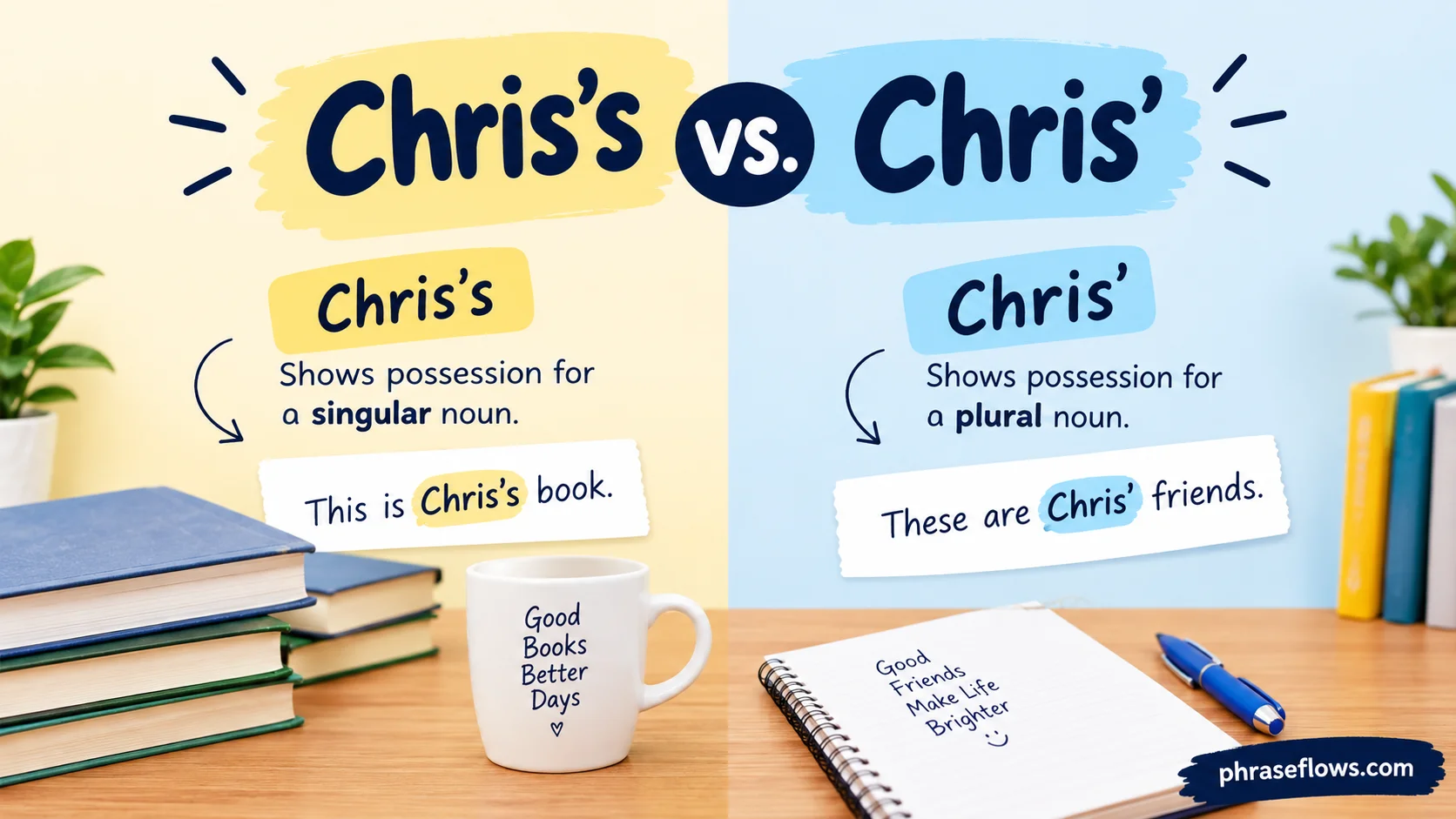

Have you ever paused while writing a sentence because you weren’t sure whether to use Chris’s vs. Chris’? You’re not alone. Both forms appear in English writing, and choosing the correct one can feel confusing because they look almost identical. Whether you’re writing a school assignment, an email, or a professional article, understanding the difference can help you avoid common grammar mistakes.
The main difference between Chris’s vs. Chris’ comes down to style guides and their rules for showing possession. Both forms can indicate that something belongs to a person named Chris. However, some style guides, such as The Chicago Manual of Style, prefer Chris’s, while the traditional Associated Press (AP) style uses Chris’. Knowing which convention to follow will help you keep your writing clear and consistent.
In this complete guide, you’ll learn when to use Chris’s and Chris’, explore practical examples, and understand how each form works in everyday and formal writing. We’ll also explain the difference between Chris, Chris’s, Chris’, and Chrises’ so you can choose the right form with confidence. By the end, you’ll have a clear understanding of these possessive forms and the grammar rules behind them.
Quick Answer: Chris’s or Chris’?
Both Chris’s and Chris’ can be correct possessive forms of the singular name Chris. However, your preferred spelling depends on the editorial style you’re following.
- Chris’s: Commonly preferred by The Chicago Manual of Style and many other writing conventions.
- Chris’: Preferred by the Associated Press (AP) style convention for singular proper names ending in s.
- Chris: The name itself, without an apostrophe, when no possession is expressed.
- Chrises’: The plural possessive form when referring to multiple people named Chris.
The following table makes the distinction easier to remember.
| Form | Meaning | Example |
| Chris | One person named Chris | Chris arrived early. |
| Chris’s | Something belonging to Chris | Chris’s backpack is blue. |
| Chris’ | The same singular possessive under another style | Chris’ backpack is blue. |
| Chrises | More than one person named Chris | The two Chrises arrived together. |
| Chrises’ | Something belonging to multiple people named Chris | The Chrises’ house has a large garden. |
The simplest rule: Follow your required style guide. If no style guide applies, Chris’s is a widely accepted choice in American English.
What Does Chris’s Mean?
Chris’s is the possessive form of the singular name Chris. Writers use it to show that something belongs to Chris or has a close connection to that person.
To form this version, keep the original name and add ’s to the end. Because Chris already ends in s, the written result contains two s letters around the apostrophe.
For example:
- Chris’s phone was ringing during the meeting.
- I borrowed Chris’s notebook before class.
- Chris’s presentation impressed the entire team.
- We visited Chris’s apartment last weekend.
- Chris’s advice helped me solve the problem.
Each example refers to one person named Chris. The apostrophe and additional s mark the possessive relationship.
Examples of Chris’s in Different Contexts
The possessive form can describe more than physical ownership. It can also express relationships, responsibilities, ideas, and personal experiences.
Ownership: Chris’s bicycle is parked outside.
Here, the bicycle belongs to Chris.
Relationships: Chris’s sister starts college this fall.
The word sister identifies a family relationship rather than an object someone owns.
Work and responsibility: Chris’s report needs a few revisions.
The report is associated with Chris because Chris prepared it or is responsible for it.
Opinions and ideas: Chris’s explanation made the topic easier to understand.
The sentence connects the explanation to the person who gave it.
Time and events: Chris’s birthday falls on a Friday this year.
The possessive form identifies an event associated with Chris.
These examples show why possessives matter in everyday writing. They help you connect people with the objects, relationships, activities, and ideas associated with them.
When Should You Use Chris’s?
Choose Chris’s when your required style guide calls for adding ’s to singular names ending in s. This convention appears in Chicago style and many other editorial settings.
It works well in:
- School assignments that follow Chicago-style rules.
- Blog posts and articles using an ’s possessive convention.
- Business documents that follow the same editorial standard.
- Stories, essays, and other writing where the chosen style calls for this form.
For example, if you’re writing a sentence about a book that belongs to Chris, you can write, “Chris’s book is on the table.”
Just remember that the rule should remain consistent throughout your document.
What Does Chris’ Mean?
Chris’ is another way to write the singular possessive of Chris. Instead of adding another s after the apostrophe, this form places the apostrophe immediately after the name’s existing final letter.
For example:
- Chris’ phone was ringing during the meeting.
- I borrowed Chris’ notebook before class.
- Chris’ presentation impressed the entire team.
- We visited Chris’ apartment last weekend.
- Chris’ advice helped me solve the problem.
Notice that the meaning stays the same as in the earlier examples. The difference lies in the spelling convention, not in who owns the phone, notebook, or apartment.
When Should You Use Chris’?
Use Chris’ when the style guide for your publication or assignment calls for an apostrophe alone after singular proper names ending in s.
The Associated Press style convention has traditionally followed this approach. AP’s published guidance distinguishes singular proper names ending in s from singular common nouns ending in s. For example, it gives Agnes’ book as a proper-name possessive and the witness’s answer as a common-noun possessive.
Thread Reader App
This spelling may suit:
- Newspaper articles following AP style.
- Newsroom copy and media publications that use AP conventions.
- Organizations with an editorial guide that specifies apostrophe-only possessives.
- Any document whose required style explicitly prefers this form.
Important: Don’t assume that Chris’ is automatically more correct because the name already ends in s. Many respected writing conventions add another s. The relevant style guide determines which spelling you should use.
Chris’s vs. Chris’: Key Differences Explained
At first glance, the two spellings look almost identical. However, understanding their grammatical role helps you choose between them without confusion.
| Feature | Chris’s | Chris’ |
| Grammatical role | Singular possessive | Singular possessive |
| Refers to | One person named Chris | One person named Chris |
| Shows ownership or association | Yes | Yes |
| Chicago style preference | Preferred | Alternative practice |
| AP style convention | Generally not the preferred form | Preferred for singular proper names ending in s |
| Basic meaning | Belonging to Chris | Belonging to Chris |
The Chicago Manual of Style explicitly states that both approaches exist but prefers the form with the additional s. Its current guidance discusses these rules in the 18th edition, published in 2024.
The Chicago Manual of Style Online
Does Chris’s Have a Different Meaning From Chris’?
No. In ordinary sentences, Chris’s and Chris’ express the same possessive relationship when used according to their respective conventions.
Consider these examples:
- Chris’s jacket is hanging by the door.
- Chris’ jacket is hanging by the door.
Both sentences identify the jacket as belonging to Chris. Neither version indicates a different jacket, a different person, or a different degree of ownership.
The spelling changes because editors follow different rules for names ending in s.
Does the Extra S Change Pronunciation?
In standard pronunciation, the possessive of Chris usually ends with an additional unstressed syllable, often represented by the sound /ɪz/. Both spellings generally represent the same spoken form.
In other words, adding an extra written s doesn’t normally mean you pronounce a completely different word. The distinction is primarily written and editorial.
What Do Major Style Guides Say About Chris’s and Chris’?
Different style guides exist because publishers need consistent rules for spelling, punctuation, capitalization, and other writing choices. Their recommendations don’t always match.
The apostrophe in Chris’s is a useful example of how two respected conventions can handle the same grammatical relationship differently.
Chicago Manual of Style: Chris’s
The Chicago Manual of Style generally recommends adding ’s to singular proper names ending in s.
Under this convention, the preferred spelling is Chris’s.
Examples include:
- James’s car
- Charles’s office
- Chris’s jacket
- Iris’s notebook
Chicago’s guidance explains that writers generally form singular possessives by adding an apostrophe and s, even when the original name already ends in s. The guide’s official Q&A also confirms that it prefers Dickens’s novel over Dickens’ novel.
The Chicago Manual of Style Online
+1
You can consult the official Chicago Manual of Style website for its guidance.
Associated Press Style: Chris’
The Associated Press Stylebook traditionally uses an apostrophe alone for the possessive of singular proper names ending in s.
Under this convention, the preferred spelling is Chris’.
Examples include:
- James’ car
- Charles’ office
- Chris’ jacket
- Agnes’ book
AP distinguishes these names from singular common nouns such as witness, whose possessive is written witness’s under its guidance.
Thread Reader App
For news writing, follow the current edition of the AP Stylebook or your newsroom’s current editorial rules.
General American English: Both Forms Appear
American English doesn’t have a single universal convention for every possessive name ending in s. Chicago favors Chris’s, while the traditional AP convention favors Chris’.
You’ll encounter both forms in published writing. That doesn’t mean you should switch between them randomly.
If a teacher, editor, or employer has provided a style guide, follow it. If no guide applies, choose one accepted form and use it consistently.
A Brief History of the Chicago Rule
The Chicago approach has changed over time. Earlier editions used different rules depending partly on a name’s length and ending. Chicago later moved toward a more consistent practice of adding ’s to singular proper names, regardless of their number of syllables.
The Chicago Manual of Style Online
This history helps explain why older books and publications may contain spellings that differ from current recommendations. A form you find in an older text doesn’t necessarily reflect the style guide’s present rule.
How to Form the Possessive of Names Ending in S
Once you understand Chris’s vs. Chris’, you can apply the same principle to many other names. The key is to determine whether the name is singular or plural and then follow your chosen style convention.
Add Apostrophe + S
Many style guides form the possessive of a singular name by adding ’s, even when the name already ends in s.
Here are some examples:
| Name | Possessive form | Example sentence |
| Chris | Chris’s | Chris’s jacket is missing. |
| James | James’s | James’s car needs repairs. |
| Charles | Charles’s | Charles’s office is upstairs. |
| Iris | Iris’s | Iris’s garden looks beautiful. |
| Lucas | Lucas’s | Lucas’s homework is finished. |
| Dennis | Dennis’s | Dennis’s presentation starts soon. |
This method follows a straightforward pattern: retain the full name and add apostrophe + s.
For instance, if James owns a bicycle, James’s bicycle expresses that relationship. You don’t need to remove the original final s or change the name.
Add Only an Apostrophe
Other conventions place an apostrophe after the final s without adding another letter.
| Name | Possessive form | Example sentence |
| Chris | Chris’ | Chris’ jacket is missing. |
| James | James’ | James’ car needs repairs. |
| Charles | Charles’ | Charles’ office is upstairs. |
| Iris | Iris’ | Iris’ garden looks beautiful. |
| Lucas | Lucas’ | Lucas’ homework is finished. |
| Dennis | Dennis’ | Dennis’ presentation starts soon. |
This pattern follows the traditional AP convention for singular proper names ending in s. However, other publications may prefer the additional s.
Remember: Don’t choose a spelling based only on which version looks shorter or sounds more natural to you. Use the convention required by your publication or assignment.
Chris’s vs. Chris’ vs. Chrises’: What’s the Difference?
These three forms often cause confusion because they look similar. However, they serve different purposes.
Chris’s and Chris’ both express singular possession under different conventions. Chrises’, on the other hand, expresses plural possession.
Chris’s: Possession by One Person
Use Chris’s when referring to something belonging to one person named Chris under a style that adds ’s.
Examples:
- Chris’s dog enjoys playing outside.
- Chris’s room needs a fresh coat of paint.
- Chris’s idea helped the group finish the project.
Each sentence refers to one individual.
Chris’: Singular Possession Under an Alternative Convention
Use Chris’ when following a style that places only an apostrophe after a singular proper name ending in s.
Examples:
- Chris’ dog enjoys playing outside.
- Chris’ room needs a fresh coat of paint.
- Chris’ idea helped the group finish the project.
The meaning remains unchanged. The spelling simply follows a different editorial rule.
Chrises’: Possession by Multiple People
What happens when two or more people share the name Chris?
First, form the plural Chrises. Then add an apostrophe to show that the group possesses something.
For example:
- The Chrises’ house has a spacious backyard.
- We attended the Chrises’ joint birthday party.
- The Chrises’ family business has operated for years.
In these sentences, Chrises’ refers to something associated with multiple people named Chris.
Here’s a useful comparison:
| Sentence | Meaning |
| Chris owns a dog. | One person named Chris. |
| Chris’s dog is friendly. | One person’s dog, using the ’s convention. |
| Chris’ dog is friendly. | One person’s dog, using the apostrophe-only convention. |
| The Chrises own a dog. | Multiple people named Chris own a dog. |
| The Chrises’ dog is friendly. | The dog belongs to the group of people named Chris. |
The distinction matters because an apostrophe doesn’t automatically make a word plural. Pluralization and possession are two separate grammatical steps.
Common Mistakes to Avoid When Using Chris’s and Chris’
Even experienced writers occasionally misuse apostrophes. Most errors happen when writers confuse possession with plurality or apply different conventions without realizing it.
Here are the mistakes worth watching for.
Treating Chris’ as Universally Incorrect
It’s incorrect to claim that Chris’ can never be used. The spelling follows an established possessive convention used in AP-style writing.
Likewise, Chris’s isn’t incorrect simply because the name already ends in s. Chicago style expressly favors that construction.
The Chicago Manual of Style Online
+1
The correct choice depends on the style guide.
Confusing a Possessive With a Plural
An apostrophe doesn’t usually make a name plural.
For example:
- Incorrect for a simple plural: Two Chris’s attended the event.
- Correct plural: Two Chrises attended the event.
- Correct plural possessive: The Chrises’ invitations arrived yesterday.
When you’re referring to multiple people, form the plural first. Add an apostrophe only if the sentence also expresses possession.
Adding an Apostrophe When No Possession Exists
Not every sentence containing the name Chris requires an apostrophe.
Compare these examples:
- Correct: Chris enjoys reading novels.
- Correct: Chris’s novels are on the shelf.
- Correct under AP style: Chris’ novels are on the shelf.
The first sentence simply identifies the person performing an action. The other two connect the novels to Chris.
Switching Between Styles in the Same Article
Imagine an article that uses Chris’s office in one section and James’ office in another, even though both names follow the same grammatical pattern.
That inconsistency can distract readers and make the writing look unedited.
Unless a specific exception applies, choose one convention and apply it throughout the document. Consistency helps your writing feel polished and professional.
Assuming Every Word Ending in S Follows the Same Rule
Names, common nouns, and plural nouns don’t always follow identical possessive conventions.
For example, AP distinguishes a singular common noun such as witness from a singular proper name such as Chris. Its traditional guidance uses witness’s but Chris’.
Thread Reader App
Therefore, don’t rely on a shortcut such as “every word ending in s takes only an apostrophe.” Check the grammatical form and the applicable style.
Read More: Studder vs. Stutter: Which Spelling Is Correct? Meaning, Differences, and Examples
Chris’s vs. Chris’ in Different Writing Situations
The best choice can depend on where and why you’re writing. Here’s how to apply the rule in common situations.
Academic Writing
For school assignments, follow your instructor’s requirements first. Some assignments specify Chicago style or another formal editorial convention, while others provide their own punctuation rules.
If your assignment requires Chicago style, use Chris’s book. If it specifically requires AP style, use Chris’ book.
For example:
Chris’s research examines how children develop reading skills.
This sentence follows the Chicago convention. Under AP style, the possessive name would be written Chris’ research.
Whichever form you choose, use it consistently throughout the assignment.
Business and Professional Writing
Professional documents benefit from clear and consistent punctuation. If you’re preparing a report, presentation, proposal, or internal memo, check whether your organization has an editorial style guide.
For example:
- Chicago-style document: Chris’s quarterly report is ready.
- AP-style document: Chris’ quarterly report is ready.
Both sentences convey the same information. The preferred spelling depends on the organization’s rules.
Casual Writing and Social Media
Everyday messages don’t always require strict adherence to a formal style guide. Still, understanding the distinction can help you write clearly.
For example:
- “I left my notebook at Chris’s house.”
- “I left my notebook at Chris’ house.”
Both forms are recognizable. If you’re writing a longer post or message, pick one spelling and stick with it.
Website Content and Blog Posts
For website articles, consistency matters across individual posts and the entire site. Readers may not notice every apostrophe, but inconsistent punctuation can make otherwise strong content look less polished.
If your website already uses James’s, Charles’s, and similar forms, Chris’s will usually fit that pattern.
If your editorial guide specifies AP style, use Chris’ instead. Avoid switching conventions simply to make one sentence look different from another.
A Simple Way to Choose the Correct Form Every Time
You don’t need to memorize every possessive rule to handle this example correctly. A short decision process will usually settle the question.
Your quick decision guide
- Check for possession. Does the sentence connect something to Chris? If not, write Chris without an apostrophe.
- Check the style guide. Does it require ’s for singular proper names ending in s? Choose Chris’s.
- Check for an apostrophe-only rule. If your guide follows the AP convention for singular proper names ending in s, choose Chris’.
- Check for multiple people. If several people named Chris share ownership, write Chrises’ for the plural possessive.
- Review consistency. Apply the same rule to comparable names throughout your writing.
Here’s the same guidance in a compact table.
| Your situation | Best choice |
| Chicago style | Chris’s |
| AP style | Chris’ |
| No specified style guide | Chris’s is a widely accepted default |
| Referring to one person without possession | Chris |
| Referring to multiple people named Chris | Chrises |
| Showing possession by multiple people named Chris | Chrises’ |
Conclusion:
Choosing between Chris’s vs. Chris’ becomes easier when you understand the style rules behind each form. Both can show possession by one person named Chris, but different style guides prefer different spellings. The Chicago Manual of Style generally favors Chris’s, while the Associated Press (AP) style convention uses Chris’ for singular proper names ending in s.
When writing an article, school assignment, or professional document, follow the required style guide and apply its rules consistently. If no specific guide applies, Chris’s is a widely accepted choice in American English. Remember that Chrises is the plural form when referring to multiple people named Chris, while Chrises’ shows possession by those people. With these simple rules in mind, you can use each form confidently and keep your writing clear and accurate.
FAQs:
Is Chris’s or Chris’ correct?
Both forms can be correct. Chris’s follows Chicago style, while Chris’ follows the traditional AP convention for singular proper names ending in s. Choose the form required by your style guide.
Is Chris’s more correct than Chris’?
Neither form is universally more correct. Chicago style generally prefers Chris’s, whereas AP style traditionally prefers Chris’. The right choice depends on your writing requirements.
Does Chris’ mean more than one person?
No. Chris’ can indicate possession by one person named Chris. The plural form is Chrises, which refers to two or more people with that name.
What is the plural possessive of Chris?
The plural possessive is Chrises’. For example, “The Chrises’ house has a beautiful garden” indicates that the house belongs to multiple people named Chris.
Should I use Chris’s or Chris’ in formal writing?
Follow the style guide required by your publication, school, or workplace. Use Chris’s for Chicago style and Chris’ for the traditional AP convention. If no style guide applies, choose one accepted form and use it consistently.




1 thought on “Chris’s vs. Chris’: Which One Is Correct? A Complete Grammar Guide”