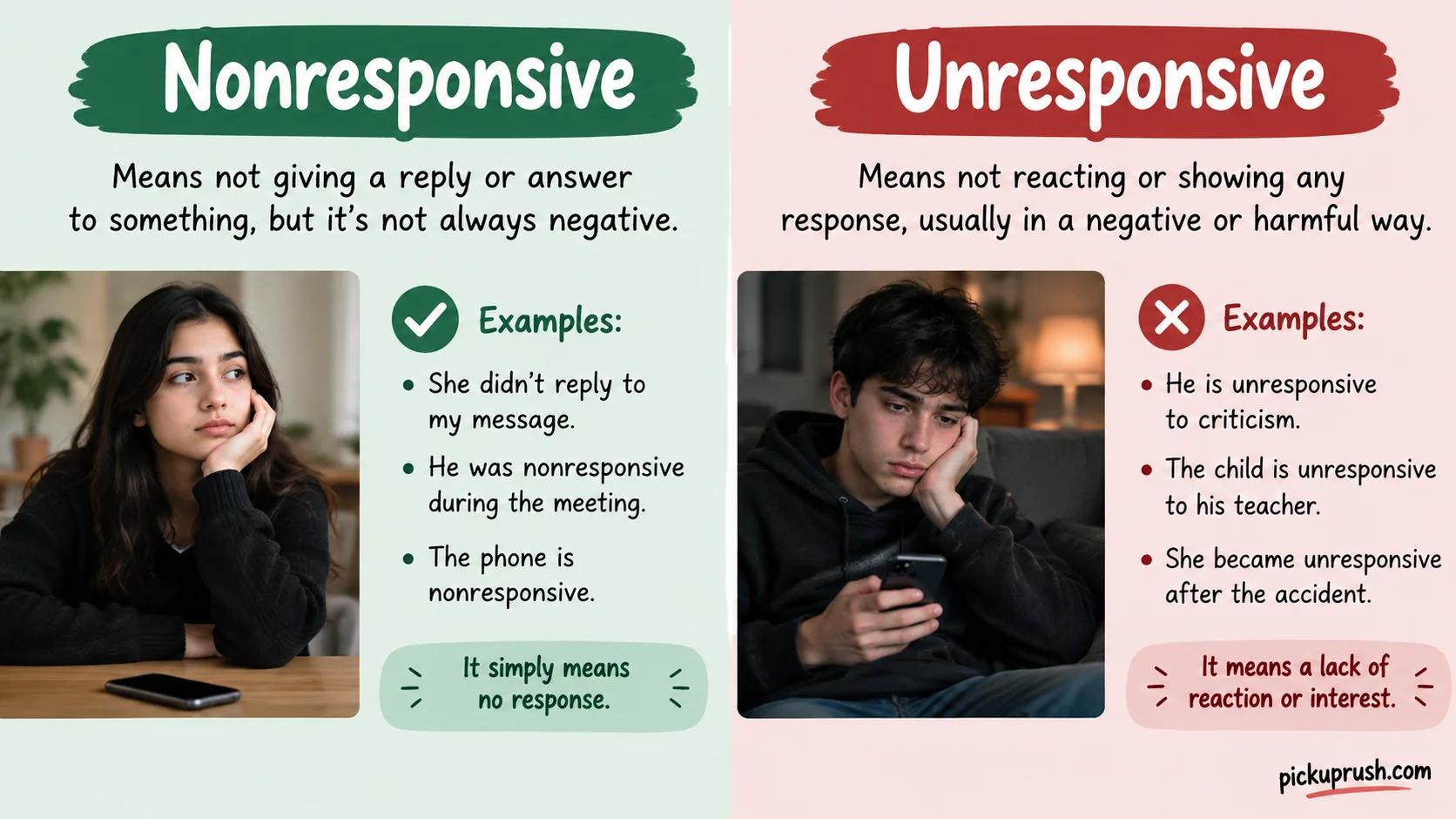

Have you ever wondered whether to call a person unresponsive or nonresponsive? The two words look almost identical, and both describe a lack of response, which makes them easy to confuse. However, Nonresponsive vs Unresponsive: Differences and Usage becomes clearer when you look at the context. In everyday English, unresponsive is generally the more natural choice when a person, device, or system fails to react.
The difference becomes more noticeable in professional writing, medical contexts, and formal situations. Unresponsive often describes someone or something that does not react, while nonresponsive can emphasize a missing, inadequate, or expected response. Understanding this subtle distinction can help you choose the right word without making your sentence sound awkward or unclear.
In this guide, we’ll look at simple definitions, real-life examples, common situations, and practical usage tips. You’ll see how both words work when describing a person, patient, device, system, email, or other situation. By understanding how each term functions, you can avoid common mistakes and make your writing more precise, natural, and professional.
What Does Nonresponsive Mean?
Nonresponsive means not responding or failing to provide the response that is expected or required. It can describe a person, statement, organization, treatment, system, or formal submission.
For example:
- The customer remained nonresponsive to repeated requests.
- The witness gave a nonresponsive answer.
- The proposal was considered nonresponsive because it failed to meet the stated requirements.
- The condition was nonresponsive to the initial treatment.
Notice the emphasis in these examples. Something expected a particular kind of response, yet that response was missing or inadequate.
The word becomes especially useful when the quality or relevance of a response matters. A person who doesn’t answer an email might be called unresponsive. A witness who answers a question but talks about an unrelated subject may be described as giving a nonresponsive answer.
Nonresponsive in Formal and Specialized Contexts
Nonresponsive appears frequently in professional and technical language because it can describe a failure to satisfy a specific requirement.
In legal settings, for example, an objection may arise when an answer doesn’t address the question asked. In procurement, a proposal may be described as nonresponsive when it doesn’t satisfy mandatory specifications.
Consider this example:
A company submits a proposal for a project but leaves out a required certification.
Calling the proposal nonresponsive can communicate more than simply saying the company didn’t respond. The company submitted something. The problem is that the submission didn’t satisfy the stated requirements.
This distinction matters in formal writing because “no response” and “inadequate response” aren’t necessarily the same thing.
What Does Unresponsive Mean?
Unresponsive generally means not responding, reacting, or answering.
It’s common in everyday English and works across a wide range of situations:
- The customer became unresponsive after several emails.
- My laptop is unresponsive.
- The patient was unresponsive.
- The child was unresponsive to the loud noise.
- The company remained unresponsive to requests for clarification.
The word can describe both communication and physical reaction. That’s one reason it has such broad usage.
When someone doesn’t answer your messages, they’re unresponsive. When a computer doesn’t react when you click an icon, it’s also unresponsive. In a medical context, however, the word can have a much more specific meaning.
Unresponsive in Medical Contexts
In medical language, unresponsive can describe a person who doesn’t react appropriately to external stimuli or attempts at interaction.
However, unresponsive doesn’t automatically mean unconscious in every use.
For example, someone might be described as unresponsive because they don’t answer questions or react normally. The precise medical meaning depends on the person’s condition and the circumstances.
That’s why context is important:
- Everyday: He was unresponsive to my messages.
- Technical: The touchscreen became unresponsive.
- Medical: The patient was unresponsive.
The same adjective appears in all three sentences, but the expected response changes dramatically.
Nonresponsive vs Unresponsive: The Key Difference
The central distinction is one of emphasis rather than a strict grammatical rule.
| Feature | Nonresponsive | Unresponsive |
| Basic meaning | Failing to provide an expected or required response | Failing to respond or react |
| Common emphasis | Missing, inadequate, irrelevant, or insufficient response | Lack of reaction or reply |
| Everyday conversation | Common, but sometimes less natural | Very common |
| Formal writing | Especially useful | Also appropriate |
| Legal/procedural contexts | Frequently useful | Less specific in some contexts |
| Medical contexts | Used in specific contexts | Very common |
| Technology | Can be used | Very common |
| Formal requirements | Particularly useful | Less precise |
| Describing people | Yes | Yes |
| Describing answers | Yes | Yes |
| Describing devices | Yes | Yes |
A useful way to remember the difference is this:
Nonresponsive often focuses on the response itself. Unresponsive often focuses on the failure to respond.
That distinction isn’t absolute. Native speakers use both words across overlapping contexts.
Nonresponsive vs Unresponsive: Are They Synonyms?
Yes, nonresponsive and unresponsive are closely related synonyms, but synonyms don’t always work equally well in every sentence.
Compare these examples:
The client was unresponsive to our emails.
This naturally emphasizes the client’s failure to reply.
Now consider:
The answer was nonresponsive to the question.
Here, the issue isn’t necessarily that the speaker gave no answer. The speaker may have answered at length. The problem is that the answer didn’t address the question.
That’s an important difference.
Imagine asking:
“What time does the store close?”
Someone replies:
“The store has been open since 1998.”
They responded verbally. Yet their answer was nonresponsive because it didn’t address what you asked.
This is where the distinction becomes especially useful.
When to Use Nonresponsive
Use Nonresponsive for a Missing or Inadequate Answer
Nonresponsive works well when a response is expected to address a particular issue.
Common examples include:
- A question that receives an irrelevant answer
- A request that isn’t properly addressed
- A complaint that receives no meaningful response
- A formal inquiry that isn’t answered appropriately
- A response that fails to satisfy the purpose of the question
For example:
The witness’s answer was nonresponsive to the attorney’s question.
The sentence doesn’t necessarily mean the witness said nothing. It means the answer didn’t address the question appropriately.
That’s a more precise meaning than simply saying the witness was unresponsive.
Use Nonresponsive for Requirements and Formal Decisions
One of the most important specialized uses of nonresponsive appears in formal processes.
A submission may be nonresponsive when it fails to meet a stated requirement.
Examples include:
- Nonresponsive bid
- Nonresponsive proposal
- Nonresponsive application
- Nonresponsive submission
- Nonresponsive offer
- Nonresponsive answer
For example:
The procurement committee rejected the bid because it was nonresponsive to a mandatory specification.
Here, nonresponsive doesn’t necessarily mean the bidder ignored the request. The bidder submitted a bid. The issue is that the bid didn’t conform to the requirements.
This is a valuable distinction in professional writing.
Use Nonresponsive for Treatment or Stimuli
The adjective can also describe something that doesn’t respond to a treatment or stimulus.
For example:
The condition was nonresponsive to the initial treatment.
In this context, the focus isn’t on communication. Instead, the treatment produced no sufficient response.
You may also encounter language such as:
- Nonresponsive to therapy
- Nonresponsive to treatment
- Nonresponsive to medication
- Nonresponsive to stimulation
The precise meaning depends on the field and the surrounding context.
When to Use Unresponsive
Use Unresponsive for People Who Don’t React or Reply
For ordinary communication, unresponsive is often the most natural choice.
You might say:
- Why has she been unresponsive to my texts?
- The customer became unresponsive after receiving the estimate.
- I’ve called twice but he’s still unresponsive.
- The support team was unresponsive to the complaint.
The word fits naturally when you focus on someone’s lack of communication or reaction.
In casual speech, you can often replace it with the simpler phrase “hasn’t responded.”
For example:
She hasn’t responded to my message.
This sounds more neutral than:
She has been unresponsive to my message.
The second version can suggest a pattern or a degree of difficulty in getting a response.
Use Unresponsive for Devices and Technology
Unresponsive is extremely common when describing technology that doesn’t react to commands.
For example:
- My computer is unresponsive.
- The app became unresponsive.
- The touchscreen is unresponsive.
- The website became unresponsive.
- The phone stopped responding.
In these sentences, the meaning is straightforward: you perform an action and the device doesn’t react as expected.
Although nonresponsive can also describe technology, unresponsive tends to sound especially natural in everyday technical troubleshooting.
Use Unresponsive for Medical Situations
Medical writing commonly uses unresponsive when describing a person who doesn’t respond normally to external interaction or stimuli.
For example:
Emergency personnel found the person unresponsive.
This usage differs from saying:
The person was unresponsive to my email.
The adjective stays the same. The context changes the meaning.
In medical contexts, avoid assuming that unresponsive = unconscious. Medical professionals assess responsiveness using specific observations and clinical procedures. The adjective alone doesn’t provide a complete diagnosis.
Nonresponsive vs Unresponsive in Different Contexts
Context can make the preferred word much clearer.
| Situation | More natural wording | Example |
| Ignoring emails | Unresponsive | The client has been unresponsive to our emails. |
| Answer doesn’t address a question | Nonresponsive | His answer was nonresponsive to the question. |
| Frozen computer | Unresponsive | My computer became unresponsive. |
| Formal bid fails requirements | Nonresponsive | The bid was deemed nonresponsive. |
| Medical situation | Unresponsive | The patient was unresponsive. |
| Treatment doesn’t produce the expected effect | Nonresponsive | The condition was nonresponsive to treatment. |
| Customer ignores complaints | Unresponsive | The company was unresponsive to customer complaints. |
| Formal answer fails to address an issue | Nonresponsive | The response was nonresponsive to the request. |
This table isn’t a collection of rigid grammar laws. Both words can work in several of these situations. The goal is to show where each word tends to communicate the intended idea more precisely.
Nonresponsive vs Unresponsive in Everyday English
In everyday conversation, unresponsive usually feels more natural when talking about someone’s behavior.
Consider:
I’ve texted him three times, but he’s been unresponsive.
That sounds normal and conversational.
By contrast:
I’ve texted him three times, but he’s been nonresponsive.
This is grammatically understandable, but it can sound more formal or deliberate.
There’s an easy alternative when you simply mean that someone hasn’t replied:
I’ve texted him three times, but he hasn’t responded.
That phrasing is often the clearest choice.
A Simple Everyday Comparison
Unresponsive:
My friend has been unresponsive all morning.
Focus: the person isn’t replying or reacting.
Nonresponsive:
His answer was nonresponsive to my question.
Focus: the answer didn’t address what was asked.
That small shift can make your writing more accurate.
Nonresponsive vs Unresponsive in Professional Writing
Professional writing often demands more precision because a word can describe a specific procedural problem.
Nonresponsive can be useful when the writer needs to show that something failed to satisfy an expected standard.
For example:
The submitted proposal was nonresponsive to the mandatory technical requirements.
This is more specific than:
The submitted proposal was unresponsive.
The first sentence tells the reader that the proposal failed to address or satisfy requirements. The second could suggest a failure to communicate rather than a failure to comply.
However, don’t assume professional writing always requires nonresponsive. You can still write:
The vendor was unresponsive to repeated requests for clarification.
Here, unresponsive is completely natural because the subject is the vendor’s communication behavior.
Common Mistakes With Nonresponsive and Unresponsive
Thinking One Word Is Incorrect
The most common mistake is assuming that only one form is legitimate.
Both nonresponsive and unresponsive are established English words. The question is usually which one fits the context better.
Treating Them as Perfect Substitutes
The words overlap, but they don’t always carry the same emphasis.
Compare:
- The employee was unresponsive to the manager’s emails.
- The employee’s answer was nonresponsive to the manager’s question.
The first describes a failure to respond. The second describes an answer that failed to address the question.
Assuming Unresponsive Always Means Unconscious
This interpretation is too narrow.
Someone can be unresponsive to:
- A phone call
- An email
- A question
- A request
- A sound
- A stimulus
The medical meaning is only one part of the word’s broader usage.
Assuming Nonresponsive Always Sounds More Professional
Nonresponsive often appears in formal language. That doesn’t make unresponsive informal or unsuitable for professional writing.
For example:
The supplier remained unresponsive despite four written requests.
That’s perfectly appropriate in a business report.
Using a Rigid Rule
Avoid rules such as:
- “Nonresponsive is only used for formal writing.”
- “Unresponsive is only used for people.”
- “Nonresponsive means someone is unwilling to cooperate.”
- “Unresponsive always means unconscious.”
English doesn’t work that neatly.
Context determines meaning.
Nonresponsive vs Unresponsive Example Sentences
Nonresponsive Examples
Here are examples that show the range of nonresponsive:
- The witness gave a nonresponsive answer to the question.
- The bid was declared nonresponsive because it omitted a required document.
- The company provided a nonresponsive reply to the complaint.
- The proposal was nonresponsive to the project’s technical requirements.
- The treatment proved nonresponsive to the condition.
- The applicant submitted a nonresponsive form.
- The response was nonresponsive to the specific issue raised.
- The committee rejected the nonresponsive submission.
- His explanation was nonresponsive to the central question.
- The vendor’s statement remained nonresponsive to the requested clarification.
Unresponsive Examples
These examples highlight common uses of unresponsive:
- The customer became unresponsive after receiving the invoice.
- My laptop suddenly became unresponsive.
- The app is completely unresponsive.
- The client has been unresponsive to several emails.
- The touchscreen became unresponsive after the update.
- The patient was described as unresponsive.
- The company remained unresponsive to repeated inquiries.
- The website became unresponsive during the attempted checkout.
- He was unresponsive to repeated requests for an answer.
- The device remained unresponsive after several attempts to restart it.
Nonresponsive vs Unresponsive: Side-by-Side Examples
Sometimes both adjectives are possible. The difference becomes clearer when you examine the emphasis.
| Sentence | What it emphasizes |
| The customer was unresponsive to our emails. | The customer didn’t reply. |
| The customer’s reply was nonresponsive to our request. | The reply didn’t address the request. |
| The computer became unresponsive. | The computer stopped reacting. |
| The system was nonresponsive to the command. | The expected response to the command was absent. |
| The patient was unresponsive. | The patient wasn’t responding normally. |
| The treatment was nonresponsive to the condition. | The condition didn’t respond adequately to treatment. |
This illustrates an important principle: look at the relationship between the subject and the expected response.
A Quick Rule for Remembering Nonresponsive vs Unresponsive
A useful memory aid is:
Nonresponsive = the response is missing, inadequate, irrelevant, or doesn’t meet the expected requirement.
Unresponsive = the subject isn’t responding or reacting.
It’s only a guideline. English has plenty of overlap between these words.
When you’re unsure, ask yourself:
“Am I describing a failure to react, or am I judging whether the response actually addressed what was expected?”
If you’re describing a person who doesn’t answer your messages, unresponsive is usually natural.
If you’re describing an answer that doesn’t address a question, nonresponsive is often more precise.
Which One Should You Use?
Use this quick decision guide:
| If you mean… | Consider… |
| Someone doesn’t answer messages | Unresponsive |
| A device doesn’t react | Unresponsive |
| A patient doesn’t respond normally | Unresponsive |
| An answer doesn’t address a question | Nonresponsive |
| A proposal fails mandatory requirements | Nonresponsive |
| A treatment produces insufficient response | Nonresponsive |
| A business doesn’t reply to requests | Unresponsive |
| A formal submission fails stated criteria | Nonresponsive |
There’s also nothing wrong with choosing a simpler construction when it communicates the idea better.
Instead of:
The client was unresponsive to the message.
You can write:
The client didn’t respond to the message.
Instead of:
The answer was nonresponsive to the question.
You can write:
The answer didn’t address the question.
Good writing isn’t about choosing the more sophisticated word. It’s about choosing the clearest accurate expression.
Case Study: Why Context Changes the Word
Imagine a company asks a supplier:
“Can you deliver 500 units by October 15?”
The supplier sends back:
“We’ve supplied this product for more than ten years.”
The supplier technically responded. Yet the response doesn’t answer the delivery question.
In this situation, calling the response nonresponsive makes sense because the response fails to address the requested information.
Now imagine the supplier sends nothing after several emails.
You might describe the supplier as unresponsive.
The difference is subtle but useful:
- No reply: The supplier is unresponsive.
- Irrelevant reply: The supplier’s answer is nonresponsive.
That distinction explains why the two words can overlap while still serving different purposes.
Read More: Accross vs Across: Which Is the Correct Spelling?
Facts About the Words
A few linguistic facts help put the distinction into perspective:
- Both words function as adjectives.
- Both describe some form of failure to respond.
- Unresponsive has broad everyday, technical, and medical uses.
- Nonresponsive has strong formal and specialized uses.
- Neither word is automatically “more correct” than the other.
- Context determines which word sounds more precise.
- Nonresponsive can describe a response that exists but fails to answer the relevant question.
- Unresponsive can describe something that simply fails to react.
- Neither word should automatically be interpreted as meaning unconscious.
Conclusion:
Nonresponsive and unresponsive are closely related words, but they are not always interchangeable. Nonresponsive generally describes someone or something that does not respond or fails to provide a response, often in a communication, technical, or administrative context. For example, you might say, “The customer has been nonresponsive to several emails.”
Unresponsive usually suggests a stronger lack of reaction or response. It can describe a person who does not react to communication or surroundings, as well as a device, system, or application that has stopped reacting to commands. For example, “The computer became unresponsive after the update.”
The easiest way to remember the difference is that nonresponsive often means “not responding,” while unresponsive can emphasize a complete or noticeable failure to respond. Both are correct English words, and your choice should depend on the context and the degree of response you want to describe.
FAQs:
1. Is “nonresponsive” a correct word?
Yes. Nonresponsive is a standard English word. It is commonly used to describe a person, organization, system, or device that does not respond to communication or requests.
2. Is “unresponsive” a correct word?
Yes. Unresponsive is also a correct and widely used English word. It can describe someone who does not react or a device or system that fails to respond to commands.
3. What is the main difference between nonresponsive and unresponsive?
The main difference is emphasis and context. Nonresponsive often describes a failure or refusal to respond, while unresponsive can suggest that something or someone is not reacting at all or has stopped responding.
4. Can nonresponsive and unresponsive be used interchangeably?
Sometimes, yes. In contexts such as emails, customer communication, or technical problems, either word may work depending on the sentence. However, they can carry slightly different shades of meaning, so choosing the word that best fits the situation is important.
5. Which should I use: nonresponsive or unresponsive?
Use nonresponsive when you want to emphasize that a response has not been provided. Use unresponsive when you want to emphasize a lack of reaction or responsiveness. For example, “The client is nonresponsive to emails” focuses on communication, while “The computer is unresponsive” focuses on a system that isn’t reacting.




1 thought on “Nonresponsive vs Unresponsive: Differences and Usage”