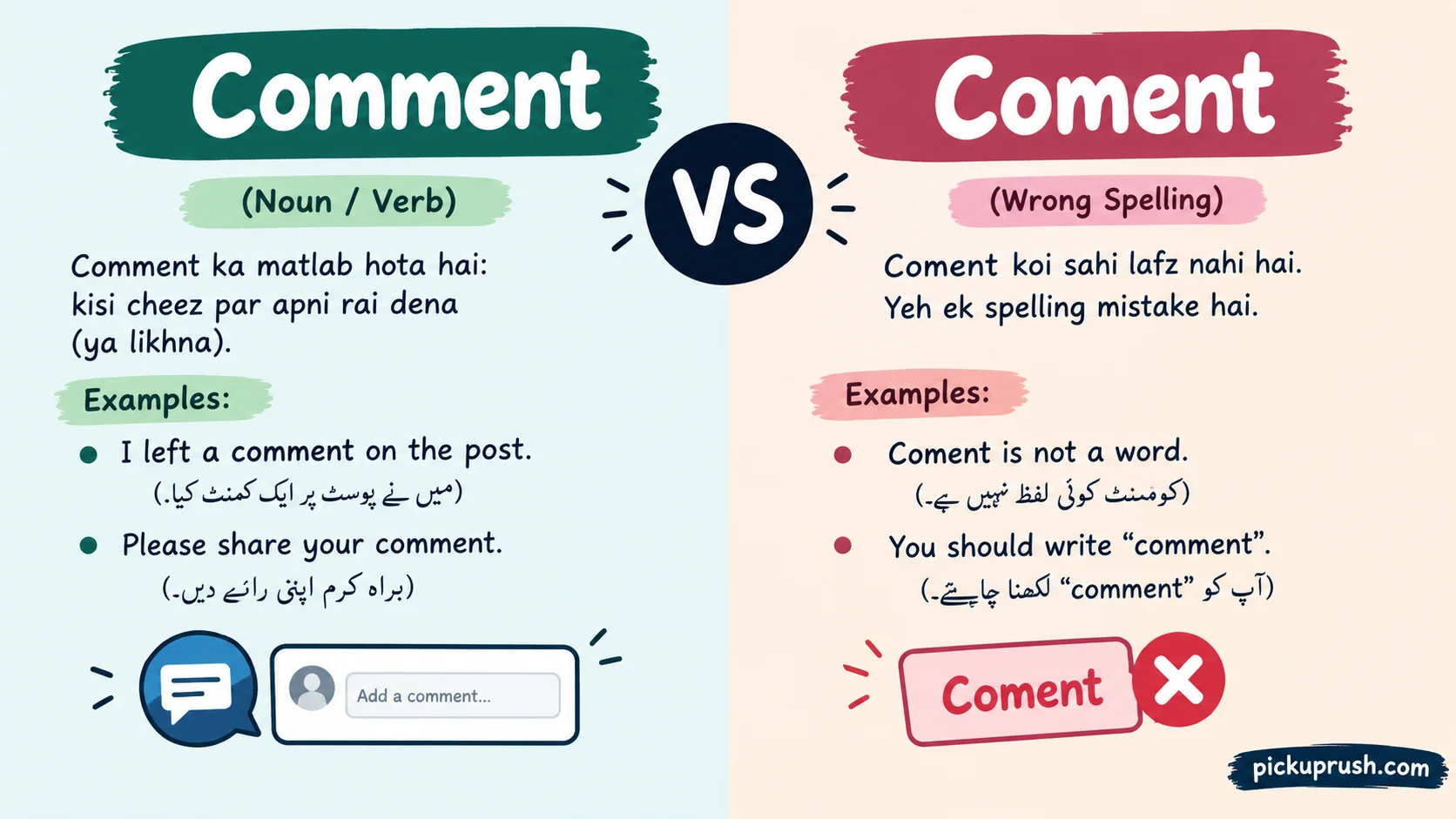

Comment vs Coment: Correct Spelling and Usage is a common spelling question because both forms look almost the same. The main difference is just one letter, but that small detail matters when you want to write correct English. Comment is the standard spelling, while Coment is generally considered a misspelling.
You will often see the word comment in everyday conversations, social media posts, blogs, emails, websites, and professional communication. It can refer to a spoken or written remark, an opinion, or an observation. Using the correct spelling helps make your writing clearer and more professional, especially when you are sharing feedback or responding to someone.
In this guide, you’ll learn the difference between comment and Coment, understand their meanings, and see how comment works in different situations. We’ll also look at common spelling mistakes, useful examples, and the correct forms such as comments, commented, and commenting, so you can use the word confidently in your writing.
Comment vs Coment: Which Spelling Is Correct?
The correct spelling is comment.
The spelling coment is not the standard form of the English word. If you’re writing an email, school assignment, article, report, social media post, or other English text, use comment.
| Spelling | Correct in standard English? | Meaning |
| Comment | Yes | A remark, observation, opinion, or response; also the act of making such a remark |
| Coment | No | Generally a misspelling of comment |
The important detail is the double m:
C-O-M-M-E-N-T
Not:
C-O-M-E-N-T
For example:
- Correct: Please leave a comment below.
- Incorrect: Please leave a coment below.
The same spelling applies whether you’re using comment as a noun or a verb.
What Does “Comment” Mean?
Comment has several closely related uses. It can function as both a noun and a verb, which makes it one of those everyday English words worth learning well.
Comment as a Noun
As a noun, a comment is something someone says or writes to express an opinion, observation, reaction, or piece of information.
For example:
- Her comment made everyone laugh.
- I read several useful comments on the article.
- The teacher wrote a positive comment on my assignment.
- His comment about the project raised an important question.
A comment doesn’t have to be negative. It can be positive, negative, neutral, humorous, informative, or critical.
For example, these are all comments:
- “That explanation was really helpful.”
- “The instructions could be clearer.”
- “I noticed a mistake in the second paragraph.”
- “That was an interesting point.”
The meaning depends on the context.
Comment as a Verb
As a verb, comment means to say or write something about a subject, usually to express an observation, opinion, or reaction.
For example:
- She commented on the new policy.
- The teacher commented on my essay.
- He commented that the meeting had been productive.
- Several readers commented on the article.
One particularly common structure is comment on.
comment on + subject
Examples:
- The manager commented on the team’s progress.
- She refused to comment on the rumors.
- The author commented on the importance of clear communication.
This construction is especially useful in formal and professional English.
Why Is “Coment” Incorrect?
The main problem with coment is simple: it leaves out one of the two m’s required in the standard spelling.
English spelling doesn’t always mirror pronunciation. When you hear comment, you may not consciously notice that the written word contains two consecutive m’s. As a result, someone writing quickly might spell it coment.
Think of it as a spelling trap rather than a difference in meaning.
The correct pattern is:
com + ment → comment
The double m belongs to the established spelling of the word.
A Simple Memory Trick
Try remembering this:
A comment has two m’s because you need to make room for both letters.
Or simply break the word visually:
COM + MENT = COMMENT
When proofreading, look at the middle:
- ❌ coment
- ✅ comment
That tiny visual check can prevent the mistake.
Comment vs Coment: Side-by-Side Comparison
Here’s the difference at a glance:
| Feature | Comment | Coment |
| Standard English spelling | Yes | No |
| Used as a noun | Yes | No |
| Used as a verb | Yes | No |
| Used in American English | Yes | No |
| Used in professional writing | Yes | No |
| Used for online responses | Yes | No |
| Contains double “m” | Yes | No |
| Recommended spelling | Yes | No |
If you’re deciding between the two, there isn’t a separate meaning to choose between. In standard English, comment is the form you want.
How to Spell “Comment” Correctly
The word contains seven letters:
C-O-M-M-E-N-T
A useful way to remember it is to divide it into two parts:
COM + MENT
The first part ends in m, while the second part begins with m. Put them together and you get:
COM + MENT = COMMENT
Common Spelling Mistake
The most common error is removing one m:
Coment ❌
Comment ✅
Other errors can happen when people type quickly, but the central issue remains the same: don’t forget the second m.
Quick Spelling Test
If you aren’t sure which form looks right, ask yourself:
Does the word contain mm in the middle?
If you’re talking about a remark, response, observation, or the act of expressing one, the answer is yes.
Comment: Pronunciation and Spelling
The spelling can cause confusion because pronunciation doesn’t always reveal every letter in an English word.
Comment is commonly pronounced approximately as:
KAH-ment in American English.
The two m’s occur together in the spelling, but you don’t pronounce them as two separate syllables.
That’s an important lesson about English spelling. Written English preserves established spellings that aren’t always perfectly predictable from pronunciation.
Similar spelling patterns occur throughout English. A reader can’t always reconstruct the exact spelling of a word simply by hearing it.
So if you hear someone say comment, don’t use the sound alone to decide whether the written word contains one or two m’s.
Common Uses of “Comment”
The word comment appears in everyday conversation as well as specialized fields.
Social Media and Online Discussions
On social platforms, a comment usually means a written response to a post, video, photograph, or another piece of content.
Examples:
- She left a comment on the video.
- The post received hundreds of comments.
- I replied to his comment.
- Please keep your comments respectful.
In this context, comment often means a short public response rather than a detailed opinion.
Articles and Blogs
Many websites allow readers to leave comments beneath an article.
For example:
Readers can leave a comment after the article.
A blog comment might:
- Ask a question
- Add information
- Correct an error
- Share an experience
- Agree or disagree with an argument
- Start a discussion
The word still has the same basic meaning: a response or remark connected to a particular subject.
Professional Communication
You’ll also see comment in workplace and academic settings.
For example:
- “Do you have any comments on this proposal?”
- “The supervisor commented on the revised report.”
- “Please add your comments to the document.”
- “The reviewer made several useful comments.”
In professional writing, comment often refers to an observation or feedback about a document, decision, proposal, or piece of work.
Code and Technical Writing
Comment has a specialized meaning in programming.
A programming comment is text that developers add to source code to explain something for human readers. Depending on the programming language, the computer generally doesn’t execute the comment as ordinary program instructions.
For example, a developer might add a comment explaining why a particular function exists or what a section of code does.
This technical meaning is related to the everyday meaning because both involve adding explanatory information.
Comment in Different Grammatical Forms
One useful way to master the word is to learn its common grammatical forms.
| Form | Function | Example |
| comment | Noun / base verb | I have a comment. / Please comment on this. |
| comments | Plural noun / third-person verb | Her comments were useful. / He comments frequently. |
| commented | Past tense / past participle | She commented on the report. |
| commenting | Present participle / gerund | He is commenting on the proposal. |
Notice something important: the double m stays throughout these forms.
- comment
- comments
- commented
- commenting
It doesn’t disappear when the word changes grammatical form.
Comment vs Similar Words
Understanding nearby words can make your vocabulary more precise.
Comment vs Opinion
An opinion is a belief or judgment about something.
A comment is broader. It can express an opinion, but it can also simply provide an observation or response.
For example:
“The report contains three sections.”
That’s an observation or comment.
“The report is too long.”
That’s a comment that also expresses an opinion.
So, while opinions can appear in comments, the two words aren’t exact synonyms.
Comment vs Remark
Remark and comment overlap considerably.
A remark often refers to something someone says or writes, especially a particular statement.
A comment can describe a similar statement but is also extremely common for online responses, professional feedback, and formal observations.
For example:
- She made an interesting remark during the discussion.
- She left an interesting comment below the article.
Both can work, although the context may make one more natural than the other.
Comment vs Feedback
Feedback usually refers to information given about someone’s work, performance, product, or idea.
A comment can be much broader.
For example:
“The introduction needs more evidence.”
That’s a comment.
If a teacher provides several such observations to help improve an essay, those observations collectively may constitute feedback.
In short:
Comment = a remark or observation
Feedback = information intended to help evaluate or improve something
Comment vs Criticism
A comment isn’t automatically criticism.
Consider these examples:
- “Your presentation was clear.” — positive comment
- “The presentation starts at 10 a.m.” — neutral comment
- “The presentation needs more examples.” — critical comment
The word comment itself doesn’t tell you whether the statement is favorable or unfavorable.
Common Spelling Mistakes Related to “Comment”
Because comment is frequently typed online, the missing second m can appear in informal writing.
Here’s the correction:
| Incorrect | Correct |
| coment | comment |
| coments | comments |
| comented | commented |
| comenting | commenting |
The same spelling principle applies to related forms.
If you know comment contains two m’s, it’s easier to remember commented and commenting as well.
Why Fast Typing Causes Errors
When you type quickly, your brain often focuses on the meaning of a word rather than each individual letter. Familiar words can therefore produce typos even when you know the correct spelling.
That’s why proofreading matters, especially in:
- School assignments
- Business emails
- Reports
- Blog posts
- Resumes
- Website copy
- Public announcements
A spell checker can catch coment in many applications. Still, understanding the spelling yourself is more reliable because automated tools don’t replace careful proofreading.
Examples of Correct “Comment” Usage
Everyday Examples
- I wanted to make a comment about the new schedule.
- Her comment was surprisingly funny.
- He made a helpful comment during the conversation.
- Nobody responded to my comment.
- She commented on the unusual weather.
Formal Examples
- The committee invited members to comment on the proposal.
- The reviewer included several detailed comments.
- Please provide your comments before Friday.
- The professor commented on the quality of the research.
- The report includes comments from several specialists.
Online Examples
- I left a comment beneath the article.
- The video has thousands of comments.
- She replied to my comment.
- Readers can comment on individual posts.
- The website allows users to edit their comments.
Positive, Negative, and Neutral Examples
Positive:
“Your explanation was very clear.”
Negative or critical:
“The instructions need more detail.”
Neutral:
“The meeting begins at nine.”
All three can function as comments depending on the context.
“Comment” in Common Expressions
English speakers frequently use comment in set phrases.
Make a Comment
Make a comment means to say or write something about a subject.
She made a comment about the new policy.
Leave a Comment
Leave a comment is especially common online.
Readers can leave a comment below the article.
Post a Comment
Post a comment usually refers to publishing a response online.
He posted a comment after watching the video.
Add a Comment
Add a comment means to contribute an observation or note.
You can add a comment to the shared document.
Comment on Something
Comment on means to express an observation, opinion, or response concerning something.
The journalist commented on the latest developments.
This is one of the most important grammatical patterns to remember.
No Comment
No comment is a common expression used when someone chooses not to provide an answer or statement about a particular subject.
“Do you have anything to say about the matter?”
“No comment.”
The phrase appears frequently in journalism and public statements.
Comment vs Coment in American English
In American English, the standard spelling is comment.
There isn’t a standard American-English spelling distinction in which comment means one thing and coment means another. The two forms aren’t alternatives with different meanings.
Therefore, whether you’re writing an academic paper, business message, website article, social media post, or everyday text, use:
comment
The spelling coment should generally be treated as an error.
Read More: Nonresponsive vs Unresponsive: Differences and Usage
A Quick Case Study: Choosing the Correct Spelling
Imagine you’re editing a company blog before publication. The draft contains this sentence:
“Readers can leave a coment below and share their experience.”
At first glance, the mistake is easy to miss because coment closely resembles the correct word.
During proofreading, the writer checks the spelling and changes it to:
“Readers can leave a comment below and share their experience.”
Now the sentence uses the standard spelling.
This tiny correction matters because spelling errors can distract readers from otherwise useful content. In professional writing, small details contribute to the overall clarity and credibility of a page.
Comment vs Coment: Quick Rules to Remember
Keep these rules handy:
- Comment is the correct standard English spelling.
- Coment is generally a misspelling.
- Comment contains two m’s.
- The word works as both a noun and a verb.
- Use comment on when describing what someone responds to.
- A comment can be positive, negative, or neutral.
- Comment is commonly used in social media, blogs, workplaces, classrooms, and programming.
- Related forms such as comments, commented, and commenting also retain the double m.
The One-Second Spelling Check
When you’re unsure, remember:
COM + MENT = COMMENT
That double m is the key.
Conclusion:
The difference between Comment vs Coment: Correct Spelling and Usage is simple: comment is the correct spelling in standard English, while Coment is generally a misspelling. The word comment can describe a spoken or written remark, opinion, observation, or response.
Remembering the double m in comment can help you avoid this common spelling mistake. Whether you’re writing a social media post, email, blog, academic paper, or professional message, using comment keeps your writing clear, accurate, and polished.
FAQs:
Is Comment the correct spelling?
Yes. Comment is the correct standard English spelling. Coment is generally considered a misspelling.
What does comment mean?
Comment means a spoken or written remark, opinion, observation, or response about something.
Is Coment a word?
Coment is not the standard English spelling of the word comment. In most everyday and professional writing, you should use comment.
Why is comment spelled with two m’s?
The standard spelling is comment, with two m letters. Remembering the double m can help prevent the common misspelling Coment.
What are the plural and related forms of comment?
The common forms include comments, commented, and commenting. These forms all keep the double m in the base word.



1 thought on “Comment vs Coment: Correct Spelling and Usage”