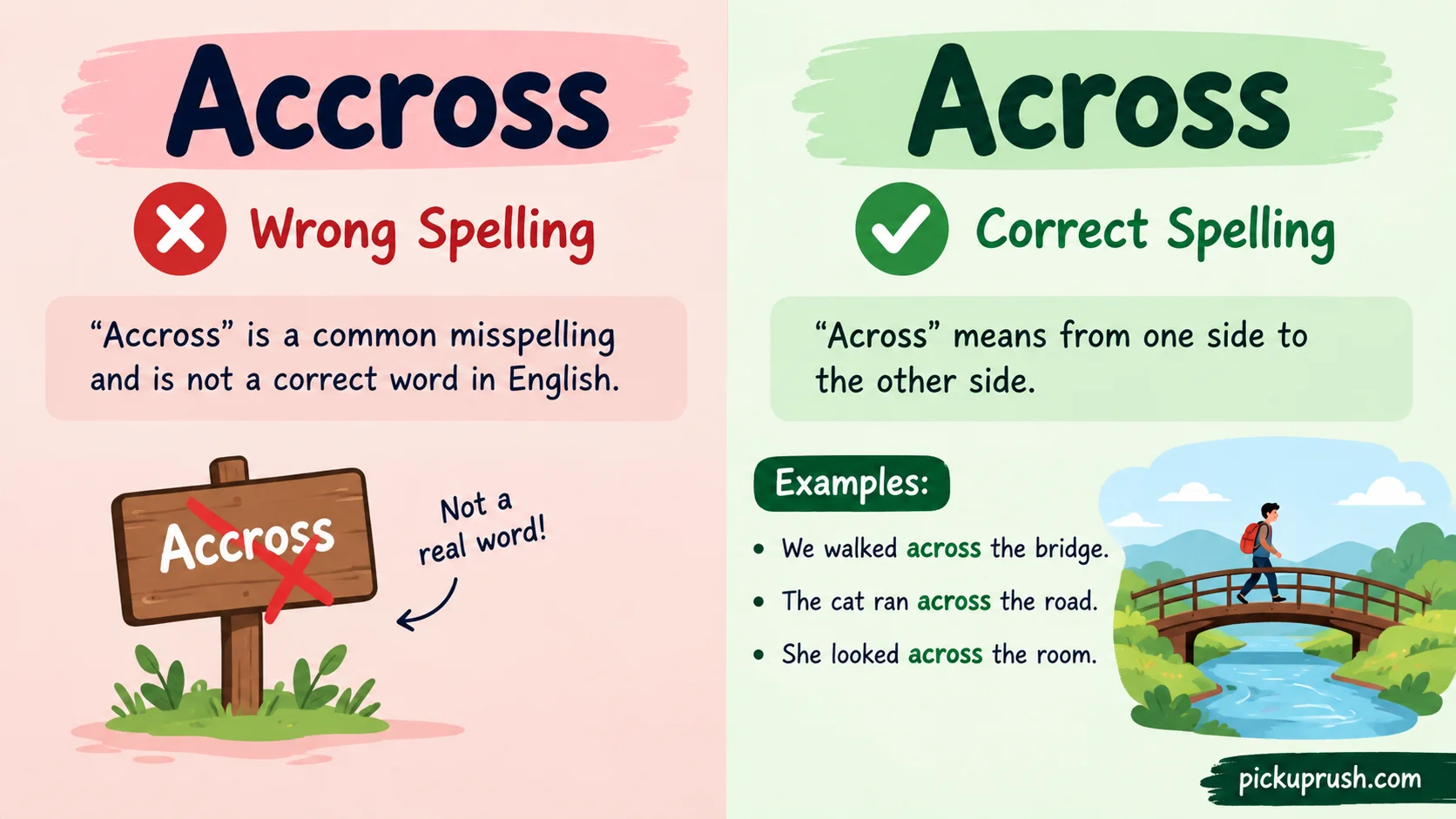

Have you ever stopped while writing and wondered whether accross or across is correct? Accross vs Across: Which Is the Correct Spelling? is a common spelling question because the two forms look almost identical. The correct spelling is across, with only one c. Accross is an incorrect spelling and should be avoided in formal, academic, professional, and everyday writing.
The word across is commonly used to describe movement or position from one side to another. For example, you might walk across the street, swim across the river, or see a building across the road. It can function as both a preposition and an adverb, depending on how it is used in a sentence. Understanding its meaning and spelling makes it easier to use the word confidently.
In this guide, you’ll learn the difference between accross and across, why across is the correct spelling, and how to use it in real sentences. We’ll also look at common mistakes, helpful examples, and simple ways to remember that across is spelled with one c. By the end, you should be able to use the correct form naturally without second-guessing yourself.
Accross vs Across: The Quick Answer
The difference is simple:
| Spelling | Status | Meaning | Example |
| Across | Correct | From one side to another, on the opposite side, or throughout an area | “We walked across the bridge.” |
| Accross | Incorrect | No standard English meaning | “We walked accross the bridge.” |
Across has only one c after the initial a.
Correct: The children ran across the field.
Incorrect: The children ran accross the field.
The misspelled form accross doesn’t become correct simply because people use it frequently. In edited writing, school assignments, professional documents, and standard American English, use across.
What Does “Across” Mean?
Across has several related meanings. At its core, it describes movement or position from one side to another.
For example:
- “She walked across the street.”
- “A bridge stretches across the river.”
- “The store is across the road.”
- “The rule applies across all departments.”
The exact meaning depends on the sentence.
Across for Movement
When across describes movement, it usually means moving from one side of something to another.
Examples include:
- “We swam across the lake.”
- “He ran across the playground.”
- “They drove across the country.”
- “The cat jumped across the narrow gap.”
In each case, the word describes a path that extends from one side, point, or area to another.
Across for Location
Across can also describe where something is located in relation to something else.
For example:
“The library is across the street from the school.”
Here, the library isn’t necessarily moving. Across tells you that the library sits on the opposite side of the street.
You’ll often see this structure in everyday American English:
- across the street
- across the road
- across the river
- across the room
- across the hall
- across from the station
Across for Distribution or Coverage
The word can describe something that extends throughout a place, group, system, or category.
For example:
“The new policy applies across the entire organization.”
Here, across doesn’t mean physically moving from one side to another. Instead, it communicates broad coverage.
Other examples include:
- “The survey was conducted across several states.”
- “The program operates across multiple schools.”
- “Prices increased across the market.”
- “The change affected teams across the company.”
This broader use is especially common in business, academic, news, and professional writing.
Across in Communication
You’ll also encounter across in expressions involving communication and impressions.
Consider:
“The speaker’s main point came across clearly.”
Here, came across means that an idea, feeling, or message was successfully understood or perceived.
Another example:
“Her explanation didn’t come across as rude.”
In this sentence, come across describes the impression someone gives to others.
Why Is “Accross” Incorrect?
The problem with accross is straightforward: it contains an unnecessary second c.
The standard spelling is:
A + CROSS = ACROSS
The word cross already contains the c needed for across. Adding another one creates the misspelling accross.
English spelling can make this mistake tempting. Many familiar English words contain doubled consonants:
- accommodate
- accompany
- access
- account
- address
- collect
- occur
Because doubled consonants appear frequently in English, writers sometimes assume that across should follow the same pattern.
It doesn’t.
The correct spelling remains across.
Is “Accross” Ever a Standard Variant?
No. Accross isn’t the standard American English spelling of the word.
If you’re writing an essay, email, article, report, application, or other formal text, use across.
If you see accross online, it may simply be a typing or spelling error.
Across: Pronunciation and Grammar
Understanding pronunciation can help you recognize the word, although pronunciation alone won’t tell you whether to use one or two c’s.
In American English, across is commonly pronounced approximately like uh-CROSS, with the main stress on the second syllable.
The spelling is:
a-c-r-o-s-s
Notice the important detail: there is one c, followed by r, then o-s-s.
Is “Across” a Preposition?
Yes. Across commonly works as a preposition when it connects a noun or noun phrase to another part of the sentence.
Examples:
- “They walked across the bridge.”
- “She looked across the room.”
- “We drove across the state.”
In these examples, across introduces the noun phrase that identifies the area being crossed.
Is “Across” an Adverb?
Yes. Across can also function as an adverb.
For example:
“She walked across.”
The word still communicates movement from one side toward another, but it doesn’t introduce an object directly.
Another example is:
“The message came across clearly.”
In this expression, across forms part of the phrasal verb come across.
Across vs Accross: The Spelling Difference
The entire spelling issue comes down to one extra letter.
Across: A-C-R-O-S-S
Accross: A-C-C-R-O-S-S
The second form inserts another c before the r.
A useful visual reminder is:
A + CROSS = ACROSS
You don’t write A + CCROSS. Therefore, you don’t write accross.
Quick Spelling Check
Before submitting your writing, look for these common errors:
- ❌ accross
- ✅ across
- ❌ accross the street
- ✅ across the street
- ❌ accross the country
- ✅ across the country
- ❌ accross from
- ✅ across from
- ❌ come accross
- ✅ come across
Examples of “Across” in Sentences
Seeing the word in different contexts makes its usage much easier to understand.
Across for Movement
These sentences show movement from one side to another:
- “The runner sprinted across the finish line.”
- “We walked across the parking lot.”
- “She traveled across the country.”
- “The dog ran across the yard.”
- “They rowed across the lake.”
The common idea is crossing a space or area.
Across for Location
When across describes location, it often means on the opposite side.
- “The bank is across the street.”
- “Her office is across the hall.”
- “A café sits across the road.”
- “The hotel is across from the museum.”
- “He sat across the table from his sister.”
The word helps establish a spatial relationship.
Across for Coverage
Here, across refers to multiple locations, groups, or areas.
- “The company has offices across the country.”
- “The survey included students across several schools.”
- “The update was released across all platforms.”
- “The issue appeared across multiple departments.”
This usage is common when discussing scope or reach.
Across in Communication
The word also appears naturally in communication-related expressions:
- “Her enthusiasm really came across.”
- “The instructions didn’t come across clearly.”
- “He tried to get his point across.”
- “The humor may not come across in a written message.”
These aren’t about physically crossing something. Instead, they describe how a message, impression, or idea reaches another person.
Common Phrases With “Across”
Several everyday expressions contain across. Learning them as complete phrases can help you remember the correct spelling.
Across From
Across from means on the opposite side of something.
Examples:
- “The restaurant is across from the theater.”
- “I live across from the park.”
- “The bus stop is across from the library.”
This phrase appears constantly in everyday American conversation.
Come Across
Come across has more than one common meaning.
It can mean to find or encounter something unexpectedly:
“I came across an old photograph while cleaning.”
It can also describe the impression someone or something gives:
“She comes across as confident and friendly.”
The meaning comes from the context.
Get Across
Get across means to communicate an idea successfully.
For example:
“The teacher used an example to get the main idea across.”
The speaker wants the listener to understand a particular point.
Run Across
Run across can mean to encounter or find something, often unexpectedly.
For example:
“I ran across an interesting article while researching the topic.”
It can also have a literal meaning involving movement:
“The child ran across the playground.”
Across the Board
Across the board is an idiom meaning generally or in every category or area.
For example:
“The company introduced changes across the board.”
The phrase is especially common in business and general reporting.
Common Mistakes With “Across”
Spelling across correctly is easy once you recognize the main traps.
Adding a Second C
The most common mistake is:
accross ❌
The correct form is:
across ✅
Don’t let words such as access or accompany influence the spelling. Across doesn’t double the c.
Confusing Across With Through
These words sometimes appear in similar contexts, but they aren’t always interchangeable.
Compare:
“We walked across the field.”
This suggests movement from one side of the field toward another.
Now consider:
“We walked through the forest.”
This emphasizes movement within the forest.
The distinction becomes clearer when you picture the path. Across often focuses on crossing a space. Through emphasizes entering and passing within something.
Confusing Across With Over
Over can describe movement above something or crossing an obstacle.
Compare:
- “We walked across the bridge.”
- “The bird flew over the bridge.”
- “The athlete jumped over the fence.”
The first sentence focuses on crossing the bridge. The second emphasizes movement above it. The third describes passing above an obstacle.
Across vs Through vs Over
| Word | General idea | Example |
| Across | From one side to another or throughout an area | “She walked across the field.” |
| Through | From one part of something to another while within it | “He walked through the tunnel.” |
| Over | Above something or from one side to another over an obstacle | “The bird flew over the fence.” |
These words can overlap in certain situations. The best choice depends on the relationship you want to describe.
Why Do People Spell “Across” as “Accross”?
The misspelling accross likely feels natural to some writers because English contains many words with doubled consonants.
For example:
- access
- account
- address
- accommodate
- occur
- successful
A writer who remembers the sound but not the exact spelling might add an extra c.
Typing errors also contribute. When someone writes quickly, a repeated consonant can slip into a word without being noticed.
The important point is that frequency doesn’t make accross an accepted spelling. In standard edited English, the form remains across.
How to Remember the Correct Spelling of Across
The easiest memory trick is surprisingly simple:
A + CROSS = ACROSS
Think about the word cross itself.
You cross a street. You walk across the street.
You cross a bridge. You walk across the bridge.
You cross a field. You walk across the field.
So when you’re unsure, break the word apart mentally:
A + CROSS → ACROSS
That gives you the correct spelling without having to memorize a complicated rule.
A Simple Memory Sentence
Use this sentence:
“I cross the road, so I walk across the road.”
The connection between cross and across makes the spelling easier to recall.
Across in American English
Across is the standard spelling used in American English.
You’ll find it in many kinds of writing, including:
- school assignments
- business communication
- newspapers
- books
- academic papers
- websites
- everyday messages
- professional reports
There isn’t a standard American English spelling accross.
If you’re proofreading an article or editing a document, replace accross with across whenever the intended word is the standard preposition or adverb.
Read More: Scoup vs Scoop: Which Spelling Is Correct? Meaning, Usage & Examples
Across vs Accross in Different Types of Writing
Formal Writing
Use across in formal documents:
“The policy applies across all regional offices.”
The spelling doesn’t change based on how formal the writing is.
Academic Writing
Academic writers frequently use across when discussing populations, regions, studies, or categories.
For example:
“Researchers observed similar patterns across several age groups.”
Here, across communicates that the observation extends through multiple groups.
Business Writing
Business English uses the word frequently:
- across departments
- across teams
- across markets
- across regions
- across the organization
- across multiple platforms
Example:
“The company introduced the new system across its regional offices.”
Casual Writing
You’ll also hear and see across constantly in ordinary conversation:
- “It’s right across the street.”
- “I’ll meet you across the hall.”
- “We drove across town.”
- “I came across your message earlier.”
The spelling stays the same in every context.
A Practical Editing Case Study
Imagine a student writes:
“The survey was conducted accross five schools, and the results were compared accross different age groups.”
At first glance, the sentence may look fine because accross resembles the correct word. However, both instances contain the same spelling error.
The corrected version is:
“The survey was conducted across five schools, and the results were compared across different age groups.”
The meaning hasn’t changed. Only the spelling has been corrected.
This example shows why proofreading matters. A single recurring spelling mistake can appear several times in the same document.
What to Check During Proofreading
When reviewing your writing, search specifically for:
- accross
- Accross
- ACCROSS
If you find any of these forms where you mean the standard English word, change them to across.
Quick Correction Guide
| Incorrect | Correct |
| accross | across |
| Accross the street | Across the street |
| accross the country | across the country |
| accross from the store | across from the store |
| come accross | come across |
| get accross | get across |
| run accross | run across |
The rule is consistent: use one c in across.
Conclusion:
The difference between Accross vs Across is simple: across is the correct spelling in standard English, while accross is a common spelling mistake. Across can describe movement from one side to another, position on the opposite side, or something covering an area or range.
To avoid this mistake, remember that across has only one c after the initial “a.” Using the correct spelling will make your writing clearer and more accurate in emails, schoolwork, professional communication, and everyday writing.
FAQs:
Is Across the correct spelling?
Yes, across is the correct standard English spelling. Accross is a misspelling.
Is Accross a word?
Accross is generally not accepted as the standard spelling of the English word. In normal writing, use across.
What does across mean?
Across can mean from one side to another, on the opposite side, or throughout an area or group. For example, “She walked across the street.”
Why do people spell across as accross?
People may write accross because they mistakenly add an extra c. The correct spelling contains only one c: across.
How can I remember the spelling of across?
A simple way to remember it is to focus on the spelling a-c-r-o-s-s. Think of across as having one c and two s letters.




1 thought on “Accross vs Across: Which Is the Correct Spelling?”