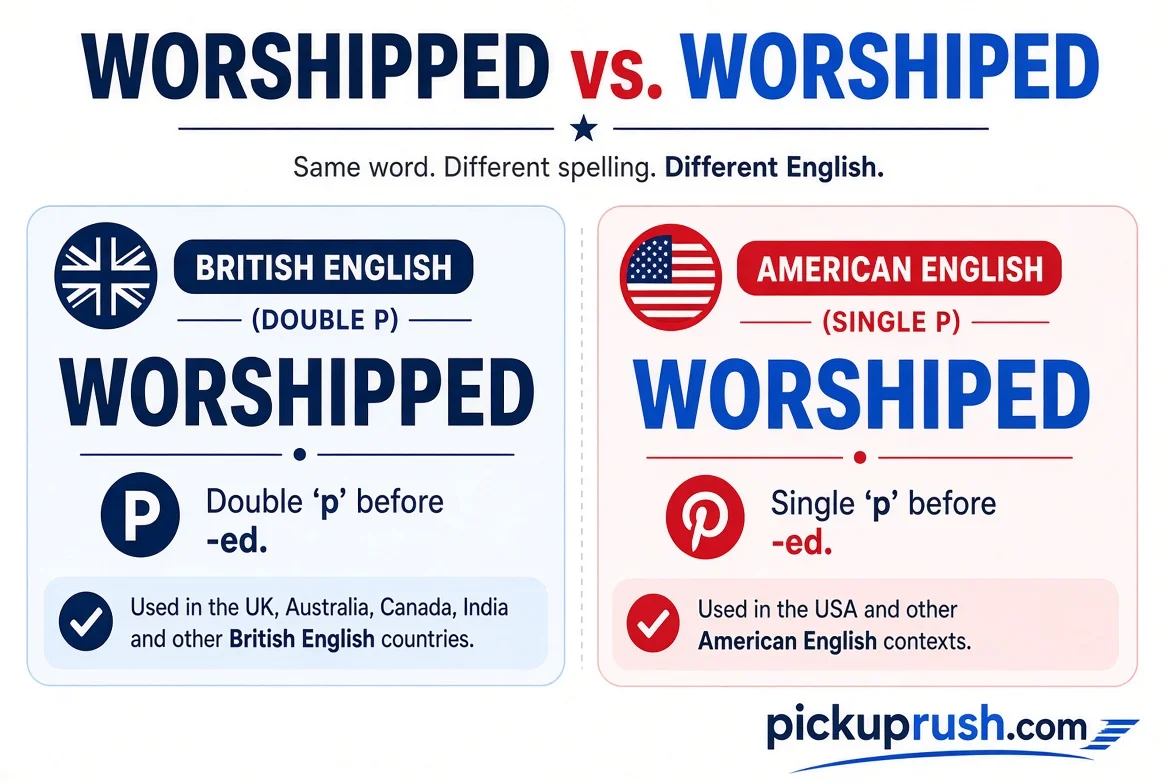

Have you ever stopped while writing because you could not decide between worshipped vs. worshiped? You are not alone. These two spellings look almost identical, but the extra p often causes confusion. The good news is that both forms are correct, and the difference mainly comes from American and British English spelling preferences.
Worshipped vs. Worshiped: Difference and Usage Explained is really about understanding when and where each spelling is commonly used. Worshipped is strongly associated with British English, while worshiped is widely used in American English. Neither spelling changes the meaning, tense, or idea behind the word worship.
Once you understand the spelling pattern, this common English question becomes much easier. Whether you are writing about faith, religious practices, history, or everyday language, knowing the preferred form for your audience can help you write with more accuracy and confidence. In this guide, we will look at the differences, usage, regional preferences, and simple examples to help you choose the right spelling.
Worshipped vs. Worshiped at a Glance
| Spelling | Typical usage | Grammatical role | Example |
| Worshipped | British English and other varieties | Past tense / past participle | They worshipped at the temple. |
| Worshiped | American English | Past tense / past participle | They worshiped at the temple. |
| Worship | All major varieties | Base verb | They worship every Sunday. |
| Worshipping | British English | Present participle | They were worshipping together. |
| Worshiping | American English | Present participle | They were worshiping together. |
Cambridge identifies worshipped as the past tense and past participle and also records worshiped as the US form. Its entry for worship likewise shows the -pp- form alongside the US -p- variant.
So, when you see the two spellings, don’t treat them as competing words. Think of them as regional spelling variants of the same verb.
What Does Worshipped Mean?
Worshipped is the past tense and past participle of worship. The verb can describe religious devotion, reverence toward a deity, or extremely strong admiration for a person or thing.
In a religious context, worship involves showing respect or devotion toward God or a god. It can involve prayer, ceremonies, rituals, or other forms of religious practice. Cambridge defines worship as showing strong respect and admiration for God or a god and also uses it for attending a religious ceremony.
For example:
- The ancient people worshipped several gods.
- The community worshipped together every Sunday.
- Thousands of people worshipped at the historic temple.
The word can also have a figurative meaning. Someone might say that fans worshipped a famous athlete when they mean those fans admired that person intensely.
For example:
The young fans worshipped the championship-winning athlete.
Here, the sentence doesn’t necessarily describe religious worship. Instead, it emphasizes extreme admiration.
Cambridge’s examples also demonstrate this broader use, including cases where people are described as worshipping another person because of deep admiration.
What Does Worshiped Mean?
Worshiped has the same meaning as worshipped. It is also the past tense and past participle of worship.
The difference is simply the spelling.
American English commonly uses the single-p form:
- The people worshiped their gods.
- The congregation worshiped together.
- Fans worshiped the famous singer.
- She worshiped her grandmother and admired her deeply.
If you’re writing in standard American English, worshiped is generally the form that fits the spelling convention you’re likely following.
However, it would be misleading to say that worshipped is always wrong in American English. Established dictionaries and American publications also use the double-p form. Merriam-Webster, for example, recognizes worshipped as a spelling variant. That means regional preference is useful guidance rather than an ironclad boundary.
Worshipped vs. Worshiped: What’s the Real Difference?
The most important point is this:
There is no difference in meaning between worshipped and worshiped.
Both forms can describe an action that happened in the past. Both can also function as a past participle.
Consider these two sentences:
- The villagers worshipped the ancient gods.
- The villagers worshiped the ancient gods.
The meaning remains the same.
The difference lies in the spelling convention.
| Feature | Worshipped | Worshiped |
| Base verb | worship | worship |
| Past tense | worshipped | worshiped |
| Past participle | worshipped | worshiped |
| Meaning | Same | Same |
| Pronunciation | Normally the same | Normally the same |
| Common regional association | British English | American English |
| Extra letter | Two p’s | One p |
This is why the choice shouldn’t be based on meaning. Instead, choose the form that matches the English variety and editorial style you’re using.
Why Are Worshipped and Worshiped Spelled Differently?
The difference comes from the way British and American English developed different spelling conventions.
British English traditionally retains doubled consonants in certain words when suffixes are added. American English often simplifies some of those spellings.
That’s why you can encounter patterns such as:
- worshipped / worshiped
- worshipping / worshiping
- worshipper / worshiper
These forms belong to the same word family, yet spelling conventions can vary by region.
It’s important not to turn this into an oversimplified rule, though. English spelling has plenty of exceptions. You can’t simply apply one doubling rule to every word and expect the result to be correct.
For worship, dictionaries provide a much safer guide than trying to create your own spelling rule.
Cambridge specifically records the spelling pattern as “-pp- or US also -p-.”
A Simple Way to Remember It
For everyday writing, this shortcut works well:
British English: worshipped
American English: worshiped
Just remember that actual usage can cross those regional lines.
Worshipped vs. Worshiped in American English
If you’re writing for a primarily American audience, worshiped is a natural choice.
For example:
- The ancient Egyptians worshiped many gods.
- The congregation worshiped together.
- The villagers worshiped at the shrine.
- The followers worshiped the deity for generations.
Using worshiped also creates consistency when the rest of your writing follows American spelling conventions.
For example, an American English article might use:
- color rather than colour
- center rather than centre
- traveled rather than travelled
- canceled rather than cancelled
- worshiped rather than worshipped
That doesn’t mean every writer must force every word into one rigid pattern. Style guides, dictionaries, publishers, and individual publications can have their own preferences.
The key is consistency.
Worshipped vs. Worshiped in British English
In British English, worshipped is the familiar traditional form.
For example:
- The ancient community worshipped several gods.
- The villagers worshipped at the shrine.
- Thousands of people worshipped together.
- The followers worshipped the deity for many generations.
The same doubled-p pattern appears in the related present participle worshipping.
So a British English sentence might read:
The villagers were worshipping at the temple when the ceremony began.
This spelling pattern makes the word family visually consistent:
worship → worshipped → worshipping → worshipper
By contrast, American English commonly uses:
worship → worshiped → worshiping → worshiper
Cambridge’s dictionary entries support this distinction by listing worshipped and worshipping while identifying the single-p forms as US variants.
Worshipped vs. Worshiped Examples in Sentences
Seeing both forms side by side makes the difference much easier to understand.
| British-style spelling | American-style spelling |
| The people worshipped their gods. | The people worshiped their gods. |
| The community worshipped together. | The community worshiped together. |
| Fans worshipped the famous athlete. | Fans worshiped the famous athlete. |
| They worshipped at the ancient temple. | They worshiped at the ancient temple. |
| The villagers worshipped the deity. | The villagers worshiped the deity. |
Notice something important: nothing changes except the spelling.
The subject doesn’t change. The tense doesn’t change. The meaning doesn’t change. The pronunciation doesn’t normally change either.
Only the regional spelling convention differs.
Worship Can Have More Than One Meaning
Understanding worship itself makes the spelling difference easier to grasp.
Religious Meaning
The most familiar meaning involves religious devotion.
For example:
The community worshipped at the temple every week.
Here, worshipped describes participation in religious practice.
Figurative Meaning
The verb can also describe intense admiration.
For example:
The fans worshipped the musician after the successful tour.
The sentence uses worshipped figuratively to suggest extreme admiration or devotion.
Cambridge’s dictionary includes both the religious sense and the broader sense of showing strong admiration.
This distinction matters because you shouldn’t assume that every use of worshipped or worshiped refers to religion.
Worship, Worshipped, Worshiped, Worshipping, and Worshiping
The different forms can cause confusion because the spelling variation appears across the word family.
Here’s a useful breakdown:
| Form | Function | Common British form | Common American form |
| worship | Base verb | worship | worship |
| worships | Third-person singular | worships | worships |
| worshipped | Past tense / past participle | worshipped | worshiped commonly |
| worshipping | Present participle | worshipping | worshiping commonly |
| worshipper | Noun | worshipper | worshiper commonly |
Cambridge explicitly lists worshipping as the present participle and gives worshiping as the US form. It similarly lists worshipped and worshiped for the past tense and past participle.
Example With the Base Form
Many people worship in different ways.
Example With the Past Tense
The community worshipped together last Sunday.
Or in American English:
The community worshiped together last Sunday.
Example With the Present Participle
They were worshipping when the ceremony began.
Or:
They were worshiping when the ceremony began.
The grammar remains the same. The spelling changes according to the convention being followed.
When Should You Use Worshipped?
Choose worshipped when it fits the spelling system you’re using.
It is particularly appropriate when:
- You’re writing British English.
- Your publication follows British spelling.
- Your school or organization uses British English.
- The surrounding text consistently uses British spellings.
- You’re following a style guide that prefers the double-p form.
For example:
The ancient civilization worshipped several gods.
If the rest of your article uses British spellings, changing only this word to worshiped can make the text look inconsistent.
When Should You Use Worshiped?
Choose worshiped when you’re following conventional American English spelling.
It works well when:
- Your audience is primarily American.
- Your publication follows American spelling.
- Your style guide specifies the single-p form.
- The surrounding text uses American spelling conventions.
For example:
The ancient civilization worshiped several gods.
Again, the meaning is identical.
The main goal is to make your spelling fit the style of the entire piece.
Is Worshipped a Spelling Mistake?
No.
Worshipped is a legitimate English spelling. It is listed by established dictionaries and is widely used, particularly in British English. Cambridge defines it directly as the past simple and past participle of worship.
Likewise, worshiped isn’t a mistake.
Both spellings are established.
So these statements are too absolute:
“Worshiped is wrong.”
And:
“Worshipped is wrong.”
A more accurate explanation is:
Worshipped and worshiped are both correct spellings. Regional and editorial conventions determine which form you should normally choose.
That distinction is especially useful for English learners because many spelling questions don’t have a simple right-versus-wrong answer.
Common Mistakes With Worshipped and Worshiped
Assuming Only One Spelling Is Correct
The biggest mistake is treating one spelling as universally correct.
English has regional spelling differences, and worshipped/worshiped is one example.
Mixing Both Forms in One Article
Using both spellings randomly can make your writing look careless.
For example:
The people worshiped their gods. Later, they worshipped at the same temple.
There may be contexts where this mixture is justified, such as quoting different sources. But if you’re simply writing one article, it’s usually better to choose a consistent form.
Thinking the Meaning Changes
The extra p doesn’t create a new meaning.
Both forms mean the same thing.
Thinking the Extra P Changes the Pronunciation
The spellings are different, but the words aren’t normally distinguished by pronunciation.
The extra p is an orthographic difference rather than a signal that the word should be pronounced differently.
Applying a Doubling Rule Too Broadly
It’s tempting to think that English always doubles the final consonant before -ed or -ing.
It doesn’t.
English spelling rules have many conditions and exceptions. The safest approach is to check the specific word and follow the dictionary or style guide appropriate to your variety of English.
Worshipped vs. Worshiped in Formal Writing
Formal writing doesn’t require one spelling universally. Instead, it requires consistency and adherence to the appropriate style.
The choice can matter in:
- Academic papers
- School assignments
- News articles
- Business documents
- Websites
- Books
- Historical writing
- Religious publications
- Professional reports
If your institution specifies American English, use worshiped where appropriate.
If it specifies British English, worshipped will normally fit better.
If you’re writing for a publication, check its house style before making a decision.
A Practical Editing Test
When proofreading, don’t inspect this word in isolation.
Look at the surrounding spelling choices.
If your article uses:
- color
- center
- traveling
- canceled
then worshiped will usually fit the American pattern.
If it uses:
- colour
- centre
- travelling
- cancelled
then worshipped will usually fit the British pattern.
This isn’t a universal mathematical formula. It’s simply a useful editorial consistency check.
A Quick Case Study: One Sentence, Two English Varieties
Imagine an article about an ancient civilization.
An American publication might write:
The people worshiped several gods and built temples dedicated to them.
A British publication might write:
The people worshipped several gods and built temples dedicated to them.
Both sentences communicate the same information.
Neither version has a different grammatical meaning.
The spelling simply reflects the editorial convention of the publication.
Now imagine the same article uses British spelling everywhere except this one word:
The people worshiped several gods and travelled to the temple each year.
The sentence isn’t necessarily unintelligible or grammatically wrong. However, the combination of worshiped and travelled may look inconsistent to readers expecting a single spelling system.
That is why style consistency matters more than memorizing one supposedly universal answer.
How to Remember Worshipped vs. Worshiped
A simple memory trick can save you from second-guessing yourself:
British English → worshipped
American English → worshiped
You can also remember the related forms:
British:
- worshipped
- worshipping
- worshipper
American:
- worshiped
- worshiping
- worshiper
Keep in mind that these are general usage preferences, not absolute barriers. Real-world English contains regional variation, and dictionaries may recognize forms outside the most common regional pattern.
Is Worshipped a Verb?
Yes. Worshipped is a verb form.
More specifically, it can serve as the simple past tense or past participle of worship.
Simple Past
The people worshipped the deity.
Here, worshipped tells us about an action that happened in the past.
Past Participle
The deity was worshipped by the community.
Here, worshipped appears with the auxiliary verb was and forms a passive construction.
The American equivalent would be:
The deity was worshiped by the community.
The grammatical function stays the same.
Read More: Laser vs Lazer: Know the Difference and Use the Correct Spelling
What Do Dictionaries Say About Worshipped and Worshiped?
Dictionary evidence is useful because it prevents spelling advice from becoming guesswork.
Cambridge’s entry identifies worshipped as the past simple and past participle of worship. Its learner dictionary also explicitly lists worshiped as the US form.
Cambridge’s main entry further labels the spelling pattern “-pp- or US also -p-.”
That wording is important. It shows why the simple statement “one is British and one is American” is useful for beginners but doesn’t tell the entire story.
Actual English usage is broader than a neat two-column rule.
Conclusion:
The difference between worshipped and worshiped is mainly a matter of regional spelling, not meaning. Worshipped is the preferred form in British English, while worshiped is widely used in American English. Both spellings are correct, and neither changes the meaning or grammatical function of the word.
The easiest way to choose is to consider your audience and keep your spelling consistent throughout your writing. Once you understand this simple pattern, there is no need to second-guess the word every time you use it. Whether you choose worshipped or worshiped, your writing can remain clear, accurate, and natural.
FAQs:
Is worshipped or worshiped correct?
Both worshipped and worshiped are correct spellings. Worshipped is more common in British English, while worshiped is widely used in American English.
Is worshipped British or American?
Worshipped is generally the preferred spelling in British English. It uses the double p before the -ed ending.
Is worshiped American English?
Yes. Worshiped is a common spelling in American English. It follows the American tendency to use a single p in this form.
Does worshipped mean something different from worshiped?
No. There is no difference in meaning, tense, or intensity. Both forms are the past tense and past participle of worship.
Which spelling should I use in my writing?
Choose the spelling that matches your intended audience and style guide. Use worshipped for British English and worshiped for American English, and keep the choice consistent.




1 thought on “Worshipped vs. Worshiped: Difference and Usage Explained”