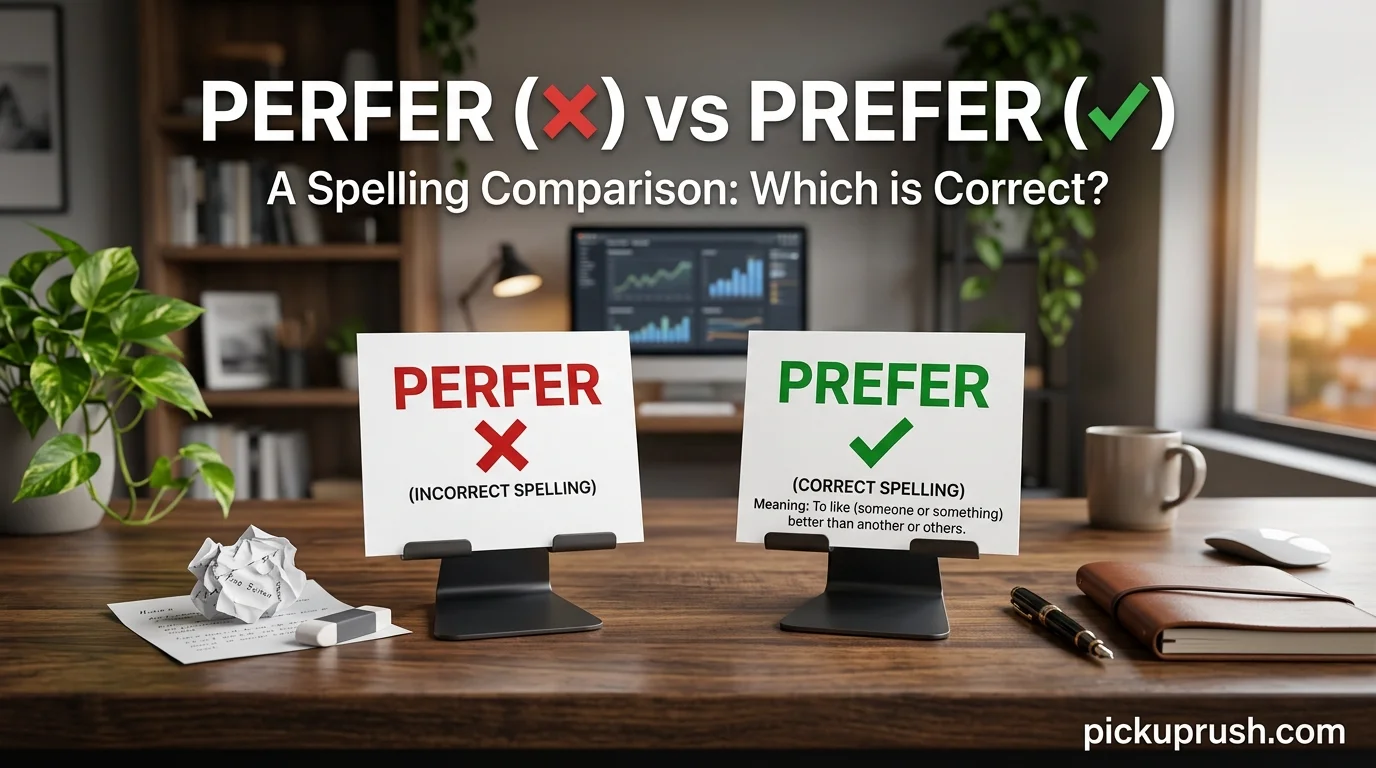

Many English learners get confused when choosing between perfer vs prefer. The two spellings look almost identical, so it is easy to place the letters in the wrong order, especially when writing quickly. However, only prefer is the correct spelling in standard English, while perfer is a common spelling mistake.
The word prefer is a useful verb that means to like, choose, or favor one thing over another. You might say, “I prefer tea to coffee,” when explaining your personal choice or preference. The word is used in both American and British English, so its spelling does not change depending on the variety of English you use.
In this guide, you will learn the difference between Perfer vs Prefer: Which Spelling Is Correct?, why people often write perfer, and how to remember the correct spelling. You will also see simple examples and practical tips that can help you use prefer confidently in everyday and formal writing.
Perfer vs Prefer: Which One Is Correct?
The correct spelling is prefer.
Perfer is not the standard spelling of the verb. If you’re writing an email, school assignment, article, report, or professional message, use prefer.
| Word | Standard spelling? | Meaning | Example |
| Prefer | Yes | To like or choose one thing more than another | I prefer tea to coffee. |
| Perfer | No | Common misspelling of prefer | ❌ I perfer tea to coffee. |
The difference is only one letter, but that letter matters. The correct word is spelled p-r-e-f-e-r, not p-e-r-f-e-r.
Correct examples
- I prefer tea to coffee.
- She prefers quiet places.
- We prefer walking to driving.
- He prefers to work in the morning.
- They prefer books to movies.
Incorrect examples
- ❌ I perfer tea to coffee.
- ❌ She perfers quiet places.
- ❌ We perfer walking to driving.
A useful way to remember the spelling is to break the word into two parts:
pre + fer = prefer
There’s no extra r after the first e.
What Does “Prefer” Mean?
Prefer means to like, choose, or want one person or thing more than another. Cambridge Dictionary defines it as liking, choosing, or wanting one thing rather than another.
The idea of comparison is important. When you say, “I like coffee,” you’re simply stating that you enjoy coffee. When you say, “I prefer coffee to tea,” you’re comparing two choices.
For example:
I prefer summer to winter.
This sentence tells the reader that summer ranks higher in your personal preference.
You can use prefer for things, activities, people, places, foods, styles, and many other choices.
- I prefer small restaurants.
- Maya prefers classical music.
- We prefer traveling by train.
- He prefers working alone.
- They prefer blue over green.
The word can also appear without an explicit comparison when the context already makes the choice clear:
“Would you like coffee?”
“No, thanks. I’d prefer tea.”
Here, the alternative is understood from the conversation.
Why Do People Write “Perfer” Instead of “Prefer”?
The perfer vs prefer mistake is easy to make because the two spellings look and sound similar.
One reason is pronunciation. In American English, prefer is pronounced roughly as /prɪˈfɝː/. The second syllable receives the main stress. Cambridge gives the US pronunciation as /prɪˈfɝː/.
Because English pronunciation and spelling don’t always match neatly, someone may hear the word and mentally reconstruct its spelling incorrectly.
Another factor is the familiar per- spelling pattern found in many English words. When writing quickly, someone may unconsciously arrange the letters as perfer.
However, perfer doesn’t become correct simply because it appears frequently as a typo. The standard spelling remains prefer.
A simple memory trick
Think of the word as:
PRE + FER
Not:
PER + FER
If you remember pre- at the beginning, the correct spelling becomes much easier to reproduce.
How to Use “Prefer” Correctly
Knowing that prefer is correct is only the first step. You also need to know how the verb works in a sentence.
English uses several common patterns with prefer. The right structure depends on what follows the verb.
Prefer One Thing to Another
One of the most useful patterns is:
prefer + A + to + B
Use this structure when comparing two nouns or noun phrases.
Examples:
- I prefer tea to coffee.
- She prefers summer to winter.
- They prefer trains to buses.
- We prefer online classes to traditional lectures.
- He prefers fiction to nonfiction.
Cambridge specifically identifies prefer A to B as a standard comparison pattern and notes that than should not replace to in this construction.
Why “to” matters
A common mistake is to transfer the pattern used with other comparative expressions.
For example:
❌ I prefer tea than coffee.
The standard form is:
✅ I prefer tea to coffee.
The word to is part of the normal grammatical pattern for this type of comparison.
Prefer Doing Something to Doing Something Else
You can also compare two activities by using -ing forms.
The structure is:
prefer + verb-ing + to + verb-ing
For example:
- I prefer reading to watching television.
- She prefers walking to driving.
- We prefer cooking to eating out.
- He prefers studying at night to studying in the morning.
Notice the parallel structure. Both activities use the -ing form.
I prefer walking to driving.
This works naturally because walking and driving are grammatically balanced.
Cambridge gives the same general pattern with examples involving activities and notes that prefer can be followed by either an -ing form or a to-infinitive.
Prefer to Do Something
Another common construction is:
prefer + to + base verb
Examples:
- I prefer to work alone.
- She prefers to stay home.
- We prefer to travel in the morning.
- He prefers to study before breakfast.
- They prefer not to discuss the issue.
This structure is particularly useful when you’re describing a preferred action without directly comparing it with another action.
For example:
I prefer to work from home.
The listener doesn’t necessarily need to know what you would choose instead. The sentence simply communicates your preference.
Cambridge notes that both a to-infinitive and an -ing form can follow prefer, with the to-infinitive being more common in its grammar guidance.
Prefer Doing Something Rather Than Doing Something Else
You can also use rather than to contrast two activities.
For example:
- I prefer walking rather than driving.
- She prefers reading rather than watching television.
- They prefer working remotely rather than commuting.
However, the exact structure can change depending on the sentence. A particularly clear pattern is:
would prefer + to-infinitive + rather than + base verb
For example:
I’d prefer to stay home rather than go out.
Cambridge specifically gives would prefer … rather than as a valid structure for contrasting choices.
The important point is not to mix grammatical patterns randomly.
Prefer vs Rather
Prefer and rather can both express choices, but they don’t work in exactly the same way.
Compare:
- I prefer tea to coffee.
- I would rather drink tea than coffee.
The meanings are closely related, but the grammar differs.
Prefer
The common pattern is:
prefer + noun + to + noun
I prefer tea to coffee.
Or:
prefer + to-infinitive
I prefer to stay home.
Would rather
The common pattern is:
would rather + base verb
I would rather stay home.
You wouldn’t normally write:
❌ I would rather to stay home.
Instead, write:
✅ I would rather stay home.
Keeping these structures separate makes your writing much cleaner.
Prefer vs Like
The difference between prefer and like is subtle but useful.
Like tells you that you enjoy something.
I like coffee.
Prefer usually tells you that one choice has an advantage in your personal preference over another.
I prefer coffee to tea.
Think of it this way:
Like = positive feeling
Prefer = comparative choice
You can like both options while still preferring one.
For example:
I like both cities, but I prefer Chicago to Boston.
The speaker enjoys both places. However, one ranks higher in the speaker’s preference.
Prefer vs Choose
Prefer and choose aren’t interchangeable.
Prefer describes a preference.
Choose describes an actual decision.
For example:
I prefer the blue shirt.
This tells us which shirt you like better.
But:
I chose the black shirt.
This tells us which shirt you actually selected.
The two can even point in different directions:
I prefer the blue shirt, but I chose the black one because it was on sale.
That distinction is useful because preferences don’t always determine final decisions. Price, convenience, availability, timing, and other circumstances can affect what someone actually chooses.
Common Spelling and Grammar Mistakes With “Prefer”
The perfer vs prefer spelling error is only one problem. Several grammar mistakes appear with this verb as well.
Writing “Perfer” Instead of “Prefer”
This is the most basic mistake.
❌ I perfer tea to coffee.
✅ I prefer tea to coffee.
The incorrect version adds the r too early.
Adding an Extra “R”
Some writers remember that the past form is preferred and accidentally transfer that spelling pattern to the base form.
Remember:
- prefer
- prefers
- preferred
- preferring
The base form remains prefer.
Using “Prefer Than”
One of the most common grammar errors is:
❌ I prefer tea than coffee.
Use:
✅ I prefer tea to coffee.
Cambridge explicitly identifies this as a typical error and recommends to when comparing things or activities with prefer.
Using “Prefer” Without “To” Before an Infinitive
Another mistake is leaving out to:
❌ I prefer go early.
The standard form is:
✅ I prefer to go early.
Cambridge lists this as another typical error: when prefer is followed by an infinitive, use the to-infinitive.
Mixing “Prefer” With “Would Rather”
Avoid combining the structures incorrectly.
❌ I prefer to rather stay home.
Better options include:
✅ I prefer to stay home.
✅ I would rather stay home.
Both express a preference, but each follows its own grammatical pattern.
Prefer in American English
Prefer is completely normal in American English. You’ll find it in casual conversation, business writing, academic prose, emails, instructions, and everyday descriptions of personal choices.
For example:
- I prefer email communication.
- Would you prefer a morning appointment?
- She prefers working independently.
- We prefer this version of the proposal.
- I’d prefer not to discuss that right now.
The word can sound neutral, polite, or formal depending on the sentence around it.
For example, compare:
“I want tea.”
with:
“I’d prefer tea.”
The second sentence often sounds more measured and polite. That makes would prefer especially useful when making requests or stating a choice without sounding overly blunt.
Prefer Pronunciation
The standard American English pronunciation of prefer is represented by Cambridge as /prɪˈfɝː/.
The stress falls on the second syllable.
That pronunciation helps explain why some people may have trouble connecting the spoken word with its written form. English contains many words whose spelling isn’t an exact reflection of their sound.
Still, pronunciation doesn’t change the spelling.
Prefer remains the correct written form.
Prefer: Verb Forms and Word Family
The verb changes form depending on tense and grammatical position.
| Form | Word | Example |
| Base form | prefer | I prefer tea. |
| Third-person singular | prefers | She prefers tea. |
| Past tense | preferred | He preferred tea yesterday. |
| Past participle | preferred | Tea was preferred by most guests. |
| Present participle | preferring | She is preferring a quieter option. |
| Noun | preference | Everyone has a personal preference. |
| Adjective | preferable | This option is preferable. |
The forms preferred and preferring deserve special attention because their spelling changes.
Preferred
The past form is:
preferred
It contains a doubled r.
I preferred the earlier version.
This doesn’t mean the base form should become perfer. The double r belongs to the inflected form preferred.
Preferring
The present participle is:
preferring
For example:
She is preferring the quieter environment.
In ordinary usage, however, prefer is generally treated as a verb that describes a state or choice rather than an ongoing temporary action. For many situations, a simple form such as She prefers the quieter environment sounds more natural.
Preference
The related noun is preference.
My preference is to work in the morning.
A preference is the choice or liking itself, while prefer is the verb used to express it.
Perfer vs Prefer Examples
Seeing the difference in complete sentences makes the spelling easier to remember.
Correct sentences
- I prefer tea to coffee.
- She prefers quiet restaurants.
- We prefer working in the morning.
- He prefers to walk to work.
- They prefer books to movies.
- I’d prefer to stay home tonight.
- Would you prefer coffee or tea?
- She prefers reading to watching television.
- We prefer to finish the project today.
- He prefers the original design.
Incorrect sentences
- ❌ I perfer tea to coffee.
- ❌ She perfers quiet restaurants.
- ❌ We perfer working in the morning.
- ❌ I prefer tea than coffee.
- ❌ He prefer go early.
- ❌ She prefer to reading at night.
Corrected versions
| Incorrect | Correct |
| I perfer tea. | I prefer tea. |
| She perfers coffee. | She prefers coffee. |
| I prefer tea than coffee. | I prefer tea to coffee. |
| I prefer go early. | I prefer to go early. |
| I prefer to reading. | I prefer reading. |
| I would rather to stay home. | I would rather stay home. |
A Simple Trick to Remember “Prefer”
If perfer vs prefer keeps causing trouble, use one short memory rule:
PRE comes before FER: PRE-FER.
Think of prefer as two pieces:
PRE + FER
The incorrect spelling rearranges those letters:
PER + FER ❌
That small visual distinction can prevent a surprisingly common typo.
Another useful technique is to connect prefer with preference.
Both begin with:
pre-
- prefer
- preference
- preferable
Seeing the same beginning across the word family can reinforce the correct spelling.
Prefer vs Perfer at a Glance
| Feature | Prefer | Perfer |
| Standard English spelling | Yes | No |
| Part of speech | Verb | Not the standard verb spelling |
| Meaning | Like or choose one thing more than another | Usually intended as prefer |
| Correct example | I prefer tea to coffee. | ❌ I perfer tea to coffee. |
| Common comparison | prefer A to B | — |
| Infinitive pattern | prefer to do | — |
| Common source of confusion | Pronunciation and spelling | Misspelling |
The main takeaway is simple: prefer is the word you want.
Read More: Parents’ vs. Parent’s: Differences and Correct Usage
Real-World Usage: Choosing the Right Structure
Imagine you’re ordering breakfast and someone asks what you’d like.
You could say:
I prefer coffee to tea.
Here, you’re comparing two drinks.
If the person asks what you’d like right now, you might say:
I’d prefer coffee.
Now you’re making a specific choice.
If you’re talking about a regular habit, you could say:
I prefer to drink coffee in the morning.
These sentences all use prefer, but the structure changes according to the meaning.
| Situation | Natural sentence |
| General comparison | I prefer coffee to tea. |
| General activity | I prefer drinking coffee in the morning. |
| Preferred action | I prefer to drink coffee in the morning. |
| Specific request | I’d prefer coffee, please. |
| Alternative choice | I’d prefer to stay home rather than go out. |
Understanding these small differences will make your writing sound much more natural.
Conclusion:
The difference between perfer and prefer is simple once you remember the correct spelling. Prefer is the only accepted spelling in standard English, while perfer is an incorrect spelling mistake. The word prefer means to like, choose, or favor one thing over another, and you can use it in both everyday and formal writing.
Remember that prefer starts with pre, not per. Keeping the correct letter order in mind can help you avoid this common mistake in emails, essays, business documents, and other types of writing. With a little practice, using prefer correctly will become natural.
FAQs:
Is “perfer” a correct English word?
No. Perfer is a misspelling. The correct English word is prefer.
What does “prefer” mean?
Prefer means to like, choose, or favor one person, thing, or option more than another.
Is “prefer” used in American and British English?
Yes. Prefer has the same spelling and meaning in both American English and British English.
Why do people spell “prefer” as “perfer”?
People often make this mistake because the words look similar, and they may accidentally switch the letters r and e when typing or spelling from memory.
How can I remember the spelling of “prefer”?
Remember that prefer begins with pre. Connecting the spelling with a simple sentence such as “I prefer tea to coffee” can make it easier to remember.


1 thought on “Perfer vs Prefer: Which Spelling Is Correct?”