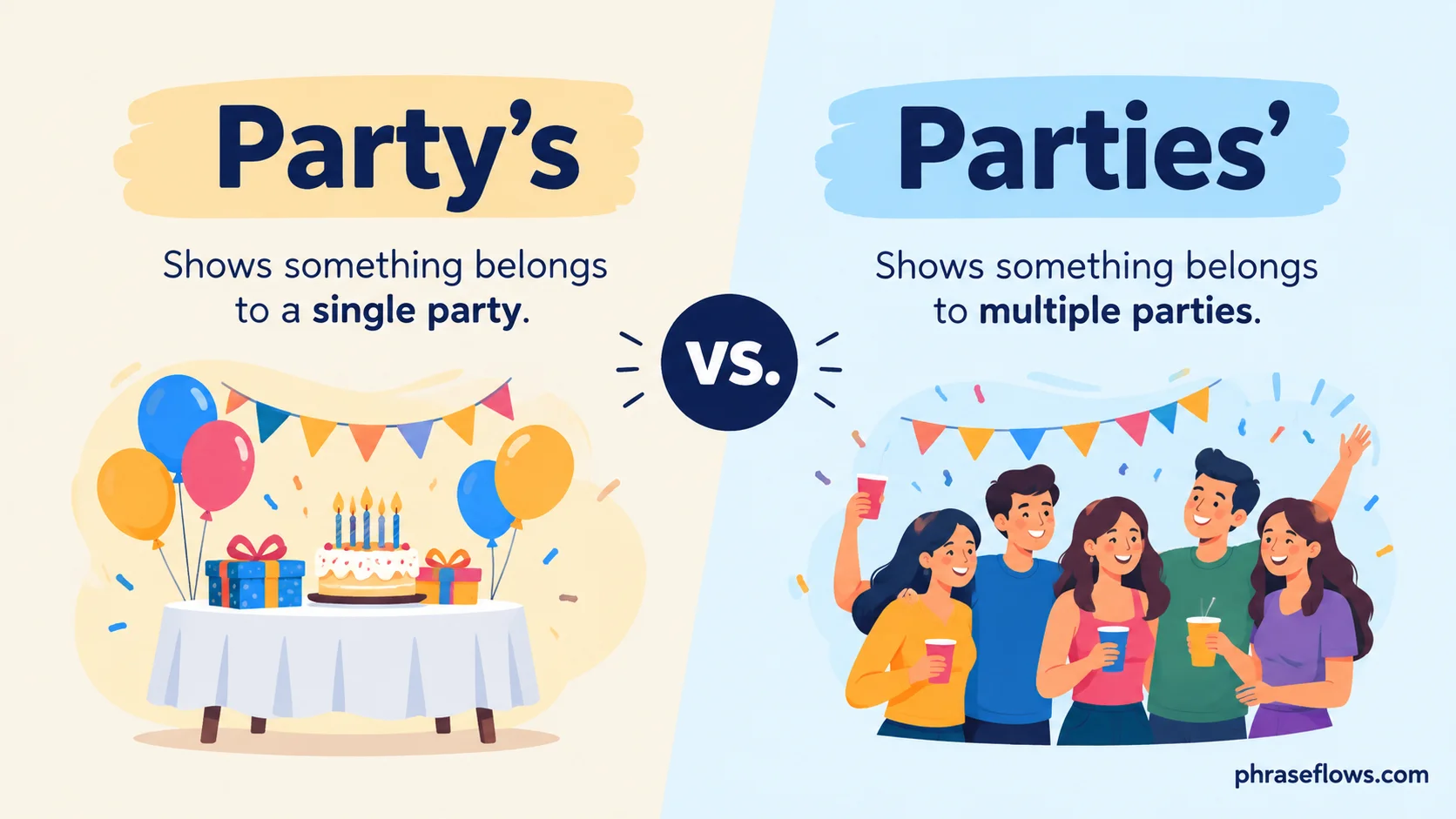

Have you ever wondered whether to write Party’s vs. Parties? Although these words look similar, they have different meanings and grammatical functions. Choosing the wrong spelling can change your sentence or make your writing confusing.
The good news is that the difference between party’s vs. parties is easy to understand once you know what the apostrophe does and how English forms plural nouns. One word can show ownership or shorten a phrase, while the other refers to more than one party.
In this guide, you’ll learn the meaning of each word, when to use it, how to avoid common mistakes, and how to apply the rules in everyday, legal, political, and social writing. You’ll also find comparison tables and practical examples to help you remember the difference.
Party’s vs. Parties: The Basic Difference
The main difference between party’s and parties comes down to possession, contraction, and plurality. Both spellings are correct, but you can’t use them interchangeably.
Party’s is the singular possessive form of party. It can also be a contraction of party is or party has. In contrast, parties is the plural form of party and refers to two or more events, people, groups, or organizations.
Consider these examples:
- The party’s decorations looked beautiful. (The decorations belong to or are associated with one party.)
- We attended three birthday parties last month. (There was more than one party.)
- The party’s starting soon. (The party is starting soon.)
- Both parties signed the agreement. (Two or more sides signed it.)
Here’s a quick comparison to make the distinction clearer.
| Feature | Party’s | Parties |
| Grammatical function | Singular possessive noun or contraction | Plural noun |
| Main meaning | Belonging to one party; party is or party has | More than one party |
| Apostrophe | Yes | No |
| Example | The party’s theme was elegant. | The parties had different themes. |
| Simple test | Check for ownership or expand the contraction | Check whether you mean multiple parties |
Remember: An apostrophe doesn’t usually make a noun plural. In party’s, it marks possession or forms a contraction. In parties, the spelling change creates a plural.
What Does Party’s Mean?
The word party’s has two main grammatical uses. It can show that something belongs to or relates to one party, or it can shorten a phrase containing party is or party has.
The correct meaning depends on the sentence. For example, in the party’s invitation, the word shows a relationship between the party and its invitation. In the party’s over, it shortens the party is over.
Let’s examine both uses.
Party’s as a Possessive Noun
Use party’s when you want to show ownership, responsibility, association, or another relationship involving one party.
A party can mean a social gathering, a political organization, or a person or group involved in an agreement. The possessive form works in all these contexts.
For example:
- The party’s location changed at the last minute.
- The party’s host welcomed everyone at the door.
- The political party’s platform focuses on education.
- The party’s responsibilities appear in the contract.
- The party’s decision surprised the other members.
In each sentence, party’s connects one party with something related to it. The relationship doesn’t always mean literal ownership. A political organization doesn’t necessarily own its platform in the same way someone owns a bicycle. The apostrophe still shows the connection.
A simple rule: If you can reasonably replace the phrase with “the party’s own” or “belonging to the party,” the possessive form may be appropriate.
For example, the party’s schedule means the schedule associated with that party.
Party’s as a Contraction
Party’s can also shorten party is or party has. In this use, the apostrophe marks omitted letters rather than possession.
The surrounding words usually make the intended meaning clear.
Examples of party’s meaning party is:
- The party’s getting started at seven.
- The party’s almost over.
- The party’s more exciting than we expected.
You can expand each contraction to party is:
- The party is getting started at seven.
- The party is almost over.
- The party is more exciting than we expected.
Examples of party’s meaning party has:
- The party’s been postponed.
- The party’s already started.
- The party’s received several complaints.
In these sentences, party’s can expand to party has:
- The party has been postponed.
- The party has already started.
- The party has received several complaints.
One useful clue is the word that follows the contraction. Forms such as party’s been and party’s received often indicate party has. However, context remains important.
Writing tip: Contractions sound natural in casual conversation, emails, and informal articles. In formal legal documents or academic writing, spelling out party is or party has may improve clarity.
What Does Parties Mean?
Parties is the plural form of party. Use it when you refer to two or more celebrations, political organizations, people, or groups involved in an activity or agreement.
The meaning of party depends on the context. At a birthday celebration, a party is a social event. In a contract, a party is a person or organization involved in the agreement. The plural form works in both situations.
For example:
- We attended three birthday parties last month.
- Several political parties participated in the election.
- Both parties agreed to the new terms.
- The interested parties received copies of the report.
- The school organized separate graduation parties for different classes.
None of these examples requires an apostrophe because parties simply identifies more than one party.
Parties Referring to Social Gatherings
When discussing social events, parties refers to multiple celebrations or gatherings. These might include birthdays, graduation celebrations, holiday gatherings, or other occasions.
For example:
- My cousins hosted two graduation parties this summer.
- The neighborhood holds holiday parties every December.
- We received invitations to several birthday parties.
- The children enjoyed both parties.
Notice the difference between the following sentences:
- The party’s decorations were colorful. This refers to decorations associated with one event.
- The parties had colorful decorations. This refers to multiple events.
The first sentence uses a possessive form. The second uses a plural noun. A small spelling difference changes the grammatical meaning.
Parties Referring to People or Groups
In business, politics, and legal writing, parties often refers to people, companies, organizations, or groups involved in a particular matter.
For example:
- Both parties signed the contract.
- The parties agreed to resolve the disagreement.
- Several political parties supported the proposal.
- All interested parties attended the meeting.
This use is especially common in contracts and formal documents. A contract might identify two companies as the parties involved in an agreement. Once the document refers to both companies together, parties is the appropriate plural form.
The word doesn’t necessarily mean people attending a celebration. Context determines whether it refers to social events, organizations, or participants in an agreement.
Why Does Party Change to Parties?
The spelling change from party to parties follows a common English pluralization rule. When a noun ends in a consonant followed by y, you usually change the y to i and add -es.
The pattern looks like this:
| Singular | Plural |
| Party | Parties |
| City | Cities |
| Company | Companies |
| Country | Countries |
| Family | Families |
| Story | Stories |
| Baby | Babies |
| Library | Libraries |
This rule explains why parties is correct and partys is not the standard plural spelling.
However, not every noun ending in y follows the same pattern. When a vowel comes before the final y, you generally keep the y and add s.
| Singular | Plural |
| Boy | Boys |
| Toy | Toys |
| Day | Days |
| Key | Keys |
| Journey | Journeys |
The important detail is the letter immediately before the final y. In party, that letter is t, a consonant. Therefore, the correct plural is parties.
Does an Apostrophe Make a Word Plural?
No. An apostrophe doesn’t normally form an ordinary plural in English.
Compare these examples:
- Incorrect: We attended three partys.
- Incorrect: We attended three party’s.
- Correct: We attended three parties.
The first spelling ignores the standard pluralization rule. The second incorrectly uses an apostrophe to indicate a plural.
An apostrophe has other grammatical jobs, including showing possession and forming contractions. For example, party’s theme shows possession, while party’s ready can mean party is ready.
Once you separate these functions, the spelling becomes much easier to remember.
Party’s vs. Parties: Key Differences at a Glance
The quickest way to understand party’s vs. parties is to compare their grammatical roles and look at what each sentence means.
| Word | Grammatical function | Example | Meaning |
| Party | Singular noun | The party starts at seven. | One party |
| Party’s | Singular possessive | The party’s host arrived early. | The host associated with one party |
| Party’s | Contraction | The party’s starting soon. | The party is starting soon |
| Parties | Plural noun | The parties start at seven. | Multiple parties |
| Parties’ | Plural possessive | The parties’ schedules differ. | Schedules associated with multiple parties |
One detail deserves special attention: parties’ is different from both party’s and parties. It is the plural possessive form.
For example, the parties’ representatives refers to representatives associated with multiple parties. The apostrophe comes after the s because the noun is already plural.
Party’s vs. Parties vs. Parties’: Three Different Meanings
Consider these sentences:
The party’s decision was final.
One party made the decision or is associated with it. The apostrophe appears before the s because the possessive noun is singular.
The parties made a decision.
Two or more parties made a decision. There is no apostrophe because parties is plural, not possessive.
The parties’ decision was final.
Multiple parties made or shared the decision. The apostrophe comes after the final s to show plural possession.
These distinctions matter in everyday writing, but they’re especially important in contracts, business reports, and other documents where a small grammatical change can affect clarity.
When to Use Party’s vs. Parties
Choosing the correct form becomes easier when you identify what the sentence needs to express. Are you talking about one party’s possession, more than one party, or possession involving several parties?
Use the following rules to decide.
Use Party’s to Show Ownership or Association
Choose party’s when you want to show that something belongs to or relates to one party.
Examples include:
- The party’s budget exceeded expectations.
- The party’s organizer confirmed the venue.
- The party’s rules prohibited outside decorations.
- The party’s representative answered the questions.
- The party’s position changed during negotiations.
You can often test the sentence by asking “Whose?”
For example:
Whose budget exceeded expectations? The party’s budget.
That question points to the singular possessive form.
Remember that ownership can mean a connection or responsibility rather than literal ownership. A political party’s position is associated with the organization even if the organization doesn’t physically own that position.
Use Parties to Refer to More Than One
Use parties when the sentence refers to multiple events, groups, or participants without showing possession.
Examples:
- We attended several birthday parties.
- The political parties announced their candidates.
- Both parties accepted the proposal.
- The parties met to discuss the agreement.
- Several interested parties requested more information.
A helpful question is: How many parties are involved?
If the answer is two or more and the sentence doesn’t express possession, parties is usually the correct choice.
Use Parties’ for Possession by Multiple Parties
When something belongs to or is associated with multiple parties, use parties’.
For example:
- The parties’ representatives attended the meeting.
- The parties’ responsibilities are listed in the agreement.
- Both parties’ positions were explained.
- The parties’ signatures appear on the final page.
Notice how the apostrophe follows the s. The word parties is already plural, so you add the apostrophe after its final letter to form the plural possessive.
Compare these examples:
| Sentence | What it means |
| The party’s representative attended. | One party has a representative. |
| The parties attended. | Multiple parties attended. |
| The parties’ representatives attended. | Multiple parties have representatives who attended. |
This three-way distinction is useful whenever you write about ownership, responsibility, or relationships involving one or more groups.
Use Context to Identify the Correct Form
Sometimes the easiest way to choose between party’s and parties is to examine the words around it.
Consider this sentence:
The party’s organizer invited guests to several parties.
Both forms are correct, but they serve different purposes.
- Party’s organizer identifies the organizer associated with one party.
- Several parties refers to multiple celebrations.
Here’s another example:
The party’s representative contacted the parties involved in the dispute.
The first form shows association with one party. The second identifies multiple participants in a dispute.
Rather than relying on how the words look, focus on their meaning. Grammar becomes much more manageable when you understand the job each word performs.
Party’s vs. Parties in Different Contexts
The word party appears in several areas of everyday and professional life. Understanding the context can help you choose the right spelling.
Social Events
When writing about celebrations, party’s often indicates something associated with one event, while parties refers to multiple events.
Examples:
- The party’s music kept everyone dancing.
- The party’s start time changed.
- We attended three birthday parties last weekend.
- The neighborhood hosts summer parties every year.
The distinction is simple: use party’s for a singular possessive relationship and parties when counting multiple celebrations.
Legal Agreements
In legal writing, party often means an individual, company, or organization involved in a contract or dispute.
For example:
- The party’s obligations are listed in the contract.
- Both parties signed the agreement.
- The parties’ responsibilities are clearly defined.
- Each party’s consent must be documented.
These sentences demonstrate three important grammatical patterns. Party’s refers to one participant’s obligations or consent. Parties refers to multiple participants. Parties’ shows that a statement applies to multiple participants collectively.
In formal documents, choose the form that accurately reflects the intended meaning. If a clause concerns one participant, the singular form may be necessary. If it concerns all participants, the plural may be more suitable.
Politics and Organizations
The word party can also refer to a political organization. In this context, the same spelling rules apply.
Examples:
- The party’s platform focuses on education.
- The party’s leader addressed the audience.
- Several political parties participated in the election.
- The parties’ proposals differed on several issues.
The subject matter changes, but the grammar doesn’t. The apostrophe in party’s marks possession or association, while parties indicates a plural noun.
Read More: Success vs. Sucess: Which Is Correct? Meaning, Spelling, and Examples
Party’s vs. Parties: Examples in Sentences
Seeing the words in complete sentences is one of the best ways to understand their differences. The following examples cover possessive use, contractions, plural nouns, and plural possession.
Examples of Party’s
Here are sentences where party’s shows possession or association:
- The party’s invitation included the dress code.
- The party’s success depended on careful planning.
- The party’s decorations matched the chosen theme.
- The party’s budget covered food and entertainment.
- The party’s location was changed because of the weather.
- The political party’s policies attracted public attention.
- The party’s representative presented the proposal.
In each sentence, party’s connects one party with a related object, feature, or responsibility.
The word can also function as a contraction:
- The party’s getting started soon. (The party is getting started soon.)
- The party’s almost over. (The party is almost over.)
- The party’s been postponed. (The party has been postponed.)
- The party’s already received a response. (The party has already received a response.)
These contractions are generally more natural in informal writing. In formal writing, spelling out the words can prevent ambiguity.
Examples of Parties
Use parties when referring to multiple events, people, or groups:
- We attended two birthday parties in June.
- The school organizes holiday parties for students.
- Several political parties joined the debate.
- Both parties agreed to the revised terms.
- The parties met to discuss their concerns.
- The company invited all interested parties to the presentation.
- The children enjoyed games at both parties.
Each sentence refers to more than one party. None requires an apostrophe.
Examples of Parties’
Use parties’ when something relates to or belongs to multiple parties:
- The parties’ agreement resolved the dispute.
- The parties’ representatives arrived early.
- Both parties’ proposals received careful consideration.
- The parties’ responsibilities were outlined in writing.
- The parties’ signatures confirmed their approval.
The apostrophe comes after the final s because the noun is plural.
Common Mistakes to Avoid When Using Party’s and Parties
Even though the rules are straightforward, writers sometimes confuse plurals with possessives. A few common errors are worth checking for.
Using Party’s as a Plural
Incorrect: We attended three party’s last month.
Correct: We attended three parties last month.
The sentence counts multiple events. It doesn’t show ownership, so no apostrophe is needed.
Using Partys Instead of Parties
Incorrect: Several political partys participated.
Correct: Several political parties participated.
Because party ends in a consonant followed by y, the plural changes y to i and adds -es.
Using Parties Instead of Party’s for Possession
Incorrect: The parties theme was colorful.
Correct: The party’s theme was colorful.
The first sentence intends to identify the theme of one party. The singular possessive form needs an apostrophe before the s.
If the theme belongs to multiple parties, however, you could write the parties’ theme.
Confusing Parties’ With Party’s
Incorrect: The parties’s agreement was approved.
Correct: The parties’ agreement was approved.
When a regular plural noun already ends in s, the possessive apostrophe usually follows that final letter. You don’t add another s.
Adding an Apostrophe to an Ordinary Plural
Incorrect: The political party’s met yesterday.
Correct: The political parties met yesterday.
Here, the sentence refers to multiple political organizations. The apostrophe incorrectly suggests possession or a contraction.
The key lesson: Don’t add an apostrophe just because a noun ends in s or sounds plural. First determine whether you’re expressing quantity, possession, or a contraction.
A Quick Trick to Remember Party’s vs. Parties
If you often hesitate between these spellings, use a simple three-part check.
One party + possession
Use party’s
Example: The party’s host welcomed everyone.
More than one party
Use parties
Example: Several parties attended.
More than one party + possession
Use parties’
Example: The parties’ representatives met.
You can also use the contraction test for party’s.
If replacing party’s with party is or party has makes sense, the contraction may be correct.
- The party’s ready. → The party is ready.
- The party’s been delayed. → The party has been delayed.
However, this test only checks contractions. For possessives, ask whether the sentence shows a relationship with one party.
These quick checks work well for emails, school assignments, articles, invitations, and professional documents.
Conclusion:
Understanding party’s vs. parties is simple once you know how each word works. Use party’s to show possession or as a contraction of party is or party has. Choose parties when referring to two or more events, people, or groups. When showing possession involving multiple parties, use parties’.
For example, the party’s theme refers to one party, while the parties signed the agreement refers to multiple groups. Remember these differences to avoid common spelling mistakes and make your writing clearer. A quick check of the sentence’s meaning will help you choose the correct form every time.
FAQs:
Is Party’s or Parties Correct?
Both party’s and parties are correct, but they have different meanings. Party’s shows possession or represents party is or party has, while parties is the plural form of party.
Is Parties the Plural of Party?
Yes, parties is the correct plural form of party. Because party ends in a consonant followed by y, you change the y to i and add -es.
Is Party’s Possessive or Plural?
Party’s is a singular possessive form or a contraction. It isn’t the regular plural. For example, the party’s decorations shows possession, while several parties refers to multiple events.
What Is the Difference Between Parties’ and Party’s?
Party’s indicates possession by one party, while parties’ indicates possession by multiple parties. For example, the party’s decision refers to one party, whereas the parties’ decisions refers to multiple parties.
Can Party’s Mean Party Is or Party Has?
Yes, party’s can represent either party is or party has. For example, the party’s starting soon means the party is starting soon, while the party’s been postponed means the party has been postponed.




1 thought on “Party’s vs. Parties: Meaning, Differences, and Correct Usage”