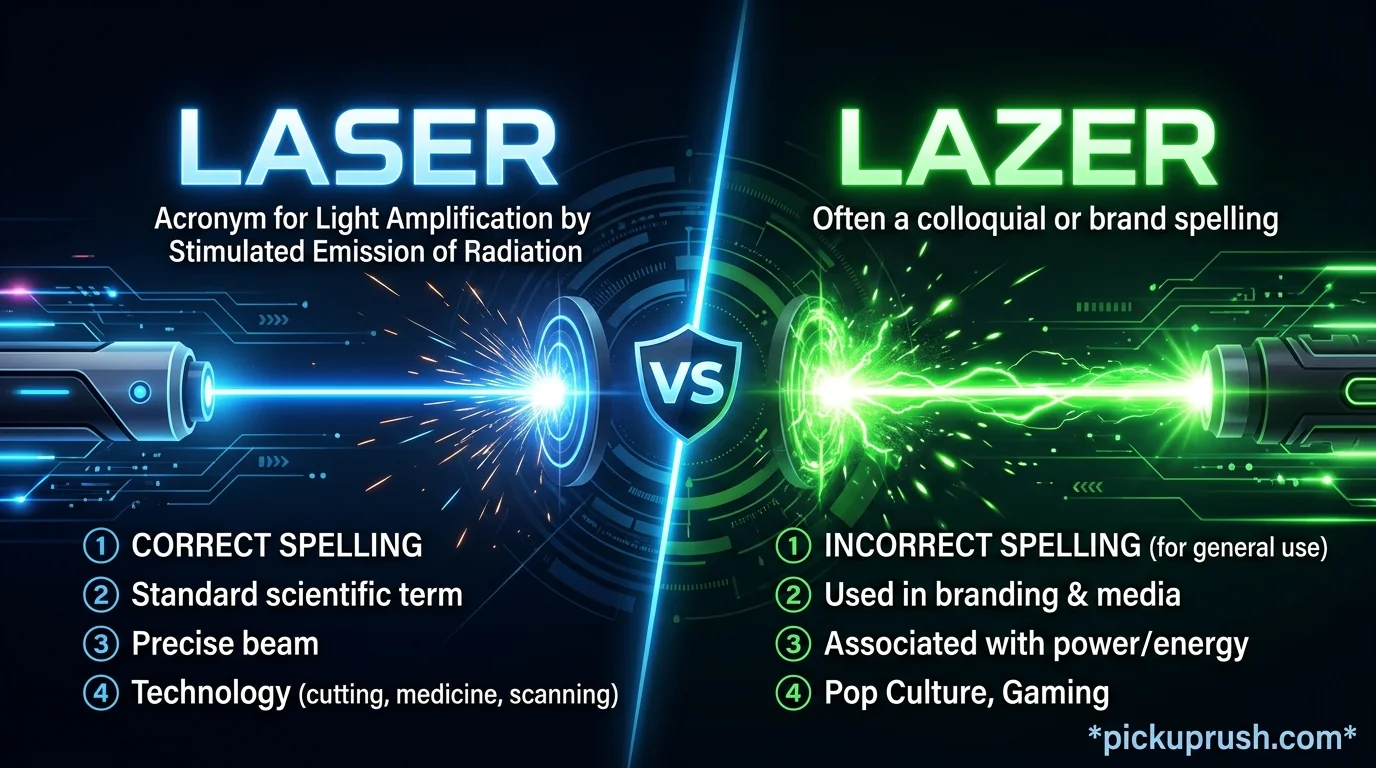

Laser vs Lazer: Know the Difference and Use the Correct Spelling is a common question for people who are unsure about the correct spelling in English. Although Laser and Lazer look almost identical, they do not have the same role in standard writing. Laser is the accepted English spelling used for a device that produces a focused beam of light, while Lazer is often seen as a creative or alternative form.
The word Laser has a clear technical meaning and comes from the acronym Light Amplification by Stimulated Emission of Radiation. It is widely used in science, medicine, technology, and manufacturing, including applications such as cutting, welding, laser printers, and barcode scanners. Because the word is well established, major dictionaries, style guides, and language experts recognize Laser as the standard form for professional and formal writing.
You may still come across Lazer in brand names, company names, music titles, gaming, marketing campaigns, and pop culture. In those cases, it may be an intentional creative choice or stylistic choice, often designed to create a modern appearance. However, using Lazer in ordinary or formal writing can result in a misspelling. Knowing when to use each form makes your word choice more accurate and helps you communicate with greater confidence.
Laser vs Lazer: Quick Answer
The short answer is simple: laser is correct, while lazer is generally incorrect when referring to the technology.
A laser is a device that produces light through optical amplification based on stimulated emission of electromagnetic radiation. The word LASER originally came from the phrase “Light Amplification by Stimulated Emission of Radiation.” NIST confirms both the acronym’s expansion and the basic scientific principle behind the technology.
Here’s the difference at a glance:
| Word | Standard spelling? | Meaning | Example |
| Laser | Yes | A device that produces an intense, concentrated beam of light | The technician used a laser to measure the distance. |
| Lazer | Generally no | Usually a misspelling of laser | Use laser rather than lazer in standard writing. |
So, if you’re writing an article, school assignment, technical document, email, or professional report, choose laser.
What Does “Laser” Mean?
A laser is a device that generates a highly organized beam of electromagnetic radiation. Unlike ordinary light from a lamp, sunlight, or a candle, laser light can have properties that make it extremely directional and coherent.
At a basic level, a laser uses energy to excite atoms, molecules, a semiconductor, or another suitable system. Under the right conditions, those excited particles release energy as photons. Mirrors or other optical components then help build and direct the light into a laser beam. NIST describes this process in terms of an energized system held between mirrors, where particles reach higher-energy states and participate in stimulated emission.
That technology has become part of everyday life. You may encounter lasers in:
- Barcode scanners
- Optical communication
- Medical equipment
- Manufacturing machinery
- Scientific instruments
- Laser printers
- Optical storage systems
- Surveying and measurement equipment
- Consumer electronics
- Research laboratories
The technology isn’t limited to one type of light either. Different lasers can operate at different wavelengths and use different materials or mechanisms to generate their output.
Why Is Laser Such a Useful Technology?
The usefulness of a laser comes from its ability to produce light with characteristics that can be controlled very precisely.
A laser beam can be tightly focused, directed over a distance, modulated for communication, or used to deliver energy to a very specific area. That’s why the same basic technology can appear in something as ordinary as a barcode scanner and something as specialized as a scientific instrument.
The Smithsonian notes that lasers eventually found applications ranging from grocery-store scanners to fiber-optic communication.
What Does “Lazer” Mean?
Lazer is generally not the standard spelling for the light-producing technology.
In ordinary English writing, someone who writes lazer usually means laser. The substitution of z for s doesn’t create a different standard technical term.
For example:
Incorrect: The technician adjusted the lazer.
Correct: The technician adjusted the laser.
However, there’s an important exception.
A word can appear with an unusual spelling because it is being used as a proper name, brand name, character name, username, or creative term. If an organization or individual intentionally spells a name “Lazer,” that spelling can be correct for that particular name.
The key is context. Don’t automatically change a proper name just because it doesn’t follow the normal spelling of laser.
Laser vs Lazer: The Key Difference
The biggest difference between laser vs lazer is spelling rather than technology.
Laser Uses an “S”
The standard English word is:
laser
It contains an s after the first vowel.
Lazer Uses a “Z”
The nonstandard form is:
lazer
It replaces the s with a z.
That small change is enough to make the word nonstandard when you’re referring to the technology.
The Meaning Usually Comes From Context
If someone writes:
The doctor used a lazer.
The intended meaning is almost certainly:
The doctor used a laser.
In other words, the spelling mistake doesn’t usually indicate a different type of device. It simply changes the spelling of the word.
Why Is It Spelled “Laser”?
The spelling becomes much easier to remember once you understand the word’s origin.
LASER comes from:
Light Amplification by Stimulated Emission of Radiation
The initials form L-A-S-E-R.
That’s why the standard spelling contains an s rather than a z. The spelling isn’t based simply on how the word happens to sound.
NIST identifies laser as an acronym for “Light Amplification by the Stimulated Emission of Radiation.”
The history of the technology makes the word even more interesting.
The first working laser was demonstrated by physicist Theodore H. Maiman and his assistant Irnee D’Haenens at Hughes Research Laboratories in California in May 1960. Maiman’s device used a synthetic ruby crystal and produced laser light in pulses rather than as a continuous beam.
The Smithsonian also records the fascinating detail that several experimental models existed, which means historians cannot identify with absolute certainty which physical unit produced the very first laser light.
A Simple Memory Trick
When you’re stuck between laser vs lazer, remember the acronym:
LASER = Light Amplification by Stimulated Emission of Radiation
The acronym gives you the spelling:
L-A-S-E-R
Not L-A-Z-E-R.
It’s a much stronger memory trick than simply trying to remember which spelling “looks right.”
Laser vs Lazer: Pronunciation
Another reason people confuse these spellings is pronunciation.
Laser is normally pronounced as a two-syllable word in American English. The spoken word doesn’t clearly tell you whether the written form contains an s or a z.
That’s an important lesson for English learners: pronunciation and spelling don’t always line up perfectly.
For example, hearing someone say laser won’t necessarily help you reconstruct the spelling from sound alone. That’s why remembering the word’s acronym is useful.
Examples of “Laser” in Sentences
Seeing the correct spelling in different contexts makes the distinction easier to remember.
Everyday Technology
The store uses a laser scanner to read product barcodes.
Medicine
The specialist explained how the laser treatment would work.
Manufacturing
The factory uses a laser cutter to make precise shapes.
Communications
Engineers use lasers in systems that transmit information through optical fibers.
Science
The researchers directed a laser beam at the experimental material.
Consumer Electronics
The printer uses a laser to create the image on the page.
Measurement
The surveyor used a laser measuring device to determine the distance.
Plural Form
Modern laboratories can contain several different types of lasers.
Notice that the word stays consistent in each example. Whether you’re talking about medicine, manufacturing, science, or electronics, the standard spelling remains laser.
Common Mistakes With Laser
The spelling problem isn’t complicated, but a few patterns make it especially common.
Writing “Lazer” Because It Sounds Natural
Some people hear the word and assume that lazer should be the spelling.
English doesn’t always work that way.
A familiar pronunciation can lead writers toward a spelling that seems logical even though it isn’t standard. The same general problem occurs with many English words whose spelling can’t be predicted perfectly from their pronunciation.
When in doubt, remember:
Laser = S
Assuming the “Z” Makes It a Different Technology
It doesn’t.
In standard English, lazer isn’t the name of a separate type of laser technology. If you’re discussing the scientific device, the normal spelling is laser.
Assuming Every Use of “Lazer” Is a Mistake
This is where context matters.
If Lazer appears as part of an official name, title, brand, username, or fictional character name, changing it to laser could actually change the intended name.
For example, a company might deliberately choose an unconventional spelling for branding purposes. In that situation, the spelling belongs to the name rather than the ordinary dictionary word.
Capitalizing LASER in Every Sentence
The word began as an acronym, so you’ll often see it written as LASER when its acronym origin is being emphasized.
However, modern English commonly uses laser as an ordinary noun.
For example:
The laboratory purchased a new laser.
There’s normally no need to write:
The laboratory purchased a new LASER.
The all-capital form can still appear in technical or historical discussions where the acronym itself is relevant. The lowercase form is standard in ordinary prose.
Laser vs Lazer: Grammar and Word Forms
Once you know the correct spelling, the related forms are straightforward.
| Form | Example |
| laser | The laser is powerful. |
| lasers | The laboratory has several lasers. |
| laser beam | The laser beam traveled across the room. |
| laser printer | She replaced the office laser printer. |
| laser pointer | The presenter used a laser pointer. |
| laser treatment | The physician discussed laser treatment. |
| laser cutting | The manufacturer specializes in laser cutting. |
| laser light | The instrument detects laser light. |
The word laser can appear as a noun on its own or as part of a compound term.
That flexibility explains why it shows up across many fields.
Where Lasers Are Used
The history of the laser is a good example of how a scientific invention can move from a laboratory into ordinary life.
Today, lasers support a broad range of applications.
Medicine
Medical professionals use different kinds of lasers for carefully controlled procedures. Applications vary depending on the wavelength, energy level, tissue involved, and specific medical goal.
Manufacturing
Industrial lasers can support cutting, welding, marking, drilling, and other precision processes.
Their ability to deliver energy to a controlled location makes them useful when manufacturers need accuracy and repeatability.
Communications
Laser technology plays an important role in optical communication. Light can carry information through optical fibers over long distances.
Retail
The familiar barcode scanner is another practical example. The Smithsonian specifically highlights grocery-store scanning as one of the technologies that grew from laser development.
Science
Researchers use lasers to study atoms, molecules, materials, and many other physical phenomena.
The technology has become important in fields ranging from optics and spectroscopy to quantum research.
A Brief History of the Laser
The word laser may look simple, but its history stretches back decades before the first working device appeared.
Scientists had already developed the maser, which used stimulated emission at microwave frequencies. Researchers then explored whether similar principles could work with shorter wavelengths of electromagnetic radiation.
The Smithsonian explains that researchers initially referred to these proposed devices as optical masers. The term laser was adopted later.
The breakthrough came in 1960.
Theodore Maiman’s ruby laser demonstrated that the concept could work in practice. His device produced pulses of laser light using a synthetic ruby crystal stimulated by a flashlamp.
That first working device was relatively simple compared with modern laser systems. Yet it opened the door to an enormous range of later developments.
A Few Important Facts
- 1917: Albert Einstein’s work on stimulated emission provided an important theoretical foundation.
- 1950s: Researchers developed masers and investigated related optical concepts.
- 1960: Theodore Maiman demonstrated the first working laser.
- 1960s onward: Researchers developed new laser types and explored practical applications.
- Today: Lasers are used in medicine, manufacturing, communications, research, measurement, and consumer technology.
The Smithsonian notes that Einstein’s 1917 theoretical work preceded Maiman’s 1960 working laser by more than four decades.
A Real-World Case Study: The First Ruby Laser
The story of Maiman’s ruby laser offers a useful example of why laser is the correct spelling and why the word has such a specific scientific history.
Maiman’s device used a synthetic ruby crystal surrounded by a xenon flashlamp. When the lamp produced an intense burst of light, it stimulated the ruby and generated a concentrated pulse of laser light.
The device didn’t look like the sleek laser equipment people might imagine today. It was an experimental machine built to demonstrate that the principle actually worked.
That distinction matters because the word laser wasn’t invented as a casual label for a bright beam. It emerged from a specific scientific concept and its corresponding acronym.
Laser vs Lazer in Formal Writing
If you’re writing something formal, the choice is straightforward.
Use laser when referring to the technology.
This applies to:
- School assignments
- Scientific articles
- Business documents
- Technical manuals
- Blog posts
- News articles
- Medical writing
- Engineering documents
- Research papers
- Professional emails
Avoid lazer unless you’re reproducing an intentional name or another context where that exact spelling matters.
Correct
The company developed a new laser cutting system.
Incorrect in Standard Usage
The company developed a new lazer cutting system.
The second version doesn’t become correct simply because readers can understand what it means.
Read More: Finaly vs. Finally: Differences, Correct Spelling, Meaning, and Usage
Laser vs Lazer: Quick Comparison
| Feature | Laser | Lazer |
| Standard English spelling | Yes | No, when referring to the technology |
| Contains an S | Yes | No |
| Contains a Z | No | Yes |
| Related to the LASER acronym | Yes | No |
| Used in scientific writing | Yes | Generally no |
| Used for the light-producing technology | Yes | Usually a misspelling |
| Can appear as a proper name | Yes | Yes |
| Standard plural | lasers | Depends on the name or context |
| Recommended in formal writing | Yes | Only when intentionally part of a name |
Is “Lazer” Ever Correct?
Yes, but context is important.
Lazer can be an intentional spelling when someone uses it as a name. For example, a fictional character, company, product, stage name, or username might deliberately use the spelling.
That doesn’t change the standard spelling of the technology.
Think of it this way: proper names can have unusual spellings. If a name officially uses Lazer, you shouldn’t “correct” the name to Laser simply because the latter is the standard English word.
However, if you’re independently writing about the technology, laser remains the appropriate choice.
How to Remember Laser vs Lazer
The easiest trick is also the most reliable:
LASER = Light Amplification by Stimulated Emission of Radiation
Look at the initials:
Light
Amplification
Stimulated
Emission
Radiation
There’s your S.
So when you’re choosing between laser and lazer, remember the scientific phrase behind the word.
Quick Memory Rule
Laser has an S because LASER comes from the acronym with S for “stimulated.”
That single connection can prevent the spelling mistake.
Conclusion:
The difference between Laser and Lazer mainly comes down to standard spelling and context. Laser is the correct and widely accepted English spelling for the device and its related technology. It is the form you should use in academic writing, professional writing, technical documents, and everyday English. Lazer can appear as a brand name, creative spelling, or stylistic choice, but it is not normally the standard spelling of the word. Choosing Laser in formal contexts helps you avoid spelling mistakes and keeps your writing clear and accurate.
FAQs:
Is Laser or Lazer the correct spelling?
Laser is the standard and correct spelling in English. Lazer is generally used as a creative, alternative, or brand-specific spelling.
What does the word Laser mean?
Laser refers to a device that produces a concentrated beam of light. The word comes from the acronym Light Amplification by Stimulated Emission of Radiation.
Is Lazer a real word?
Lazer can be a real name or spelling used by brands, companies, entertainment projects, and other creative contexts. However, it is not the standard spelling for the laser device in formal English.
Should I use Laser in formal writing?
Yes. Use Laser in academic, professional, scientific, medical, and general formal writing unless Lazer is part of an official name or brand.
Why do some brands use Lazer instead of Laser?
Some brands and creative projects use Lazer to create a distinctive or modern appearance. This intentional spelling does not change the standard English spelling, which remains Laser.




1 thought on “Laser vs Lazer: Know the Difference and Use the Correct Spelling”