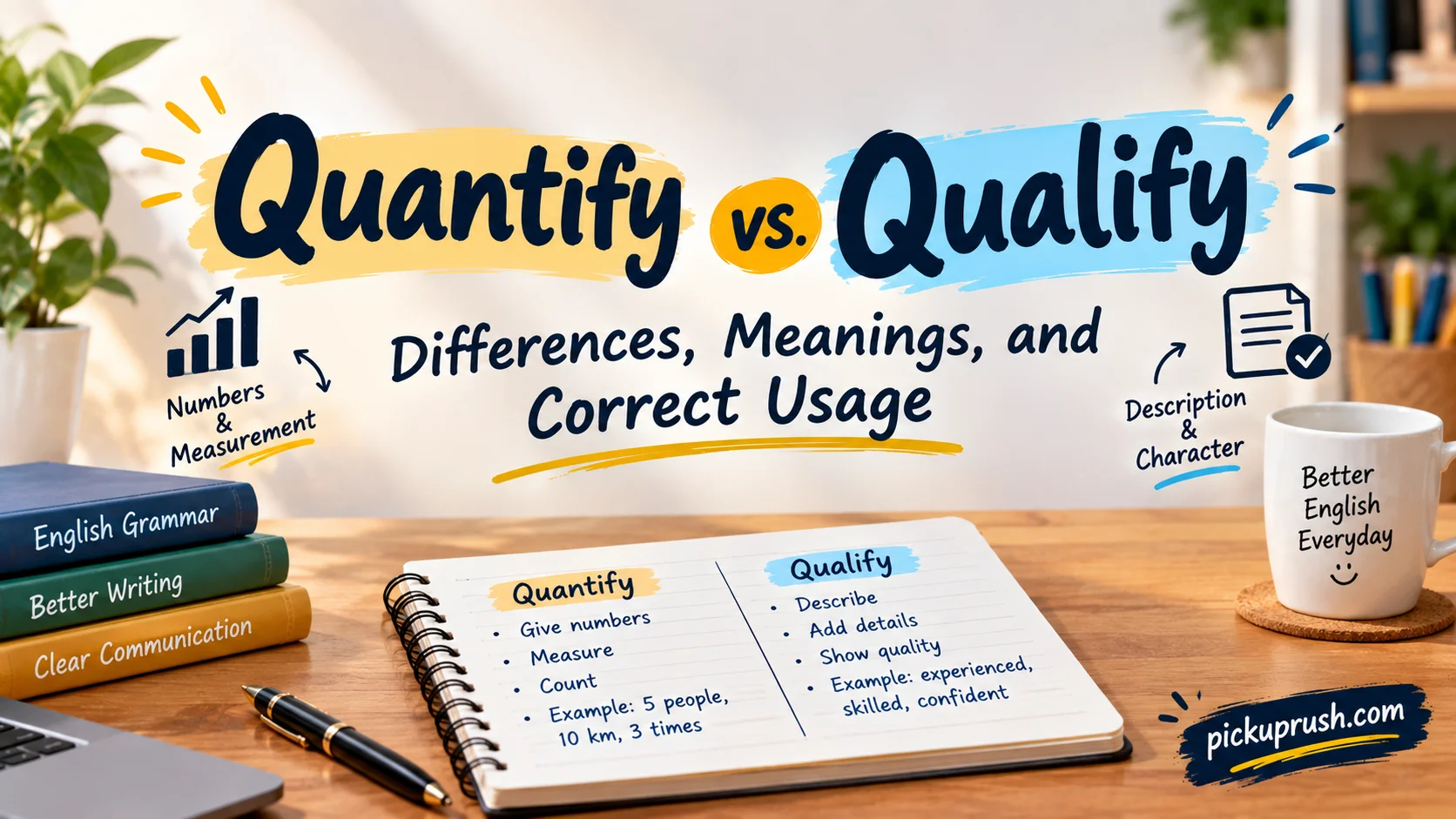

Many English words look and sound similar, but they can have completely different meanings and uses. Quantify and Qualify are two such words that often confuse students, writers, and English learners. Understanding their difference is important for using the correct word in both speaking and writing.
Quantify means to measure or express something using numbers, figures, or data. Qualify, on the other hand, means to meet certain requirements or to add information that limits, explains, or clarifies a statement. Although both words may appear similar, their meanings and purposes are different.
Learning the correct usage of Quantify and Qualify can improve your English grammar, vocabulary, and writing skills. By understanding their meanings and seeing how they are used in different contexts, learners can avoid common mistakes and communicate more clearly and accurately.
Quantify vs. Qualify: Quick Difference
The fastest way to understand quantify vs. qualify is to connect each word with its central idea.
| Word | Basic meaning | Common question | Typical contexts | Example |
| Quantify | Measure or express an amount | How much? How many? | Data, money, research, measurements | “The study quantified the increase in demand.” |
| Qualify | Limit, modify, describe, or meet requirements | Under what conditions? Does it meet the requirements? | Claims, statements, applications, eligibility | “The evidence qualifies the original claim.” |
Think of quantify as putting a measurable value on something. Think of qualify as adding a boundary, condition, or requirement.
For instance:
- “The company quantified its losses at $2 million.”
- “The company qualified its statement by noting that the estimate could change.”
The first sentence gives an amount. The second adds a qualification or limitation.
Quick rule: If you’re dealing with an amount or measurable value, think quantify. If you’re adding a condition, limitation, or requirement, think qualify.
What Does “Quantify” Mean?
Quantify Definition and Meaning
Quantify means to determine, measure, or express the quantity of something. In many situations, that means assigning a number or numerical value to something that might otherwise seem difficult to measure.
The word connects naturally with quantity, which means an amount or number of something. This connection makes the meaning easier to remember.
For example, saying that a business experienced “a large increase in sales” gives a general description. Saying that sales increased by 18% provides a quantified result.
You can quantify things such as:
- Costs
- Revenue
- Losses
- Time
- Distance
- Risk
- Demand
- Performance
- Pollution levels
- Survey responses
- Production
- Customer growth
Quantification doesn’t always require counting physical objects. You can also measure abstract concepts when you have a reliable way to assign values to them.
Examples of Quantify
Here are several examples showing how quantify works in different situations:
- “The researchers quantified the amount of carbon dioxide in the sample.”
- “The report attempts to quantify the financial impact of the delay.”
- “Managers need to quantify the project’s expected costs.”
- “The survey helped the company quantify customer demand.”
- “The researchers quantified the change in temperature.”
- “The analyst used historical data to quantify the potential risk.”
Notice the common thread. Each sentence involves determining how much, how many, or to what measurable degree.
Quantify in Research and Data
The word quantify appears frequently in academic, scientific, medical, financial, and technical writing because these fields often depend on measurable evidence.
Suppose researchers want to study whether a new study method improves test performance. Saying that students “performed better” provides a broad observation. Researchers could quantify the improvement by reporting an average score increase of 7 points.
That numerical information makes the result easier to compare and analyze.
The same principle applies to business. A manager might say:
“Customer complaints increased significantly.”
That statement describes a change but doesn’t measure it. A quantified version might report that complaints increased by 12% over three months.
The second version gives the reader something concrete to evaluate.
What Does “Qualify” Mean?
Qualify Definition and Meaning
Qualify has several related meanings, so context matters more than it does with quantify.
One common meaning is to modify, limit, or make a statement more precise. When you qualify a statement, you add information that prevents the statement from sounding broader or more certain than the evidence supports.
For example:
- “The treatment is effective.”
That sounds absolute. If the evidence only supports effectiveness in certain cases, you might qualify the statement:
- “The treatment appears effective for patients with mild symptoms.”
The added condition narrows the original claim.
Qualify can also mean meet the requirements for something. This meaning often appears with the preposition for.
For example:
- “She qualifies for the scholarship.”
- “The team qualified for the final.”
- “He qualified for the program.”
Here, qualify doesn’t mean “measure.” It means that someone meets the necessary conditions or standards.
Examples of Qualify
Consider these examples:
- “The scientist qualified the conclusion by mentioning the small sample size.”
- “The teacher qualified her recommendation with a few conditions.”
- “Applicants must meet the age requirement to qualify for the program.”
- “The team qualified for the tournament.”
- “The new evidence qualifies the earlier interpretation.”
- “The lawyer qualified the statement to avoid making an unsupported claim.”
These examples show why qualify has a wider range of uses.
Quantify vs. Qualify: Key Differences
Quantify vs. Qualify Meaning
The main difference between quantify and qualify comes down to what you’re trying to accomplish.
Quantify focuses on measurement. You want to establish an amount, number, level, or measurable value.
Qualify focuses on conditions, limits, precision, or eligibility. You want to narrow an idea, add a condition, or determine whether someone meets a requirement.
Compare these sentences:
- “The researchers quantified the environmental damage.”
- “The researchers qualified their conclusion.”
The researchers quantified the damage by measuring it. They qualified their conclusion by explaining its limits.
What Each Word Answers
A useful shortcut is to ask a question.
| If you’re asking… | Consider using… |
| How much? | Quantify |
| How many? | Quantify |
| What amount? | Quantify |
| What measurable level? | Quantify |
| Under what conditions? | Qualify |
| With what limitation? | Qualify |
| Does this person meet the requirements? | Qualify |
| How can this statement be made more precise? | Qualify |
This isn’t a rule that covers every possible sentence. However, it works as a quick test in many everyday situations.
Quantify vs. Qualify Grammar
Both quantify and qualify commonly function as verbs.
Common patterns include:
Quantify + object
- quantify the cost
- quantify the risk
- quantify the effect
- quantify the damage
Qualify + object
- qualify a statement
- qualify a claim
- qualify an opinion
- qualify a conclusion
Qualify + for + noun
- qualify for a scholarship
- qualify for a position
- qualify for a competition
- qualify for assistance
That last pattern deserves special attention because “qualify for” has a specific meaning related to eligibility.
Quantify vs. Qualify Examples
Seeing the words side by side makes their difference much clearer.
| Sentence | Word | Why it works |
| “The company quantified its losses.” | Quantified | The company measured the losses. |
| “The company qualified its forecast.” | Qualified | The company added limits or conditions to the forecast. |
| “Researchers quantified the change in temperature.” | Quantified | Temperature can be expressed through measurement. |
| “Researchers qualified their conclusion.” | Qualified | They added limitations to the conclusion. |
| “She qualified for the scholarship.” | Qualified | She met the scholarship requirements. |
| “The report quantified the financial impact.” | Quantified | The report expressed the impact in measurable terms. |
A Simple Context Comparison
Imagine that a company wants to explain a product’s success.
First, it might quantify the result:
“Sales increased by 25% during the first quarter.”
Then, it might qualify the conclusion:
“Sales increased by 25% during the first quarter, although the company introduced the product in a market with unusually high demand.”
The first statement provides measurement. The second adds context and limitation.
That distinction captures the heart of quantify vs. qualify.
When to Use “Quantify”
Use quantify when you need to express something in measurable terms.
It works especially well when the subject involves data, statistics, money, time, or other measurable factors.
Common Uses of Quantify
You might quantify:
- Financial losses: “The audit quantified the losses.”
- Business growth: “The report quantified the increase in revenue.”
- Risk: “The team tried to quantify the potential risk.”
- Environmental effects: “Scientists quantified the level of pollution.”
- Performance: “The study quantified the improvement in productivity.”
- Demand: “The survey quantified consumer demand.”
- Time: “The project manager quantified the hours required.”
- Damage: “Engineers quantified the structural damage.”
A helpful test is to ask whether you can reasonably attach a number, measurement, percentage, amount, or scale to the idea.
If you can, quantify may be the appropriate verb.
When to Use “Qualify”
Use qualify when you’re dealing with conditions, limitations, requirements, or precision.
This can happen in two major ways.
Qualify a Statement or Claim
When you qualify a statement, you make it more limited or precise.
For example:
- Broad: “The method works.”
- Qualified: “The method works in most small-scale tests.”
The second statement doesn’t necessarily reject the first idea. Instead, it establishes a boundary around it.
This use matters in academic and professional writing because absolute claims can become misleading when evidence has limits.
Qualify for Something
When someone qualifies for something, they meet the necessary conditions.
Examples include:
- qualify for a scholarship
- qualify for a loan
- qualify for a job
- qualify for a competition
- qualify for a program
- qualify for financial assistance
For example:
“Students who meet the academic requirements qualify for the scholarship.”
Here, qualify means meet the requirements.
Quantify vs. Qualify in Different Contexts
Quantify vs. Qualify in Business
Business writing uses both words, but they perform different jobs.
A financial analyst might quantify revenue growth by reporting a percentage. A manager might qualify a forecast by explaining that market conditions could change.
For example:
- “The company quantified its expected savings at $500,000.”
- “The company qualified that estimate because energy prices remain uncertain.”
The first sentence supplies a measurable figure. The second adds a limitation.
Quantify vs. Qualify in Academic Writing
Academic writers frequently quantify findings and qualify conclusions.
A research paper might quantify a result using percentages, averages, or other measurements. However, researchers often need to qualify their conclusions when a study has limitations.
For example:
“The survey found a 15% increase in reported satisfaction.”
That’s a quantified finding.
A qualified interpretation might say:
“The findings suggest improved satisfaction among surveyed participants, although the sample was relatively small.”
The second statement avoids claiming more than the evidence can support.
Quantify vs. Qualify in Science and Research
Scientific work often depends on accurate measurement, making quantify especially common.
Researchers may quantify:
- chemical concentrations
- temperature changes
- population sizes
- energy levels
- experimental effects
- biological responses
- rates of change
At the same time, scientists may qualify interpretations when uncertainty remains.
This distinction is important because measurement and interpretation aren’t the same thing.
A researcher can quantify an observed change without claiming that the change proves a particular cause.
Quantify vs. Qualify in Everyday English
You don’t need to work in a laboratory or financial office to use these words correctly.
Consider a household budget. You might quantify how much you spend on groceries each month.
If you say, “Eating at restaurants is always more expensive,” someone might qualify that statement by adding, “That depends on the restaurant and what you order.”
Again, one word deals with measurement, while the other adds context or limits.
Common Mistakes With Quantify and Qualify
Using Qualify When You Mean Measure
A common mistake occurs when someone wants to describe measurement but chooses qualify because the words look similar.
For example:
- ❌ “The study qualified the amount of water used.”
- ✅ “The study quantified the amount of water used.”
The second sentence clearly communicates measurement.
Using Quantify When You Mean Add a Condition
The opposite mistake happens when someone wants to narrow a statement.
- ❌ “The researcher quantified the claim by adding an exception.”
- ✅ “The researcher qualified the claim by adding an exception.”
Adding an exception qualifies a claim. It doesn’t quantify it.
Confusing “Qualify” With “Qualify For”
The construction matters.
Qualify something generally means to modify or limit it.
“The lawyer qualified the statement.”
Qualify for something generally means to meet the requirements for it.
“The applicant qualified for the position.”
These meanings are related because both involve the idea of conditions or standards, but the grammatical structures differ.
Assuming Similar Spelling Means Similar Meaning
The endings -ify make the words look related. That similarity can be misleading.
Compare their core associations:
- Quantity → quantify
- Qualification → qualify
The first points toward amount and measurement. The second points toward requirements, conditions, or limitations.
Quantify vs. Qualify: A Practical Case Study
Imagine a school wants to evaluate a new tutoring program.
The administrators collect test scores before and after the program. They find that the average score increased from 72 to 79.
The administrators can quantify the improvement because they have numerical evidence.
However, they shouldn’t automatically conclude that the tutoring program caused every student’s improvement. Perhaps some students also received additional help outside school.
The administrators could therefore qualify their conclusion:
“Students in the tutoring program showed higher average scores, although other factors may have contributed to the improvement.”
This short example demonstrates both words naturally:
- Quantify → measure the change.
- Qualify → limit the conclusion by adding relevant context.
Quantify vs. Qualify: Word Forms and Related Words
Knowing related forms can help you recognize these words in different types of writing.
Forms of Quantify
| Word form | Example |
| Quantify | “Researchers quantify the results.” |
| Quantified | “The study quantified the effect.” |
| Quantifying | “The team is quantifying the risk.” |
| Quantification | “The quantification of costs took several weeks.” |
| Quantifiable | “The benefits are difficult to make quantifiable.” |
The noun quantification refers to the process of expressing something in measurable terms.
Forms of Qualify
| Word form | Example |
| Qualify | “The evidence qualifies the claim.” |
| Qualified | “She qualified for the competition.” |
| Qualifying | “The qualifying round begins tomorrow.” |
| Qualification | “The applicant meets the qualification requirements.” |
| Qualifier | “The phrase ‘in some cases’ acts as a qualifier.” |
The word qualifier can refer to something that limits or modifies a statement. It can also describe a person or event that qualifies for the next stage of a competition.
Quantify vs. Qualify: Easy Memory Trick
The easiest memory trick connects quantify with quantity.
Quantify → Quantity → Amount
If you’re thinking about how much, how many, or what measurable amount, choose quantify.
Qualify → Qualification → Requirement
If you’re thinking about meeting requirements, adding conditions, or limiting a statement, choose qualify.
Try this quick mental test:
Can you measure it?
→ Quantify
Do you need to limit it or meet a condition?
→ Qualify
For example:
- “Can we measure the financial loss?” → Quantify the loss.
- “Can we add a limitation to this claim?” → Qualify the claim.
- “Does the student meet the requirements?” → The student qualifies.
It’s a small distinction, but it makes word choice much easier.
Quantify vs. Qualify: Which One Should You Use?
Choosing between these words becomes straightforward once you identify the intended meaning.
| Your intended meaning | Correct word |
| Measure an amount | Quantify |
| Express something numerically | Quantify |
| Determine the size or extent of something | Quantify |
| Add a limitation to a statement | Qualify |
| Make a claim more precise | Qualify |
| Add a condition | Qualify |
| Meet eligibility requirements | Qualify |
| Become eligible for something | Qualify for |
Consider the sentence before choosing a word. Don’t select qualify simply because it sounds close to quantify.
If the sentence involves data, measurements, amounts, percentages, or numerical values, quantify will often be the right choice.
If it involves conditions, restrictions, exceptions, eligibility, or a more careful statement, qualify is usually the better option.
Conclusion:
Understanding the difference between Quantify and Qualify makes English writing clearer and more accurate. Quantify is used when we measure or express something with numbers, while Qualify is used to add conditions, explain meaning, or show that someone meets certain requirements. Knowing their correct usage helps students and writers avoid confusion and communicate their ideas effectively.
FAQs:
What does Quantify mean?
Quantify means to measure, count, or express something using numbers or data.
What does Qualify mean?
Qualify means to meet specific requirements or to add information that limits or clarifies a statement.
What is the main difference between Quantify and Qualify?
Quantify focuses on numbers and measurement, while Qualify focuses on conditions, descriptions, or clarification.
Are Quantify and Qualify interchangeable?
No. They have different meanings and should be used according to the context and purpose of the sentence.
Why is it important to learn their difference?
Learning the difference helps improve grammar, vocabulary, writing skills, and clear communication.




1 thought on “Quantify vs. Qualify: Differences, Meanings, and Correct Usage”