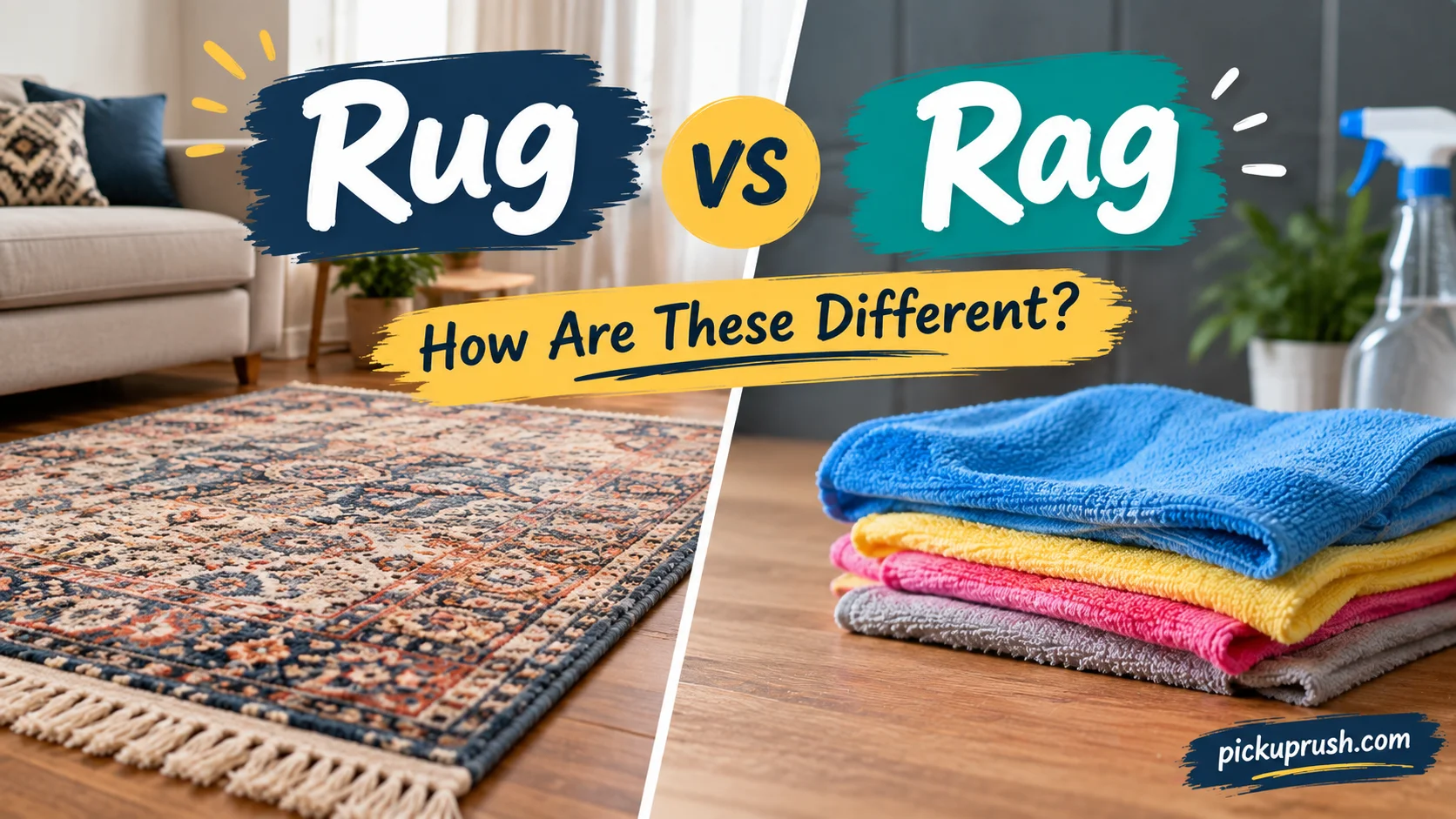

Have you ever wondered about Rug vs. Rag, How Are These Different? These two words may sound similar, but they have different meanings and uses. A rug is a decorative floor covering that adds warmth and comfort to a room, while a rag is an old piece of cloth commonly used for cleaning, wiping, and handling spills.
Understanding the difference between a rug and a rag can help you avoid common English vocabulary and spelling mistakes. Although both are made of fabric, their purposes are quite different. Rugs are used for home decoration, floor protection, and comfort, whereas rags are practical cleaning materials used for dusting, wiping surfaces, and completing household chores.
In this guide, we will explore rug meaning, rag meaning, their key differences, and examples of how to use each word correctly. Whether you are an English learner, student, writer, or simply curious about everyday vocabulary, understanding these terms will improve your word choice, grammar, and communication skills.
Rug vs. Rag: Quick Difference
The easiest way to understand rug vs. rag is to focus on their usual purpose.
| Word | Main meaning | Typical use | Example |
| Rug | A floor covering | Decoration, comfort, insulation, or protection | “The rug looks beautiful under the table.” |
| Rag | A piece of cloth | Cleaning, wiping, polishing, or handling messy tasks | “Use a rag to clean the counter.” |
| Rag rug | A rug made from pieces or strips of fabric | Floor covering | “She placed a handmade rag rug in the hallway.” |
A rug is generally something you place on a floor. A rag is generally something you hold in your hand to wipe or clean a surface.
Here’s a quick memory trick:
Rug → room and floor.
Rag → wipe and clean.
That simple association can prevent most everyday mistakes.
What Does “Rug” Mean?
A rug is a piece of material designed to cover part of a floor. Rugs can add warmth, comfort, decoration, texture, or protection to an indoor or outdoor space.
Unlike wall-to-wall carpeting, a rug is usually a separate movable floor covering. You can roll it up, move it to another room, replace it, or clean it separately.
Rugs come in many forms. Some are small enough to sit beside a bed, while others cover a large portion of a living room. They can be rectangular, square, round, oval, runner-shaped, or made in unusual decorative shapes.
Common rug materials include:
- Wool
- Cotton
- Jute
- Sisal
- Synthetic fibers
- Polyester
- Nylon
- Recycled or reclaimed textiles
The material doesn’t determine whether something is a rug by itself. Its design and intended use matter more.
For instance, a thick woven textile specifically made to sit beneath a dining table is naturally called a rug. A small piece of cotton fabric used to wipe that table is a rag.
Examples of “Rug” in a Sentence
Here are several examples that show how rug works in everyday English:
- “The rug sits beneath the coffee table.”
- “We bought a soft rug for the bedroom.”
- “The hallway rug keeps dirt from spreading through the house.”
- “Please move the chair onto the rug.”
- “The patterned rug gives the room a warmer appearance.”
- “He rolled up the rug before moving the furniture.”
Notice the common pattern. In each sentence, the rug relates to a floor, room, furniture, or interior space.
What Does “Rag” Mean?
A rag is usually a piece of cloth used for wiping, cleaning, polishing, drying, or handling something that may become dirty.
A rag can be an old piece of clothing, fabric, or another textile that someone has repurposed for practical work. It doesn’t need to have a particular shape or size.
For example, an old cotton shirt might no longer be useful as clothing. Someone could cut it into smaller pieces and use those pieces as cleaning rags.
Rags are common in many settings:
- Kitchens
- Garages
- Workshops
- Households
- Gardens
- Automotive work
- Painting and maintenance
- General cleaning
The word can also refer to a cloth used for polishing. A person might use a soft rag to wipe dust from furniture or clean a surface.
However, rag has meanings beyond cloth. As a verb, to rag can mean to tease or make fun of someone repeatedly. In some contexts, it can also mean to criticize harshly or complain about something.
The surrounding sentence tells you which meaning applies.
Examples of “Rag” in a Sentence
- “Grab a rag and wipe the table.”
- “He used an old rag to clean the dusty shelf.”
- “Keep a clean rag nearby when you’re working with paint.”
- “She used a soft rag to polish the surface.”
- “The mechanic wiped his hands with a rag.”
- “His friends like to rag him about his terrible sense of direction.”
The first five examples use rag as a noun. The final example uses rag as a verb.
Rug vs. Rag: Key Differences
The distinction between rug vs. rag becomes clearer when you compare their meaning, purpose, construction, and typical context.
Rug vs. Rag: Difference in Meaning
A rug normally means a floor covering. It provides a surface between your feet and the floor while also contributing to the appearance of a room.
A rag, on the other hand, normally means a piece of cloth used for practical purposes such as cleaning or wiping.
Consider these two sentences:
- “The rug is under the sofa.”
- “The rag is under the sink.”
Both sentences can be grammatically correct. Yet they describe completely different objects.
The first refers to a floor covering. The second likely refers to a piece of cleaning cloth stored near the sink.
Rug vs. Rag: Difference in Use
Their purposes provide another strong clue.
You might use a rug to:
- Cover part of a floor
- Add decoration
- Provide warmth
- Reduce the feeling of a hard floor
- Protect a floor from everyday wear
- Define an area within a larger room
You might use a rag to:
- Wipe a spill
- Clean a counter
- Remove dust
- Polish an object
- Wipe tools
- Clean greasy surfaces
In short, a rug occupies space, while a rag performs a task.
Rug vs. Rag: Difference in Material and Construction
A rug is often purpose-made. Manufacturers or craftspeople design it as a floor covering. Its fibers, backing, thickness, weave, and durability can all reflect that purpose.
A rag doesn’t necessarily have this kind of construction. It may simply be a piece of leftover, worn, or repurposed fabric.
That distinction isn’t absolute. You can buy purpose-made cleaning rags, and some rugs contain recycled textiles. The important point is the intended function and context.
For example, a woven piece of fabric made specifically for the floor is a rug. An old cotton towel cut into pieces for wiping surfaces functions as a rag.
Rug vs. Rag: Difference in Size and Purpose
People sometimes assume that a large piece of cloth must be a rug and a small piece must be a rag. That’s not a reliable rule.
Size doesn’t determine the word.
A tiny bathroom rug is still a rug because it’s designed as a floor covering. A large cleaning cloth can still function as a rag because you use it for wiping or cleaning.
Purpose provides the better clue.
Rug vs. Rag Examples in Everyday Situations
Context makes the difference especially easy to see.
Imagine walking into a living room. A patterned piece of textile lies beneath the coffee table. You’d call it a rug because it covers part of the floor.
Now imagine spilling juice on the table. You reach for a piece of cloth and wipe the liquid away. That cloth is a rag.
Here’s another example. Someone is repairing a bicycle in a garage. They keep an old piece of cloth nearby to wipe their hands and clean dirty parts. That cloth is a rag, not a rug.
Everyday Comparison
| Situation | Correct word | Why? |
| Textile beneath a coffee table | Rug | It covers the floor. |
| Cloth used to wipe a spill | Rag | It performs a cleaning task. |
| Small textile beside a bed | Rug | It’s a floor covering. |
| Old shirt used for cleaning | Rag | The fabric has been repurposed for wiping. |
| Decorative floor covering | Rug | Its purpose is to cover and decorate the floor. |
| Cloth used to polish furniture | Rag | It’s used for cleaning or polishing. |
| Handmade fabric floor covering | Rug | It functions as a floor covering. |
| Strips of old clothing woven into a floor covering | Rag rug | The textile creates a rug. |
Is a Rag the Same as a Rug?
No. A rag isn’t the same as a rug.
The confusion comes from the fact that both objects can involve fabric or textile material. Their purposes, however, usually separate them.
A rug is normally designed to remain on a floor. A rag is normally something you pick up and use for wiping, cleaning, or another practical task.
Think about the difference between these two actions:
Put the rug down.
Pick the rag up.
That isn’t a strict grammatical rule, but it captures the usual difference remarkably well.
A rug may stay in one location for days, months, or years. A rag often moves from one surface to another as you clean.
Can a Rug Be Used as a Rag?
Technically, almost any absorbent piece of fabric could potentially be used for cleaning. However, that doesn’t mean you’d normally call a rug a rag.
Suppose an old floor rug becomes damaged and someone cuts it into pieces for cleaning. Once those pieces serve as cleaning cloths, calling them rags can make sense because their function has changed.
Still, an ordinary decorative rug remains a rug even though it’s made from fabric.
This shows why context and function matter so much in English. The material alone doesn’t determine the correct word.
What Is a Rag Rug?
A rag rug is where these two words meet.
A rag rug is a floor covering made from pieces or strips of fabric, often including recycled or leftover textiles. People have traditionally made rag rugs from old clothing, fabric scraps, sheets, and other textiles.
The phrase might seem contradictory at first. If a rag is a cleaning cloth and a rug is a floor covering, how can something be both?
The answer lies in the phrase rag rug. Here, rag describes the material or construction while rug identifies the finished object’s function.
A handmade rag rug might contain braided, woven, crocheted, or otherwise assembled strips of fabric. Once completed, the object functions as a rug.
So:
Rag + rug = a rug made from rag-like pieces of fabric.
That doesn’t make rag and rug synonyms.
Rug vs. Rag: Pronunciation
The pronunciation difference is small but important in spoken English.
In standard US English:
- rug: /rʌɡ/
- rag: /ræɡ/
Both words end with the /ɡ/ sound. The major difference occurs in the vowel.
Rug uses the vowel sound /ʌ/, as in cup or sun.
Rag uses the vowel sound /æ/, as in cat or map.
You can practice them as a pair:
rug → /rʌɡ/
rag → /ræɡ/
The words are short, so a small vowel change creates a completely different word.
Rug vs. Rag: Word Forms and Related Words
Understanding related forms can help you recognize these words in different sentences.
Forms of “Rug”
The most common plural form is:
- rug → rugs
Examples:
- “The store sells handmade rugs.”
- “We cleaned the rugs before the guests arrived.”
You may also encounter compounds and phrases such as:
- area rug
- bathroom rug
- bedroom rug
- door rug
- rug pad
- rag rug
Forms of “Rag”
The ordinary plural is:
- rag → rags
Examples:
- “The workshop keeps several rags nearby.”
- “Put the dirty rags in the laundry basket.”
You may also encounter ragged, which has several meanings depending on context. It can describe something rough, worn, irregular, or torn. In some contexts, it can also describe a person who looks untidy.
The word rag also appears in compounds and expressions. For example, rag rug refers to a type of rug made from fabric strips or pieces.
Rug vs. Rag: Which Word Should You Use?
When you’re unsure which word to choose, ask yourself what the object actually does.
Use rug when:
- It is primarily a floor covering.
- It sits beneath furniture.
- It covers part of a room’s floor.
- It adds comfort or decoration to a space.
- You’re talking about an area rug, runner, or similar floor textile.
Use rag when:
- It’s a piece of cloth used for cleaning.
- You’re wiping dust or dirt.
- You’re cleaning a spill.
- You’re polishing something.
- You’re working in a garage or workshop.
- You’re referring to the cloth itself rather than a finished floor covering.
A quick decision guide makes the distinction even easier:
Does it belong on the floor? → Rug
Do you use it to wipe something? → Rag
If the answer is yes to both because you’re discussing a rag rug, the complete phrase gives you the context.
Common Mistakes With Rug and Rag
Because rug and rag differ by only one vowel, spelling and vocabulary mistakes can happen easily.
Using “Rag” for a Floor Covering
Incorrect:
“I bought a new rag for the living room floor.”
Unless the speaker means an unusual piece of cleaning cloth, rug is the natural choice.
Better:
“I bought a new rug for the living room.”
Using “Rug” for a Cleaning Cloth
Incorrect:
“Use the rug to wipe the counter.”
Better:
“Use the rag to wipe the counter.”
The context clearly describes a cleaning cloth.
Assuming the Words Are Synonyms
Although both words can relate to textiles, rug and rag aren’t interchangeable.
Calling a rug a rag can make a sentence sound strange. Calling a rag a rug can make the reader imagine a floor covering instead of a cleaning cloth.
Confusing “Rag Rug” With the Two Words Being Synonyms
The phrase rag rug doesn’t mean that rag is another word for rug.
Instead, it describes a rug made from pieces or strips of fabric.
That’s similar to other compound terms where one word describes the material or type and the second identifies the object.
Rug vs. Rag: Easy Way to Remember the Difference
If you regularly mix up these words, connect each one with an action.
Remember “Rug”
Think:
Rug → Room → Floor
A rug usually belongs somewhere on the floor.
Remember “Rag”
Think:
Rag → Rub → Clean
A rag is commonly used to rub or wipe something clean.
For example, imagine two scenes:
Scene one: A patterned textile sits beneath a sofa. That’s a rug.
Scene two: Someone picks up a piece of cloth and wipes dust from the sofa. That’s a rag.
The visual difference makes the vocabulary distinction much easier to retain.
Rug vs. Rag: Rug, Rag, and Carpet Compared
A related source of confusion involves rug and carpet. While they’re closely related, they’re not always used in exactly the same way.
| Term | General meaning |
| Rug | A separate floor covering that usually covers only part of a floor |
| Carpet | A floor covering that can cover a large area and may be fitted wall-to-wall |
| Rag | A piece of cloth generally used for wiping, cleaning, or similar practical purposes |
The boundary between rug and carpet can vary by regional usage and context. In everyday US English, however, an area rug normally refers to a movable floor covering rather than wall-to-wall carpeting.
The important point for rug vs. rag remains simple: a rug belongs to the category of floor coverings while a rag generally serves as a piece of cloth for practical tasks.
A Simple Case Study: Choosing Between Rug and Rag
Imagine a family cleaning and redecorating a living room.
First, they place a large patterned textile beneath the sofa and coffee table. They call it a rug because it covers part of the floor and contributes to the room’s appearance.
Next, someone notices dust on the coffee table. They grab an old cotton cloth and wipe the surface. That cloth is a rag.
Later, they discover that the old floor covering contains strips of recycled fabric. They learn that this particular type of floor covering can be called a rag rug.
Nothing about the three objects requires the words to be synonyms. The terms describe their roles and context.
Read More : Quantify vs. Qualify: Differences, Meanings, and Correct Usage
Rug vs. Rag: Key Facts at a Glance
- Rug usually means a separate floor covering.
- Rag usually means a piece of cloth used for wiping, cleaning, or polishing.
- A rug can be made from many different materials.
- A rag can be made from old clothing, towels, fabric scraps, or purpose-made cloth.
- Size doesn’t determine whether something is a rug or a rag.
- Purpose and context provide the strongest clues.
- Rag rug is a legitimate term for a rug made from pieces or strips of fabric.
- Rug is pronounced /rʌɡ/ in standard US English.
- Rag is pronounced /ræɡ/ in standard US English.
- Rug and rag aren’t interchangeable in ordinary usage.
Conclusion:
Understanding rug vs. rag is simple when you remember their different purposes. A rug is a decorative floor covering that adds warmth, comfort, and style to your home, while a rag is an old piece of cloth used for cleaning, wiping, and handling spills. Although these words sound similar, their meanings and everyday uses are different. Knowing when to use each word can help you avoid common vocabulary mistakes and improve your English communication.
FAQs:
1. What is the main difference between a rug and a rag?
A rug is used to cover and decorate floors, while a rag is a piece of cloth used for cleaning, wiping, or dusting.
2. Is a rug the same as a rag?
No, a rug and a rag are different. A rug is usually a decorative floor covering, while a rag is generally an old or unwanted cloth used for household cleaning.
3. Can a rag be used as a rug?
Yes, a large or thick rag can sometimes be used as a simple floor covering. However, it may not provide the same comfort, durability, or decorative appeal as a proper rug.
4. Is a foot rug different from a foot rag?
Yes, a foot rug is designed to provide comfort or absorb moisture near a doorway or bathroom. A foot rag usually refers to a piece of cloth used for wiping or cleaning feet.
5. Why do people confuse rug and rag?
People often confuse these words because they have similar spellings, differ by only one vowel, and refer to objects made from fabric. Understanding their meanings and usage examples makes them easier to distinguish.




1 thought on “Rug vs. Rag, How Are These Different?”