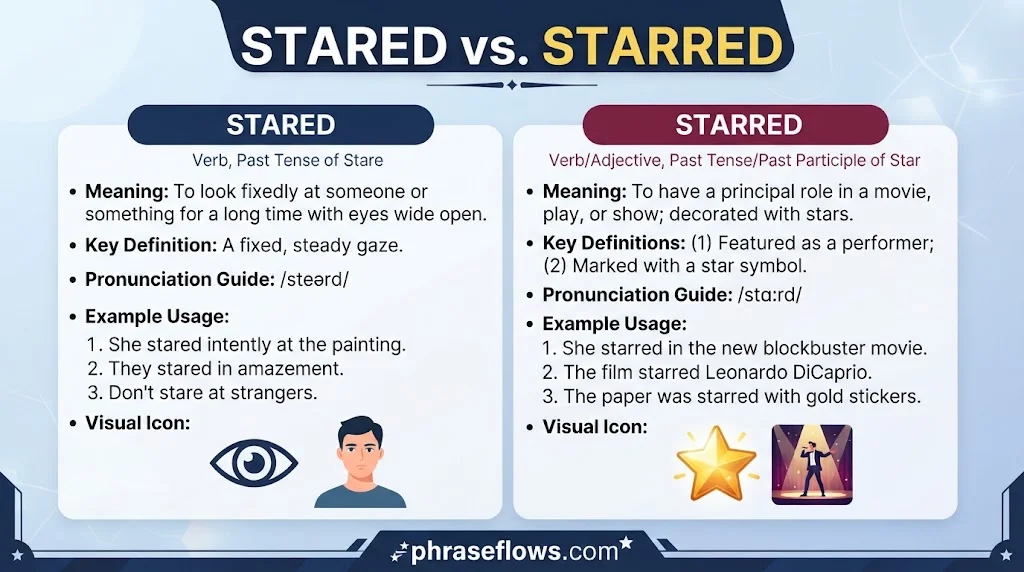

Have you ever paused while writing because you couldn’t decide between stared and starred? These two English words sound exactly alike when spoken, but they have completely different meanings. Stared relates to looking at someone or something with fixed attention, while starred can describe playing a leading role or marking something as important.
The difference between these words becomes clearer when you see them in a sentence. If someone looked at a beautiful sunset for a long time, you would say they stared at it. If an actor had a leading role in a movie, you would say they starred in it. Choosing the wrong word can change the meaning of your entire sentence and may make your writing confusing or careless.
The good news is that you can easily avoid this common grammar mistake once you connect each word with its meaning. Think of stared when the sentence is about looking, and starred when it is about acting, featuring, or marking something. With a few clear examples and simple memory tricks, you can use both words naturally and confidently.
Stared vs. Starred: The Quick Difference
The easiest way to understand stared vs. starred is to look at their base verbs.
| Word | Base verb | Main meaning | Example |
| Stared | stare | Looked intently or fixedly | She stared at the painting. |
| Starred | star | Appeared as a leading performer | He starred in the movie. |
| Starred | star | Marked with a star or asterisk | I starred the important points. |
So, if you’re talking about looking, use stared. If you’re talking about acting, featuring, or marking something with a star, use starred.
A useful shortcut is this:
Stared = looked. Starred = featured or marked.
The surrounding words can also help. Stared at commonly relates to looking, while starred in commonly relates to performing in a production.
What Does “Stared” Mean?
Stared is the past tense and past participle of the verb stare. It means to look at someone or something steadily, directly, or for longer than a normal glance.
A stare usually lasts longer than an ordinary look. It can happen because you’re surprised, curious, confused, impressed, distracted, or deeply focused.
For example:
- She stared at the painting for several minutes.
- He stared at me in surprise.
- They stared out the window during the long journey.
- I stared into space while thinking about the problem.
- The child stared at the enormous dinosaur skeleton.
The word itself doesn’t always tell you why someone is looking. Context supplies that information.
Someone might stare because they saw something unexpected. Another person might stare because they’re concentrating on a difficult task.
Common Expressions With “Stared”
You’ll often see stared with particular prepositions or adverbs.
Stared at means looked directly and intently at something or someone.
She stared at the strange message on her phone.
Stared into often describes looking deeply into a space or surface.
He stared into the distance.
Stared out can describe looking outward through a window or opening.
She stared out the train window.
Stared blankly describes looking without showing much expression or apparent reaction.
He stared blankly at the question.
These patterns make stared relatively easy to recognize once you know its meaning.
What Does “Starred” Mean?
Starred is the past tense and past participle of star. The verb star has several meanings, but two are especially important when distinguishing it from stared.
The first common meaning relates to entertainment. If an actor starred in a movie, television show, play, or other production, that person had a major or leading role.
For example:
- The actor starred in a successful comedy.
- She starred in several television productions.
- The film starred two well-known performers.
- He starred alongside an experienced cast.
The second meaning involves marking something with a star or asterisk.
For example:
- I starred the questions I wanted to review.
- The editor starred the most important paragraph.
- She starred the entries that needed attention.
In this sense, starred means something was marked or highlighted with a star symbol.
“Starred” in Entertainment
The entertainment meaning often appears with in, alongside, or similar wording.
The actor starred in the film.
Here, starred has nothing to do with looking. It tells you about the person’s role in the production.
This distinction becomes especially important in biographies, movie descriptions, reviews, and entertainment articles.
Compare:
- She stared at the actor. → She looked at the actor.
- She starred in the movie. → She acted as a prominent performer in the movie.
The sentences differ by only one letter in the verb, yet their meanings are unrelated.
“Starred” as a Mark or Symbol
You may also encounter starred in instructions, notes, forms, lists, and documents.
For example:
Please complete all starred fields.
Here, starred means the fields have been marked with a star or asterisk.
Another example:
The teacher asked students to review the starred questions.
The questions aren’t performers. Someone marked them with stars to draw attention to them.
Stared vs. Starred in Grammar
Understanding the base verbs makes the spelling much easier.
| Base verb | Past tense | Meaning |
| stare | stared | Look fixedly or intently |
| star | starred | Feature prominently or mark with a star |
The spelling difference comes from how each base verb combines with the past-tense ending -ed.
Why “Stare” Becomes “Stared”
The verb stare ends in a silent e. When English adds -ed to many verbs ending in silent e, the existing e remains and the suffix contributes d.
So:
stare → stared
You can see the same pattern in:
- care → cared
- hope → hoped
- smile → smiled
- bake → baked
- move → moved
Notice that stared doesn’t need a second r.
Why “Star” Becomes “Starred”
The verb star has a different spelling pattern.
It is a one-syllable verb ending in a consonant after a short vowel sound. When -ed is added, the final consonant is doubled:
star → starred
Similar examples include:
- stop → stopped
- plan → planned
- rub → rubbed
- drop → dropped
- shop → shopped
The doubled consonant helps preserve the pronunciation associated with the base word.
This is why starred has two r’s while stared has only one.
Stared vs. Starred: Why the Extra R Matters
At first glance, the difference between stared and starred may look like a tiny spelling detail. It isn’t.
Consider these sentences:
The audience stared at the performer.
The audience looked at the performer.
The performer starred in the play.
The performer had a major role in the play.
The first sentence describes an act of looking. The second describes a role in entertainment.
This makes the spelling important because using the wrong form can change the meaning of the sentence.
A Simple Meaning Test
When you’re unsure which word to use, ask yourself:
Is the sentence about looking?
If yes, choose stared.
Is the sentence about acting, featuring, or marking something with a star?
If yes, choose starred.
For example:
We stared at the stars.
Here, stared means looked at.
The actress starred in the television series.
Here, starred means appeared as a major performer.
The noun stars in the first sentence doesn’t change the spelling of the verb. That’s an important detail. You can stare at stars, but you don’t star at them when you mean “look at them.”
Stared vs. Starred: Common Sentence Examples
Seeing the words in realistic sentences makes the difference easier to remember.
Examples With “Stared”
- The students stared at the unexpected experiment.
- She stared at the screen while waiting for the page to load.
- He stared into the distance from the balcony.
- The dog stared at the empty food bowl.
- I stared blankly at the complicated instructions.
- Everyone stared when the lights suddenly went out.
- She stared out the window during the rainy afternoon.
- He stared at the map before choosing a route.
- The audience stared at the unusual stage setup.
- They stared in disbelief when the result appeared.
In each example, stared relates to visual attention.
Examples With “Starred”
- The actor starred in a major motion picture.
- She starred in a popular television drama.
- The play starred several experienced performers.
- He starred alongside his longtime acting partner.
- The director’s latest film starred a young cast.
- I starred the questions I need to study.
- She starred the important names on the list.
- The form contains several starred fields.
- The teacher marked the starred exercises for extra practice.
- The article includes starred items that need attention.
Here, the word either describes performing or marking something with a star.
Stared vs. Starred: Side-by-Side Examples
A direct comparison can make the distinction stick.
| Stared | Starred |
| She stared at the painting. | She starred in the movie. |
| He stared at the strange object. | He starred alongside a famous actor. |
| They stared in surprise. | The film starred two leading performers. |
| I stared into the distance. | I starred the key points in my notes. |
| The child stared at the bright display. | The teacher reviewed the starred questions. |
| We stared out the window. | The show starred a talented young cast. |
The preposition often gives you a valuable clue.
Stared at → looking
Starred in → appearing in a production
Starred the item → marked the item
Stared at vs. Starred in
Among all the possible combinations, stared at and starred in cause some of the most frequent confusion.
“Stared at”
Use stared at when someone looks steadily or intently at a person, object, place, or image.
The customer stared at the menu.
The customer is looking at the menu.
She stared at the photograph.
She looked at the photograph for some time.
“Starred in”
Use starred in when someone had a prominent role in a movie, show, play, or another production.
The actor starred in the comedy.
The actor had a leading or prominent role.
She starred in the school play.
She performed in an important role in the play.
A useful memory trick is to connect the preposition to the meaning:
Stared at something.
Starred in something.
That distinction won’t cover every possible grammatical use of the verbs, but it works extremely well for these common expressions.
Common Mistakes With Stared and Starred
Writing “starred at” When You Mean “looked at”
A common error is:
❌ She starred at him.
If you mean she looked at him intently, write:
✅ She stared at him.
The verb needs the e before the d because it comes from stare.
Writing “stared in” When You Mean “acted in”
Another common mistake appears in entertainment writing.
❌ He stared in the movie.
The correct sentence is:
✅ He starred in the movie.
Here, the verb comes from star, not stare.
Confusing “Stared” With “Starred”
Because the two words sound very similar in many varieties of English, spelling mistakes can slip through when you’re writing quickly.
The best solution isn’t to memorize the letters separately. Instead, connect each spelling with its meaning:
- stare → stared → looking
- star → starred → performing or marking
That gives you a meaning-based memory rather than a purely visual one.
Is “Stared” or “Starred” Correct?
Both are correct. The correct choice depends entirely on what you mean.
Use stared when the verb means looked intently.
He stared at the clock.
Use starred when the verb means featured as a performer.
He starred in the television show.
Use starred when something has been marked with a star or asterisk.
She starred the most important sentences.
Therefore, asking which spelling is “correct” without considering the sentence isn’t enough. Both words belong to standard English.
Is It “Stared in a Movie” or “Starred in a Movie”?
The correct expression is starred in a movie when you mean that someone had a significant acting role.
The actor starred in a new movie.
The incorrect form is:
❌ The actor stared in a new movie.
Why? Stared means looked intently. It doesn’t mean “acted in” or “appeared as a leading performer.”
You can certainly use stared and movie in the same sentence if the meaning involves looking:
The audience stared at the screen throughout the movie.
Here, stared is correct because the audience was looking at the screen.
Is It “Stared at Me” or “Starred at Me”?
If the intended meaning is looked at me, the correct phrase is:
She stared at me.
Not:
❌ She starred at me.
The extra r in starred belongs to the verb star. It doesn’t create a stronger form of stare.
You can think of the difference this way:
stare + at → look at
star + in → perform in
That small distinction solves many common spelling errors.
Is “Starred at” Ever Correct?
Starred at isn’t the standard phrase when you mean “looked at.”
For that meaning, use stared at.
✅ He stared at the painting.
❌ He starred at the painting.
The verb starred has its own meanings. It can describe someone who performed prominently or something that received a star or asterisk mark.
The context matters, but starred at shouldn’t replace stared at.
Stared vs. Starred: Word Forms
Knowing the related forms can prevent additional spelling mistakes.
| Verb | Present | Past | -ing form | Meaning |
| stare | stare | stared | staring | Look intently |
| star | star | starred | starring | Feature prominently or mark with a star |
Notice another important difference:
- stare → staring
- star → starring
The second verb doubles the r before -ing.
Stared, Starred, and Starring
These three forms are easy to mix up when you’re writing about entertainment.
Stared means looked intently.
She stared at the poster.
Starred means had a prominent role.
She starred in the production.
Starring is the present participle or gerund form of star.
The film is starring several established performers.
The spelling starring contains two r’s because it comes from star.
A Quick Spelling Guide
| If you mean… | Use… | Example |
| Looked intently | stared | He stared at the screen. |
| Had a leading role | starred | She starred in the film. |
| Marked with a star | starred | I starred the important section. |
| Looking right now | staring | He is staring at the screen. |
| Performing in a production | starring | The movie is starring several actors. |
This distinction becomes much easier when you focus on the base verb instead of the spelling alone.
How to Remember the Difference Between Stared and Starred
A simple memory trick can save you from second-guessing the spelling.
Think “Eyes” for Stared
Stared contains the base word stare.
When someone stares, they’re using their eyes to look at something.
Stared = looked.
Think “Star” for Starred
Starred contains the complete word star.
A star can be a famous performer. Something can also receive a star as a mark.
Starred = performed or marked.
So remember:
One R: stared → looked.
Two Rs: starred → star, performer, or star symbol.
Practice: Stared or Starred?
Choose the correct word in each sentence.
- The audience ___ at the unusual costume.
- The actress ___ in three productions.
- I ___ the questions that seemed most important.
- He ___ at the clock during the meeting.
- The television series ___ several well-known performers.
- She ___ into the distance.
- The form asks you to complete all ___ fields.
Answers
- The audience stared at the unusual costume.
- The actress starred in three productions.
- I starred the questions that seemed most important.
- He stared at the clock during the meeting.
- The television series starred several well-known performers.
- She stared into the distance.
- The form asks you to complete all starred fields.
The key is to identify the action first. Once you know what the sentence means, the spelling usually becomes obvious.
Why English Speakers Confuse Stared and Starred
The confusion comes partly from pronunciation. In ordinary speech, the difference between stared and starred may be difficult to notice depending on the speaker’s accent.
Their spellings also look almost identical:
- stared
- starred
Both begin with star, but stared actually comes from stare while starred comes from star.
That makes the words a perfect example of why English spelling can’t always be solved by sound alone.
Context provides the missing information.
If the sentence talks about eyes, looking, watching, or observing, stared is probably the right choice.
If it talks about actors, movies, television, plays, performers, or star symbols, starred is probably what you need.
Read More: Trek vs Treck: Which Spelling Is Correct? Meaning, Usage, and Examples
Final Comparison: Stared vs. Starred
| Feature | Stared | Starred |
| Base verb | stare | star |
| Basic meaning | Looked intently | Featured prominently or marked with a star |
| Common phrase | stared at | starred in |
| Number of r’s | One | Two |
| Entertainment use | No | Yes |
| Marking use | No | Yes |
| Example | She stared at him. | She starred in the play. |
Conclusion:
Understanding stared vs. starred becomes easy when you remember what each word describes. Stared is the past tense of stare and means looking at someone or something with fixed attention, while starred is the past tense of star and can mean having a leading role, featuring prominently, or marking something with a star or asterisk.
The easiest way to remember the difference is to connect stared with looking and starred with acting, featuring, or marking. Although the words sound alike, their meanings and uses are different. Choosing the correct word will help you make your sentences clearer and avoid common grammar mistakes.
FAQs:
Is “stared” the same as “starred”?
No. Stared means looked at someone or something with fixed attention, while starred can mean played a leading role, featured prominently, or marked something with a star.
What is the past tense of “stare”?
The past tense of stare is stared. For example, “She stared at the painting for several minutes.”
What is the past tense of “star”?
The past tense of star is starred. For example, “The actor starred in a popular movie.”
How can I remember the difference between stared and starred?
A simple memory trick is to connect stared with looking and starred with acting, featuring, or marking. This makes the difference easier to remember.
Why do people confuse stared and starred?
People often confuse them because stared and starred sound alike when spoken. Their spelling and meanings are different, so checking the context can help you choose the correct word.




1 thought on “Stared vs. Starred: How to Use Each Word Correctly”