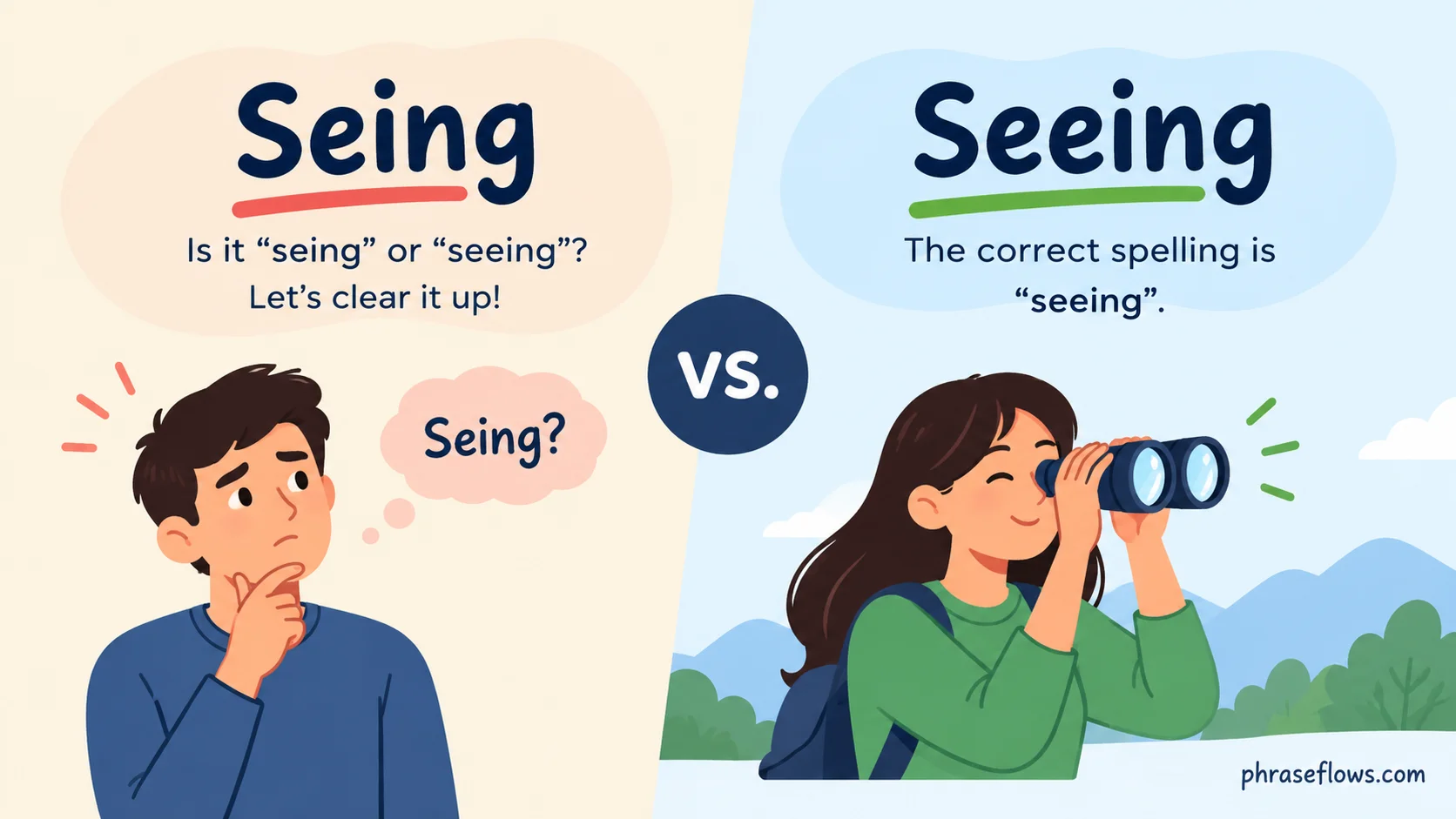

Have you ever paused while typing a word because you weren’t sure whether its spelling was correct? Seing vs. Seeing: Difference, Meaning, Spelling Rules, and Usage is a common English spelling topic that can confuse writers in everyday situations. Although both forms may appear online, seeing is the correct spelling in standard English, while seing is a misspelling. This small error can easily slip into emails, school assignments, blog posts, and other written communication.
The main reason for this mistake is that people sometimes forget to keep both e’s when adding -ing to the verb see. The correct word formation is simple: see + ing = seeing. The word seeing can function as a present participle or a gerund, depending on how it is used in a sentence. For example, “I am seeing the doctor tomorrow” describes a planned appointment, while “Seeing the results made her happy” uses the word differently. Understanding this spelling rule makes it easier to recognize the correct form.
Learning the difference between seing and seeing can improve your spelling accuracy and help you avoid common writing errors. Even if autocorrect doesn’t catch a mistake, checking repeated letters during proofreading can help you find it. Whether you’re writing online content, preparing an assignment, or sending a quick message, knowing the correct spelling helps your writing stay clear and professional. Once you understand the rule, remembering the correct form becomes much easier.
Seing vs. Seeing: What’s the Difference?
The main difference between seing and seeing comes down to spelling. Seeing is the standard present participle of the verb see. Writers sometimes misspell it as seing by accidentally leaving out one of the two e’s in the original word.
According to the Cambridge Dictionary, the verb see has three principal forms: see, saw, and seen. Its present participle is seeing.
definition in the Cambridge English Dictionary
+1
Consider these examples:
- Correct: I enjoy seeing my friends on weekends.
- Incorrect: I enjoy seing my friends on weekends.
- Correct: We are seeing the results of our hard work.
- Incorrect: We are seing the results of our hard work.
The incorrect examples contain a spelling error, not a different grammatical form. Replacing seing with seeing fixes the problem without changing the intended meaning.
| Word | Status | Explanation | Example |
| Seeing | Correct | The -ing form of see | She is seeing a doctor. |
| Seing | Generally incorrect | A misspelling of seeing in ordinary English | She is seing a doctor. |
| See | Correct | The base form of the verb | I see a bird. |
| Saw | Correct | The simple past tense | I saw a bird. |
| Seen | Correct | The past participle | I have seen that bird before. |
Why Does Seeing Have Two E’s?
The answer is straightforward: the base verb see already contains two e’s, and both remain when you add -ing.
The spelling follows this pattern:
See + ing = seeing
You don’t remove either e. You simply attach -ing to the original verb.
This is similar to agree, which becomes agreeing, and flee, which becomes fleeing. The final letters of these verbs remain in place when the suffix is added.
However, English verbs don’t all follow the same spelling pattern. For example, make becomes making because the final silent e disappears before -ing. That’s why learning the correct form of each verb matters.
What Does Seeing Mean?
Seeing is the present participle of see. Depending on the context, it can describe visual observation, a meeting, an experience, or the process of understanding something. It can also function as a gerund, which means an -ing verb form acts as a noun.
The Cambridge Dictionary identifies several meanings of see, including using your eyes, meeting someone, and understanding an idea. These meanings carry over into sentences that use seeing.
definition in the Cambridge English Dictionary
+1
Let’s look at the most common uses.
Seeing Means Looking at Something
The most familiar meaning of seeing involves using your eyes to notice people, objects, places, or events.
For example:
- I am seeing a beautiful sunset from my balcony.
- We enjoyed seeing the mountains during our trip.
- She is seeing the birds outside her window.
- They were seeing the fireworks when the lights went out.
In these examples, seeing describes visual observation. The word doesn’t change its spelling, whether you’re looking at a sunset or watching fireworks.
One important detail: English speakers often use can see rather than am seeing when describing what they can observe at that moment. For instance, “I can see the mountains” sounds more natural than “I am seeing the mountains” in many everyday situations.
Cambridge Dictionary
Seeing Means Meeting or Visiting Someone
The word seeing can also describe meeting someone, visiting a person, or having an appointment.
For example:
- I’m seeing my dentist tomorrow morning.
- We’re seeing our grandparents this weekend.
- She’s seeing a career counselor about her future.
- He is seeing his teacher after class.
Notice that these sentences don’t necessarily involve looking at something. Instead, seeing refers to meeting or visiting someone.
The continuous form works naturally when you talk about an arranged meeting or a planned visit.
Cambridge Dictionary
+1
Seeing Means Understanding Something
Sometimes, seeing refers to recognizing an idea or understanding a situation rather than using your eyes.
Consider these examples:
- After reading the explanation, I’m seeing the problem differently.
- She’s seeing why the decision matters.
- Once you examine the evidence, you’ll start seeing the bigger picture.
In everyday conversation, however, English speakers often use I see to mean “I understand.” They generally don’t use the continuous form in that same sense.
For example:
- Natural: I see what you mean.
- Less natural in the intended sense: I’m seeing what you mean.
The distinction matters because the correct spelling doesn’t automatically make every sentence sound natural. You also need to choose the appropriate verb form for the meaning you want to express.
Cambridge Dictionary
+1
Seeing Means Experiencing Something
You can also use seeing when describing an experience or an event that unfolds over time.
For example:
- Our town is seeing rapid growth.
- The company is seeing more customers this year.
- We’re seeing positive changes in the classroom.
- Scientists are seeing new possibilities for future research.
In these sentences, seeing means experiencing, witnessing, or observing a development. The word can describe changes in a community, business, or other situation.
The intended meaning comes from the surrounding words. That’s why reading the complete sentence is often more helpful than examining a word in isolation.
How to Use Seeing in a Sentence
Although seeing has only one standard spelling, it can serve different grammatical functions. Understanding these functions helps you write more accurate and natural sentences.
Seeing in Continuous Verb Tenses
One common use of seeing is in continuous verb constructions. These forms usually include a version of the verb be, such as am, is, are, was, or were.
The basic present continuous pattern is:
Subject + am/is/are + seeing
Examples:
- I am seeing my doctor this afternoon.
- She is seeing a movie with her family.
- They are seeing improvements in their project.
- We were seeing several interesting sights during our vacation.
The exact meaning depends on the context. In one sentence, seeing can describe a planned meeting. In another, it can refer to observing a change or experiencing a development.
Be careful not to assume that every use of see works naturally in the continuous tense. When see means understanding something, the simple present often sounds better.
| Less natural or incorrect for the intended meaning | More natural alternative |
| I’m seeing what you mean. | I see what you mean. |
| She’s seeing the answer now. | She understands the answer now. |
| I’m seeing the words on the page. | I can see the words on the page. |
The first column isn’t universally wrong in every possible context. The point is to choose a construction that matches your intended meaning.
Seeing as a Gerund
A gerund is an -ing form of a verb that functions as a noun. When seeing acts as a gerund, it can serve as the subject or object of a sentence.
For example:
- Seeing is believing.
- I enjoy seeing new places.
- Seeing the final result made everyone happy.
- She appreciates seeing her hard work pay off.
In the first sentence, seeing acts as the subject of the statement. In the second, it follows the verb enjoy and functions as its object.
Here’s another useful example:
“Seeing the finished painting made Daniel smile.”
The phrase seeing the finished painting identifies what made Daniel smile. The entire phrase functions as the subject of the sentence.
Recognizing gerunds can help you understand why seeing sometimes appears without a helping verb such as is or are.
Seeing in Common Expressions
English contains several familiar expressions that use seeing. Learning them helps you recognize the word in everyday conversation, books, and articles.
| Expression | Meaning | Example |
| Seeing is believing | Direct experience can make something easier to believe. | I didn’t think the machine could work, but seeing is believing. |
| Seeing eye to eye | Agreeing with someone | My classmates and I are seeing eye to eye on the project. |
| Seeing the bigger picture | Understanding the overall situation | Try seeing the bigger picture before making a decision. |
| I’ll be seeing you | A casual way to say goodbye | Thanks for visiting. I’ll be seeing you soon. |
| Seeing that | Given that; because | Seeing that everyone was ready, we started the meeting. |
These expressions don’t require any special spelling changes. The word remains seeing in each case.
One useful distinction: seeing eye to eye is an established idiom, while seeing the bigger picture is a common figurative expression. Both use seeing correctly, but their meanings go beyond literal eyesight.
Seing vs. Seeing: Correct and Incorrect Examples
The fastest way to remember the difference is to compare incorrect spellings with corrected sentences. In every example below, the standard spelling is seeing.
| Incorrect sentence | Correct sentence |
| I am seing a bird outside. | I am seeing a bird outside. |
| She enjoys seing her friends. | She enjoys seeing her friends. |
| We are seing the results now. | We are seeing the results now. |
| He is seing a specialist tomorrow. | He is seeing a specialist tomorrow. |
| They look forward to seing the show. | They look forward to seeing the show. |
| Seing the ocean made me happy. | Seeing the ocean made me happy. |
| I love seing new places. | I love seeing new places. |
| Are you seing the difference? | Are you seeing the difference? |
Each correction follows the same spelling rule. Add -ing to see without removing either e.
However, a sentence can have the right spelling and still need a grammatical adjustment. For instance, “I am seeing the difference” can work when describing a developing realization, but “I see the difference” is often more natural when you simply want to say that you understand.
Remember: Spelling, grammar, and natural usage are related, but they aren’t the same thing.
Common Mistakes to Avoid When Writing Seeing
Even confident writers make small spelling errors. Fortunately, a few simple checks can help you catch them before you publish an article, send an email, or submit an assignment.
Leaving Out One E
The most direct mistake is writing seing instead of seeing.
Because both forms look similar, the missing letter can escape notice during a quick review. This is especially common when you’re typing quickly or focusing on the meaning rather than the spelling.
Quick fix: Check that the word contains the complete sequence s-e-e-i-n-g.
Applying the Wrong Spelling Rule
Some English verbs drop a final silent e when you add -ing. For example:
- Make → making
- Write → writing
- Dance → dancing
However, see doesn’t follow that pattern. Its two e’s remain in place:
- See → seeing
- Agree → agreeing
- Flee → fleeing
The difference lies in the spelling of the base verb. Don’t remove a letter simply because another verb drops its final e.
Confusing Seeing With Seen or Saw
The words see, saw, seen, and seeing belong to the same verb family, but they don’t serve identical grammatical roles.
| Verb form | Grammatical role | Example |
| See | Base form or simple present | I see the sign. |
| Seeing | Present participle or gerund | I am seeing the sign clearly. |
| Saw | Simple past tense | I saw the sign yesterday. |
| Seen | Past participle | I have seen the sign before. |
A common mistake is writing “I have saw it” instead of “I have seen it.”
The correct construction uses have plus the past participle: I have seen it.
Likewise, seeing usually needs a suitable grammatical structure. You can write “I am seeing it” or “Seeing it made me happy,” but those sentences use the -ing form in different ways.
Assuming Pronunciation Determines Spelling
The pronunciation of seeing doesn’t provide a reliable reason to omit one of its letters. English spelling often preserves letters that don’t correspond neatly to separate sounds.
For that reason, it’s better to remember the written form than to guess the spelling from how the word sounds.
A useful habit is to read the complete word while checking its letters. Once the pattern becomes familiar, you’re less likely to type seing by mistake.
Read More: Channel vs. Chanel: Difference, Meaning, Spelling, and Usage
Easy Ways to Remember the Correct Spelling
If you frequently confuse seing with seeing, a simple memory trick can help. Instead of memorizing the incorrect form, build the correct spelling from the original verb.
Use the See + Ing Rule
Remember this simple formula:
SEE + ING = SEEING
The base word see contains two e’s. When you add -ing, keep both letters.
Try breaking the word into two parts:
- SEE — the original verb.
- ING — the suffix that creates the -ing form.
Put them together, and you get SEEING. This method works because it reminds you where every letter belongs.
Compare Seeing With Similar Verbs
Comparing related words can make English spelling patterns easier to remember.
| Base verb | Correct -ing form |
| See | Seeing |
| Agree | Agreeing |
| Flee | Fleeing |
| Be | Being |
| Make | Making |
| Write | Writing |
Notice that see, agree, and flee retain their final e’s. Meanwhile, make and write drop the final silent e before adding -ing.
The word be becomes being, which follows its own familiar pattern. Comparing these examples helps you understand why one spelling rule doesn’t work for every English verb.
Proofread With a Simple Checklist
Before submitting a piece of writing, check the following:
- Does the word contain two e’s before the -ing ending?
- Have I written seeing instead of seing?
- Does the sentence use the correct verb form?
- Does the sentence sound natural when read aloud?
- Have I checked for other small spelling mistakes?
You don’t need to spend several minutes checking one word. A quick review is usually enough to catch this particular error.
A Practical Example: Correcting Seing in Everyday Writing
Imagine that a student is writing a short paragraph about a family vacation.
The first draft reads:
“Last summer, we enjoyed seing the mountains. We were seing beautiful lakes along the road, and seing the sunset made the trip unforgettable.”
Although readers can probably understand the paragraph, the spelling error appears three times. Correcting it improves the writing immediately.
Here’s the revised version:
“Last summer, we enjoyed seeing the mountains. We saw beautiful lakes along the road, and seeing the sunset made the trip unforgettable.”
Notice another improvement: “We saw beautiful lakes” sounds more natural when describing a completed event during a past vacation.
This example illustrates two useful lessons:
- Correct spelling matters. Every occurrence of seing should become seeing.
- Verb tense matters, too. The simple past saw often works better when describing a completed experience.
The goal isn’t merely to replace one spelling with another. It’s to make the entire sentence clear, accurate, and natural.
Conclusion:
The difference between seing vs. seeing comes down to one simple spelling rule. Seeing is the correct form of the verb see with the suffix -ing, while seing is generally a misspelling in standard English. Whether you’re talking about observing something, meeting someone, or understanding a situation, always use seeing.
Remember the easy formula: see + ing = seeing. Keep both e’s when adding the suffix, and you’ll avoid this common spelling mistake. With a little practice, you’ll use seeing correctly in your everyday writing, emails, and articles.
FAQs:
Is Seing or Seeing Correct?
Seeing is the correct spelling in standard English. Seing is generally a misspelling of the present participle of see. For example, write “I enjoy seeing my friends,” not “I enjoy seing my friends.”
Why Does Seeing Have Two E’s?
The verb see already contains two e’s. When you add -ing, both letters remain, producing seeing. The correct spelling follows the simple pattern see + ing = seeing.
What Does Seeing Mean?
Seeing can mean looking at something, meeting someone, experiencing a situation, or understanding something. For example, “I’m seeing my doctor tomorrow” refers to a planned appointment, while “Seeing is believing” expresses the idea that firsthand experience helps you believe something.
Is Seeing a Verb or a Noun?
Seeing can function as a verb form or a gerund. In “She is seeing her doctor,” it forms part of the verb phrase. In “Seeing is believing,” it functions as a gerund acting as the subject of the sentence.
How Can I Remember the Correct Spelling of Seeing?
Use the formula SEE + ING = SEEING. Remember that the original verb see keeps both e’s when you add -ing. This simple trick helps you avoid writing seing by mistake.




1 thought on “Seing vs. Seeing: Difference, Meaning, Spelling Rules, and Usage”