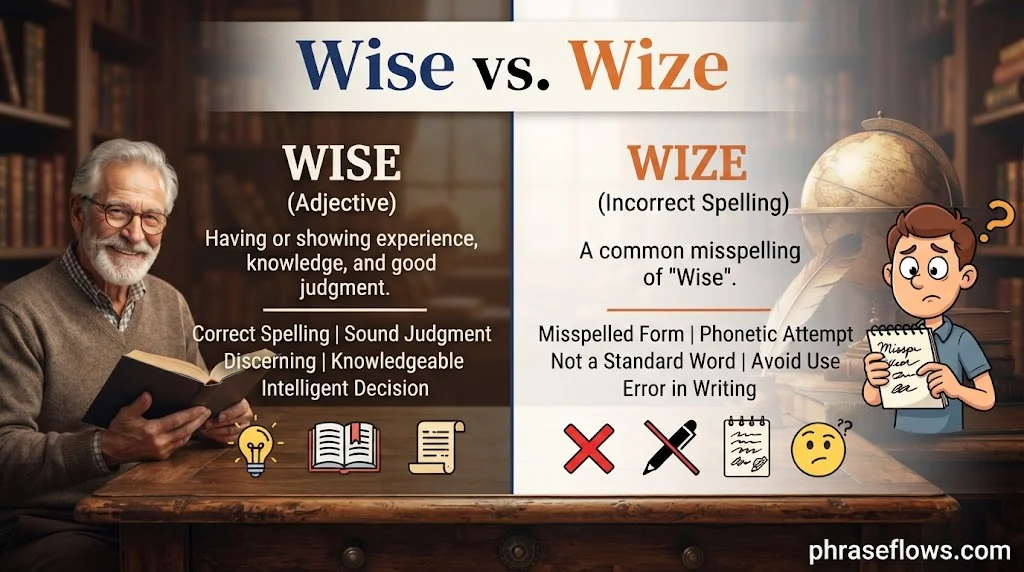

If you’ve ever wondered about Wise vs. Wize, you’re not alone. These two spellings look almost identical and sound the same, which makes them easy to confuse. However, wise is the correct spelling in modern standard English, while wize is generally considered a misspelling.
The word wise describes someone who has knowledge, good judgment, or experience. It is a common English word used in everyday conversations, books, education, emails, and professional writing. You may also see Wize online as a brand name, business name, product name, or creative spelling, but these special uses do not make it the standard spelling.
Understanding the difference between wise and wize can help you avoid simple spelling mistakes and make your writing clearer. In this guide, we’ll look at the meaning, correct usage, common mistakes, and examples so you can confidently choose the right spelling whenever you write.
Wise vs. Wize: Which One Is Correct?
The short answer is simple: wise is the correct standard English spelling.
Use wise when you mean someone or something that shows good judgment, knowledge, or practical understanding. Oxford defines wise as being able to make sensible decisions and give good advice because of experience and knowledge. It also uses the word for actions that are sensible or based on good judgment.
For example:
- She made a wise decision.
- His grandfather gave him wise advice.
- It would be wise to check the details first.
- A wise leader listens before making a decision.
- Saving some money was a wise choice.
In each sentence, wize would be incorrect if it were intended as the ordinary English word.
| Word | Standard English spelling? | Typical use |
| wise | Yes | Describing good judgment, knowledge, or sensible choices |
| wize | No, not as the ordinary spelling of wise | May appear in names, brands, usernames, or stylized writing |
One important distinction matters here. A nonstandard spelling can still be the official spelling of a name. If a company or product deliberately calls itself Wize, changing it to Wise would no longer reproduce that proper name accurately.
What Does “Wise” Mean?
Wise is an adjective associated with good judgment and practical understanding. It doesn’t simply mean “intelligent.”
Someone can be intelligent without always making sensible decisions. A wise person generally combines knowledge or experience with sound judgment.
For example, imagine two students preparing for an important presentation. One knows a lot about the subject but ignores the deadline and doesn’t practice. Another knows the material well and also plans ahead, checks the facts, and prepares for questions.
The second student’s behavior could be described as wise because knowledge has been turned into sensible action.
Cambridge defines wise as having or showing the ability to make good judgments based on a deep understanding and experience of life.
Wise as an Adjective
The most common use of wise is as an adjective.
It can describe a person:
She is a wise teacher who knows when to listen.
It can also describe a decision or action:
Moving the meeting to a quieter location was a wise choice.
Common combinations include:
- wise person
- wise leader
- wise decision
- wise choice
- wise advice
- wise move
- wise investment
- wise approach
- wise course of action
The word often carries a positive judgment. Calling something a wise decision suggests that the decision makes sense after considering the circumstances.
Oxford specifically lists combinations such as wise decision, wise move, wise choice, and wise investment.
Wise Doesn’t Always Mean Highly Intelligent
This distinction is worth remembering.
Intelligent often relates to mental ability or the capacity to understand complex ideas. Wise focuses more strongly on judgment and the sensible use of knowledge or experience.
Consider this example:
Maya understood every technical detail but ignored the obvious risks.
She may be intelligent, but ignoring those risks wouldn’t necessarily be wise.
Now consider:
Maya understood the risks and chose the safer option.
That decision was wise.
In everyday English, the two words can overlap. They aren’t perfect synonyms.
Wise as a Verb in “Wise Up”
Wise also appears as a verb, although this use is less common than the adjective.
The expression wise up means to become aware of something, especially after previously failing to recognize what was happening. Oxford lists wise up as a phrasal verb and also records expressions such as get wise to somebody or something.
For example:
- He eventually wised up to the situation.
- You need to wise up and pay attention.
- She quickly got wise to what was happening.
This is a useful reminder that wise has a wider grammatical role than simply describing a person.
The spelling doesn’t change to wize just because the pronunciation contains a z sound.
Common Expressions With “Wise”
The word wise appears in several familiar expressions.
Wise Choice
A wise choice is a choice that shows good judgment.
Taking notes during the lecture was a wise choice.
Wise Decision
A wise decision is a decision based on sensible thinking.
It was a wise decision to compare the options before choosing one.
Wise Advice
Wise advice usually comes from experience or careful judgment.
Her wise advice helped him avoid an unnecessary problem.
Wise Move
A wise move means a smart or sensible action.
Backing up the files was a wise move.
Wise Up
Wise up means to become more aware or informed about a situation.
Eventually, he wised up to the fact that the offer wasn’t genuine.
-Wise
The spelling -wise also appears as a suffix. Cambridge explains that it can mean “in this way or direction” or, informally, “relating to” a particular subject.
Examples include:
- clockwise
- lengthwise
- likewise
- otherwise
- money-wise
- weather-wise
The suffix has a broader grammatical history and function than simply using wise as an adjective.
What Does “Wize” Mean?
In ordinary English, wize isn’t the standard spelling of the adjective wise.
That’s the most important point.
If a sentence says:
She gave me wize advice.
The expected standard spelling is:
She gave me wise advice.
Likewise:
It would be wise to wait.
Not:
It would be wize to wait.
However, seeing Wize somewhere doesn’t automatically mean the writer made a mistake. A word can function as a proper name even when its spelling differs from standard vocabulary.
For example, a fictional company, website, product, or username might intentionally use Wize as its chosen name. In that context, the spelling belongs to the name rather than serving as an alternative spelling of the adjective.
That distinction is important in editing. Don’t “correct” an official name simply because it looks unusual.
Wise vs. Wize: Key Differences
| Feature | Wise | Wize |
| Standard English spelling | Yes | No |
| Ordinary dictionary adjective | Yes | No |
| Means showing good judgment | Yes | Not normally |
| Suitable for academic writing | Yes | No, unless it is a proper name |
| Suitable for professional writing | Yes | Only when referring to a specific name |
| Can appear as a brand or username | Yes | Yes |
| Common spelling error | No | Yes, when intended to mean wise |
| Pronunciation | /waɪz/ | Usually intended to imitate wise when used as a stylization |
The table highlights the central issue: wise and wize aren’t interchangeable spellings in standard English.
Why Do People Spell “Wise” as “Wize”?
The main reason is pronunciation.
The word wise is pronounced /waɪz/. The final s produces a z sound, not the sound many learners expect from the letter s. Cambridge gives the American pronunciation as /waɪz/.
That creates a natural spelling trap.
Someone may think:
Sound: /waɪz/
Expected spelling: wize
But English doesn’t work that neatly.
The spelling wise is established regardless of the sound produced by the final letter.
This same problem appears elsewhere in English. A letter can represent a sound that differs from its most familiar pronunciation. That’s why relying entirely on sound can lead to spelling errors.
Sound and Spelling Aren’t the Same Thing
Think of pronunciation as the spoken map of a word and spelling as its written address. They point to the same word, but the routes aren’t always identical.
With wise, the written s represents the /z/ sound.
So:
wise → /waɪz/
The spelling remains wise.
This is why hearing the word isn’t enough to determine whether it should contain an s or z.
Common Mistakes With Wise and Wize
The most common mistake happens when writers spell the word according to how it sounds.
Mistake: Using “Wize” in Standard Writing
Incorrect:
Making a wize decision can save time.
Correct:
Making a wise decision can save time.
Mistake: Assuming the Z Sound Requires the Letter Z
Incorrect:
She gave me some wize advice.
Correct:
She gave me some wise advice.
The sound doesn’t determine the spelling by itself.
Mistake: Treating Wize as an Alternative Spelling
In standard English, wize isn’t simply a casual alternative to wise.
It’s better to think of the two forms this way:
wise = standard English word
Wize = potentially a deliberate name or stylization
That simple distinction prevents most errors.
Wise vs. Wize in Formal and Informal Writing
Academic Writing
In school, college, research, and other academic contexts, use wise when the adjective is required.
For example:
The committee made a wise decision after reviewing the evidence.
Avoid:
The committee made a wize decision after reviewing the evidence.
A nonstandard spelling can distract the reader and may be marked as a spelling error.
Professional Writing
Business emails, reports, proposals, resumes, and workplace documents also call for wise.
For example:
It would be wise to review the agreement before signing.
The unusual spelling wize can make polished writing look careless unless you’re intentionally referring to a company or product named Wize.
Social Media and Casual Writing
Online writing is more flexible. People sometimes alter spellings to create memorable usernames, product names, slogans, or visual identities.
That doesn’t make wize a standard spelling of wise.
A stylized spelling can serve a branding purpose while remaining nonstandard English.
Wise, Wisely, Wisdom, and Wiser: Related Words
Learning the word family makes the spelling easier to remember.
| Word | Part of speech | Meaning | Example |
| wise | Adjective | Showing good judgment | That was a wise choice. |
| wisely | Adverb | In a wise or sensible way | She spent her money wisely. |
| wisdom | Noun | Good judgment or knowledge gained through experience | His wisdom helped the team. |
| wiser | Comparative adjective | More wise | She became wiser with experience. |
| wisest | Superlative adjective | Most wise | That was the wisest option. |
Oxford lists wiser as the comparative form and wisest as the superlative form of wise.
Notice the spelling pattern:
wise → wiser → wisest → wisely → wisdom
The spelling doesn’t suddenly become wize simply because the pronunciation contains a /z/ sound.
Wise vs. Wize in Real-World Editing
Imagine you’re proofreading this sentence:
The manager made a wize decision after reviewing the numbers.
At first glance, the sentence sounds completely natural. That’s exactly why the mistake can survive casual proofreading.
The correct version is:
The manager made a wise decision after reviewing the numbers.
Now imagine a different sentence:
The company launched a new product called Wize.
Here, Wize could be correct because it functions as a proper name.
This creates an important editing rule:
Correct the spelling when it is being used as an ordinary English word. Preserve it when it is an intentional proper name.
Context determines which treatment is appropriate.
A Simple Case Study: Choosing the Right Spelling
Consider three situations.
Situation A: School Essay
It was wize to compare the sources before writing the report.
Correction: It was wise to compare the sources before writing the report.
Why? The sentence uses the ordinary English adjective.
Situation B: Business Document
The finance team recommended a wize investment strategy.
Correction: The finance team recommended a wise investment strategy.
Again, wise is the standard adjective.
Situation C: Brand Name
The customer downloaded the Wize app.
If Wize is the official name of that particular app, changing it to Wise would be inappropriate.
The lesson is straightforward: spelling depends on whether you’re writing ordinary English or reproducing an established name.
How to Remember the Correct Spelling of Wise
If you frequently confuse wise vs. wize, use a simple memory trick.
Think of the related word wisdom.
wise → wisdom
Both begin with wis-.
You can also remember a short sentence:
A wise person uses an S.
The sentence isn’t a grammar rule. It’s simply a memory aid.
Another useful approach is to focus on meaning rather than sound. If you’re describing good judgment, sensible behavior, or practical knowledge, the word you want is almost certainly wise.
Wise vs. Wize: Quick Usage Test
Try choosing the correct form in each sentence.
| Sentence | Correct answer |
| It would be ___ to check the figures again. | wise |
| She gave me some ___ advice. | wise |
| That was a very ___ decision. | wise |
| He became ___ after years of experience. | wiser |
| The teacher encouraged students to spend their time ___. | wisely |
| The product is officially called ___. | Depends on the official name |
The first five clearly require forms from the wise word family.
The final example depends on context. If a company officially calls its product Wize, retain that spelling when referring to the product.
Read More: Blankie vs Blanky: Difference, Meaning, Usage, and Which Spelling Is Correct
Why “Wise” Is More Than a Spelling Choice
The difference between wise and wize may look like a tiny spelling issue, but it illustrates a larger feature of English: pronunciation and spelling don’t always match perfectly.
The spelling wise has been established in English for centuries. Its pronunciation does not give writers permission to replace s with z.
That’s why experienced writers don’t spell every word purely by sound. They learn the conventional written form and recognize common pronunciation patterns.
The same principle helps with many other English spelling questions.
Conclusion:
The difference between wise and wize is simple once you know which spelling belongs in standard English. Wise is the correct and accepted spelling when you mean someone who has good judgment, knowledge, or experience. Wize, on the other hand, is generally considered a misspelling, although it may appear as a brand name, business name, product name, or creative spelling.
When writing an email, essay, report, or professional document, choose wise. Remember that words can sound exactly alike without having the same spelling. Using the correct form will help you maintain clear, accurate, and professional writing.
FAQs:
Is wise or wize correct?
Wise is the correct spelling in modern standard English. Wize is generally considered a misspelling unless it is being used as a specific name, brand, or other proper name.
What does wise mean?
Wise means having good judgment, knowledge, or experience. It can describe a person, decision, action, or piece of advice.
Is wize a real word?
Wize may appear as an obsolete historical spelling or as a modern brand, business, product, or creative name. However, it is not the standard spelling you should normally use in modern English.
Why do people confuse wise and wize?
The two forms can sound the same when spoken, so pronunciation can make the spelling confusing. However, similar pronunciation does not mean that both spellings are correct.
Should I use wise in professional writing?
Yes. Use wise in professional emails, reports, essays, documents, and other standard forms of writing when you mean having good judgment or knowledge.


1 thought on “Wise vs. Wize: Usage and Mistakes Explained”