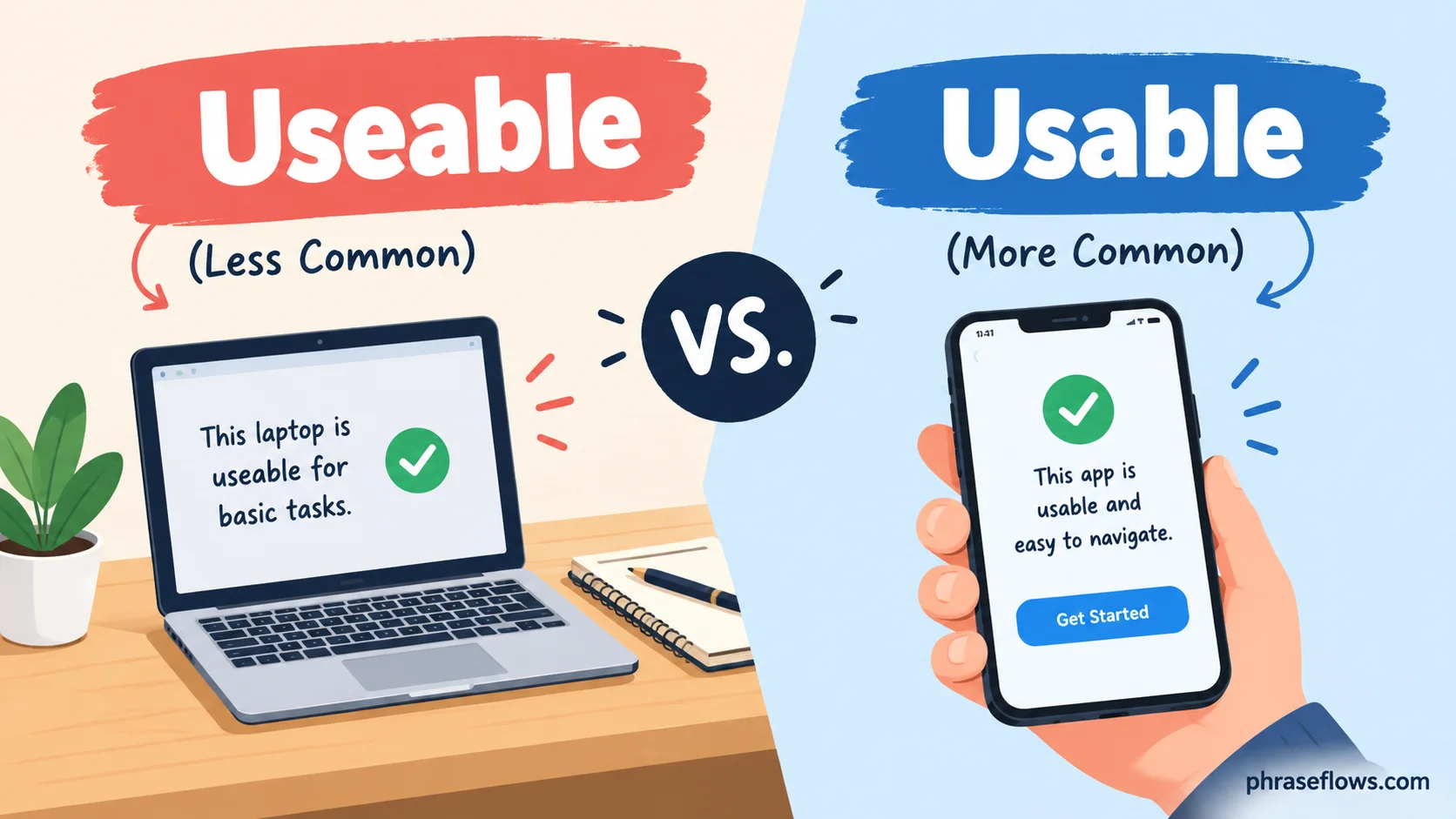

The difference between useable and usable can be confusing because both words look correct and have nearly the same meaning. Many people use them interchangeably when talking about something that can be used. However, usable is the more common and preferred spelling in modern English, while useable is considered a less common variant.
This small spelling difference often creates uncertainty in everyday writing, academic work, professional communication, and online content. When you understand the difference between useable vs. usable, you can make a clearer word choice and avoid unnecessary spelling mistakes. Knowing which form is more widely accepted can also make your writing look more consistent and polished.
In this guide, you will learn whether useable or usable is the correct choice, how each word is used, and which spelling works best in different contexts. We will also look at simple examples so you can understand the distinction easily and use the right form with confidence.
Useable vs. Usable: Quick Answer
Usable and useable are both adjectives. Both describe something that can be used or is suitable for use.
However, usable is the form most readers will expect in contemporary American English.
| Word | Meaning | Status | Best choice for US English |
| Usable | Able or suitable to be used | Standard and common | Yes |
| Useable | Able or suitable to be used | Recognized variant | Usually no |
| Unusable | Not able or suitable to be used | Standard opposite | Yes |
The important point is that useable isn’t simply a random misspelling. Merriam-Webster’s dictionary resources recognize useable, while Cambridge provides a pronunciation entry for the word.
So the practical rule is simple:
When you’re unsure, use “usable.”
That spelling is familiar, concise, and unlikely to distract your reader.
What Does “Usable” Mean?
Usable means capable of being used or suitable for a particular purpose.
The word often describes something that works well enough to serve its intended function. Cambridge gives examples involving software, houses, interfaces, data, and other practical things.
For example:
- The old laptop is still usable.
- We need to find a usable solution.
- Only three rooms are currently usable.
- The software has a simple and usable interface.
- The survey produced 416 usable responses.
Notice something important here. Usable doesn’t necessarily mean excellent. It means that something can actually be used for its intended purpose.
An old chair might be usable even if it isn’t attractive. A piece of software might be usable even if it lacks advanced features. A damaged building might become usable after repairs.
Usable in Everyday English
In everyday writing, usable usually describes an object, resource, space, or solution that remains practical.
Consider this sentence:
The phone has a cracked screen, but it’s still usable.
The speaker isn’t saying the phone is perfect. They’re saying it can still perform its basic function.
Another example:
We found a usable table in the storage room.
Here, usable means the table is suitable enough for its intended purpose.
This distinction makes the word especially useful when you want to avoid exaggeration. You can describe something as usable without claiming that it’s outstanding.
Usable in Technical and Professional Writing
The word appears frequently in technical contexts because professionals often need to distinguish between something that merely exists and something that can actually be used.
Common combinations include:
- usable data
- usable space
- usable information
- usable software
- usable interface
- usable equipment
- usable materials
- usable results
- usable design
- usable version
For example:
The researchers removed incomplete records and analyzed the remaining usable data.
Or:
The redesign created more usable space without expanding the building.
In software and design, usable can carry an especially practical meaning. A system may technically function while still being difficult for people to navigate. That’s why writers often talk about a usable interface or usable design.
What Does “Useable” Mean?
Useable generally means the same thing as usable: capable of being used or fit for use.
The spelling simply retains the extra e from use before adding -able.
For example:
The damaged equipment is still useable.
This means essentially the same thing as:
The damaged equipment is still usable.
The difference isn’t semantic. It’s primarily a matter of spelling preference and frequency.
Cambridge lists useable pronunciation information while its main dictionary entry is usable. Merriam-Webster’s resources also recognize useable as a word.
That matters because it means you shouldn’t automatically mark every occurrence of useable as an outright spelling error.
Instead, think of it as a less common variant.
Why Are “Useable” and “Usable” Both Used?
The confusion comes from the way English forms adjectives with the suffix -able.
The base verb is use. Adding -able can naturally make you think the result should be:
use + able = useable
That logic isn’t unreasonable.
English spelling, however, doesn’t always work like a simple mathematical equation. When suffixes attach to words, letters may be retained, dropped, or changed depending on established spelling conventions.
That’s why English contains many forms that don’t behave exactly alike.
Compare:
- use → usable
- read → readable
- wash → washable
- move → movable
- like → likable
- value → valuable
The spelling of derived words has developed through long-standing patterns of English usage. As a result, you can’t always determine the preferred modern spelling simply by attaching a suffix to the original word.
A Useful Way to Think About It
Imagine two roads leading to the same destination.
Useable and usable generally lead to the same meaning. However, usable is the road most modern American readers are accustomed to taking.
That doesn’t make the other road meaningless. It simply makes it less familiar.
Useable vs. Usable: Key Differences
There is no major difference in meaning between the two forms.
| Feature | Usable | Useable |
| Part of speech | Adjective | Adjective |
| Basic meaning | Able to be used | Able to be used |
| Pronunciation | Generally the same | Generally the same |
| Spelling | More concise | Retains the extra “e” |
| Modern usage | More common | Less common |
| American English | Preferred | Recognized variant |
| Formal writing | Recommended | Usually avoid unless required |
| Meaning difference | None in ordinary use | None in ordinary use |
The biggest practical difference is reader expectation.
If a reader sees usable, the word will probably pass unnoticed. That’s good. In polished writing, familiar wording often works best because readers can focus on the message rather than the spelling.
If the same reader sees useable, they may pause and wonder whether it’s a typo.
That hesitation is one reason usable makes the better default.
Useable vs. Usable: Which One Should You Use?
For most situations, choose usable.
This recommendation applies especially to:
- American English
- Business writing
- Academic writing
- Blog posts
- Website copy
- Product descriptions
- Technical documentation
- Reports
- Professional emails
- Educational material
For example, write:
The software is usable on both desktop and mobile devices.
Rather than:
The software is useable on both desktop and mobile devices.
The second sentence isn’t necessarily meaningless or grammatically incomprehensible. Yet the first version looks more natural to most contemporary readers.
When Might “Useable” Appear?
You may encounter useable in dictionaries, older publications, specialized writing, or material that follows a particular spelling preference.
If you’re quoting an original source, reproducing a historical document, or following an established house style, preserving useable may make sense.
Otherwise, there’s little practical reason to choose the less familiar form.
Correct Usage of “Usable”
Usable works as an adjective before a noun or after a linking verb.
Before a Noun
You can place usable directly before the noun it describes.
Examples:
- We need usable information.
- The team found usable evidence.
- The building has very little usable space.
- The company needs a more usable system.
- The researchers collected usable data.
After a Linking Verb
You can also use it after verbs such as be, remain, and become.
Examples:
- The equipment is still usable.
- The room became usable after repairs.
- The old computer remains usable.
- The document isn’t usable in its current form.
This flexibility makes usable a particularly practical adjective.
Common Collocations With “Usable”
Certain word combinations appear naturally in English.
Usable Space
Usable space refers to space that can actually serve a practical purpose.
The renovation increased the amount of usable space in the office.
Usable Data
Usable data refers to information that meets the requirements for a particular analysis, task, or purpose.
After removing incomplete records, the researchers had enough usable data.
Usable Information
Usable information is information that someone can actually apply or act upon.
The report contains plenty of information, but only some of it is immediately usable.
Usable Interface
In technology and design, a usable interface is one people can navigate and operate effectively.
The update gave the application a cleaner and more usable interface.
Usable Product
A product can be technically functional without being particularly convenient. Calling it usable focuses on whether people can actually use it for its intended purpose.
The prototype isn’t attractive yet, but it’s usable.
Correct Usage of “Useable”
Because useable is a recognized variant, it can appear in sentences without changing the basic meaning.
Examples include:
- The old equipment is still useable.
- We need a useable version of the document.
- Only a small section of the material remains useable.
- The designer created a more useable layout.
- Is this file useable for the final report?
Each sentence is understandable and follows the same grammatical pattern as its usable counterpart.
Still, if the goal is clear and conventional American English, usable is normally the stronger choice.
Usable vs. Useable in American English
For American English, usable should be the default spelling.
That doesn’t mean every appearance of useable represents bad English. Instead, it reflects a difference between recognition and preference.
A word can be valid while still being less common.
This distinction matters in spelling questions because people often expect a simple “right or wrong” answer. English doesn’t always cooperate with that binary.
Here, the better explanation is:
Usable = preferred standard form.
Useable = accepted but less common variant.
Cambridge’s American English entry defines usable as something “able to be used for a purpose,” while its pronunciation resources separately recognize useable.
Usable vs. Useable in British English
British English doesn’t create a completely different meaning for the two words.
Both spellings can be encountered, although usable remains a widely recognized form.
It’s therefore risky to claim that useable belongs exclusively to British English. Real English usage is more complicated than that.
If you’re writing for an international audience, usable remains a sensible choice because it is immediately recognizable across varieties of English.
In other words, there’s no need to switch to useable simply because your readers may use British English.
Examples of “Usable” in Sentences
Here are several natural examples showing how usable works in different contexts:
- The technician confirmed that the machine was still usable.
- We need usable data before we can draw a conclusion.
- The renovation created more usable space.
- This guide contains usable information for new employees.
- The application has a simple and usable interface.
- The damaged file isn’t usable anymore.
- The team developed a usable solution within two weeks.
- Only a portion of the equipment remained usable after the inspection.
- The prototype isn’t finished, but it’s already usable.
- The instructions need revision before they’re usable by customers.
These examples also show that usable doesn’t mean exactly the same thing as useful in every situation.
Usable vs. Useful: Don’t Confuse Them
This distinction deserves attention because usable and useful often appear in similar sentences.
Usable means something can be used or is suitable for use.
Useful means something provides value, help, or practical benefit.
For example:
The old computer is usable, but it isn’t particularly useful for modern video editing.
The computer works. Therefore, it is usable.
However, it may not offer much practical value for that particular task. Therefore, it isn’t very useful.
Another example:
The report contains usable information.
This means the information can be used.
The report contains useful information.
This means the information is helpful or valuable.
The two ideas overlap, but they aren’t interchangeable in every sentence.
Examples of “Useable” in Sentences
Because useable is a recognized variant, it can appear naturally in writing:
- The equipment is still useable after the repair.
- We need a useable copy of the document.
- The remaining materials are useable for the project.
- The software is technically useable, although it needs improvement.
- Only a few rooms were useable after the storm.
Now compare:
The equipment is still useable.
with:
The equipment is still usable.
The meaning remains essentially unchanged. The second version simply follows the spelling most readers expect.
Useable vs. Usable: Common Mistakes
Treating “Useable” as Always Wrong
This is probably the biggest mistake.
Useable is a recognized word, so automatically calling it a misspelling oversimplifies the issue. Merriam-Webster resources recognize the form, and Cambridge provides pronunciation information for it.
Assuming the Words Have Different Meanings
They generally don’t.
If someone says an object is useable, they ordinarily mean that the object can be used. The same applies to usable.
Mixing Both Spellings
Consistency matters.
Suppose a report begins with:
The equipment is usable.
Later, it says:
The remaining materials are useable.
That sudden spelling change may make readers wonder whether the writer intended a distinction.
Unless there is a specific reason to preserve both forms, choose usable and stick with it.
Thinking the Extra “E” Makes the Word More Correct
English spelling isn’t always that literal.
Although useable looks like a straightforward combination of use and able, established English usage favors usable in most contemporary writing.
A spelling can look logically constructed and still not be the preferred conventional form.
Useable vs. Usable: An Easy Memory Trick
Here’s a simple way to remember the preferred spelling:
Usable = use + able to use
Think of usable as the compact form you reach for when something can be used.
For example:
This chair is usable.
The chair can serve its intended purpose.
When you’re writing quickly, remember that usable is the spelling that usually needs no explanation or defense.
Usable vs. Useable and Other “-Able” Words
English has many adjectives ending in -able, but their spelling patterns aren’t perfectly uniform.
Consider:
- read → readable
- wash → washable
- move → movable
- value → valuable
- use → usable
- like → likable
These examples show why you shouldn’t assume that every base word simply keeps all of its original letters when -able is added.
The spelling of derived words often reflects established conventions rather than a single mechanical rule.
That’s one reason English spelling can feel less like a formula and more like a collection of well-worn paths.
Usable vs. Useable in Formal Writing
When writing formally, usable is the better default.
It works well in:
- Research papers
- Business reports
- Resumes
- Websites
- Technical manuals
- Academic assignments
- Professional correspondence
- Product documentation
Using the more familiar spelling removes a tiny potential distraction.
For example:
The study produced enough usable data for further analysis.
This sounds natural and professional.
By comparison:
The study produced enough useable data for further analysis.
The meaning remains clear. However, some readers may notice the spelling because useable is less familiar.
Good professional writing doesn’t merely aim to be technically defensible. It also aims to be clear, familiar, and effortless to read.
Read More: Perfer vs Prefer: Which Spelling Is Correct?
A Practical Case Study: Editing a Business Report
Imagine a company preparing a report about an outdated computer system.
The first draft says:
The existing software is useable, but several features are difficult to access. The team also identified limited useable storage.
The sentences aren’t incomprehensible. Yet an editor could make the wording more consistent:
The existing software is usable, but several features are difficult to access. The team also identified limited usable storage.
Nothing about the meaning changed.
The revision simply uses the more familiar spelling throughout the document. That small adjustment creates a cleaner editorial style.
What This Shows
The issue isn’t whether readers can understand useable.
They can.
The issue is whether useable is the strongest default choice when usable is already established and widely familiar.
For most modern American writing, usable wins that comparison.
Usable vs. Useable: Quick Decision Guide
Use this simple guide when you’re editing your writing:
| If you are… | Choose |
| Writing for an American audience | Usable |
| Writing a business report | Usable |
| Writing an academic paper | Usable |
| Writing website content | Usable |
| Writing technical documentation | Usable |
| Quoting an original source | Preserve the original spelling |
| Following a specific house style | Follow that style |
| Encountering “useable” in a published text | Don’t automatically assume it’s an error |
This approach avoids unnecessary arguments about whether one form is “real.”
Both forms have a place in English. Usable simply makes the strongest general-purpose choice.
Conclusion:
The difference between useable and usable is small, but choosing the more familiar spelling can make your writing clearer and more consistent. Both forms exist and generally carry the same meaning, but usable is the standard and more common choice in modern English.
For everyday, academic, professional, technical, and digital writing, usable is usually the better option. Useable is not meaningless or impossible to find, but it is much less common. Choosing usable helps you follow current usage and communicate your meaning without unnecessary confusion.
FAQs:
Is usable or useable correct?
Both usable and useable are recognized English forms, but usable is the more common and preferred spelling in modern English.
Is useable a misspelling of usable?
Not necessarily. Useable is a less common variant spelling of usable. However, usable is generally preferred in modern writing.
What does usable mean?
Usable means something that can be used successfully or is suitable for a particular purpose. For example, a tool is usable when it works properly and can serve its intended function.
Can I use useable in formal writing?
You can find useable in formal and published writing, but usable is normally the safer choice for professional, academic, and digital communication because it is more widely used.
Which spelling should I remember?
Remember usable as your default spelling. It is the more common form and is generally the best choice when you are unsure which version to use.




1 thought on “Useable vs. Usable: Difference and Correct Usage”