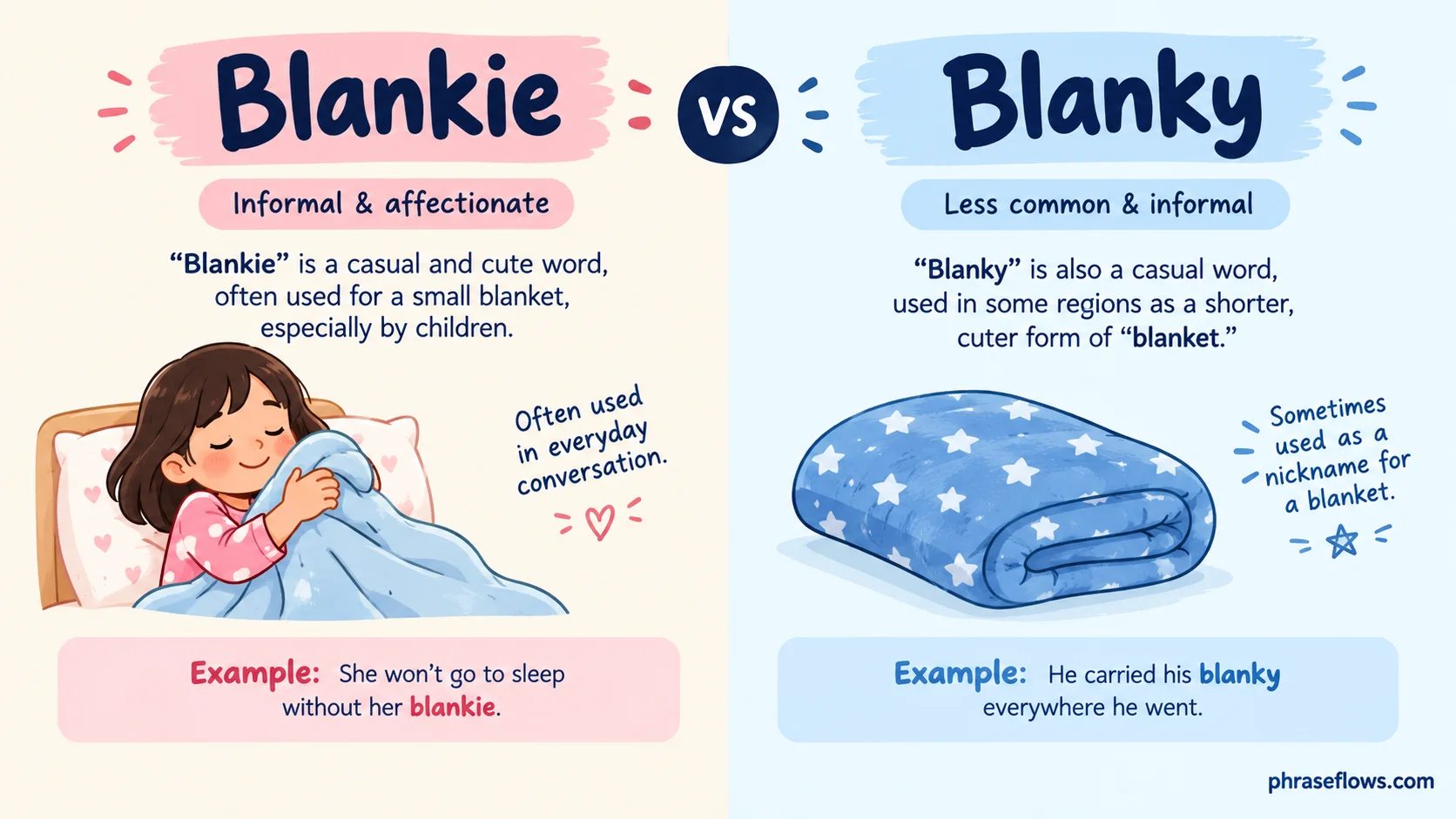

Blankie vs blanky can be confusing because both spellings appear in informal English. If you’ve seen someone call a child’s favorite blanket a blankie and another person write blanky, you may wonder whether one is correct or whether the two words have different meanings.
In most everyday contexts, blankie and blanky refer to essentially the same thing: a small blanket, especially one that a child uses as a familiar comfort object. The main difference comes down to spelling, usage, and preference rather than a major difference in meaning.
For general informal writing, blankie is the more familiar choice. However, blanky can also appear as an informal variant. When you need a neutral or formal term, blanket is usually the better option.
Blankie vs Blanky: Quick Difference
The simplest way to understand blankie vs blanky is to look at how people use the words.
| Feature | Blankie | Blanky |
| Basic meaning | An informal term for a blanket, often a child’s comfort blanket | An informal variant referring to a blanket, often a child’s comfort blanket |
| Tone | Affectionate and casual | Affectionate and casual |
| Standard formal English | No | No |
| Common informal spelling | Yes | Yes, but less familiar |
| Typical audience | Families, children, casual readers | Families, children, casual readers |
| Neutral alternative | Blanket | Blanket |
The important point is that the two spellings usually don’t represent two different objects.
For example:
- “Where’s the baby’s blankie?”
- “Where’s the baby’s blanky?”
Both sentences can refer to the same favorite blanket.
The spelling simply changes.
What Does “Blankie” Mean?
Blankie is an informal and affectionate form of blanket. It commonly describes a child’s favorite blanket or a small blanket associated with comfort, sleep, or security.
The word often has a warm, child-friendly tone. Parents might use it when talking to a young child, while adults may use it when discussing a child’s belongings.
For example:
“Emma won’t go to sleep without her blankie.”
Here, blankie doesn’t simply identify a piece of fabric. It suggests that the blanket has become a familiar comfort object for the child.
The word can also appear in casual adult speech:
- “I packed his favorite blankie for the trip.”
- “She left her blankie at Grandma’s house.”
- “The toddler carried his blankie everywhere.”
- “We washed the blankie before bedtime.”
Blankie as a Comfort Object
A blankie often has more significance than an ordinary household blanket.
Children may become strongly attached to familiar objects because those objects remain consistent while their surroundings change. A particular blanket has a recognizable texture, smell, size, and appearance. For a young child, that familiarity can make bedtime, travel, daycare, or other changes feel more predictable.
That’s why blankie often carries an emotional meaning that blanket doesn’t.
Compare these two sentences:
- “The hotel provided a blanket.”
- “She brought her blankie on the family vacation.”
The first sentence focuses on a practical item. The second suggests a personal comfort object.
What Does “Blanky” Mean?
Blanky is an informal variant of blankie. It can be used to refer to a blanket, particularly one associated with a child or affection.
Like blankie, it isn’t normally used as the formal name for a type of blanket. Instead, it belongs to the kind of informal vocabulary people use in familiar settings.
Examples include:
- “He wants his blanky before bedtime.”
- “Don’t forget the baby’s blanky.”
- “Her old blanky has been with her for years.”
- “The dog dragged the blanky off the couch.”
The exact emotional tone depends on context. In a family conversation, blanky can sound perfectly natural. In a technical description of bedding, however, blanket would be much more appropriate.
Blankie vs Blanky: Meaning Compared
When comparing blankie vs blanky, meaning is probably the easiest part.
Both forms generally point to the same basic idea. Neither spelling normally indicates a different material, size, construction, or function.
In other words:
Blankie ≈ Blanky → informal term for a blanket, especially a comfort blanket.
The distinction is primarily about form and usage, not the physical object.
| Example | Meaning |
| “He sleeps with his blankie.” | His familiar comfort blanket |
| “He sleeps with his blanky.” | Essentially the same meaning |
| “He sleeps with his blanket.” | A neutral reference to the blanket |
The first two sound more affectionate. The third sounds more neutral.
Is “Blankie” a Word?
Yes. Blankie is an established informal English word used for a blanket, especially a child’s familiar blanket.
However, there’s an important distinction between being a legitimate informal word and being suitable in every type of writing.
English contains thousands of informal words that people use naturally in conversation but rarely choose for formal documents. Blankie fits that pattern.
You might comfortably write:
“Don’t forget the baby’s blankie.”
But in a product specification or formal report, you’d probably write:
“The child was provided with a soft blanket.”
The difference isn’t about whether blankie is understandable. It’s about register.
What Is Register?
In language, register describes the level or style of language appropriate to a particular situation.
A few examples make the idea clearer:
| Setting | Natural choice |
| Talking to a toddler | Blankie |
| Family text message | Blankie |
| Children’s story | Blankie |
| Casual conversation | Blankie / Blanky |
| Product description | Blanket |
| Academic writing | Blanket |
| Formal report | Blanket |
So calling blankie an “incorrect word” would miss the point. It’s better described as informal vocabulary.
Is “Blanky” a Word?
Blanky can also be found as an informal variant of blankie. Its use tends to depend more heavily on personal, family, or contextual preference.
Informal vocabulary doesn’t always develop according to the neat spelling rules you might expect from formal English. People often create affectionate forms of words through endings such as -y, -ie, or similar patterns.
For example, English speakers use affectionate forms such as:
- doggy
- kitty
- horsie
- mommy
- daddy
These forms don’t necessarily follow a single universal rule. They’re shaped by pronunciation, habit, culture, and repeated everyday use.
Blanky follows a similar informal pattern.
Blankie vs Blanky: Which Spelling Is More Common?
If you’re choosing between the two spellings for a general audience, blankie is usually the safer choice.
Why?
Because blankie has a strong association with the idea of a child’s favorite or comfort blanket. It’s immediately recognizable to many English speakers.
Blanky is also understandable, but it has a more variant-like quality. You may encounter it in personal writing, family language, children’s speech, or character dialogue.
That doesn’t mean every occurrence of blanky is a mistake. Informal language allows considerable variation.
A Practical Rule
Use this simple guide:
- Choose blankie when you want the widely recognizable informal form.
- Choose blanky when that spelling reflects someone’s established personal or family usage.
- Choose blanket when you need a standard, neutral term.
This rule works well because it considers both meaning and audience.
Why Are There Two Spellings?
The answer lies partly in how English forms affectionate and diminutive words.
Both -ie and -y can appear in informal English. They can make a word sound friendlier, smaller, younger, or more affectionate.
Consider how the endings function in familiar words:
- dog → doggy
- dad → daddy
- aunt → auntie
- sweet → sweetie
These endings don’t always carry exactly the same meaning. Their effect depends on the individual word and the context.
With blankie and blanky, the spelling variation can arise naturally because both forms fit familiar patterns in English.
Pronunciation also plays a role. When two spellings sound very similar, people can settle on different written forms without intending to create different meanings.
This is especially common with informal vocabulary, where spoken usage often comes before standardized written usage.
Blankie and Blanky in Everyday English
You’ll most often encounter these words in relaxed situations.
Family Conversations
Parents and relatives may use either spelling when talking about a child’s favorite blanket.
“Have you seen Noah’s blankie?”
The word immediately signals an informal family setting.
Children’s Stories
Writers may use blankie or blanky to make dialogue sound age-appropriate or affectionate.
A character who says “I need my blankie” sounds very different from one who says “I need my blanket.”
The first expression feels more childlike and emotionally familiar.
Casual Messages
Someone might text:
“I washed her blankie. It’ll be dry before nap time.”
There’s no need for the more formal blanket when the conversation is personal and relaxed.
Social Media
Parents may also use blankie in captions or casual posts because the word has a warm, playful tone.
The spelling isn’t usually the focus. The emotional association is.
When to Use “Blankie”
Blankie works especially well when your writing has a warm, informal, or child-centered tone.
Use it when:
- You’re speaking to or about a young child.
- You’re describing a child’s favorite comfort object.
- You’re writing casual dialogue.
- You’re creating a friendly family-oriented message.
- You want an affectionate tone.
- The source or speaker naturally uses blankie.
For example:
“Mia grabbed her blankie and climbed into bed.”
The sentence feels natural because the word fits the setting.
If you replaced it with blanket, the meaning would remain clear:
“Mia grabbed her blanket and climbed into bed.”
However, the emotional tone becomes slightly more neutral.
When to Use “Blanky”
Blanky makes sense when you’re reproducing a person’s established wording or writing deliberately informal dialogue.
For example, if a family calls a particular blanket “Blanky,” changing the name to blankie could make the writing less authentic.
You might also encounter blanky in:
- Personal messages
- Family vocabulary
- Children’s dialogue
- Informal stories
- Character speech
- User-generated content
The key is consistency.
If you choose blanky in a piece of writing, don’t randomly alternate between blanky and blankie unless you’re intentionally showing different speakers or spellings.
Blankie vs Blanky in Formal Writing
Neither blankie nor blanky is usually the best choice for formal writing.
That’s where blanket earns its place.
Consider this comparison:
| Informal | Neutral/Formal |
| “The child carried her blankie into the room.” | “The child carried her blanket into the room.” |
| “Please wash his blanky.” | “Please wash his blanket.” |
| “The baby sleeps with a blankie.” | “The baby sleeps with a comfort blanket.” |
There’s nothing inherently wrong with the informal versions. They simply carry a different tone.
If you’re writing an academic paper, professional report, medical document, product description, or instruction manual, blanket will generally communicate the idea more precisely.
Blankie vs Blanket: An Important Distinction
It’s useful to separate blankie vs blanky from blankie vs blanket.
Blankie and blanky are informal forms. Blanket is the standard everyday noun.
A blanket can be any covering designed to provide warmth, comfort, or protection. It can be used on a bed, couch, outdoors, or in other situations.
A blankie, by contrast, often suggests a particular personal blanket, especially one connected to a child.
For example:
“The airline gave every passenger a blanket.”
That’s a practical use.
Now compare:
“The toddler wouldn’t leave her blankie behind.”
That’s personal and affectionate.
The object may technically be a blanket in both cases. The word choice changes the emotional framing.
Common Mistakes With Blankie and Blanky
Understanding the distinction helps you avoid several common mistakes.
Assuming Blanky Is Always Wrong
Not necessarily. Blanky can function as an informal variant, especially in personal or child-centered language.
Assuming They Describe Different Objects
Usually, they don’t. The two spellings generally refer to the same basic type of object.
Using Blankie in Formal Documents
The word may sound overly casual in professional or academic writing. Blanket is usually more suitable.
Switching Between Spellings
If you’re writing an article or story, consistency improves readability.
Choose the spelling that fits your intended audience and stick with it.
Treating Informal Language Like a Spelling Test
Informal English has room for variation. A word can be understandable and established in casual use without being the preferred term for formal prose.
Blankie vs Blanky: Example Sentences
Examples make the difference easier to see.
Casual Conversation
- “Where did you put the baby’s blankie?”
- “She won’t sleep without her blanky.”
- “I need to wash his blankie tonight.”
- “Her favorite blanky is getting pretty worn.”
Talking About Children
- “The toddler held his blankie during the car ride.”
- “She packed her blanky before leaving for Grandma’s house.”
- “His blankie has become part of his bedtime routine.”
Informal Writing
- “We found the missing blankie under the couch.”
- “That little blanky has traveled everywhere with her.”
Neutral Writing
- “The child carried a blanket into the bedroom.”
- “The caregiver washed the child’s comfort blanket.”
Notice how the vocabulary changes with the tone and purpose of the sentence.
Blankie vs Blanky: Pronunciation
In ordinary use, blankie and blanky are generally pronounced similarly enough that listeners may not know which spelling a speaker has in mind.
The difference becomes visible when the word appears in writing.
That’s one reason informal spelling variations can survive. If two forms sound nearly identical, speakers don’t receive a strong pronunciation cue telling them which spelling to choose.
Written English then reflects different habits.
Blankie vs Blanky: Word Formation
Both forms connect naturally to the standard noun blanket.
The informal forms can be understood as affectionate derivatives rather than completely unrelated vocabulary.
The endings -ie and -y commonly appear in informal English. They can signal familiarity or affection.
However, English doesn’t have a single mechanical formula that determines when every noun should take one ending or another.
That’s why it’s better to treat blankie and blanky as established informal forms rather than trying to invent a strict rule that applies to every similar word.
Read More: Sponser vs Sponsor: Difference, Meaning, Spelling, and Usage
Blankie vs Blanky: Regional and Personal Usage
Informal vocabulary can vary considerably from one household to another.
One family might always say blankie. Another might call the same object blanky. A third might simply use the child’s name for it.
Children can also create their own names for familiar objects. Once a particular form becomes part of family vocabulary, people may continue using it for years.
This personal variation doesn’t necessarily tell you which form has broader usage.
For general writing, blankie offers the more recognizable choice. For personal dialogue or quoted language, however, preserving the speaker’s preferred form can make the writing feel more authentic.
Blankie vs Blanky: Which One Should You Use?
If you’re still unsure about blankie vs blanky, use the context as your guide.
Choose “Blankie” When:
- You want a familiar informal spelling.
- You’re writing for a broad audience.
- You’re discussing a child’s comfort blanket.
- You want an affectionate tone.
- You’re writing casual dialogue or family-oriented content.
Choose “Blanky” When:
- It’s the spelling someone actually uses.
- You’re preserving a family’s terminology.
- You’re writing dialogue where the spelling reflects the character’s voice.
- The context is intentionally informal.
Choose “Blanket” When:
- You’re writing formally.
- You need a neutral term.
- You’re describing bedding or household goods generally.
- You’re writing technical, academic, or professional material.
The easiest rule is this:
Use “blankie” for familiar informal writing, “blanky” when that variant fits the context, and “blanket” for neutral or formal English.
Blankie vs Blanky: Key Takeaways
The difference between blankie vs blanky isn’t as complicated as it first appears.
Here are the main facts:
- Blankie is an informal term for a blanket, particularly a child’s comfort blanket.
- Blanky is an informal variant with essentially the same basic meaning.
- Neither form normally describes a fundamentally different type of blanket.
- Blankie is generally the safer informal spelling for a broad audience.
- Blanky can appear naturally in personal, family, or child-centered language.
- Both forms are more casual than blanket.
- Blanket is the better choice for formal or neutral writing.
- Context, audience, and consistency matter when choosing between the informal forms.
FAQs:
Is blankie or blanky correct?
Blankie is the more familiar informal spelling, while blanky can be used as an informal variant. Both can refer to a child’s favorite or comfort blanket. For formal writing, use blanket instead.
Is blankie a real word?
Yes. Blankie is an established informal English term. It commonly refers to a child’s blanket or a familiar comfort object.
Is blanky another spelling of blankie?
Generally, yes. Blanky can serve as an informal variant of blankie. The two forms typically have the same basic meaning.
Which is more common, blankie or blanky?
Blankie is generally the more recognizable spelling in broad informal English. However, blanky also appears in personal and child-centered usage.
Should you use blankie in formal writing?
Usually, no. If you need a neutral or formal term, blanket is the better choice. Blankie works best when the informal or affectionate tone is intentional.
What is another word for blankie?
The simplest alternative is blanket. Depending on context, you could also use comfort blanket or security blanket. These alternatives aren’t always exact substitutes because their meanings can vary by context.
Conclusion
The blankie vs blanky difference mainly comes down to spelling and informal usage rather than meaning. Both forms can refer to a child’s favorite blanket or another familiar comfort blanket.
If you want the more broadly recognizable informal spelling, blankie is usually the better choice. Blanky can still work when it reflects personal, family, or character-specific usage.
When the situation calls for standard English, there’s an even simpler answer: use blanket. It carries the same basic physical meaning without the strongly affectionate tone of the informal forms.
So, when choosing between blankie, blanky, and blanket, don’t focus only on spelling. Consider who you’re writing for, how formal the situation is, and what tone you want the word to create. That’s what makes the choice sound natural.




1 thought on “Blankie vs Blanky: Difference, Meaning, Usage, and Which Spelling Is Correct”