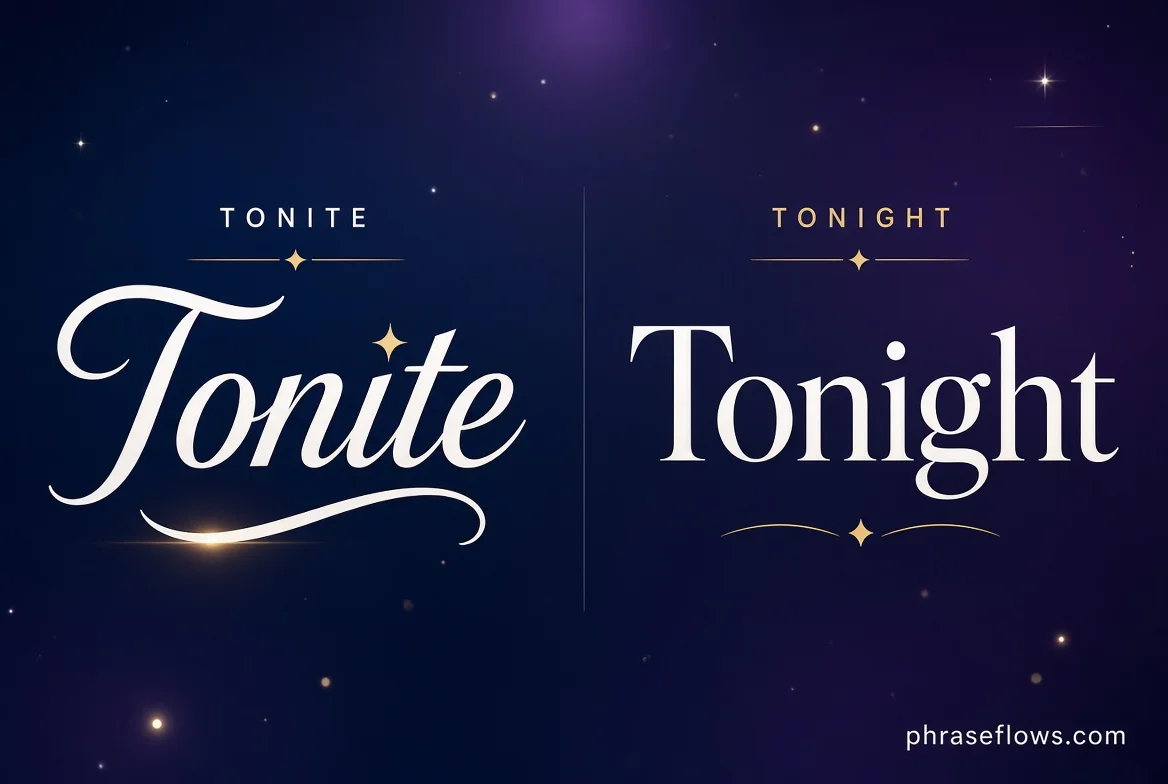

Have you ever wondered whether Tonite vs. Tonight is the correct spelling? Both forms appear in everyday communication, including text messages, social media posts, advertisements, and song titles. They have the same meaning and pronunciation, but only one is accepted as the standard spelling in modern English. Knowing the difference can help you avoid common spelling mistakes.
Tonight is the correct and widely accepted spelling. It refers to the evening or night of the current day and works in both formal and informal writing. Tonite is an informal, nonstandard variation that people sometimes use for a casual or creative touch. Although you may see it online or in advertising, it isn’t the appropriate choice for academic work, professional writing, or formal communication.
Understanding Tonite vs. Tonight makes it easier to choose the right word in different situations. Whether you’re writing an email, preparing a school assignment, publishing an article, or sharing a social media caption, correct spelling helps make your message clear and polished. In this guide, you’ll learn the meaning of both forms, their key differences, common usage mistakes, and practical examples to help you use Tonight with confidence.
Quick Answer: Tonite or Tonight?
Tonight is the correct standard spelling in American English and British English. It refers to the evening or night of the present day.
Tonite is an informal alternative spelling that people sometimes use in advertisements, casual messages, promotional headlines, and creative writing. It generally has the same intended meaning as tonight, but it isn’t appropriate for standard formal writing.
Here’s a quick comparison:
| Word | Meaning | Standard Spelling | Common Usage |
| Tonight | The evening or night of the current day | Yes | Everyday, academic, and professional writing |
| Tonite | Informal alternative spelling of tonight | No | Casual messages, advertising, and creative contexts |
Examples:
- Standard: We are going to watch a movie tonight.
- Informal: We are going to watch a movie tonite.
Both sentences communicate the same intended message. However, the first uses the spelling accepted in standard written English.
If you’re unsure which version to choose, remember one simple rule: Use tonight in almost every situation.
What Is the Difference Between Tonite and Tonight?
The main difference between tonite and tonight is their spelling and level of formality. Both generally refer to the same period, but only tonight is the standard spelling.
The word tonight appears in dictionaries as an established English word. It works naturally in conversations, books, school assignments, workplace communication, and professional documents.
Tonite, on the other hand, represents an informal spelling variation. People sometimes choose it because it looks shorter or creates a particular visual style. You might encounter it on entertainment posters, promotional graphics, or social media captions.
Consider these examples:
- Tonight: The concert begins at eight tonight.
- Tonite: The concert begins at eight tonite.
The meaning remains clear in both examples. Nevertheless, tonight is the better choice when you want correct standard English.
Tonight Is the Standard English Spelling
Tonight is the accepted spelling used in standard English. It refers to the evening or night associated with the present day.
You can use this word when discussing plans, appointments, entertainment, school activities, family gatherings, or professional events.
For example:
- I have to finish my homework tonight.
- Are you attending the school event tonight?
- The restaurant closes early tonight.
- We should discuss the project tonight.
- My favorite television show airs tonight.
Notice how naturally tonight fits into each sentence. It tells the reader when an activity happens without requiring additional explanation.
The spelling also remains consistent across American and British English. You don’t need to change it depending on which variety of English you’re using.
Tonite Is an Informal Alternative Spelling
Tonite is an informal spelling variation of tonight. Although readers generally understand what it means, it doesn’t replace the standard spelling in formal communication.
You may see it in advertising slogans, entertainment promotions, casual messages, and creative designs. For example, a promotional poster might use the phrase “Live Music Tonite!” to create a short, attention-grabbing headline.
Writers sometimes prefer this version because it has a compact appearance. It can also create a relaxed or playful tone.
However, there’s an important distinction between intentional informal spelling and standard spelling. Using tonite deliberately in a creative advertisement doesn’t make it the correct form for an academic essay or professional report.
For ordinary writing, tonight remains the appropriate choice.
What Does Tonight Mean?
The word tonight refers to the evening or night of the current day. People use it when discussing something happening later that day or referring to the night associated with that day.
For example, if someone says, “I’ll call you tonight,” they mean they’ll make the call during the evening or night of the current day.
The exact time can depend on the situation. One person might consider seven o’clock part of the evening, while another might use tonight when referring to a much later hour.
Unlike words that identify an exact time, tonight describes a general period rather than a specific hour.
Tonight as an Adverb
Tonight commonly functions as an adverb of time. An adverb explains when, where, how, or to what extent an action happens.
When tonight acts as an adverb, it answers the question “When?”
Consider these examples:
- We will finish the assignment tonight.
- She is preparing dinner tonight.
- They plan to travel tonight.
- The teacher will explain the lesson tonight.
- I need to organize my notes tonight.
In each sentence, tonight describes the timing of an action.
It often appears at the end of a sentence because that position sounds natural in everyday English. However, you can place it elsewhere when the sentence structure calls for it.
For example:
Tonight, we will discuss the most important points from the meeting.
Here, tonight appears at the beginning to emphasize the timing.
Tonight as a Noun
Although people frequently use tonight as an adverb, it can also function as a noun.
As a noun, it refers to the evening or night itself rather than simply describing when an action happens.
For example:
- Tonight is going to be special.
- We have several plans for tonight.
- The weather tonight looks pleasant.
- Tonight promises an exciting performance.
In these sentences, tonight refers to the night as a period or occasion.
Understanding this grammatical difference helps you use the word more naturally. Its function depends on how it works within a sentence.
Examples of Tonight in Sentences
Here are additional examples showing how to use tonight in everyday communication:
- I need to complete my English assignment tonight.
- Are you planning to visit your grandparents tonight?
- The football match starts at nine tonight.
- We have an important meeting tonight.
- My family is preparing a special dinner tonight.
- She wants to finish reading her book tonight.
- The school is hosting a cultural program tonight.
Each sentence uses tonight correctly to identify the evening or night associated with the current day.
What Does Tonite Mean?
Tonite is an informal spelling of tonight. It generally refers to the evening or night of the current day, just like its standard counterpart.
Although you might encounter this spelling in everyday communication, it doesn’t have the same status as tonight in standard written English.
For example, someone might write “See you tonite!” in a casual text message. The reader will probably understand the intended meaning immediately. However, a writer preparing a formal invitation would normally choose “See you tonight!”
The distinction becomes especially important when writing for a broad audience. Standard spelling makes your message look polished and prevents readers from mistaking an intentional stylistic choice for an accidental spelling error.
Examples of Tonite in Informal Sentences
Here are several examples showing how people might use tonite in casual communication:
- Are you coming to the party tonite?
- Let’s watch our favorite movie tonite.
- The band is performing live tonite.
- Don’t forget about our meeting tonite!
- We have something special planned for tonite.
- The new episode is coming out tonite.
These examples demonstrate the intended meaning of tonite. However, replacing it with tonight makes every sentence follow standard English spelling conventions.
For instance:
Informal: The band is performing live tonite.
Standard: The band is performing live tonight.
The second version works in casual conversations as well as professional communication.
Where Is Tonite Commonly Used?
You may encounter tonite in several types of informal and promotional writing. Its shorter appearance can make a headline look compact, especially when space is limited.
Common examples include:
- Advertising: Businesses may use phrases such as “Special Offers Tonite!” in promotional designs.
- Entertainment: Posters and event graphics sometimes use tonite to announce performances.
- Social media: Users may choose it for casual captions or informal posts.
- Text messages: Friends might use it when discussing evening plans.
- Creative titles: Writers and designers may choose it to create a particular visual style.
An important point remains: these uses reflect stylistic choices rather than a different standard spelling rule.
Tonite vs. Tonight: Key Differences Explained
Understanding the difference between tonite vs. tonight becomes easier when you compare their spelling, meaning, pronunciation, and appropriate contexts.
Both forms generally communicate the same time reference. However, their suitability changes depending on the audience and purpose of your writing.
| Feature | Tonight | Tonite |
| Spelling | Standard | Informal alternative |
| Meaning | Present or coming evening or night | Generally the same |
| Pronunciation | /təˈnaɪt/ | Generally the same |
| Formal writing | Appropriate | Not recommended |
| Academic writing | Appropriate | Avoid |
| Professional emails | Appropriate | Avoid |
| Casual messages | Appropriate | Sometimes used |
| Advertising | Common | Sometimes used stylistically |
| Creative writing | Appropriate | Possible stylistic choice |
The most important difference is standard spelling versus informal spelling. You don’t need to learn two separate definitions because both forms generally communicate the same intended meaning.
Tonite vs. Tonight: Are They Pronounced the Same?
Yes. When tonite represents the informal spelling of tonight, both forms generally have the same pronunciation.
The standard pronunciation appears in the International Phonetic Alphabet as:
/təˈnaɪt/
The word has two syllables, with the main stress on the second syllable. The final sound rhymes with words such as light, right, and bright.
Changing the spelling from tonight to tonite doesn’t normally change how someone says the word.
This explains why people sometimes confuse the two forms. They hear the same pronunciation and assume either spelling will work in every situation. However, pronunciation and standard spelling don’t always follow the same pattern.
Tonite vs. Tonight: Do They Have the Same Meaning?
In ordinary informal usage, yes. Both forms generally refer to the evening or night of the current day.
For example:
- We are meeting tonight.
- We are meeting tonite.
The intended message remains the same.
However, context matters. Tonite has also appeared as a separate historical technical noun referring to an explosive blasting compound. That meaning is unrelated to the informal spelling of tonight and is rarely relevant to ordinary modern conversations.
Etymology, Origin & Meaning
+1
For everyday spelling questions, the relevant distinction is the informal variant versus the standard word.
Is Tonite Ever Correct?
The answer depends on what you mean by correct.
Tonite is an established informal spelling variant, so describing it as a completely invented or nonexistent word would be misleading. However, it isn’t the standard spelling recommended for ordinary English writing.
This distinction matters because language includes many informal spellings, abbreviations, and creative variations. Their existence doesn’t mean they belong in every type of writing.
For example, a designer might intentionally use tonite on an entertainment poster. A student writing an academic essay should use tonight instead.
When to Use Tonite
You might encounter or intentionally use tonite in situations where an informal or decorative style makes sense.
Consider these examples:
- A casual social media caption.
- A deliberately stylized event poster.
- A short promotional headline.
- An informal text between friends.
- A creative title where the spelling serves a visual purpose.
Example:
“Live Music Tonite!”
This headline uses tonite as a stylistic choice. Its meaning is clear, and the shortened form gives the design a casual appearance.
However, if the same announcement appears in a formal email or newspaper article, tonight is the better option.
When to Use Tonight
Choose tonight whenever you want to follow standard English spelling conventions.
It works in almost every ordinary writing situation, including:
- Academic assignments: We will submit our research papers tonight.
- Professional emails: I will send the revised document tonight.
- Business announcements: The store will introduce its new collection tonight.
- Blog articles: The event begins tonight at seven.
- Personal messages: I’ll call you tonight.
- News reports: The ceremony will take place tonight.
One useful advantage of tonight is its flexibility. You can use it in casual and formal situations without changing your spelling.
Why Do People Confuse Tonite and Tonight?
People often confuse these spellings because they look and sound similar. Both forms communicate the same general time reference, so the difference isn’t immediately obvious during conversation.
However, several factors explain why tonite continues to appear in written English.
Similar Pronunciation
The strongest reason for confusion is that both spellings generally sound identical.
When people speak, they don’t see the letters that make up a word. They only hear its pronunciation.
As a result, someone who regularly hears tonight might assume that tonite is an equally acceptable written version.
This confusion becomes more common when people encounter informal spellings in advertisements, captions, or messages.
Remember that a familiar pronunciation doesn’t automatically make every alternative spelling standard.
Influence of Texting and Social Media
Digital communication has made informal spelling variations more visible.
People frequently use abbreviations, shortened expressions, and creative spellings when communicating online. These choices can make messages feel relaxed and conversational.
For example:
- “See you tonight!” follows standard spelling.
- “See you tonite!” uses an informal spelling.
- “C u tonight!” uses an abbreviated expression.
All three messages communicate a similar idea, but they follow different writing conventions.
The important distinction is knowing your audience. A casual message gives you more room for informal language than a school assignment or business document.
Advertising and Entertainment Influence
Advertising has also helped keep shortened spellings familiar.
Businesses and entertainment promoters sometimes choose compact words because they fit neatly into headlines, signs, and promotional graphics.
The history of tonite goes back much further than modern texting. The Online Etymology Dictionary records its colloquial use from 1918. Linguist Louise Pound also discussed shortened advertising spellings in a 1923 publication titled Spelling-Manipulation and Present-Day Advertising.
Etymology, Origin & Meaning
This history shows that tonite wasn’t created by modern social media. It has appeared in informal and promotional writing for more than a century.
Nevertheless, advertising conventions don’t determine standard spelling.
Tonite vs. Tonight in Different Writing Situations
Choosing between these forms becomes easier when you consider where your writing will appear.
A spelling choice that works on a playful event poster might look out of place in a professional document. Understanding these differences helps you adjust your writing without changing the intended meaning.
Tonite vs. Tonight in Text Messages
Text messages usually have a conversational tone. Friends and family often use shortened expressions or informal spellings when discussing everyday plans.
For example:
- “Are we meeting tonite?”
- “I’ll see you tonight.”
- “Let’s finish the assignment tonight.”
All three messages are understandable. However, tonight is still the standard spelling and works perfectly well in casual conversations.
You don’t need to use tonite to make a message sound friendly.
Tonite vs. Tonight on Social Media
Social media gives writers more freedom to experiment with language.
A person might use tonite in a caption because it matches a particular design, mood, or promotional style. Event organizers might also choose it for a short headline.
For example:
Informal caption: Big event tonite! Don’t miss it.
Standard caption: Big event tonight! Don’t miss it.
Both versions are understandable. However, tonight is more suitable when you want consistent spelling across different types of content.
For blogs, informational posts, and professional social media accounts, standard spelling is generally the safer choice.
Tonite vs. Tonight in Professional Writing
Professional communication requires clarity and consistency. Whether you’re preparing an email, report, business announcement, or presentation, standard spelling helps your writing appear polished.
Consider these examples:
| Informal Version | Standard Professional Version |
| I’ll send the file tonite. | I’ll send the file tonight. |
| The meeting is tonite. | The meeting is tonight. |
| Our event starts tonite. | Our event starts tonight. |
| Please review this tonite. | Please review this tonight. |
The difference might seem small, but consistent spelling contributes to professional communication.
Tonite vs. Tonight in Academic Writing
Academic writing follows established spelling and grammar conventions. Students should use tonight in essays, reports, assignments, and examinations.
For example:
Incorrect for standard academic writing: The students will complete their projects tonite.
Correct: The students will complete their projects tonight.
The informal version communicates the intended meaning, but it doesn’t follow standard spelling conventions.
When completing academic work, avoid unnecessary spelling variations. Using established forms makes your writing easier to evaluate and understand.
Tonite vs. Tonight in American and British English
One common question is whether American and British English follow different spelling rules for tonite and tonight.
The answer is no. Both varieties use tonight as the standard spelling.
Unlike words such as color and colour or organize and organise, tonight doesn’t have separate standard American and British spellings.
Here’s a simple comparison:
| English Variety | Standard Spelling | Informal Alternative |
| American English | Tonight | Tonite |
| British English | Tonight | Tonite |
| Canadian English | Tonight | Tonite |
| Australian English | Tonight | Tonite |
The informal spelling tonite may appear in different English-speaking communities, particularly in promotional or casual writing. However, tonight remains the appropriate spelling for standard communication.
For example:
- American English: The movie starts tonight.
- British English: The movie starts tonight.
- Australian English: The movie starts tonight.
You don’t need to change the spelling based on your audience’s location.
How to Spell Tonight Correctly
The correct standard spelling is T-O-N-I-G-H-T.
One helpful way to remember it is to recognize the word night within tonight. The complete spelling includes the letters n-i-g-h-t, not simply n-i-t-e.
Although tonite might seem easier to write, it leaves out the traditional spelling of the word’s final element.
Common Misspellings of Tonight
Writers sometimes make mistakes when they try to remember the correct arrangement of letters.
Here are several forms you might encounter:
| Spelling | Status | Explanation |
| Tonight | Correct | Standard English spelling |
| Tonite | Informal | Alternative spelling |
| To night | Incorrect | Not the standard modern spelling |
| Tonigth | Incorrect | Incorrect letter arrangement |
| Tonigh | Incorrect | Missing the final letter |
| Tonnight | Incorrect | Contains an unnecessary extra n |
The easiest way to avoid these mistakes is to remember the complete word tonight rather than relying on how it sounds.
Easy Trick to Remember Tonight
Here’s a simple spelling trick:
TO + NIGHT = TONIGHT
Remember the complete spelling of night, and you’ll have an easier time writing tonight correctly.
You can also use this quick memory exercise:
- Write tonight five times.
- Identify the word night inside it.
- Use tonight in a short sentence.
- Check your spelling before submitting important writing.
For example:
“I’ll finish my homework tonight.”
Practicing the correct form in ordinary sentences makes it easier to remember.
Tonite vs. Tonight: Common Sentence Mistakes and Corrections
Sometimes, writers understand the meaning but choose an informal spelling without realizing that standard writing requires another form.
The following examples show how to correct common sentences.
| Informal or Nonstandard Version | Standard English Version |
| I will call you tonite. | I will call you tonight. |
| The meeting is tonite. | The meeting is tonight. |
| We are leaving tonite. | We are leaving tonight. |
| I have an exam tonite. | I have an exam tonight. |
| The show starts tonite. | The show starts tonight. |
| Are you coming tonite? | Are you coming tonight? |
| Let’s finish this tonite. | Let’s finish this tonight. |
Notice that you don’t need to change the sentence structure or meaning. Simply replace tonite with tonight.
Important: Tonite isn’t necessarily a misunderstanding or an accidental mistake. Someone may choose it intentionally for informal or promotional writing. However, tonight is the correct choice whenever standard spelling matters.
What Is the Difference Between Tonight and Tonight’s?
Another spelling question involves tonight and tonight’s.
Both forms are correct, but they serve different grammatical purposes.
Tonight refers to the present or coming evening or night. Tonight’s is the possessive form, which indicates something associated with that evening or night.
For example:
- Tonight: We have a meeting tonight.
- Tonight’s: Tonight’s meeting starts at seven.
The apostrophe and s change how the word functions in the sentence.
You can use tonight’s when describing an event, activity, program, performance, or other occurrence associated with the current evening.
Examples of Tonight’s in Sentences
Here are some practical examples:
- Tonight’s meeting will begin at seven.
- Tonight’s performance looks exciting.
- Tonight’s dinner is ready.
- Tonight’s television program features a special guest.
- Tonight’s weather looks pleasant.
- Tonight’s event will attract several visitors.
In each example, tonight’s identifies something connected with the current evening.
Is Tonite’s Also Correct?
Tonite’s is an informal variation of tonight’s. People may use it in promotional material, creative headlines, or casual communication.
For example:
- Informal: Tonite’s concert starts at eight.
- Standard: Tonight’s concert starts at eight.
The meaning remains clear, but the second version follows standard English spelling conventions.
For professional documents, articles, academic assignments, and general written communication, always choose tonight’s.
Read More: Cubical vs. Cubicle: Meaning, Differences, Usage, and Common Mistakes
Practical Case Study: Choosing Between Tonite and Tonight
Consider a small event organizer preparing three different announcements for an upcoming music performance.
The organizer needs to create a social media caption, a printed event invitation, and a formal email for invited guests.
Although all three announcements communicate the same information, their audiences and purposes differ.
| Communication Type | Example Wording | Recommended Choice |
| Casual social media caption | Live music tonite! | Either, depending on style |
| Printed event invitation | Join us for live music tonight! | Tonight |
| Formal email | The performance will begin tonight at 8 p.m. | Tonight |
What does this example teach us?
First, informal spelling can work as a deliberate design choice. A promotional caption might use tonite to create a relaxed appearance.
However, standard spelling works better when the organizer wants a polished and consistent message. The invitation and formal email should use tonight.
The lesson is simple: Your audience and writing purpose should guide your style, but standard spelling remains the safest choice.
Conclusion:
When comparing Tonite vs. Tonight, the main difference is their spelling and level of acceptance. Tonight is the correct standard spelling in modern English, while Tonite is an informal, nonstandard variation. Both forms have the same meaning and pronunciation, but they aren’t equally suitable for every situation. Use Tonight in emails, school assignments, articles, professional documents, and everyday writing. Although Tonite may appear in advertisements, song titles, or casual messages, it’s best to avoid it in standard written English. Choosing the correct spelling helps you communicate clearly and make your writing more polished.
FAQs:
1. Is Tonite or Tonight the correct spelling?
Tonight is the correct and standard spelling. Tonite is an informal, nonstandard variation and isn’t recommended in formal or professional writing.
2. What does Tonight mean?
Tonight refers to the evening or night of the current day. For example, “We are watching a movie tonight.”
3. Is Tonite a real word?
Tonite is commonly used as an informal spelling of Tonight, especially in advertisements, song titles, and casual messages. However, it isn’t the standard spelling.
4. Do Tonite and Tonight have the same pronunciation?
Yes. Both forms are generally pronounced the same way and have the same meaning. The difference is in their spelling and standard usage.
5. Should I use Tonite in formal writing?
No. Use Tonight in formal writing, academic assignments, professional emails, and articles. It is the widely accepted spelling in standard English.


1 thought on “Tonite vs. Tonight: Difference, Meaning, and Which Spelling Is Correct?”